Patrick, a reader, recently sent me a link to a Barron’s article referring to a short post by Eddy Elfenbein. As you will see, this short post, combined with the Rule of 20, will go a long way in improving our equity investment returns.
I did some research and found this fascinating stat. When the spread between the 90-day and 10-year Treasury yield is 121 basis points or more, the stock market does much better than when it’s 120 basis points or less.
Here’s how it works. Since 1962, the S&P 500 has averaged a 1.42% annualized gain when the yield spread is 120 points or less (that doesn’t include dividends). But it’s averaged 10.47% per year when the spread is 121 basis points or more. That’s a big difference.
Over the last 53 years, the spread has been 120 basis points or less about 41% of the time, and it’s been 121 basis points or more the other 59% of the time.
The spread has been over 121 points continuously for nearly seven straight years. In fact, the indicator’s only big miss came in early 2008 when it flashed bullish several months too early.
The yield spread is currently 230 basis points. If the 10-year yield stays at this level, then, according to our indicator, we don’t have to start worrying about stocks until the 90-day yield gets over 1%. It’s currently at 0.04%.
Here’s the spread over the last 30 years (the black line is at 120 basis points):

Elfenbein analysed data since 1962 but only provides a chart since 1985, a period which saw inflation and interest rates go down almost non-stop, providing a strong tailwind to equity valuations. During the 23 years between 1962 and 1985, the S&P 500 Index grew at an annual compound rate of 4.3% (ex-dividends). During the following 29 years, it grew at twice that rate (8.8%), in spite of the fact that earnings grew faster in the earlier period (+7.5%) than in the latter period (+6.8%). To illustrate the impact of rising P/Es, had the S&P 500 Index compounded in sync with earnings since 1985, it would be 1210 currently, 57% below current levels!
The chart below plots the yield spread back to 1950. It reveals meaningful differences between periods:
- the 1950-1970 period witnessed very tight spreads, generally well below 120 bps.
- The high inflation seventies saw spreads widen considerably, reaching deep negative levels 3 times when the Fed jacked up short-term rates to reign inflation in.
- Since 1982, the long disinflationary era, spreads remained wide but much more positive. The yield curve inverted briefly (5 months) in 2000 and in 2006 (9 months).
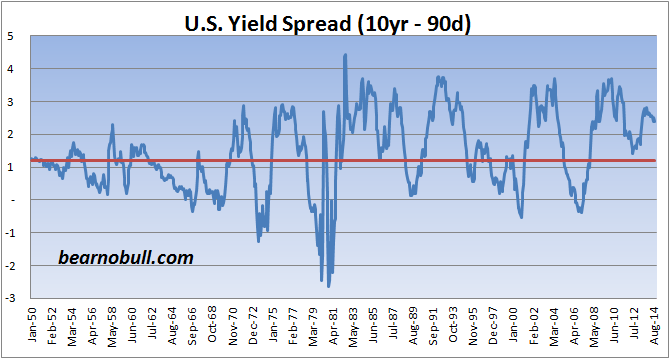
Because of the meaningful differences between periods, it seems best to look at each period separately in order to better appreciate Elfenbein’s conclusion.
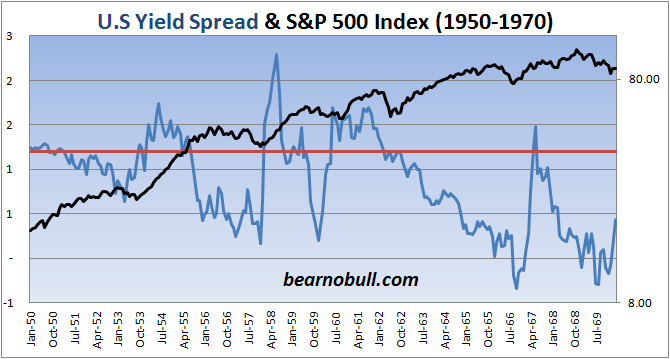
Between 1950 and 1970, the yield spread was above 120 only 25% of the time. Yet, the S&P 500 Index appreciated 9% per year compounded. However, if one had owned the Index only when the yield spread was above 120, the return would have been 28% annually compared with 3.3% when the yield spread was at or below 120 (the charts below plot the S&P Index on a log scale).
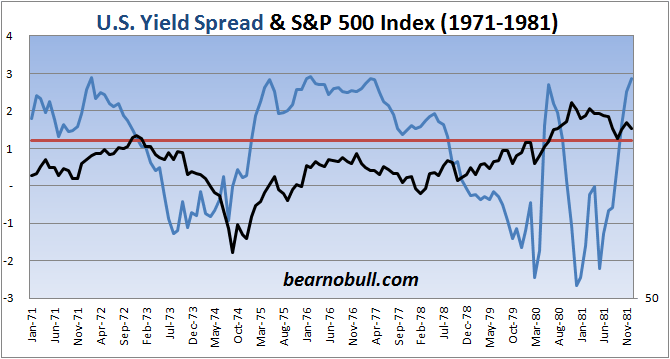
During the inflationary years of 1970 to 1981, the yield spread was above 120 sixty-four percent of the time. The S&P 500 Index appreciated only 2.7% per year compounded. However, if one had owned the Index only when the yield spread was above 120, the return would have been 13% annually compared with –8.5% when the yield spread was at or below 120.
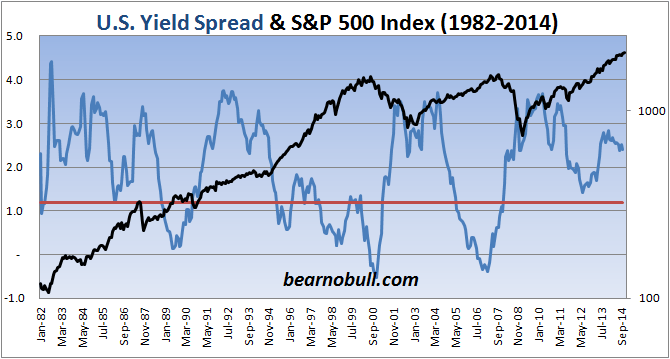
So far, so good. Let’s now consider the last 33 years, characterized by disinflation, declining interest rates, two equity bubbles and extraordinary QEs. The S&P 500 Index appreciated nearly 9% per year compounded during the whole period. The yield spread remained above 120 seventy-two percent of the time. That said, the bulk of the returns occurred between 1982 and 1997 (+13.8% annually), a period during which the yield spread above 120 seventy-eight percent of the time. Between 1998 and the end of 2007, the yield spread was at or below 120 nearly 54% of the time and the S&P 500 Index gained only 4.1% annually, all of the gains recorded during the 3 bubble years to 2000.
No indicator is perfect. Out of the 21 yield spread cycles since 1950, 6 (29%) did not perform favourably:
- Between March 1951 and January 1953, the S&P 500 Index gained 21% while the yield spread declined from 119 to 87.
- Between April 1962 and January 1966, the S&P 500 Index gained 43% while the yield spread declined from 111 to zero.
- The October 1987 crash occurred while the yield spread was well above 120 and rising.
- The S&P 500 Index gained 28% while the yield spread declined from 120 in November 1988 to 21 in August 1989.
- The S&P 500 Index gained 29% while the yield spread declined from 103 in June 2005 to zero in May 2007.
- The yield spread was rising well above 120 while the S&P 500 tanked 50% during the 12 months to March 2009.
Patrick suggests to use the yield spread in combination with the Rule of 20 barometer as they might complement each other.
The Rule of 20 simply states that fair P/E is 20 minus inflation. The black line in the chart below (the Rule of 20 Value) plots the sum of the actual P/E on trailing EPS and inflation. The Rule of 20 value generally ranges between 15 and 24 with the lower end of the range representing low valuation risks while anything above 20 indicates increasingly excessive valuation risks. The Rule of 20 is not a timing tool. It is rather a proxy to objectively assess whether the risk/reward equation is favourable or not from a valuation standpoint.
Unlike other valuation proxies, the Rule of 20 has been reliable in all types of equity markets and economic environments since it incorporates inflation in the valuation process (click on chart to enlarge). The smart way to use the Rule of 20 is to gradually increase equity exposure as the Rule of 20 P/E declines towards 15, manage exposure as it rises towards 20, and to aggressively reduce equities as it rises towards 22, being completely out of stocks beyond 22.
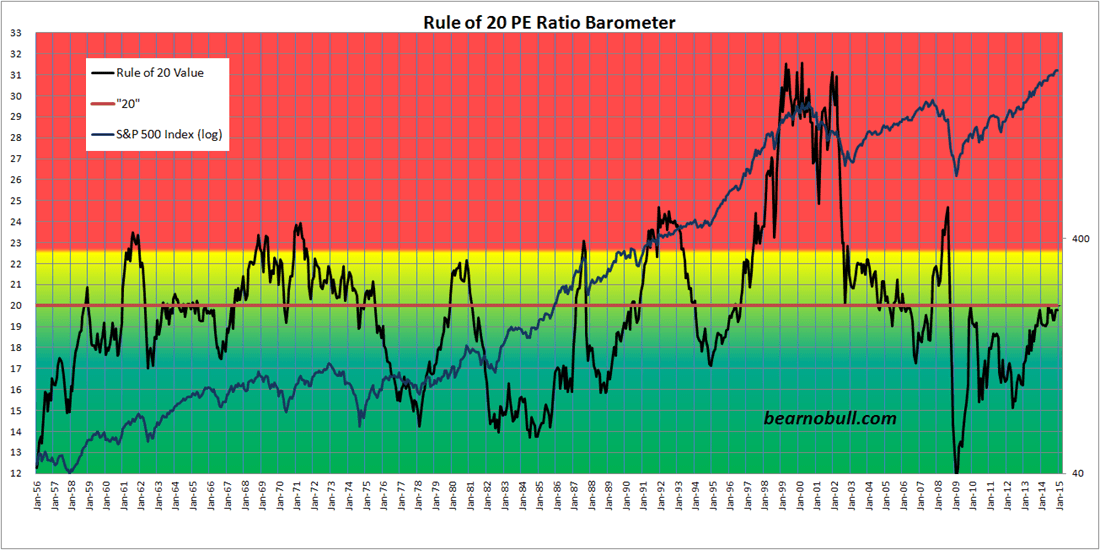
Using a simple, although admittedly really unfair, rule of being fully invested at 20 or below and totally disinvested above 20, the return (capital only) since 1950 is +10.7% annually at or below 20 compared with +0.6% above 20. Any investor would do much better by taking full advantage of the gradualism provided by the objective risk/reward calculations offered by the Rule of 20. Incidentally, this approach requires zero forecast since it only uses trailing data.
Combining the reliable valuation proxy provided by the Rule of 20 with the useful economic trend/momentum reading provided by the “120 Yield Spread ” would surely improve the already excellent results from these two proxies.
This idea is supported by the fact that in the 6 instances noted above when the yield spread failed, the Rule of 20 was actually flashing the opposite signal:
- The Rule of 20 P/E averaged a low 14.1 between March 1951 and January 1953.
- The Rule of 20 P/E dropped to 17 in June 1962 and rose above the “fair value” 20 level in June 1964 after the S&P Index had gained 40%.
- The Rule of 20 P/E moved above 20 in March 1987 and into the “extreme risk” area above 23 in August 1987.
- It then quickly dropped into the attractive valuation area where it stayed until May 1990 just before equities dropped 16%.
- The Rule of 20 P/E was in the lower risk valuation range between September 2006 and September 2007. It moved above 20 in October 2007 at 1550 and reached extreme risk levels in May 2008 at 1400.
- The Rule of 20 flashed generation-low valuation levels in February 2009 (S&P 500 P/E Ratio at Troughs: A Detailed Analysis of the Past 80 Years).
Conversely, the Rule of 20 barometer, being a valuation gauge, has occasionally had timing issues that the 120 Yield Spread would have alleviated:
- The S&P 500 Index lost 20% between July 1956 and December 1957 even though the Rule of 20 P/E was in the low 15 area. The yield spread ranged between 80 and 20 throughout that period.
- The S&P 500 Index lost 13% between July 1959 and October 1960 even though the Rule of 20 P/E fluctuated between 17.6 and 19.2 during those years. The yield spread stayed below 120 between June 1959 and May 1960.
- The S&P 500 Index lost 17% between January 1966 and September 1966 even though the Rule of 20 P/E was just below 20. The yield spread was near zero during those months.
- The S&P 500 Index gained 43% between August 1970 and December 1972 while the Rule of 20 P/E ranged between 20.3 and 24. The yield spread was well above 120 for most of this period.
- The S&P 500 Index jumped 50% between November 1990 and January 1994 even though the Rule of 20 P/E was well above 20 and often above 22. The yield spread stayed well above 120 (reaching 360 in January 1993).
- Same thing between September 2002 and May 2005 when the S&P 500 Index advanced 46% while the Rule of 20 P/E was above 20. The yield spread stayed well above 120 (reaching 370 in May 2004).
Interestingly and importantly, the only period when both gauges failed simultaneously was between December 1976 and February 1978 when equities lost nearly 20% while the Rule of 20 P/E was in the 15-16 range and the yield spread averaged 212. Only one miss out of 21 cycles is pretty remarkable.
The complementarity is clear, significant and fundamentally sound. The Rule of 20 valuation analysis provides the fundamental risk/reward equation while the 120 Yield Spread adds the momentum input from the economic and monetary trends. With simple, objective readings, investors can manage their equity exposure on the basis of both value and momentum according to their own individual risk profile.
Currently, the Rule of 20 P/E (trailing P/E plus inflation) is at 19.9x with inflation at 1.7% using trailing EPS after Q3’14. The Rule of 20 P/E has unusually failed to cross above the critical 20 level four times since 2009. While not flashing overvaluation, the Rule of 20 barometer suggests equities are fairly valued and are vulnerable to any change in investor sentiment. This last happened in October when the Rule of 20 P/E was at 19.7 before the S&P 500 Index corrected 9.8% to a Rule of 20 reading of 17.9.
Meanwhile, the yield curve, at 225, continues to comfortably exceed the 120 level, suggesting positive economic and monetary momentum supporting equities. One caveat with this reading could be that interest rates, particularly short term rates, are currently significantly manipulated by the Fed and are substantially lower than what they would be if left to natural market forces. That has been the case since 2009 but the Fed is now going out of its way telling us that rates are about to enter a period of normalization. That will likely also impact longer-term rates although these are currently heavily influenced by trends in European interest rates.
My personal bias is always to favour valuation readings over growth or momentum indicators. At my age, I am more focused on return OF capital than return ON capital. Buffet rule #1: don’t lose money; rule #2: never forget rule #1. History supports this more cautious bias. While there is little, if any, visible recession risks for the U.S., there are enough other risk factors out there suggesting that investor sentiment can turn on a dime. My three-star rating is only slightly above neutral at this time.
From now on, Bearnobull will display three crucial numbers on its sidebar:
- The Rule of 20 Value, which fluctuates between 15 and 24 with 20 being the borderline.
- The 120 Yield Spread reading.
- The 200 day moving average level, trend and gap to current S&P 500 Index level. The 200 day m.a. is an important trend indicator. It also provides a decent estimate of short-term technical downside or upside.
3 thoughts on “A Powerful Combo: the Rule of 20 and the “120 Yield Spread””
Simply, WOW. Many thanks for your time Denis.
Ditto what Christian said. Thanks so much for sharing your knowledge.
Hi Denis. This is a monumental post, thank you for connecting the dots between you and Eddy.
Comments are closed.