Eurozone business activity grew at a slightly faster rate in December, but the pace of expansion was still one of the weakest seen over the past year. The Markit Eurozone PMI® rose from November’s 16-month low of 51.1 to 51.7 in December, signalling a modest upturn in the rate of growth. However, the reading was the second-lowest seen over the past year and failed to prevent the average reading for the fourth quarter from falling to the lowest since the third quarter of 2013.
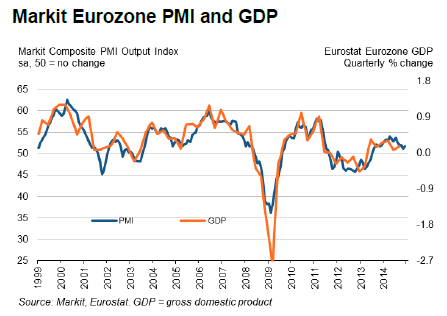
Rates of expansion remained weak in both manufacturing and services. However, while growth of manufacturing output was unchanged on November, a slightly upturn in the pace of business activity growth was recorded in the service sector.
Weakness was again particularly evident in the core countries. German companies reported the smallest increase in business activity since June 2013, while activity fell in France for the eighth successive month, albeit to the smallest extent seen for four months. Outside of Germany and France, activity rose on average at the fastest rate for five months.
The survey found signs of demand picking up, with inflows of new orders rising after slipping into decline in November. However, the increase was only marginal, with both manufacturing and services posting weak rates of expansion. While France saw Markit Eurozone PMI and GDP the first (though minor) increase in new orders for four months, German firms reported a second successive monthly decrease. Elsewhere, overall new order growth accelerated to a five-month high.
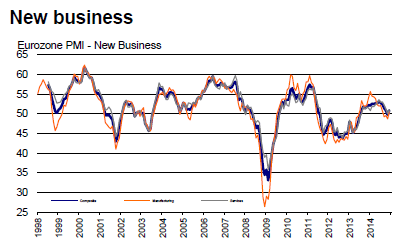
Employment growth picked up to a five-month high alongside the modest revival in new orders. But the overall pace of job creation remained weak, with ongoing job losses again seen in France and the pace of growth in Germany easing to the lowest since August. There was better news across the rest of the region, however, where the survey recorded the largest monthly increase in staffing levels since November 2007.
Average selling prices fell for the thirty-third straight month, though the rate of decline eased to a three-month low, slowing in both manufacturing and services. Falling prices were again seen in Germany, France and elsewhere across the eurozone on average.
Lower oil and other commodity prices helped bring down input costs in manufacturing, resulting in the largest monthly fall in eight months, and lower fuel costs also fed through to generate the smallest overall increase in service sector costs since mid-2010. Measured overall, input costs rose at the slowest rate for eight months. Costs fell in Germany for the first time in one-and-a-half years, while the rate of increase slowed across the rest of the region on average. Input price inflation in France accelerated slightly to a four-month high.
Looking ahead, expectations for the year ahead in the service sector dipped from November’s four-month high to again run well below levels seen earlier in the year. In manufacturing, the forward-looking new orders to inventory ratio picked up to a four-month high, though likewise remained subdued.