Fed Beige Book: Brexit Weighs on Outlook in Some Regions The U.K. vote to leave the European Union is causing concern among businesses in certain pockets of the U.S., a Federal Reserve report said. But broadly, the beige book showed the U.S. economy is expanding at a modest pace.
(…) The wide-ranging report said employment continued to grow modestly, with strong demand for skilled labor. The report said firms are finding it difficult to fill information technology, biotechnology and health-care services positions—pushing up wage rates in those types of fields.
Consumer spending showed signs of softening, the report said, and inflation pressures outside of wages “remain slight.â€
Factory activity was “mixed but generally improved across districts,†the report said.
Residential real estate activity strengthened from earlier in the spring, with home sales increasing despite limited inventory. Commercial real estate activity was stable or improved in almost all districts. (…)
U.S. Budget Deficit Widens to Near Two-Year High in June The U.S. government’s budget deficit widened in June to its highest level in two years, as revenue growth continues to slow.
Over the past year, the deficit totaled $523 billion, up 20.6% from a year earlier, the Treasury Department said in a monthly update Wednesday.
The deficit has largely been a result of weaker corporate tax revenues. While individual income taxes have been on the rise thanks to steady job growth, corporate taxes have been declining. (…)
In Advanced Economies, Two-Thirds of Population Have Seen Incomes Stagnate, Study Shows Across 25 of the world’s advanced economies, about two-thirds of the population—more than half a billion people—earn the same as or less than their peers did a decade ago.
Between 540 million and 580 million people in 2014 had lower or stagnant incomes than similarly situated people in 2005, according to a new study from the McKinsey Global Institute, the research arm of the global consulting firm McKinsey & Co. (…)
McKinsey surveyed households in the U.K., France and the U.S. In these countries, 30% to 40% of people said their incomes hadn’t advanced, indicating that even if transfers and taxes have allowed some families to improve statistically, many still yearn for higher incomes. These households expressed sharply negative views about trade and immigration. (…)
Governments in most advanced countries have cushioned the declines, at least in part. When measured in terms of disposable incomes, after taxes and transfers, disposable incomes were lower for only 20% to 25% of households.
With slow economic growth, and potential disruptions from the aging of the workforce and workplace automation, McKinsey cautioned these trends could continue in the decade ahead, and that most households in advanced economies could experience another a decade of stagnation.
U.S. Import Prices Rise on Higher Oil
Import prices, measuring what U.S. companies pay for everything from South Korean cars to Middle Eastern oil, increased 0.2% in June from a month earlier, the Labor Department said Wednesday. (…)
Excluding fuel products, import prices declined 0.3% in June from May and 2% from a year earlier. Food prices fell 1.3% from May and 2.5% from a year earlier. Prices for food, machinery and consumer-related products all declined. (…)
Wednesday’s report showed U.S. export prices grew 0.8% in June from the prior month, registering the third straight monthly increase. In the second quarter, export prices rose 2.4%, the largest three-month gain since early 2011.
Over the past year, export prices declined 3.5%.
Amazon hails Prime sale as its ‘biggest day ever’ Global orders surged 60% compared with last year’s event
Euro Area IP Drops Like a Rock in May
Euro area industrial output fell by 1.3% in May, giving back most of the gains from April’s previously impressive 1.4% rise. However, April was preceded by a 0.8% drop so that on balance EMU area IP is lower at a 2.8% annual rate over three months. It is lower over six months and up by just 0.6% over 12 months, showing a deteriorating growth profile on the timeline. (…)
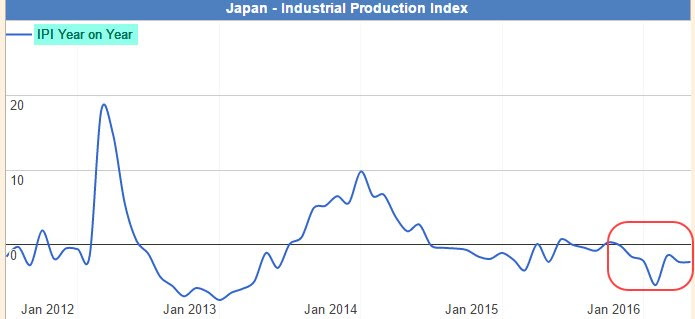
Japan posted a deeper drop in its IP today at -2.6%, down from -2.3% reported earlier. And in China exports fell by 4.8%.

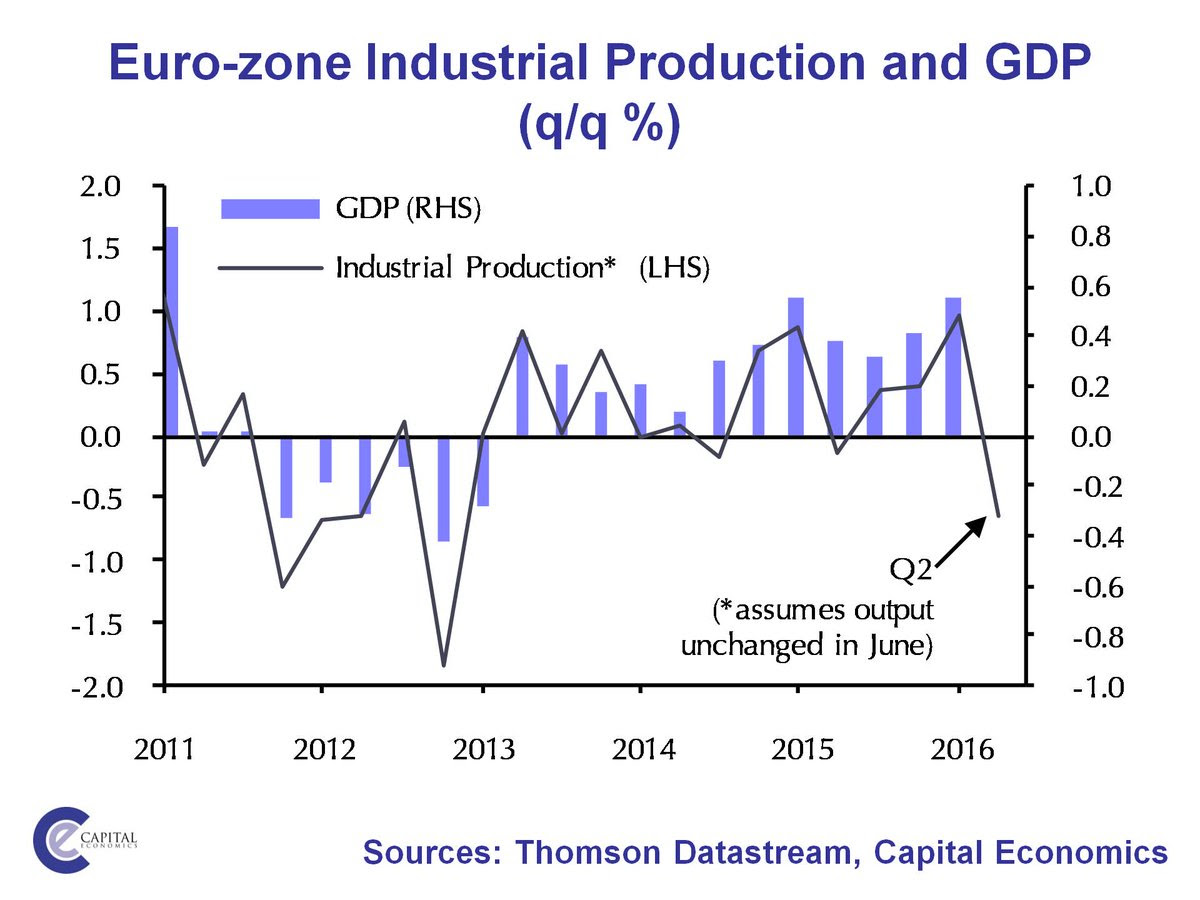 (Via The Daily Shot)
From Markit:
An upturn is signalled for June, with Markit’s Eurozone PMI pointing to a modest revival in the rate of factory output growth to the strongest seen so far this year, which suggests May’s fall in production may overstate the current weakness of the industrial sector. But the business outlook has since deteriorated, in part due to uncertainty created by the UK’s EU referendum.
Survey data from Markit, collected in June showed euro area business optimism about the year ahead dropping to the lowest since late-2014, with uncertainty created by ‘Brexit’ (and possible contagion to other countries) being the most commonly cited threat to future prospects by companies across the region.
In the USA:

In Japan (From The Daily Shot):
Globally:
Business services activity rose at the joint-slowest rate since October 2012. This pointed to subdued demand from corporate clients – a sign that recent political uncertainty has led some customers to postpone orders. Expectations for growth were at a survey-record low.
Consumer service providers also struggled, with output increasing only slightly. Job losses were seen for the first time in over two years.
Investment goods: output vs new orders
 Scary trends:
Global services: future expectations
Business services and GDP
Similar pessimism in China:
 Peekaboo!
Eurozone House Prices Rise at Fastest Pace in Eight Years
The European Union’s statistics agency on Tuesday said house prices in the eurozone were 3% higher in the first quarter of 2016 than in the year-earlier period, the largest increase since the first quarter of 2008, six months before the financial crisis. (…)
In Germany itself, the rise in house prices slowed to an annual pace of 4.4% from 5.9% in the final three months of 2015. The main exception was Austria, where prices rose by 13.4%, more than double the rate of growth recorded in that period. (…)
Foreign Investment in the U.S. Soars, Partly Because of a Tax Loophole
(…) The U.S. economy has been sluggish but still outperformed most of the developed world in recent years. Canada, Germany and Japan also invested heavily in the U.S. last year. Chinese investment is set to reach a new high in 2016 despite growing economic and security concerns from regulators and politicians.
The BEA said manufacturing accounted for more than half of total new investment expenditures, led by pharmaceuticals and medicines. Finance and insurance, real estate, and professional, scientific and technical services also were top targets for investors. (…)