 CHAOS IN RUSSIA
Sergei Guriev, a former rector of the New Economic School in Moscow, is professor of economics at Sciences Po in Paris. From the FT:
(…) What seems to have triggered the chaos was an unusual deal involving the bonds of Russia’s biggest oil company, Rosneft. Last year, in the era of three-digit oil prices, the state-owned group borrowed about $40bn from leading international and Russian banks to acquire its former competitor, Moscow-based joint venture TNK-BP. Given low oil prices and the impact of western sanctions in response to Russia’s actions in Ukraine, it is no longer clear how this debt will be repaid or refinanced.
This is why Rosneft has asked several times this year to borrow $40bn from Russia’s sovereign wealth fund. But, since the money was unavailable, at the end of last week Rosneft issued rouble-denominated bonds worth $11bn. The speculation is that these were bought by the largest state banks. The interest that investors are charging Rosneft on these bonds is substantially below even that of Russian sovereign debt of similar maturity — which is unprecedented for a company, especially one under international sanctions. Coincidentally, the buyers of these bonds were then permitted by the central bank to use them as collateral to borrow directly from the bank itself.
This deal has sent a strong message to the market. First, it showed Moscow’s priority is not fighting inflation or stabilising the rouble but supporting Rosneft. Second, it demonstrated that the central bank is ready to use highly questionable tools. The Rosneft deal has increased the risks in the banking system. The state lenders already have large exposure to the oil group — and any purchase of overpriced rouble bonds would erode their capital further.
Third, it became clear that the government and the central bank have neither strategy nor a clear understanding of how to deal with the present predicament, and certainly not in concert with a poor investment climate and resulting record capital flight.
The markets see a gathering storm but no captain. In recent weeks, Russia’s worst fears have become reality: the oil price has fallen; Asian markets have declined to bail out the nation’s banks and companies; hopes for lifting sanctions have become even more illusory.
Unless sanctions are lifted and the oil price rebounds, the Russian economy will grow much worse in 2015. (…)What will happen next? A month ago, the central bank described an “unlikely” scenario with oil at $60 a barrel and a 4 per cent fall in GDP in 2015. Now, with the oil price actually at $60, a mild recession sounds like a pipe dream. The financial disruption and the interest rate rise in the middle of Tuesday night point to a full-blown economic disaster. (…)
There are only two remaining certainties. First, unless sanctions are lifted and the oil price rebounds, the Russian economy will grow much worse in 2015. Second, we can predict that Moscow’s response — in both economic and foreign policy — will be unpredictable.
More from the FT:
In a sign of the pressure policy makers are under, Sergey Shvetsov, deputy governor of the central bank, said the situation was “critical”: “I couldn’t imagine even a year ago that such a thing would happen — even in my worst nightmares,” he said at an event in Moscow.
- “Russia is in full-blown currency crisis,” said Alexander Moseley, fund manager at Schroders. “It is difficult to see the underlying source of stress ending”.
- “Investors are pricing in that Russia is going to experience quite a nasty recession, which will feed through to other countries,” said Andrew Milligan, head of global strategy at Standard Life Investments. “There are understandable worries in what are fast becoming very illiquid markets ahead of Christmas.”
- While years of prudent fiscal policy and a war chest of $400bn in foreign exchange reserves have helped Russia fend off an outright financial crisis, the rouble rout has greatly increased the burden of more than $600bn in external debt held by banks and companies. Little of this debt can be refinanced because western sanctions have largely locked Russian borrowers out of US and European capital markets.
 Careful out there!
Home Building Faltered in November, but Broader Trends Point Up
Overall housing starts—including apartments and other multifamily dwellings—fell 1.6% in November to a seasonally adjusted annual rate of 1.028 million units, but have held above 1 million mark for three consecutive months, the Commerce Department said Tuesday.
Within that total, construction of new single-family homes fell in November to an annual rate of 677,000, after surging to a post-recession high in October.
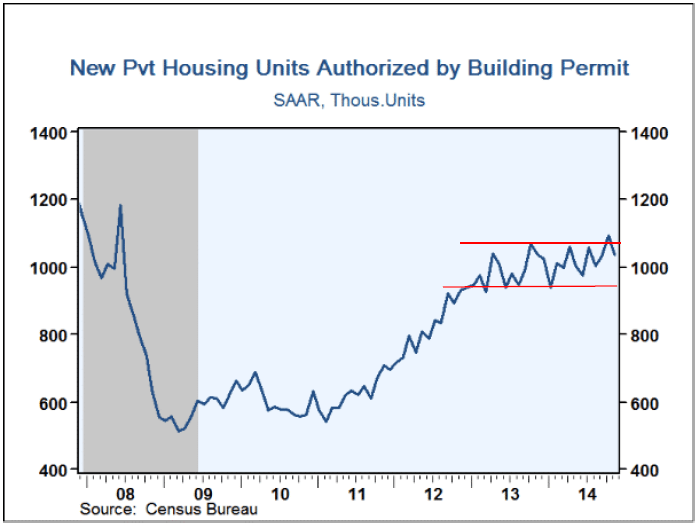
November housing permits, a leading indicator of construction, fell 5.2% to 1.035 million.
I have yet to find the “broader trends pointing up” suggested by the headline. This Haver Analytics chart does not really point up just yet. Starts follow permits. Single family permits have been essentially flat for over a year.
And how about this chart from CalculatedRisk? Any “broader trends pointing up”?

Europe’s Deflation Struggle Intensifies Europe’s struggle to avoid a slide into deflation suffered a setback in November, as consumer prices across the European Union’s 28 members rose at the slowest annual pace in five years.
The bloc’s statistics agency on Wednesday confirmed that consumer prices in the 18 countries that share the euro were just 0.3% higher than in the same month of 2013, while they were 0.4% higher in the EU as a whole. In October, the annual rates of inflation were 0.4% and 0.5%, respectively. (…)
Total hourly labor costs were up 1.3% from the third quarter of 2013, a slight slowdown from the 1.4% rate of increase recorded in the second quarter. Wage rises were unchanged at 1.4%.
Not mentioned in the WSJ article (?): core inflation was unchanged in November and +0.6% YoY, roughly in line with the previous 5 months.
As China’s Economy Slows, So Too Does Growth in Workers’ Wages
Just 20 of the 32 Chinese provinces and regions tracked by China Labor Bulletin raised their statutory minimum wages so far in 2014, fewer than the 27 areas that lifted base pay levels last year, according to report published Tuesday by the Hong Kong-based group.
The latest data also marked a third-straight year of decelerating minimum-wage growth, according to China Labor Bulletin.
In 2014, the 20 regions that have boosted their minimum wages did so by an average of 13%, lower than the average 17% seen last year. This also compared to an average increase of 20% by 25 regions in 2012, and the average 22% increase by 24 regions in the preceding year.
(…) wage growth over the past decade has already all but eroded China’s competitive edge in labor costs over many of its regional rivals, according to the academy.
In particular, average wages in China’s manufacturing sector now exceed comparable levels in South and Southeast Asia by as much as six times, the think tank said.
China Warms To a More Flexible Yuan
After years of allowing nearly uninterrupted gains in the yuan, China is growing more willing to let it depreciate modestly while seeking to add flexibility to its trading, according to Chinese officials and experts familiar with the country’s policy-making.
The shift comes as the People’s Bank of China grapples with what some within the central bank call “unprecedented” downward pressure on the yuan, thanks to a strengthening U.S. dollar and a slowing Chinese economy. The yuan has fallen more than 2% against the dollar since the beginning of this year, putting it on track for its first annual decline in five years. On Wednesday, it was down 2.3% against the dollar for the year.
But the PBOC is unlikely to permit the yuan to slide more than 3% against the dollar, the officials and advisers to the central bank say. Big yuan depreciation could cause money to flow out of the country just when China needs funds to spur economic growth. (…)