Non-Opec producers blamed for oil slide Saudi and UAE vow to maintain output targets at 30m barrels a day
(…) “The kingdom of Saudi Arabia and other countries sought to bring back balance to the market, but the lack of co-operation from other producers outside Opec and the spread of misleading information and speculation led to the continuation of the drop in prices,” he said at an energy conference in Abu Dhabi, according to Reuters. “Let the most efficient producers produce.” (…)
Speaking at the same gathering, Suhail bin Mohammed al-Mazroui, the UAE energy minister, said one of the principal reasons for the price falls was “the irresponsible production of some producers from outside Opec”. He called for oil producers to maintain, and not expand, production throughout next year to keep supply and demand in check. (…)
Mr Naimi said the kingdom would not cut production to prop up the market, even if non-Opec nations lowered output. “If they want to cut production they are welcome, we are not going to cut, certainly Saudi Arabia is not going to cut,” he said. (…)
At the conference, Mr Mazroui echoed a previous statement, saying “Opec is not a swing producer” and “it’s not fair that we correct the market for everyone else.” (…)
Russia faces full-blown crisis, says Kudrin Warning comes as central bank props up midsized lender
Russia faces a “full-blown economic crisis” next year that will trigger a series of defaults and the loss of its investment-grade credit rating, a respected former finance minister has warned.
Real incomes will fall by 2-5 per cent next year, the first decrease in real terms since 2000, said Alexei Kudrin, a longtime ally of President Vladimir Putin and widely tipped to succeed Dmitry Medvedev as prime minister. (…)
In unusually blunt comments for an establishment figure, he also called on Mr Putin to do what was necessary to improve relations with the west: “As for what the president and government must do now: the most important factor is the normalisation of Russia’s relations with its business partners, above all in Europe, the US and other countries.” (…)
Mr Kudrin said the economy would contract by at least 4 per cent next year if oil prices remained at $60 a barrel, echoing central bank forecasts of a 4.5-4.7 per cent contraction. There would “certainly” be a recession in 2016.
“Russia will have its rating downgraded, it will be cut to junk,” he said. “Due to the economic disruption . . . payment discipline will fall significantly and we will see a series of defaults of medium-sized and large companies.”
Mr Kudrin also predicted an increase in dissatisfaction among the population that could have a political impact. “There will be a fall in living standards, it will be painful. Protest activity will increase,” he said.
Not Quite Checkmate for the Bundesbank
(…) With headline inflation in the eurozone now just 0.3%—far below the ECB’s target of close to but below 2%—Mr. Weidmann no longer rejects quantitative easing on principle. He doesn’t dispute that buying government bonds might be necessary to tackle deflation, but questions whether it is necessary now: Core inflation is steady at 0.7% and long-term inflation expectations remain close to 2%. In Spain, where prices are falling fastest, consumer spending is growing strongly. Like many forecasters, the Bundesbank expects falling oil prices to boost eurozone growth.
Even so, the ECB governing council now appears near-certain to launch a government bond-buying program at its next meeting on Jan. 22, according to people familiar with its deliberations. Policy makers argue that they can’t afford to wait to see whether Mr. Weidmann is right about the impact of lower oil prices when headline inflation is likely to fall below zero in early 2015 and stay there for several months. They fear that continuing to tolerate such low inflation will undermine the ECB’s credibility, undermining inflation expectations and effectively tightening monetary policy by pushing up real interest rates. (…)
But Mr. Weidmann may still have a say over the quantitative easing endgame. Designing a government bond-buying program for a multinational currency bloc where fiscal risks are supposed to remain with national governments is more complicated than many of its proponents may have realized. Mr. Weidmann now has a chance to turn the tables on Mr. Draghi.
After all, if quantitative easing is purely a monetary policy operation as Mr. Draghi insists, then the ECB should buy only the safest and most liquid assets to shield itself from credit risk, leaving it to the market to bring down the interest rate on riskier assets via the so-called portfolio rebalancing channel.
On this analysis, the ECB should limit itself to buying only the safest bonds, which means German Bunds, the only eurozone government debt still rated Triple-A.
Of course, Mr. Weidmann knows that Mr. Draghi is very unlikely to accept this argument. The ECB can’t be sure that investors currently holding German Bunds will suddenly start buying Italian or Greek government bonds, bringing down borrowing costs for those countries as the ECB hopes. To do that, the ECB would need to buy Italian and Greek bonds itself, which means that eurozone quantitative easing won’t in fact be a pure monetary policy operation but an exercise in credit easing whose success depends on the ECB assuming eurozone fiscal risks.
That makes Mr. Weidmann’s second line of attack harder to counter: He says that if the ECB does embark on large-scale asset purchases, the credit risks should remain on the balance sheets of national central banks who would buy the government bonds on behalf of the ECB, rather than be pooled as is normal with central-bank assets. There is a precedent for this in the ECB’s covered bond-buying program, where the credit risks associated with individual bonds remains with national central banks to minimize the incentive to select poor credits. (…)
Can Mr. Draghi and Mr. Weidmann agree on a deal? The ECB is taking Mr. Weidmann’s proposal seriously. Mr. Draghi knows that the market will be disappointed if risks aren’t pooled: indeed, a deal could backfire if, in the absence of risk-sharing, investors fear that national central banks will seek a way to avoid taking losses, thereby increasing the risks for ordinary investors. But he also knows that securing the support of the Bundesbank and other dissenters for quantitative easing would be a valuable prize, boosting the vitally important “announcement effect” on confidence.
For Mr. Weidmann, the trade-off is also finely balanced. He may now be powerless to stop the eurozone’s debts becoming mutualized on the ECB’s balance sheet. But by acquiescing, he might just be able to ensure that any losses stay with national central-bank balance sheets until governments agree on a political deal. In other words, Germany might salvage some degree of control over the manner of its eventual checkmate.
South Korea cuts growth forecasts
South Korea has lowered its bullish growth forecasts for this year and next, citing weaker than expected domestic consumption, while it is considering lifting some capital control measures to protect itself against higher US interest rates.
The finance ministry revised down its growth expectations for next year to 3.8 per cent from its July estimate of 4.0 per cent. It also downgraded its growth forecast for this year from 3.7 per cent to 3.4 per cent. (…)
Korean manufacturers are increasingly squeezed between lower-cost Chinese competitors and Japanese rivals helped by the weaker yen in sectors including cars, electronics, steel, chemicals and shipbuilding. (…)
Rouble crisis hits former Soviet states
Belarus has imposed a 30 per cent tax on buying foreign currency and more than doubled interest rates to 50 per cent as the ripples of this week’s Russian market turmoil began to be felt in other former Soviet countries. (…)
In Kyrgyzstan, the central bank announced it would close down private exchange offices after a Kyrgyz som’s de facto peg to the US dollar briefly broke down on Wednesday. Armenia’s dram has fallen 17 per cent against the dollar since mid-November in a move the head of the country’s central bank dubbed “hyper-devaluation”.
The Belarus rouble has steadily lost about 15 per cent of its value against the dollar this year, but on Friday slumped 5.5 per cent to trade at its weakest level since 1998. (…)
China Offers Russia Help Shoring Up the Ruble With Currency Deal
Seven Reasons to Be Fearful
The wall of worry according to Bloomberg:
Five of the top 10 economies in the world are either in recession or on the brink — Japan, France, Italy, Brazil, Russia — and Germany might not be too far behind.
The wall of worry is constructed as follows:
1) Strong Dollar
A strong dollar is in the best interests of the U.S. Until it isn’t. (…) Recently U.S. companies have started commenting on the dollar’s earnings impact. (…)2) Emerging Markets
For the developing world, persistent dollar strengthening invites a great deal of instability. In the past, this has led to revaluations, pegging and de-coupling from the dollar. (…)3) Cheap Oil
The dollar rally has also resulted in lower-priced commodities. This is welcomed by businesses in general, but hurts a good number of oil-producing companies and nations that depend on those revenues. (…)4) The Federal Reserve
The least likely risk is that the Fed adopts a severely restrictive policy stance that precipitates a recession. Historically, it’s always been the Fed that trips up the economy. That’s probably not the case with Fed Chair Janet Yellen at the helm. Her feelings are well-known about keeping the foot on the accommodation accelerator for as long as necessary. She also has total support of the Fed governors. (…)5) China
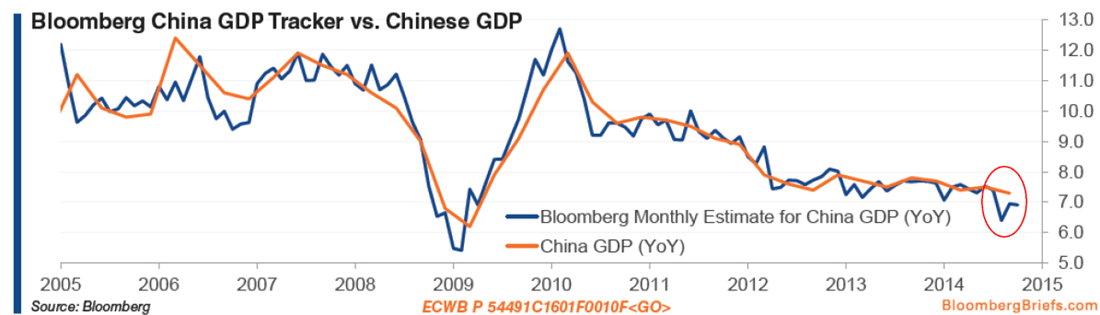
(…) China’s current pace of aggregate demand is the same as during the global crisis and market meltdown in 2008. In order to combat that, the Chinese government implemented a four trillion yuan ($586 billion) stimulus plan, ultimately sending economic activity toward 12 percent growth. Today, Chinese policy makers have no such plans. Rumors are running through the market of a Chinese devaluation. Don’t look for China to be the hero. We’re entering the Year of
the Goat.
6) Japan
(…) Japan cannot even benefit from the plunge in oil prices since the massive devaluation of the yen has negated much of the price decline in purchase terms.
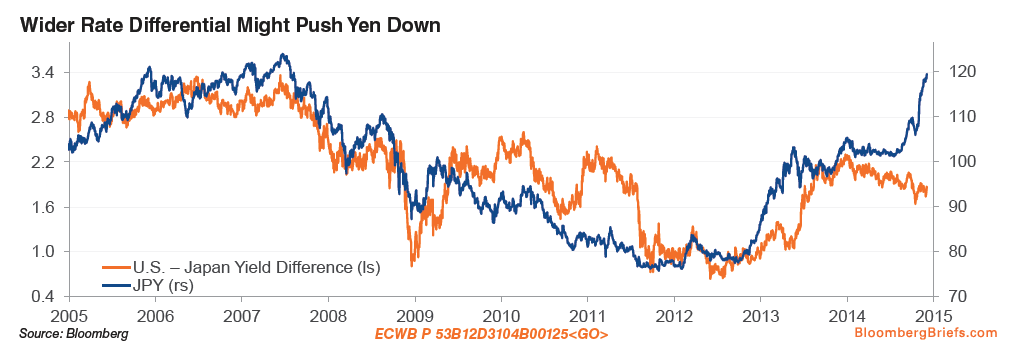
(…) the real question confronting investors today: the ‘Kuroda put’ has placed Japanese equities back on investor’s maps. But is this just a short term phenomenon? After all, no nation has ever prospered by devaluing its currency. If Japan is set to attract, and retain, foreign investor flows, it will have to come up with a more compelling story than ‘we print money faster than anyone else’. (Gavekal)
7) Europe
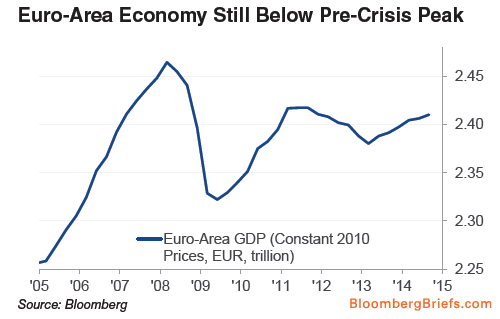
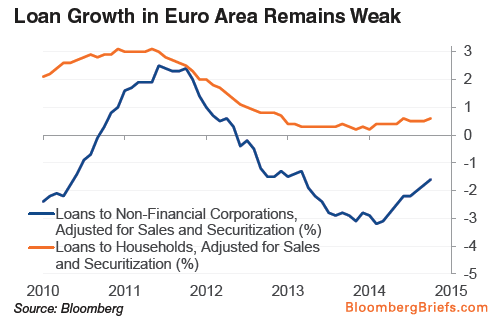
(…) A collapse in Greece or Russia could precipitate a global crisis. If Russia implodes, the likelihood of a severe European recession increases sharply.
More on Europe:
Doing biz in France: 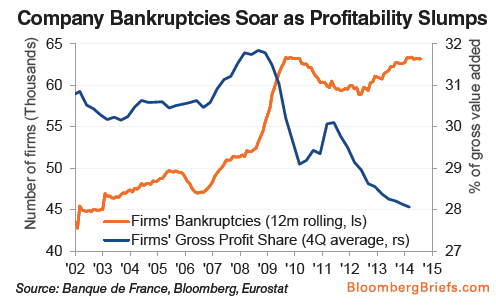
Not doing biz in Italy:
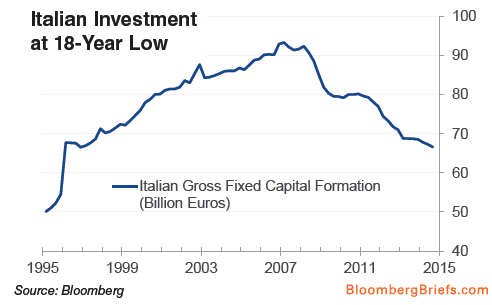
Oil Shakes Venezuelan Debt to Its Foundations
Venezuelan debt was widely held by emerging-market investors until the summer. Many viewed the bonds as a safe bet because the country brought in ample revenue as a major oil exporter. But a nearly 50% drop in the price of crude since mid-June has left Venezuela’s finances in shambles. The price of credit-default swaps on Venezuela debt, a type of insurance, indicate a 61% chance of default in the next year and a 90% chance in the next five years.
The country is an extreme example of the turmoil that sliding prices for oil and other commodities have had on emerging markets, where stocks, bonds and currencies have recently sold off from Russia to South Africa.
Venezuela and its state-run oil company, Petróleos de Venezuela SA, known as PdVSA, issued more debt than any other emerging market between 2007 and 2011. Venezuela and PdVSA have $66 billion in outstanding debt, analysts say. (…)
A Venezuelan default would be unlikely to spill over into other emerging-market countries. Venezuela is regarded as one of the world’s most poorly managed economies, stemming from years of government overspending and a cumbersome currency regime that has deterred investment into the country. (…)
In case you have not read Howard Marks’ note (see yesterday’s Bernobull’s Weekender):
Among other things, [investors] rarely understand that capital withdrawals and the resulting need for liquidity can lead to urgent selling of assets that are completely unrelated to oil. People often fail to perceive that (…) contagion can reach as far as it does.
Colombia braced for effects of oil’s fall Finance minister confident despite potential impact on public finances
Meanwhile, in our Lonesome Cowboy country:
ATA Truck Tonnage Index Surged 3.5% in November
American Trucking Associations’ advanced seasonally adjusted For-Hire Truck Tonnage Index jumped 3.5% in November, following an increase of 0.5% during the previous month. In November, the index equaled 136.8 (2000=100), which was the highest level on record.
Compared with November 2013, the SA index increased 4.4%, down slightly from October’s 4.5% increase but still was the second highest year-over-year gain in 2014. Year-to-date, compared with the same period last year, tonnage is up 3.3%.
“With strong readings for both retail sales and factory output in November, I’m not surprised that tonnage increased as well,” said ATA Chief Economist Bob Costello. “However, the strength in tonnage did surprise to the upside.”
“The index has increased in four of the last five months for a total gain of 6.4%,” Costello said. “Clearly, the economy is doing well with tonnage on such a robust trend-line.” (Chart from CalculatedRisk)

ABOUT THAT STRONG DOLLAR
Gavekal thinks that a strong dollar does not carry the same issues as before:
(…) from next to nothing in 2008, almost a quarter of Chinese trade will settle in renminbi in 2014 (…).
- China’s policy of renminbi internationalization means that emerging markets are able gradually to reduce their dependence on the US dollar. As they do, spikes in the value of the US currency (such as we have seen in 2014) are becoming less painful.
- The slowdown in Chinese oil demand, as well as China’s ability to capitalize on Putin’s difficulties to transform itself from a price-taker to a price-setter, means that the impact of oil and commodities on trade balances is much more contained.
Beyond providing stability to emerging markets, the gradual acceptance of the renminbi as a secondary trading and reserve currency for emerging markets has further implications. The late French economist Jacques Rueff showed convincingly how, when global trade moved from a gold-based settlement system to a US dollar-based system, purchasing power was duplicated. As the authors of a recent Wall Street Journal article citing Reuff’s work explained: “If the Banque de France counts among its reserves dollar claims (and not just gold and French francs) – for example a Banque de France deposit in a New York bank – this increases the money supply in France but without reducing the money supply of the US. So both countries can use these dollar assets to grant credit.” Replace Banque de France with Bank Indonesia, and US dollar with renminbi and the same causes will lead to the same effects.
Consider British Columbia’s recently issued AAA-rated two year renminbi dim sum bond. Yielding 2.85%, this bond was actively subscribed to by foreign central banks, which ended up receiving more than 50% of the initial allocation (ten times as much as in the first British Columbia dim sum issue two years ago). After the issue British Columbia takes the proceeds and deposits them in a Chinese bank, thereby capturing a nice spread. In turn, the Chinese bank can multiply this money five times over (so goes money creation in China). Meanwhile, the Indonesian, Korean or Kazakh central banks that bought the bonds now have an asset on their balance sheet which they can use to back an expansion of trade with China…
(…) the big story in China today is not ‘ghost cities’ (how long has that one been around?) or undercapitalized banks. The major story is China’s reluctance to continue funneling its excess savings into US treasuries yielding less than 2%, and its willingness to use that capital instead to integrate its neighbors’ economies with its own; using its own currency and its low funding costs as an ‘appeal product’ (and having its own companies pick up the contracts as a bonus). In essence, is this so different from what the US did in Europe in the 1940s and 1950s with the Marshall Plan?
More on this in John Mauldin’s excellent Dec. 18 Outside the Box which you should read in its entirety.
ABOUT THAT WAGE INFLATION
Moody’s explains why wages are not taking off just yet.
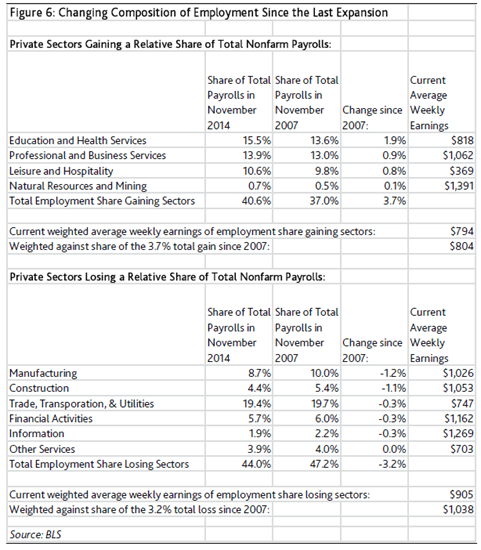
Ultimately determining the economy’s ability to generate more rapid inflation will be the evolution of jobs and wages. The stellar 0.4% monthly gain in November’s average hourly wage hints of quicker income growth, yet the 2.1% yearly pace for this value fails to impress. Beyond the debate about the number of new jobs needed to run down remaining labor market slack is the shifting composition of the labor market. Total employment compared to when the recession began in 2007 has seen growth in lower-paid professions, relative to sectors with a declining share of the labor market (Figure 6). Jobs in healthcare and education that pay an average weekly wage of $818 and those in leisure and hospitality paying a weekly wage of $369 have gained a combined 2.7% share of the labor market. Jobs in manufacturing and construction that paid respective weekly wages of $1,026 and $1,053 have lost a combined 2.3% share of the labor market. Weighted against the share of the respective gain or loss of the labor market, sectors paying yearly wages of $42,000 have advanced while sectors paying $54,000 have faded. As job growth shifts to lower-paying sectors with traditionally slower wage growth, the upside for consumer spending and prices is constrained in the long run. That will allow for the Fed to remain highly accommodative even as the unemployment rates continues to dive, and keep the peak for the fed funds target below historical averages.
ABOUT THAT WEAKER DEMAND
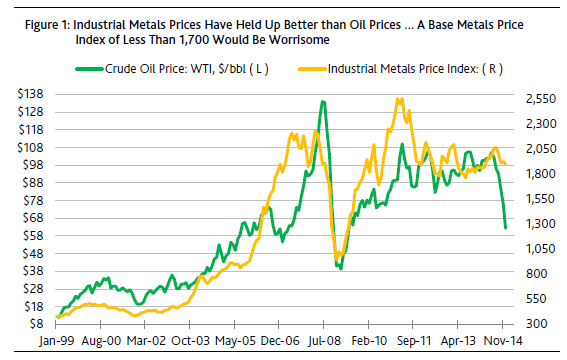
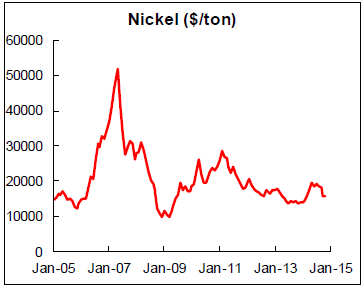
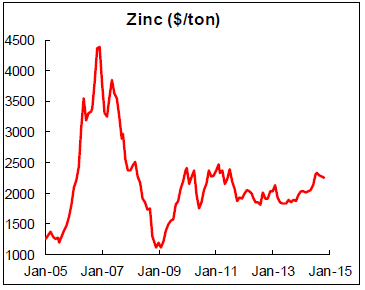
Excessive supply or weakening demand? Obviously, there is weaker demand from Europe, China, Brazil, Russia and oil producing countries. The GSCI is down 31% YoY but the most mediatized price declines are but in a few commodities suffering from clearly excessive supply conditions namely oil (-45% since summer), iron ore (-30%) and copper (-12%). Most other industrial metals prices are holding up in spite of the strong U.S dollar, reflecting reasonably sustained demand conditions as this Moody’s chart illustrates.
Food commodities are also contributing to the apparent demand slowdown but they are also mainly the result of increased supply.
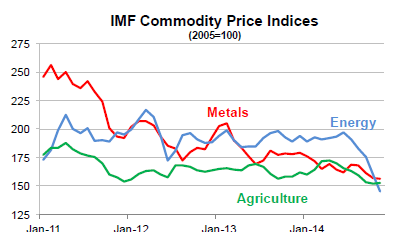
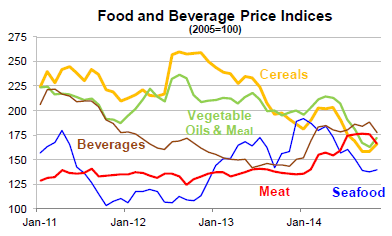
We don’t hear as much from these metals these days, but their prices are hanging in:
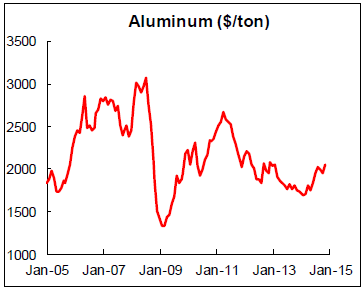
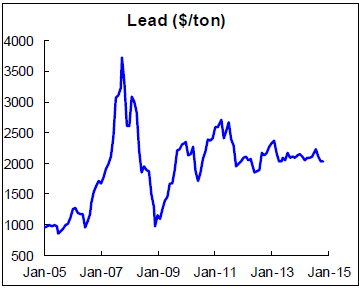
Nobody talks about nat-gas:
Natural-Gas Futures Fall Into Bear Market
Natural gas for January delivery ended down 17.8 cents, or 4.9%, at $3.464 a million British thermal units on the New York Mercantile Exchange, the lowest settlement since Nov. 4, 2013. With Friday’s selloff, the contract is down 23% from its Nov. 20, 2014, close of $4.489 a million Btus. A bear market is defined as a fall of 20% or more from a recent peak.
The natural gas market’s turn from bull to bear conditions in just one month highlights renewed volatility and the extreme forces driving trading. The combination of mild weather in December that has undercut heating demand and robust production from domestic shale fields has eliminated a supply deficit that lasted for most of this year and weighed on natural-gas prices. (…)
“It is increasingly apparent to us that weather will need to bail the market out again this winter—otherwise prices could see material downside during the spring and summer months,” Macquarie Bank said in a research note. “At this point, winter weather will determine just how low prices can go.”
SENTIMENT WATCH
The Best Stock Market Timers Are Bullish Now Although recent market weakness is unnerving investors, those who excel at calling market turns remain bullish.
Next year will be as good for stocks as this year was. That at least is the judgment of the market timers who have done the best job in the past of calling the market’s turns. In contrast, the timers who have the worst track records have most of their money out of equities.
(…) to be bearish right now, you in effect have to bet that those who have exhibited the worst market timing abilities will now get it right, while those with the best records will be wrong. (…)