Japanese Bonds Tumble as Fiscal Worries Mount Before Election
The slump in Japan’s long-term bonds intensified Monday, pushing yields sharply higher in a move that puts global debt markets on alert.
Amid signs of thin liquidity and increasing worries about higher government spending in Japan, yields on bonds from 10-year to 40-year spiked in moves reminiscent of the surge that rippled through global markets in May.
While the pressure in Japan is being heightened by the looming election on July 20, concerns over governments spending beyond their means also apply to the UK, Europe and US. (…)
The rout in Japan’s debt market also followed a tumbled in US Treasuries on Friday as worries about inflation re-emerged. In Germany on Monday, long-term borrowing costs were on course to hit their highest since 2011 on concern over tariffs and extra government spending. (…)
Politicians have been wooing voters with promises of more government spending and tax cuts, which would increase the nation’s debt load. (…)
In the sovereign debt market, a lack of liquidity in recent months has made bonds particularly vulnerable to sharp swings. A Bloomberg gauge that examines how far intraday yield levels deviate from fair value has surged since early April and is now well above the previous peak set during the global financial crisis in 2008. (…)
This year Japan allocated about a quarter of its initial budget to debt-servicing costs, totaling ¥28.2 trillion ($191 billion). The country has a debt-to-GDP ratio of 250% according to the IMF, the largest among developed economies.
If the ruling parties take a beating in the upcoming election, Japan could be pushed into further fiscal spending or tax cuts. Opposition parties have lobbied for a decrease in the sales tax to varying degrees, while the ruling Liberal Democratic Party has proposed cash handouts that take less of a toll on public finances.
“These crazy moves probably can’t be helped until the election is over,” said Tsutomu Soma, a bond and currency trader at Monex Inc. who is a 40-year trading veteran. “I’ve never seen Japan’s bonds move like this before an election. Usually you just think about it after the election’s done.”


Canada: June employment report surprised on the upside
The details of the June report are also encouraging, although it is worth noting that a large share of the jobs added that month were part-time (84%). The private sector added 47,000 jobs in July, following a gain of 60,000 in May. According to the survey released this morning, these increases have pushed private employment to a record high, with all jobs lost during the period of tariff-related uncertainty now recovered.
Despite this positive news, it is important to clarify certain elements to gain an accurate understanding of the situation. We have cautioned readers on several occasions that the Labour Force Survey (LFS) currently overstates employment gains. This is because Statistics Canada uses for this survey a 12-month moving average to estimate the number of non-permanent residents—a population that is currently declining sharply.
Therefore, it will be important to monitor the Survey of Employment, Payrolls and Hours (SEPH), which is based on employer data, to assess the extent to which private employment has truly recovered since April, as suggested by the LFS. Notably, SEPH has shown four consecutive months of contraction from December to April.
While signs of stabilization are welcome, it remains that tariff-related uncertainty contributed to a deterioration in the labour market during the first half of the year. Since February, the unemployment rate has risen by three-tenths of a percentage point. As a result, the Canadian labour market remains in a state of oversupply, which helps explain why wage growth continues to moderate. Hourly compensation for permanent employees is now increasing at its slowest pace in more than three years which is good news for inflation pressures. All in all, this morning’s report makes an interest rate cut at the end of July unlikely.


US Tariffs Revenue Climbs to Fresh Record for Single Fiscal Year
If you don’t understand that these rising government revenues were actually paid by American importers, you may see that chart very positively, until the rising expenses pass through to consumers or to profit statements. Because they will. Once they do, the government revenues become a liability for the economy, a simple transfer of money from the private sector to the government.

BTW:
“Japan was among the first countries to begin talks after April’s ‘Liberation Day’ tariff announcement. It has spent months in negotiations, with Ishiba’s envoy making seven trips to the US for talks with Trump and other officials. The nation has been the largest investor in the US for the past five years and is a crucial security ally. All that only to end up with a tariff rate 1 percentage point higher than first proposed three months ago.”
(…) Tokyo has been humiliated. “To add insult to injury,” says Gearoid, “Japan was lumped in with countries that are far less vital partners, including Kazakhstan and Myanmar.” So much for that special relationship.
- Canada addressed Trump’s bogey assertions on Fentanyl, abolished its digital tax, agreed to pay for the “Golden Dome” and to boost its military expenditures, only to see Trump set duties at 35% on August 1st.
- EU Plans to Engage More With Other Nations Hit by US Tariffs
- EU Official Says Bloc to Explore Asia Pacts as US Tariffs Loom
- Under Attack by Trump’s Tariffs, Asian Countries Seek Out Better Friends
- Vietnam learned from “Truth Social”, now the official voice of the USA, that it had agreed to a deal it never agreed to.
- Brazil was told its duties would be set at 50% because Trump was unhappy with the way the country was treating Bolsonaro, this even though the US has a trade surplus with Brazil. Bolsonaro is on trial for allegedly plotting to overturn the nation’s 2022 election.
- He uses tariff threats to get third world countries help in his deportation drives.
- He threatened BRICS nations with higher duties for “undermining the dollar”.
- He threatened a 10% tax on India for its participation in the BRICS.
- He floated a 50% tax on copper and a 200% tax on pharmaceutical imports.
Asked what formula he was using to determine the appropriate duty rate for trading partners, Trump told reporters at a White House event on Wednesday that it was “based on common sense, based on deficits, based on how we’ve been over the years, and based on raw numbers.”
“They’re based on very, very substantial facts, and also past history,” he said. (Bloomberg)
- And even if and when there is a deal, or an agreement, it’s only good until his next tantrum.
Also this:
White House Seizes on Fed Renovations as Opening to Oust Powell A dispute over the Fed’s renovation of its headquarters could provide the pretext to attempt the removal of Jerome Powell over interest-rate disagreements
White House advisers are ramping up a pressure campaign against Federal Reserve Chair Jerome Powell by alleging he either lied to Congress about the Fed’s headquarters renovation or grossly mismanaged it, potentially creating a new legal avenue to oust him. (…)
As John McEnroe once said: “You can’t be serious!”
BTW #2:
India’s Foreign Minister to Make First China Visit in Five Years
(…) External Affairs Minister Subrahmanyam Jaishankar will hold a bilateral meeting with his Chinese counterpart Wang Yi in Beijing, before traveling to Tianjin to attend the Shanghai Cooperation Organisation’s council of foreign ministers on July 14-15, the people said, asking not to be identified as the discussions are private. That the ministers are meeting separately from the summit underscores efforst by both sides to repair strained ties, they added. (…)
The officials are likely laying the groundwork for a potential visit by Indian Prime Minister Narendra Modi to the SCO leaders’ summit this fall. Modi has been “warmly” invited, according to an April note sent to local media by China’s ambassador to India, but New Delhi has not yet confirmed his attendance. (…)
In October, the two agreed to stabilize relations after Chinese President Xi Jinping and Modi met at the BRICS summit in Russia. (…)
Trump tariff threat piles pressure on Canada to expand trade with Asia
Ed Yardeni:
Liberation Day I—which occurred on April 2 and was postponed until July 9 a few days later—will now hit with full force on August 1. Instead of relenting by now, as we had expected he would do, Trump remains unrelenting in his trade war. (…)
Liberation Day II (scheduled for August 1) may be Macho Trump’s response to Wall Street’s traders who’ve been betting on the TACO Trump trade. The term “TACO”—Trump Always Chickens Out—was coined by Financial Times commentator Robert Armstrong to describe what he says is the President’s pattern of announcing heavy tariffs on countries, causing economic shock, panic, and stock market hits and then later reversing course with pauses or reductions that create market rebounds.
So what do we do now? We certainly aren’t raising our yearend S&P 500 target of 6500. On July 8, Goldman Sachs raised its target just above ours to 6600. We still think that these nearly-the-same targets are achievable by the end of the year.
However, Trump must get the tariff issue resolved in coming weeks. For now, the V-shaped stock market recovery could turn into a choppy square-root shaped pattern over the rest of the summer and early fall followed by a yearend rally.
Trump may be getting too confident that upcoming data will confirm the resilience of the economy and the slow pace of inflation. He may also be emboldened by the record high in the stock market and the calm in the bond market.
Trump’s economists should warn Trump that the core CPI inflation rates for June and July are tracking at 3.0% y/y according to the Cleveland Fed’s Inflation Nowcasting. That would be up from 2.8% in May.
In addition, our Earned Income Proxy (for private industry wages and salaries in personal income) was flat in June, suggesting that the month’s key indicators (e.g., retail sales) might be weaker than expected.
On July 10, I wrote:
BofA data has spending per household down 0.6% sequentially in Q2 spread “across most categories” but with particular concern on services, “the mainstay of spending growth over the past few years”.
That was my point on June 30th after revisions to Q1 data showed real consumer spending down 0.5% QoQ, shockingly revised from +1.8% initially reported. Revisions were particularly significant on services: +0.6% from a first estimate of +2.4%.
Consumption grew 1.1% in April but sank 3.3% annualized in May with real services down 0.3%.
Real spending on services rarely decline MoM. They have declined in 3 of the last 5 months and are up a paltry 0.36% annualized in the first 5 months of the year (2010-19 average: +1.7%).
So the “resilient consumer” has not increased its consumption since December (actually –0.2%), the first meaningful slowdown since the pandemic and a very rare occurrence outside of recessions.
This happened in spite of continued growth in real labor income, resulting in a 5-month jump in the savings rate from 3.5% to 4.5%.
Stalling mostly un-cyclical services are of concern: they generally do not weaken when total expenditures ex-durables do. They are this time, signaling unusual caution.
Importantly, spending on durables has been very strong since last fall, first as dealer inventories normalized, and in March April as Americans advanced purchasing cars ahead of expected price increases. Meanwhile, growth in other goods and services slowed measurably even while labor income remained solid.
Recall that retail sales (mostly goods spending) decreased 0.9% in nominal terms in May, restrained by autos, following a downwardly revised 0.1% drop in April, marking the first back-to-back decline since the end of 2023. Spending at restaurants and bars, the only service-sector category in the retail sales report, fell by the most since early 2023. (…)
In fact, real expenditures have not grown at all since December:

Yardeni continues:
The President told Meet the Press moderator Kristen Welker in a telephone interview on Friday that he plans to set a blanket tariff of 15%-20% on most nations, which would be up from the current 10% base rate. He called the tariffs so far “very well received.” He must figure that if he can raise roughly $300 billion per year with a 10% tariff rate on all imported goods, why not double that amount with a 20% tariff rate?
The answer to the question is that tariffs are a tax on US importers, who might try to pass some of this burden onto their overseas vendors or onto their domestic customers. The higher the tariff, the more burdensome is its tax effect. The tariff tax eats into revenues, eroding profit margins and profits.
For perspective, keep in mind that doubling the tariff intake to $600 billion would bring in more money in tariffs than total US corporate tax receipts amounted to—$503.5 billion—over the past 12 months through June. It’s hard to imagine higher tariffs not squeezing corporate profit margins. However, in our Roaring 2020s scenario, rebounding productivity growth might offset some of the corporate burden of higher tariffs. (…)
Why Are Financial Markets So Calm?
Perhaps investors have learned that Trump’s huffing and puffing is simply the way he negotiates trade deals. They are betting that it will work and result in lots of deals. They’ve also learned that Trump can change his mind often. So if some trade deals aren’t coming together fast enough, he’ll settle on a vague letter of understanding to work out a deal over time.
The risk for the economy and investors is that Trump has concluded that if the financial markets aren’t going to be vigilant about his trade war, then he can proceed with it unchecked. If so, then TTT will last past the summer. Trump certainly views soaring customs duties as a big win for his approach even though they amount to a tax increase.
Trump likes the power that comes from speaking loudly and carrying big sticks, including tariffs, sanctions, and bunker-busting bombs. This is his leadership approach, and he believes it is working for him and has been the right approach so far.
Then again, investors may agree with our current view that “this too shall pass” by the end of the summer: The economy will remain resilient, and inflation will remain surprisingly moderate. It all adds up to a relatively normal seasonal pattern, with the stock market weak during the late summer through the fall followed by a yearend rally to 6500 in our scenario.
Yardeni sees the unrelenting, emboldened Trump but “this too shall pass”. But what has actually passed so far?
Corporate conference calls and guidance starting this week will be interesting.
US increases pressure on trade negotiations in a make it or break it moment
The US hits the EU and Mexico with 30% tariffs starting 1 August. (…)
We have given up speculating about any longer-term strategies in these trade negotiations. What the letters of the last days, and in particular the letters to the EU and Mexico, show is that we are nearing a make-it-or-break-it moment.
The letters show that the US administration is increasing the pressure to reach some kind of deals. Whether negotiators are close to or still far away from reaching such a deal remains unclear.
In any case, there are three ways how this latest letter wave can end:
i) the new pressure leads to tangible results;
ii) tariffs lose their fear factor as the US administration will eventually budge at the risk of losing face; or
iii) we are entering a fully-fledged trade war.
The theoretical fourth option of postponing beyond 1 August looks highly unlikely and politically not very attractive for the US administration. (…)
The weekend letter will now clearly put pressure on the EU to increase their negotiation offers. In fact, the EU has several options in these trade talks.
Option one is to step up purchases from the US. Think of the ill-famous soybeans and LNG from seven years ago but also military equipment as part of the European strategy to increase defense spending (even though Europe will have a hard time selling to its own electorate that tax payers money will be spent on US military equipment).
Option two is to actually reduce tariffs, eg, on US cars or US agricultural products, or to reduce non-tariff trade hurdles like quality standards for US cars.
Option three are export bans on strategically important products for the US. Think of European pharmaceuticals and medicine that currently is not produced in the US – the European version of the Chinese magnesium.
The fourth and final option would be to go into outright retaliation with either increasing tariffs on US goods or the nuclear option in trade: tariffs on digital services but also tighter regulations on US tech firms.
Let’s be clear, the final option would lead to a fully-fledged trade war between the US and Europe and we can only repeat our earlier view that there are no winners in trade wars, only losers.
Against this background, the EU will increase its efforts to find an agreement with the US administration but there are red lines. Think of lower tariffs and standards for US agricultural products. At the same time, a 30% US tariff rate will not go unanswered from the EU.
The European problem, however, is that the more pressure the US administration will put on the EU the higher the likelihood that the united European line will crack.
Some have come up with the label ‘strategic uncertainty’, trying to describe the never-ending trade and tariff saga of the US administration. We have stopped speculating about the whether or not there is a longer-term strategy. We only know that financial markets seem to have grown numb, while at the same time the tariff threat is still for real.
In the European case, a 30% universal tariff could shave off some 0.4pp of GDP growth, pushing the European economy back to the brink of recession. And this is not even counting the toll the tariff uncertainty since April will be taking on investment decisions.
And even though we have stopped speculating, you want to hear a base case scenario from us. Here it is: we still expect some kind of deal before 1 August that will bring a universal tariff of 10% and sectoral tariffs of between 20% and 25% for the EU. As a result, the EU would be facing an effective US tariff rate of close to 20%. Is this a conviction call? No.
To make things even more complicated, even a deal wouldn’t mark the end of the tariff saga.
First of all, don’t forget that trade deals are not written on a one or two-pager but normally consist of hundreds of pages. Negotiations don’t last weeks but rather months and years. Therefore, any “big, beautiful deal” that might be reached over the next weeks will not come with a guarantee that it will last. Whether it holds for weeks, months, or years depends entirely on the whims of the US administration.
In today’s trade landscape, nothing can be taken for granted. Global trade is only going to become more volatile. The search for new trade partners – like between the UK and India, or the Comprehensive Economic Partnership Agreement (CEPA) announced over the weekend between the EU and Indonesia – is a clear sign of this.
Donald Trump’s letter to the EU is not a love letter but also not a hate letter. It’s a letter to increase pressure in the ongoing negotiations. The next days and weeks will tell whether Europe is willing and able to compromise to the US liking. In any case, the letters of the last week suggest that a make-it-or-break-it moment in the tariff saga is getting closer.
China Emerges From Trade Chaos With Record Exports, Surplus
(…) Exports rose 5.8% in June from a year earlier to $325 billion, exceeding the median estimate in a Bloomberg survey of analysts. Imports rose 1.1% to grow for the first time since February, according to data from the General Administration of Customs on Monday.
Shipments to the US fell 16.1% from a year earlier after slumping by over 34% in May. Chinese firms were able to increase their sales in other markets to compensate for the drop to the US, with exports to the 10 Southeast Asian nations in the Asean group soaring 17% from a year earlier. (…)

The dashed black lines on Bloomberg’s chart above are mine, to show that the decline in Chinese exports to the US actually began in 2022, without reducing total exports.
In 1H25, exports have been primarily supported by strong growth to ASEAN (12.2%), in particular Vietnam (18.8%) and Thailand (20.9%), as well as India (15.1%), Africa (18.9%), Latin America (9.4%), and Germany (12.3%).
By product, exports of semiconductors (18.9%), ships (18.6%), and autos (8.2%) continued to outpace the headline growth. The broader machinery and electrical products category also outperformed the headline figure at 8.2% YoY. (…)
Additionally, we can see the impact of tariffs hit lower value-added categories such as furniture (-6.8%), apparel (-0.2%), shoes (-7.2%), and toys (-2.1% YoY).
Overall, exports have held up better than most forecasters expected through the first half of the year, and contributed to first half GDP comfortably beating very downbeat forecasts from the start of the year. (…)
Tomorrow’s GDP data will likely show that net exports have been a solid contributor to growth in the first half of the year despite tariff flareups. (ING)
Thucydides:
Open no more negotiations with Sparta. Show them plainly that you are not crushed by your present afflictions. They who face calamity without wincing, and who offer the most energetic resistance, these, be they States or individuals, are the truest heroes.
America’s Brain Drain Could Become the World’s Brain Gain Research-funding cuts and immigration changes threaten some of America’s economic advantages
(…) A March 2025 survey by the journal Nature of more than 1,600 scientists in the U.S. found that three-quarters have considered leaving the country. Respondents specifically cited the Trump administration’s hostility to scientific research and those who practice it.
Historically, three-quarters of international students who earn a Ph.D. in the U.S. have stayed long-term. America’s ability to retain these workers—who are not just highly trained but expensive to educate—has been one key to the country’s pre-eminence in innovation. (…)
One recent analysis from economists at American University found that current and proposed cuts to federal research spending could whack the U.S. economy. A 25% cut to public research and development spending would eventually reduce the nation’s gross domestic product by 3.8% a year, they found—a drop on par with what we experienced during the Great Recession of 2007-09.
As of May, the National Institutes of Health faced a 40% (or $18 billion) reduction in its budget. And in the Trump administration’s tax-and-spending megabill that the president signed into law on July 4, America’s leaders doubled down on slashing budgets for the country’s key research funding bodies.
The National Science Foundation had its budget cut by more than 50%, or about $5 billion, which will wipe out support for 78% of the early-career researchers it supports, according to the agency’s own estimate. The National Aeronautics and Space Administration’s budget for science missions is to be cut almost in half, a loss of $3.4 billion. The list goes on, agency after agency.
Michael Kratsios, science adviser to President Trump, has said that funding cuts should be a “moment of clarity” for the scientific community, which has delivered “diminishing returns” on federal investment since 1980. “Political biases have displaced the vital search for truth,” he said.
The administration’s cuts have trickled down to universities, with tens of billions in grants being canceled and new curbs placed on exactly how scientists spend the money they receive.
The U.S. is also doubling down on policies that make it tougher for skilled immigrants to come to the country—or bar them outright. There have been reductions in the number of H-1B visas handed out and changes to the Optional Practical Training program, which allows some students to work for up to two years after they complete their degrees. That means fewer opportunities for skilled immigrants to stay in the U.S.
Google, Amazon and Moderna were founded by immigrants or their children—as were nearly half of all Fortune 500 companies. Many researchers and economists fear that funding cuts and immigration policy changes could keep the world’s brightest minds from coming to America.
Currently, only about 40% of international students who receive a degree in the U.S. stay over the long run. That’s not a new phenomenon, but funding cuts and skilled immigration restrictions threatens to worsen the situation, says Arnold. (…)
I spoke with several researchers and engineers at top universities and well-known tech companies—none eager to have their names attached to their plans—who either intend to leave the U.S. or who have already relocated. All described feelings of anguish about abandoning the U.S. but felt they had little choice: The research they were pursuing was being defunded, the nation’s politics had become too threatening and polarized, the U.S. had made it too difficult for them to do their jobs. Some cited the challenge of just coming in and out of the country when attending international conferences.
Companies that once sought to bring the world’s best and brightest to the U.S. are already dodging some of the complications of U.S. immigration law by simply setting up offices wherever that talent happens to already be. It’s a phenomenon that accelerated during the pandemic, when many companies embraced remote work, and companies became more comfortable with teams distributed across the globe. (…)
“Many of our great companies will not be able to find the science workers, the startup companies will not be created, and we will not have the people we need to teach the next generation, nor the ones we need to inform the U.S. government and the defense agencies,” she said.
 China Biotech’s Stunning Advance Is Changing the World’s Drug Pipeline Chinese biotech’s advance has been as ferocious as the nation’s breakthrough efforts in AI and EVs, eclipsing the EU and catching up to the US
The number of novel drugs in China — for cancer, weight-loss and more — entering into development ballooned to over 1,250 last year, far surpassing the European Union and nearly catching up to the US’s count of about 1,440, an exclusive Bloomberg News analysis showed.
And the drug candidates from the land once notorious for cheap knock-offs and quality issues are increasingly clearing high bars to win recognition from both drug regulators and Western pharmaceutical giants.
The findings, gleaned from an analysis of a database maintained by pharma intelligence solutions provider Norstella, show a fundamental shift in medical innovation’s center of gravity. With President Donald Trump already threatening tariffs on the pharmaceutical sector, China’s biotech advances — the scale of which is slowly coming into view — risk becoming another realm of superpower rivalry like artificial intelligence and electric vehicles.
(…) “The products are here, they’re attractive and they’re fast.”
(…) China began to overhaul its drug regulatory system in 2015 (…). The reforms helped streamline reviews, enforced data quality standards and improved transparency. The government’s ‘Made in China 2025’ plan to elevate manufacturing in 10 priority sectors also helped spur a flurry of investments in biotechnology. Altogether, they unleashed a boom led by foreign-educated and -trained scientists and entrepreneurs. (…)
“It wouldn’t be sensationalist to suggest that China will overtake the US in the next few years purely in terms of numbers of drugs that it’s bringing through into its pipeline.”
Numbers aside, the more stunning leap is in the quality of Chinese biotech innovation. While there’s constant debate in the pharmaceutical industry on whether Chinese firms are capable of producing not just effective but needle-shifting new therapies, there’s growing recognition on multiple fronts. The world’s strictest regulatory agencies, including the US Food and Drug Administration and the European Medicines Agency, increasingly view Chinese drugs as generally promising enough to justify devoting extra resources to speed up their review, handing them coveted industry designations such as priority review, breakthrough therapy designation or fast track status.
The country is now slightly ahead of the EU in earning such expedited reviews as of 2024, the data shows, a remarkable edge over a region that previously produced drugs like Wegovy. (…)
Risk-aversion remains a factor holding back Chinese pharmaceutical innovation: So far, top companies tend to focus on making better versions of existing therapies or new iterations of older ideas, and few are pioneering novel treatment approaches that have never been tried before — an endeavor that comes with a high risk of failure and is still led by the US, Europe and, to a lesser extent, Japan.
Nevertheless, the biggest Chinese breakthroughs are increasingly being snapped up by pharmaceutical giants for record sums, a sign that the perennial competition for the next blockbuster drug is also shifting East.
A novel cancer drug from Akeso Inc., which came out more effective than Merck & Co Inc.’s Keytruda in a Chinese study last year, has been likened to China biotech’s DeepSeek moment, spawning a new wave of global interest. The promise of topping Keytruda, the world’s top-selling drug, also swelled the valuation of Summit Therapeutics Inc, which in 2022 paid $500 million upfront for the development and marketing rights in the US and other regions.
Other multinational players like Merck, AstraZeneca Plc and Roche Holding AG have also scooped up Chinese assets. In May, Pfizer Inc. set a new record as it announced a $1.2 billion upfront deal with 3SBio Inc. for a cancer drug similar to Akeso’s. These deals are increasing in both value and frequency, according to biopharma deal database DealForma, signaling confidence that China-originated drugs are competitive internationally and can bring in substantial revenue.
Creating a new drug from scratch is notoriously time-consuming and expensive, and China’s massive patient pool and centralized hospital network have become a significant accelerator. An analysis of the time taken for drugs to conduct various testing stages shows that doctors in China can recruit for trials much faster — for early trials for cancer and obesity drugs, they can complete patient enrollment in half the time compared to the US.
The difference in costs means Chinese companies can afford to run multiple trials simultaneously to find a winner, or quickly launch new projects once a scientific idea is validated by other groups.
Since 2021, China has become the top location for clinical research, initiating the largest number of new trials globally, according to GlobalData.
US regulators have made it clear that China-only trial results, no matter how positive, are not sufficient to support drug approvals. Chinese biotechs with ambition to sell their drugs overseas must prove that their treatment benefits can be replicated in non-Chinese patients, through complex and slower-moving global studies.
It may still be a few years before a critical mass of drugs sourced from China wins US and EU approvals — the gold standard for high-quality treatments — and become widely used in the Western world, but many in the industry believe that’s inevitable. (…)
Of the 50 companies that generated the highest number of innovative drug candidates between 2020 and 2024, 20 of them were Chinese, compared to five in the five years before. (…)
The perception of threat has spurred calls for the US government to stymie China’s biotech growth — through restrictions such as export controls on scientific equipment and barriers to investment — and boost the domestic biotech sector, including by changing the regulatory environment to emulate countries where clinical trials are run more quickly. Robert F. Kennedy, the US Secretary of Health and Human Services, recently pledged to “Make American Biotech Accelerate.” (…)
“At the end of the day, what we do benefits patients in China, in the US and all around the world.”


It’s one thing to prevent Americans to buy Chinese cars, however better and cheaper they are, it would be more difficult to justify barring them access to life-saving medicines. Although with Trump and RFK…
Add the brain drain…
Chinese biotech shares surge as Big Pharma looks to license cancer treatments
(…) There is particular excitement around new variations of PD-1 immunotherapy treatments under development by some Chinese biotechs. New therapies known as PD-1 VEGF have recorded strong clinical results showing they stimulate an enhanced immune response to cancer.
“The reason people are crazy about PD-1 is that it is supposed to treat almost every type of cancer indication,” said Cui Cui, head of Asia healthcare research at Jefferies.
Why Measles Cases in the US Are at a Three-Decade High
(…) the Trump administration has pulled back on broad support of immunizations. Robert F. Kennedy Jr., the nation’s top health official, at times has downplayed the threat of measles in public statements and has incorrectly linked the measles vaccine to autism.
In June, Kennedy removed all the members of a CDC advisory panel on immunizations and added vaccine critics. (…)
Measles is one of the world’s most contagious viruses, infecting the respiratory tract before spreading throughout the body. Nine out of 10 unvaccinated people will get the virus if they have interacted with someone who has it. Measles causes fever and a rash, and in severe cases, can lead to complications such as deafness, blindness, pneumonia and encephalitis — swelling of the brain that can be fatal.
About 1 in 5 unvaccinated people infected with measles will require hospitalization. In 2024, however, the hospitalization rate reached 40% in the US, according to the Johns Hopkins Bloomberg School of Public Health. (…)
Measles is especially dangerous for babies and older people or those with suppressed immune systems, such as cancer patients receiving radiation or chemotherapy. Measles during pregnancy can lead to miscarriage, early delivery and low birth weight. It can also weaken the immune system for years by attacking B cells, which are crucial for remembering past infections and helping the body fight off diseases. In rare cases, the infection can linger in the brain, causing a fatal disease years after the initial exposure.
People can catch measles just by being in the same room where an infected person has breathed, coughed or sneezed within two hours. An individual can spread the disease unknowingly before showing any signs or symptoms. (…)
The vaccine, which is combined with immunizations against mumps and rubella into a shot called the MMR, is extraordinarily safe. The vaccine is 93% effective against the virus after one dose and 97% effective after two doses, making it one of the most effective vaccines on the market. (…)
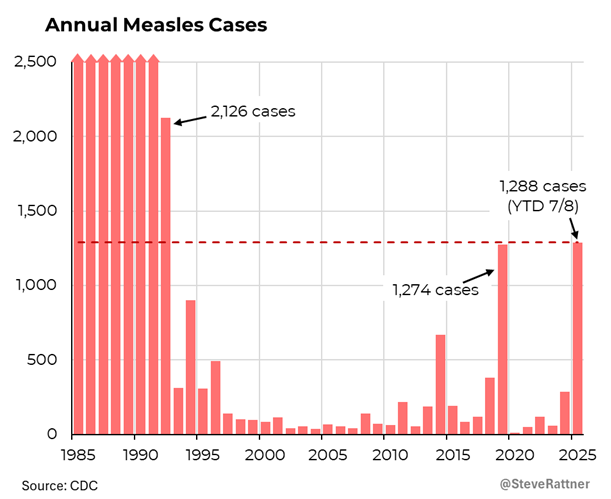
(…) the alarm isn’t just about the risk of measles. (93% of Americans are at low risk because of immunity.) It’s about what measles represents.
For those of us in public health and medicine, this outbreak is more than an infectious disease flare-up. It’s a symbol of broken trust, eroded progress, rise of individualism replacing collective good, and a system that is cracking under the weight of disinvestment and distrust.
The urgency you’re seeing from health officials isn’t just about the virus’s high transmissibility (though measles is one of the most contagious diseases known) or the risk of serious outcomes in populations without immunity. It’s about the deeper warning signal this resurgence sends.
Measles is a canary in the coal mine. When measles reappears in a country like the U.S., it signals that something has gone seriously wrong. This is a disease we had essentially eliminated—thanks to one of the safest and most effective vaccines in the history of medicine. But the way things are heading, the U.S. is at risk of losing its elimination status this year. This is not just a failure to move forward—it’s the unraveling of decades of progress, representing one of the greatest public health achievements of our era.
That progress was built on public confidence in science and medicine. When parents now refuse the MMR (measles, mumps, rubella) vaccine, it’s not because the science has changed. It’s because trust has, both due to failures of public health to reach communities and due to well-organized efforts to spread inaccurate information about vaccination, leaving many Americans’ heads spinning as they sort through the noise and figure out who to trust.
For many in medicine, the resurgence of measles, along with declining rates of routine childhood vaccination, is a concerning sign of what’s to come. If we’re losing ground on measles, we may soon be vulnerable to other vaccine-preventable diseases. Whooping cough cases are already rising. Polio, Hib, or even diphtheria may soon appear in our emergency rooms. Unlike most of human history, childhood deaths from infectious diseases are now relatively rare (at least in high-income countries like the U.S.), and we’d like to keep it that way.
FYI:
From Bruce Mehlman:
- Ignorance may be bliss but it usually makes for terrible policy. We ignore experts at our own peril. Vaccines prevent disease, climate change is real and those who live by conspiracy theories may die by them, literally or politically.


