First the facts, from Factset:
As a result of the downward revisions to earnings estimates, the estimated year-over-year earnings decline for Q1 2016 is -9.1% today, which is below the expected earnings growth rate of 0.7% at the start of the quarter (December 31). Seven sectors are projected to report a year-over-year decline in earnings, led by the Energy and Materials sectors. Three sectors are predicted to report year-over-year earnings growth, led by the Telecom Services and Consumer Discretionary sectors.
If the Energy sector is excluded, the estimated earnings decline for the S&P 500 would improve to -4.2% from -9.1%.
As a result of downward revisions to sales estimates, the estimated sales decline for Q1 2016 is -1.2% today, which is below the estimated year-over-year sales growth rate of 2.7% at the start of the quarter. Five sectors are projected to report year-over-year growth in revenues, led by the Telecom Services and Health Care sectors. Five sectors are predicted to report a year-over-year decline in revenues, led by the Energy and Materials sectors.
If the Energy sector is excluded, the estimated revenue growth rate for the S&P 500 would jump to 1.7% from -1.2%.
![image_thumb[2]](https://i0.wp.com/www.edgeandodds.com/wp-content/uploads/2016/04/image_thumb2_thumb.png?resize=554%2C359 "image_thumb[2]")
Over the past four years on average, actual earnings reported by S&P 500 companies have exceeded estimated earnings by 4.0%. During this same time frame, 67% of companies in the S&P 500 have reported actual EPS above the mean EPS estimates on average. As a result, from the end of the quarter through the end of the earnings season, the earnings growth rate has typically increased by 2.8 percentage points on average (over the past 4 years) due to the number and magnitude of upside earnings surprises.
If this average increase is applied to the estimated earnings decline at the end of Q1 (March 31) of -8.6%, the actual earnings decline for the quarter would be -5.8% (-8.6% + 2.8% = -5.8%). If -5.8% is the actual earnings decline for the quarter, it will still mark the largest year-over-year decline in earnings for a quarter since Q3 2009 (-15.7%).
At this point in time, 121 companies in the index have issued EPS guidance for Q1 2016. Of these 121 companies, 94 have issued negative EPS guidance and 27 have issued positive EPS guidance. If 94 is the final number for the quarter, it will mark the second highest number of S&P 500 companies issuing negative EPS guidance for a quarter since FactSet began tracking the data in 2006. The percentage of companies issuing negative EPS guidance is 78%, which is above the 5-year average of 73%.
![image_thumb[3]](https://i0.wp.com/www.edgeandodds.com/wp-content/uploads/2016/04/image_thumb3_thumb.png?resize=554%2C405 "image_thumb[3]")
Exactly 50% of the total negative guidance has come from IT and consumer-related companies.
Interestingly, Thomson Reuters says that 22 S&P 500 companies have already reported Q1 results. Nineteen of them are IT or consumer-centric and 17 of these have beaten consensus EPS estimates by a wide margin.
Surprisingly, these good results have not stopped the decline in overall estimates for the quarter which TR now sees at –7.6% (-7.1% on April 4th).
The media having amply warned investors about the poor Q1 earnings, guidance for Q2 and the rest of the year will be key. TR’s tally now shows Q2 EPS down 2.0% (-2.2% on April 4th) with 7 industries back into positive growth YoY. The trend would then accelerate with Q3 EPS up 4.6% culminating in Q4 at +10.4%. In all, full year EPS would rise 2.0% to $119.77 in 2016 before jumping 13.8% to $136.32 in 2017.
Such vision of a rather spectacular margins expansion is not shared by all. Permabear Albert Edwards at SoGen has been calling for a margin peak for many, many years and, no doubt, he will eventually prove right. From his latest Global Strategy Weekly (via Zerohedge)
Despite risk assets enjoying a few weeks in the sun our failsafe recession indicator has stopped flashing amber and turned to red. Newly released US whole economy profits data show a gut wrenching slump. Whole economy profits never normally fall this deeply without a recession unfolding. And with the US corporate sector up to its eyes in debt, the one asset class to be avoided – even more so than the ridiculously overvalued equity market – is US corporate debt. The economy will surely be swept away by a tidal wave of corporate default. (…)
Recent whole economy profits data show that while the Fed plays its games, the economic cycle is withering and writhing from within. For historically, when whole economy profits fall this deeply, recession is virtually inevitable as business spending slumps. (…)
We have written extensively in the past as to why sell-side economists almost to a man and woman fail to predict recessions. One of the key reasons – aside from the obvious wish not to make an unpopular call that might prove wrong and likely fatal to their career – is that they do not place enough importance on the role of profits as a driver of the economic cycle.
My own observation has led me to the conclusion that when whole economy profits begin to fall sharply, this is usually followed shortly after by the overall economy tipping over into recession, driven by the volatile business investment cycle. The national accounts, whole economy profits data give a wider and “cleaner” estimate of the underlying profits environment than the heavily doctored “pro-forma” quoted company profits data (the former also often leads the latter). As illustrated below, a longer term chart shows how whole economy profits tend to be a leading indicator of the business investment cycle. It also shows the current profits downturn is notably worse than the 1998 downturn – which is often cited as evidence that a profits recession does not necessarily lead to a full blown economic downturn.

The link between profits and capex is pretty obvious and sensible. Edwards then pretends to link capex and recessions with this chart and comments:
My own view is that Fed tightening may not be a necessary condition to catalyse a recession and that the deep profits downturn is sufficient in itself. Historically all recessions are effectively caused by slumps in business investment driven by a profits downturn: the chart below shows that whenever GDP growth (dotted line) is negative it is almost totally overlaid by the contribution of GDP growth in business investment (red line).“
![image_thumb[5]](https://i0.wp.com/www.edgeandodds.com/wp-content/uploads/2016/04/image_thumb5_thumb.png?resize=604%2C332 "image_thumb[5]")
I have some reserves on a chart overlaying YoY changes and GDP with contribution to GDP growth but it does not take long to see that negative contribution by biz investment is not a de facto driver of recessions.
In my March 21 post UP, UP, BUT NOT AWAY, I showed that declining margins do no always lead to bear markets, even that many bear markets occurred while margins were actually rising. I have also previously demonstrated that declining absolute profits do not always result in lower equity markets. Confused?
Let’s try to make sense of all of this.
- Equities go up or down based on trends in profits and valuations which are not always in sync.
- Profits go up or down based on trends in revenues and margins which are not always in sync.
- Valuations go up or down based on inflation and investors sentiment which are not always in sync.
All we have to do is accurately forecast revenues, margins, inflation and sentiment. 
- Revenues are a function of volume growth and inflation. Currently, volume growth in the economy is tepid at best with scant evidence that it is about to accelerate.
![image_thumb[7]](https://i0.wp.com/www.edgeandodds.com/wp-content/uploads/2016/04/image_thumb7_thumb.png?resize=554%2C382 "image_thumb[7]")
Moody’s builds this great chart breaking down nominal business sales with and without energy. Both are slow and slowing. Recent company surveys I saw continue to show generalized soft demand trends
![image_thumb[7]](https://i0.wp.com/www.edgeandodds.com/wp-content/uploads/2016/03/image_thumb7_thumb-1.png?w=825)
-
Margins are a function of revenue growth (volume + inflation) minus costs inflation. When core nominal revenues are rising at about 1.0% YoY, CEOs need to exert significant control on costs in order to maintain margins and grow profits. We know that wages are now rising at a 2.5%+ rate. Actually, the Atlanta Fed wage tracker is now +3.2%:
![image_thumb[11]](https://i0.wp.com/www.edgeandodds.com/wp-content/uploads/2016/04/image_thumb11_thumb.png?resize=554%2C320 "image_thumb[11]")
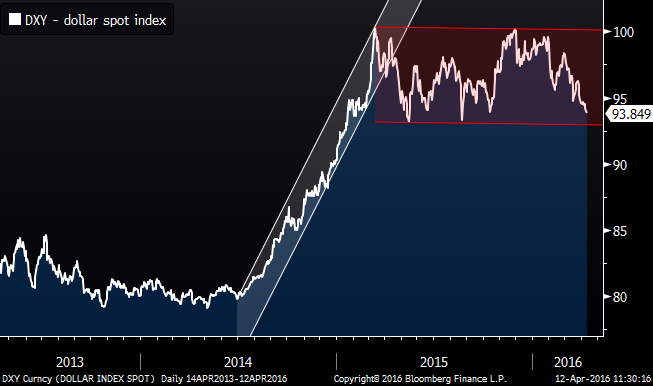
Unless corporations regain enough pricing power to raise prices to offset their rising wages, a margin squeeze will ensue. Regaining pricing power when volume growth is minimal and a strong currency undermines competitiveness with foreigners is rather difficult. It took a while but it looks like American corporations have exhausted their cost control magic.
![image_thumb[9]](https://i0.wp.com/www.edgeandodds.com/wp-content/uploads/2016/04/image_thumb9_thumb.png?resize=554%2C366 "image_thumb[9]")
Last week, I showed this smart chart to illustrate the margin squeeze currently impacting American small businesses.

Rcube, a French investment research boutique, has done excellent work on this concept. It developed a “Small Business Profit Indicator” using NFIB data to show that small biz earnings are about to tank and drag down U.S. equities earnings along:
![image_thumb[19]](https://i0.wp.com/www.edgeandodds.com/wp-content/uploads/2016/04/image_thumb19_thumb.png?resize=554%2C419 "image_thumb[19]")
![image_thumb[23]](https://i0.wp.com/www.edgeandodds.com/wp-content/uploads/2016/04/image_thumb23_thumb.png?resize=554%2C373 "image_thumb[23]")
![image_thumb[21]](https://i0.wp.com/www.edgeandodds.com/wp-content/uploads/2016/04/image_thumb21_thumb.png?resize=554%2C382 "image_thumb[21]")
U.S. CEO confidence is directly related with Rcube’s SBPI:
![image_thumb[25]](https://i0.wp.com/www.edgeandodds.com/wp-content/uploads/2016/04/image_thumb25_thumb.png?resize=554%2C384 "image_thumb[25]")
Poor CEO confidence is certainly not positive for capex investments (remember Edwards above?)…
![image_thumb[27]](https://i0.wp.com/www.edgeandodds.com/wp-content/uploads/2016/04/image_thumb27_thumb.png?resize=554%2C407 "image_thumb[27]")
…nor is it, eventually, for employment:
![image_thumb[29]](https://i0.wp.com/www.edgeandodds.com/wp-content/uploads/2016/04/image_thumb29_thumb.png?resize=554%2C368 "image_thumb[29]")
What these charts suggest is that profits are not about to turn up anytime soon unless something radically changes on the demand side of the economy. This something radical needs to show up pretty soon, otherwise employment growth will begin to fade, taking us into a vicious state of slow growth and rising wages. No wonder Mrs. Yellen is so cautious and uses the word “uncertainty” so much these days.
As previously stated, equities can rise amid declining margins and/or profits, providing valuations rise enough to more than offset lower profits. One problem is that valuations are currently already elevated thanks to central bank interventions. P/Es are high whether you look at absolute P/Es or the Rule of 20 P/E. Unless, of course, you think there will be enough greater fools to buy you out at P/E levels which in the past always reflected overvaluation and significant danger. The other problem is that valuations are negatively impacted by rising inflation, which is one of the Fed’s goal and which is also needed to protect margins. We might get our cake but …
![image_thumb[16]](https://i0.wp.com/www.edgeandodds.com/wp-content/uploads/2016/04/image_thumb16_thumb.png?resize=604%2C250 "image_thumb[16]")
![image_thumb[17]](https://i0.wp.com/www.edgeandodds.com/wp-content/uploads/2016/04/image_thumb17_thumb.png?resize=604%2C301 "image_thumb[17]")
High valuations generally need positive trends to remain lofty, let alone get even loftier. As the two charts above illustrate, equity valuations are anything but stable, underscoring the importance of investors sentiment in the equation. Today, we have high equity valuations and low investors sentiment…(next 2 charts from Ed Yardeni)
![image_thumb[36]](https://i0.wp.com/www.edgeandodds.com/wp-content/uploads/2016/04/image_thumb36_thumb.png?resize=604%2C236 "image_thumb[36]")
Positive economic surprises can help boost investors sentiment. However, even in the current slow environment, positive surprises are hard to get.
![image_thumb[37]](https://i0.wp.com/www.edgeandodds.com/wp-content/uploads/2016/04/image_thumb37_thumb.png?resize=604%2C342 "image_thumb[37]")
The other fact that 9 of the world’s 10 largest economies (China, Japan, Germany, France, the UK, Brazil, Italy, Russia and India) are experiencing an equity bear market (-20%+ from their recent high) is not helping sentiment. And even though U.S. large caps have nicely bounced off their February lows, one-in-three mid-cap stock and more than half of small caps are still down by 20% or more from their highs.
Equity cheerleaders are all out now showing how cheap stocks are on 2017 earnings. Unfortunately, this is not 2009, 2010 or 2012:
- Equities are expensive on a trailing earnings and inflation basis.
- Revenue growth is very weak given slow demand and low inflation.
- Wages are finally accelerating on declining labor slack.
- Margins are weakening and seem set to drop further barring a sustained economic revival.
Certainly, things can suddenly get better like Danny Willet experienced at the Masters but the odds that the numerous pieces fall into place are not favourable. Given the mounting pressures on margins, buying equities on forward profits is currently riskier than normal. This is a margin call, but it ain’t no marginal risk!
 Did you miss MARGIN CALL NO MARGINAL RISK ?


 Goldman Sachs
 ![image_thumb[2]](https://i0.wp.com/www.edgeandodds.com/wp-content/uploads/2016/04/image_thumb2.png "image_thumb[2]")
![image_thumb[3]](https://i0.wp.com/www.edgeandodds.com/wp-content/uploads/2016/04/image_thumb3.png "image_thumb[3]")

![image_thumb[5]](https://i0.wp.com/www.edgeandodds.com/wp-content/uploads/2016/04/image_thumb5.png "image_thumb[5]")
![image_thumb[7]](https://i0.wp.com/www.edgeandodds.com/wp-content/uploads/2016/04/image_thumb7.png "image_thumb[7]")
![image_thumb[11]](https://i0.wp.com/www.edgeandodds.com/wp-content/uploads/2016/04/image_thumb11.png "image_thumb[11]")
![image_thumb[9]](https://i0.wp.com/www.edgeandodds.com/wp-content/uploads/2016/04/image_thumb9.png "image_thumb[9]")
![image_thumb[19]](https://i0.wp.com/www.edgeandodds.com/wp-content/uploads/2016/04/image_thumb19.png "image_thumb[19]")
![image_thumb[23]](https://i0.wp.com/www.edgeandodds.com/wp-content/uploads/2016/04/image_thumb23.png "image_thumb[23]")
![image_thumb[21]](https://i0.wp.com/www.edgeandodds.com/wp-content/uploads/2016/04/image_thumb21.png "image_thumb[21]")
![image_thumb[25]](https://i0.wp.com/www.edgeandodds.com/wp-content/uploads/2016/04/image_thumb25.png "image_thumb[25]")
![image_thumb[27]](https://i0.wp.com/www.edgeandodds.com/wp-content/uploads/2016/04/image_thumb27.png "image_thumb[27]")
![image_thumb[29]](https://i0.wp.com/www.edgeandodds.com/wp-content/uploads/2016/04/image_thumb29.png "image_thumb[29]")
![image_thumb[16]](https://i0.wp.com/www.edgeandodds.com/wp-content/uploads/2016/04/image_thumb16.png "image_thumb[16]")
![image_thumb[17]](https://i0.wp.com/www.edgeandodds.com/wp-content/uploads/2016/04/image_thumb17.png "image_thumb[17]")
![image_thumb[36]](https://i0.wp.com/www.edgeandodds.com/wp-content/uploads/2016/04/image_thumb36.png "image_thumb[36]")
![image_thumb[37]](https://i0.wp.com/www.edgeandodds.com/wp-content/uploads/2016/04/image_thumb37.png "image_thumb[37]")