Producer Inflation Remains Tepid The main gauge of U.S. producer inflation ticked higher last month, though broader measures underscored downward price pressures from falling energy costs and a weak global economy.
The producer-price index for final demand, which measures changes in the prices firms receive for their goods and services, increased a seasonally adjusted 0.2% in October from a month earlier, the Labor Department said Tuesday. The index had fallen 0.1% in September and economists surveyed by The Wall Street Journal had forecast another 0.1% decline in October.
But the October rise in producer prices was largely driven by a 1.5% gain in the volatile trade-services component, which captures changes in margins received by wholesalers and retailers. Stripping out food, energy and trade services, prices rose by 0.1%.
From the same period a year earlier, producer prices rose 1.5% in October, the smallest annual rate of increase since February. Prices had risen 1.6% for the 12-month period through September and 1.8% in August.
U.S. Home-Builder Confidence Rose in November A gauge of home-builder sentiment climbed in November, a hopeful signal for the U.S. housing recovery as it struggles to find its footing.
An index of builder confidence in the market for new single-family homes rose by four points to a seasonally adjusted level of 58 this month, the National Association of Home Builders said Tuesday. (…)
The NAHB gauge rose in all four regions of the country in November from the prior month. In the Northeast it hit 51, the first time the region has seen a reading of 50 or above since April 2006.
The current-sales component of the index rose to 62 this month from 57 in October. Expectations for sales over the next six month rose to 66 from 64. A measure of traffic from prospective buyers rose to 45 from 41. (…)
 But traffic, the only almost objective measure in this survey, remains erratic. It did rise from 41 to 45 in November but it was 47 in September. In effect, all November readings are below September’s.
Looking at the three-month moving averages for regional HMI scores, the Northeast rose three points to 44, the South posted a four-point gain to 62, and the West edged up one point to 58. The Midwest registered a two-point loss to 57.
In any event, this CalculatedRisk chart shows the usefulness of this Homebuilders survey:

ECB warns of ‘pessimism’ risk to recovery
The European Central Bank’s chief economist has warned of the risk that “growth pessimism” may undermine the eurozone’s recovery, stressing policy makers remain willing to act if fears of economic stagnation take root.
Peter Praet, the member of the ECB’s top-ranking executive board responsible for economics, said the threat of these fears becoming more widespread was his biggest concern. He also insisted the governing council would unveil fresh measures, even without support from all policy makers, if the outlook for the region’s economy worsened or its existing measures fell short of swelling the central bank’s balance sheet by €1tn.
“We have seen a weakening in growth momentum [. . .] but what worries me the most is that you have a sort of longer-term growth pessimism filtering through to expectations, and authorities in general have to be very attentive to this,” Mr Praet told the Financial Times on Monday. (…)
Mr Praet played down reports of splits between members of the governing council and said the ECB would act if conditions demanded it, regardless of whether there was complete agreement among council members.
“The governing council has always proven that it can decide, in all circumstances. Very often we had to take very difficult decisions,” Mr Praet said.
“Of course [consensus] matters very much, but . . . what is very important is that markets are convinced, and I think they should be, that we can take decisions in difficult times, and [the] governing council, at the end, can conclude the discussions.”
 Tell me what decisions have they actually taken in the last 5 years other than to keep saying say that they will do whatever it takes if conditions warrant. What “growth momentum” is he talking about?
Now this:
Eurozone Construction Declined in Third Quarter
(…) Figures released by Eurostat Wednesday suggested construction was a drag on the economy during that period, recording a 1.8% decline in September from August, and a 0.5% drop between the second quarter and the third. Construction fell at a steeper, 1.0% pace, during the three months to June.
The decline in construction was spread across the eurozone, although Italy recorded the steepest decline of the major economies, down 1.7% on the quarter.
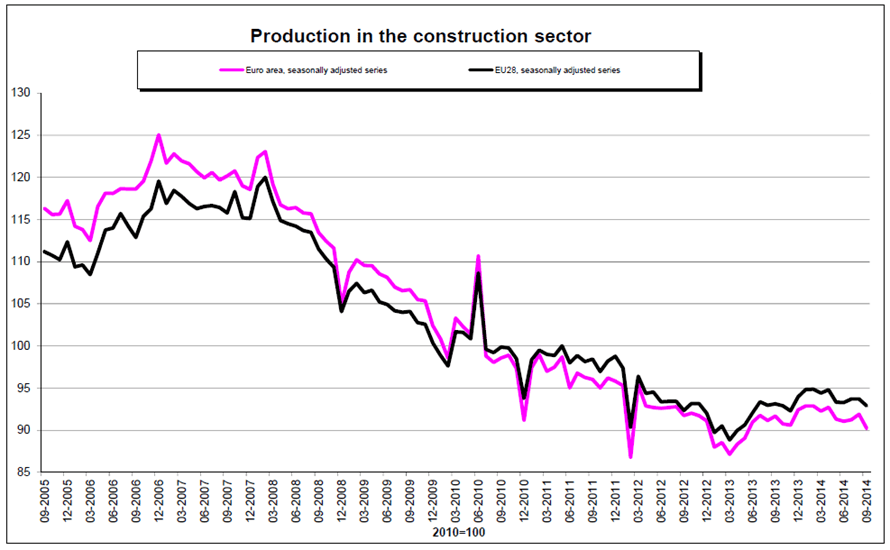
Terrible trend: last 5 months, construction activity dropped at a 7% annualized rate. Germany: –7.5%, Italy –10.8%, France –3.6%.
BOJ Stays Upbeat The Bank of Japan maintained its easing policy and upbeat view of the economy despite dismal growth figures that prompted Prime Minister Abe to delay a tax increase and call early elections.
“The Japanese economy has continued to recover moderately as a trend,” the central bank said in a statement, suggesting that it feels the economy had weathered the downturn sparked by a tax increase that took effect in April. That contrasts with Mr. Abe’s judgment that the economy isn’t strong enough to withstand another increase in the consumption tax that was planned for next year. (…)
The BOJ didn’t make any changes to its basic assessment of the economy, but it slightly upgraded it view of some aspects of the economy, including exports and housing investment.
Exports were now mostly “flat,” while the BOJ had previously said they were “weak.” It also brightened its language on housing, which took a sharp downturn after the tax hike, noting that “signs of bottoming out have been observed recently.” (…)
Interest-Rate Cuts Loom Across Asia
Consumer-price rises are moderating almost everywhere as the cost of oil and commodities like rice, soybean and sugar drop sharply. While prices are falling partly because of abundant global supply, China’s slowing growth is also having a knock-on effect across Asia, reducing demand for the region’s exports. (…)

Countries such as South Korea, India and China could reduce rates next year to take advantage of low inflation, said Deutsche Bank economist Taimur Baig, adding, however, that central banks will be cautious. Pushing rates too low could lead global investors to yank money out of Asian assets, especially if U.S. interest rates begin to rise in 2015.
A few Asian countries, in contrast, have to remain vigilant to keep inflation under control. Indonesia on Tuesday increased its benchmark rate by 0.25 percentage point to 7.75%. Indonesia is one of the few places in the region where inflation is poised to accelerate—likely to 7.5% in December from under 5% last month—after President Joko Widodo’s administration Tuesday raised government-controlled fuel prices. Economists have long called for the move, which frees up government money spent on fuel subsidies for infrastructure or social spending. (…)
With inflation stuck below 2%, the Bank of Korea reduced interest rates last month after an earlier cut in August. Many economists believe another cut is in store early next year.
In Vietnam, inflation is expected to remain below 5% in 2014, its lowest level in decades.(…)
And in India, which has long tried to rein in inflation, consumer prices in October rose at 5.5% on year, down from double digits a year ago and the slowest pace since the consumer-price series was introduced in 2012. (…)
Total debt stood at over 200% of the region’s gross domestic product in 2013, up from 147% in 2007, according to Morgan Stanley. (…)
Sales Projections Are Dropping, and It’s Not Just Oil Third-quarter earnings season is essentially over. Once again, a familiar pattern has played out: Growth on the bottom line is good enough to mask weakness on the top line. But if one crop of estimates for upcoming quarters is accurate, revenue growth is going to get even weaker, and ignoring it is going to get harder to do in 2015.
(…) Third-quarter earnings are typical: with about 95% of the S&P 500 companies reporting, EPS growth is about 8.1%, according to FactSet Research. Sales growth is 4%. Expectations are lower for the fourth quarter: only 4% EPS growth and 1.9% sales growth.
The well-dissected travails of the oil industry are playing a part in this, but that’s not the whole story, as Nicholas Colas, the chief market strategist at brokerage ConvergEx, found out when he dove into the forecasts for the 30 stocks that comprise the Dow Jones Industrial Average. Analysts expect sales for the DJIA components in the fourth-quarter will actually fall 0.1%. A month ago, that was a gain of 1.5%. In August, it was 3%.
“The chief culprit for these reduced expectations isn’t hard to find,” he wrote. Just look at the index’s two energy names: revenue for Exxon Mobil and Chevron are expected to be down about 13% from a year ago. But even apart from those two, expectations are still low. “Only seven of the 30 Dow names show positive revenue momentum – rising analyst expectations,” he said. The rest are either flat or down.
The same dynamic plays out for the balance of 2015, he pointed out. For the first quarter, for example, expectations are for sales growth of 2.8%. A month ago, that number was 4%. For the second quarter, the projection is for 0.9% sales growth; a month ago, that number was 2%. “In short, there’s no mistake here: revenue expectations are coming down quickly.”
Now, for the past five years, trends like this have not halted the bull market, he noted, and he doubts this latest weakness will, either. “Corporations facing slack end markets focused on efficiency and cost containment to maximize profitability. Investors are accustomed to that dynamic and as long as companies can eke out marginal improvements to earnings per share they seem happy enough.” But can that last forever? (…)
Russia Sells Less Than 10% of Bonds Offered at First Auction in Six Weeks
Russia sold less than 10 percent of the amount offered in its first debt auction in six weeks, as investors baulked at committing funds amid intensifying conflict in Ukraine and a bear market in oil.
The Finance Ministry placed 491 million rubles ($10 million) of the securities due in May 2016 at a weighted-average yield of 10.06 percent, according to a statement on its website. The ministry was marketing 5 billion rubles and investors submitted bids for 2.16 billion rubles. It last sold similar-maturity debt in January at 6.67 percent.
Firms With CEOs Who Play More Golf Tend To Underperform: Study
Academics Lee Bickerstaff (Miami University), David C. Cicero (Univ. of Alabama) and Andy Puckett (Univ. of Tennessee, Knoxville) analyzed data from a variety of sources to demonstrate that “CEOs that golf frequently (i.e., those in the top quartile of golf play, who play at least 22 rounds per year) are associated with firms that have lower operating performance and firm values.
This relationship probably holds for money managers as well. Maybe for Presidents too.
China and Russia vow to build alliance Pledge to strengthen military ties to counter US influence in Asia
(…) “Our co-operation in the military spheres has great potential and the Russian side is ready to develop it across the broadest possible spectrum of areas,” Mr Shoigu said. “We see the formation of a collective regional-security system as the primary objective of our joint efforts.” (…)
Russia’s deputy defence minister, Anatoly Antonov, even seemed to suggest Russia would be willing to help Beijing tackle the peaceful protests in Hong Kong.
“We have taken note of the events that recently took place in Hong Kong and the two ministers acknowledged that not a single country can feel insured against colour revolutions,” Mr Antonov said, according to Russian state media. “We believe that Russia and China should work together to oppose this new challenge to our states’ security.”
The two sides agreed to hold joint naval exercises, their fourth in recent years, in the Mediterranean next spring, followed by further naval exercises in the Pacific.
As fighting intensifies in eastern Ukraine and Russia’s neighbours fret over Moscow’s rising belligerence, Beijing has described Sino-Russian relations as the best they have ever been.
The current situation in Europe prompted former Soviet leader Mikhail Gorbachev to warn last week that the world was on the brink of a new cold war, a sentiment echoed by Belarusian officials on Tuesday. (…)
But both sides remain wary of getting too close and have trouble overcoming a long history of mutual mistrust and contempt, according to Chinese and western experts who monitor the relationship.
For all the talk of closer military ties and joint exercises, Russia has so far refused to sell its most advanced military technology, including jet engines and fighters, to China. (…)
$1m per urinal How the art market has lost its bearings
Among the many records set at Christie’s astonishing $852.9m contemporary art sale in New York last week, one has gone strangely unreported: the highest price ever paid for a urinal.
Robert Gober’s 1988 installation Three Urinals sold for $3.52m, which works out at just over $1m per urinal. They do not actually work – that is, they only take the proverbial in a figurative sense. But this is a good thing, for according to Christie’s their “smooth contours invite the viewer’s touch”, and hand sanitiser was not included in the price.
That a urinal by an artist you have probably never heard of is worth more than a masterpiece by one you have (a Gober urinal will buy you a fine Rubens) is down to the unique way in which the contemporary art world functions. There, the merit of works such as Gober’s is not judged in any traditional and objective artistic sense, but by value.
Expensive, say the experts, equals good. After all, Three Urinals is indistinguishable from three actual urinals except by virtue of its price, and several paragraphs of impenetrable art-speak in a catalogue. And if Gober’s urinals are worth $3.5m, then one of his sinks (he does a whole range of toilet ware) must also be worth millions.
In other words, we have collectively lost the ability to assess art for ourselves and on its own merits. Instead, we follow such indicators as fashion, price, and, in this case, hype. You may say it was ever thus. But the result today, when allied with an ever wealthier elite for whom buying contemporary art has become a form of conspicuous consumption, is an unprecedented art boom. Can it last?
(…) The only requirement is that works keep edging up in value.
And if they do not? Well do not worry, for the market has developed ways to help make sure the numbers go up – or at least appear to.
Two examples. First, if you are a dealer representing one of the relatively small number of artists who matter, you can bid (anonymously) on their works yourself, to register new “values”. You may have to buy some works back, but in a world where the only thing that matters is the most recent price, paying an auctioneer’s commission is merely marketing.
 The second is the guarantor purchase. A guarantor is someone who agrees a certain (undisclosed) price for a work before a sale, and makes a profit if it sells for more. To liven things up, they are allowed to bid the work up during the sale too. But if they happen to buy it, their presale negotiation (again, undisclosed) means they will not pay anything like the “price” reported by the auction house, and nor will the new “value” of the work be representative. Almost half of the lots in Christie’s sale last week were guaranteed. (…)
Momentum investing in a rigged market! Too much money around.

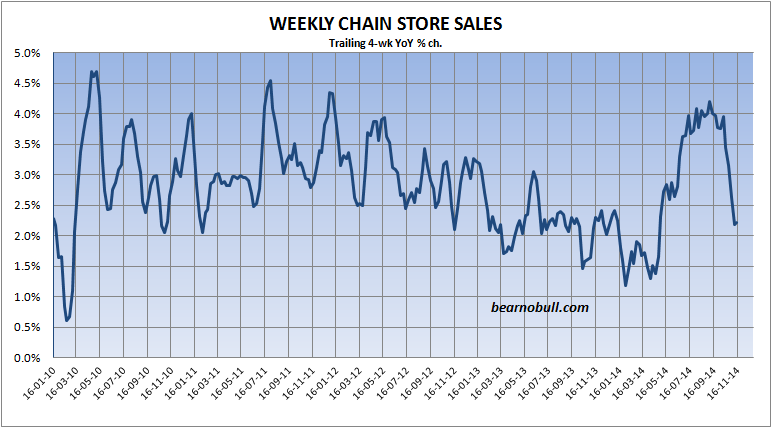
 If not, it will be the worst Christmas for retail margins…FYI, real retail sales were up only 2% YoY during Christmas 1996 and 1997. Sales were pretty strong in 1999 but cratered in 2000. Christmas 2004 was good but 2006 was pretty weak. Don’t hang your hat on this “indicator”.