Today: U.S. employment. China. Currencies. Earnings. The BOJ.
Job Gains Belie Economic Unease The U.S. labor market in October reached its longest stretch of job creation since at least World War II, a run at odds with a slow pickup in wages and voter discontent with the economy.
(…) U.S. employers, which added 214,000 jobs to payrolls last month, are on pace to post the best yearly gain in employment since 1999. The steady job growth has pushed the nation’s unemployment rate down to 5.8% last month, closer to a level many economists consider healthy. It also suggests U.S. businesses are largely shrugging off mounting worries about overseas growth that contributed to market tumult in the first half of last month.

(…) the Labor Department revised up August and September payrolls by 31,000 extra jobs. Thanks to those do-overs, the monthly change in nonfarm payrolls has been above 200,000 jobs for nine consecutive months. The 12-month moving average is holding above 220,000 new jobs per month, a large improvement from previous years.

Average hourly earnings for private-sector workers rose 2% in October compared with a year earlier. That’s in line with gains recorded for most of the year and barely above the mild pace of inflation. But the number of hours Americans are working is rising, and that’s helping boost incomes. Average weekly earnings advanced 2.6% from a year earlier, the best 12-month increase since January 2012. (…)


The share of Americans who are working rose to 59.2% in October, up a full percentage point from a year earlier. That marks an upward trend for a reading that’s largely held flat since the recession. (…)
BTW, the gain were broad based in spite of what Zerohedge clamors: the diffusion index rose to 62.3% in October.
Furthermore, David Rosenberg calculates that his composite of Janet Yellen’s labor market dashboard “is now at its best reading since October 2008 and indicates that aggregate job market conditions based on the dashboard indicators are 0.6 standard deviations below “mean” levels”. Which may well explain this warning:
-
Fed Warns of Market Volatility Federal Reserve officials are warning investors and foreign central bankers to brace for market turbulence as the Fed prepares to raise short-term interest rates next year.
In a speech to central bankers Friday in Paris, Fed Chairwoman Janet Yellen said rate increases, when they materialize in advanced economies, “could lead to some heightened financial volatility.” New York Fed President William Dudley, at the same conference, issued a more detailed alert.
“This shift in policy will undoubtedly be accompanied by some degree of market turbulence,” he said of future rate increases in the U.S. “Moreover, it could create significant challenges for those emerging market economies that have been the beneficiaries of large capital inflows in recent years.”
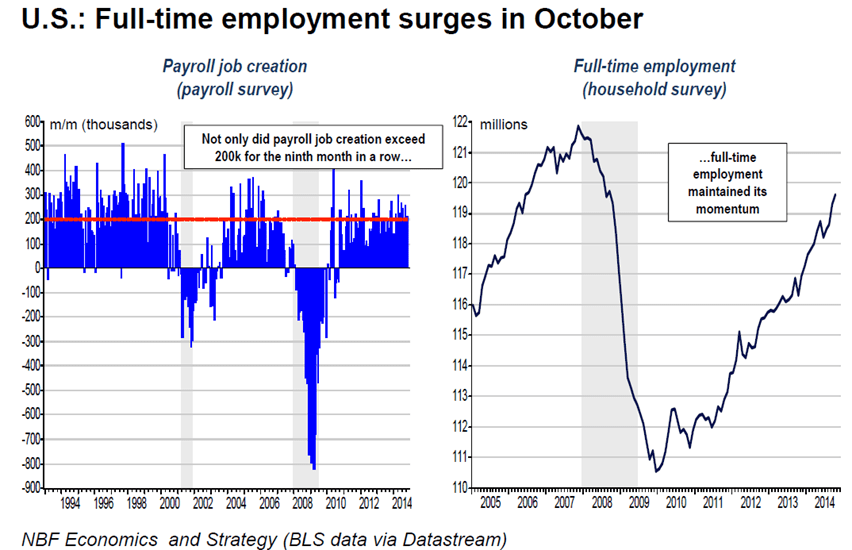
U.S.: Full-time employment surges in October
Released at the same time, the household survey, which surveys households as opposed to establishments, showed a gain of 683K jobs. The household employment report was much better than expected not just because of the size of the gains (the biggest monthly increase this year), but also because of full-time employment which has now risen by over a million in the last two months. As today’s Hot Charts show, full-time employment still remains below its pre-recession peak, but it is moving fast in that direction. That bodes well for consumption spending and homeownership in the coming quarters. (NBF)
Speaking of home ownership, employment growth for the younger generation has exploded in the past year. The YoY growth rate has risen from +1.4% YoY in the last 4 months of 2013 to +2.8% during the last 3 months and +3.2% in October. Last 3 months annualized: +4.0%.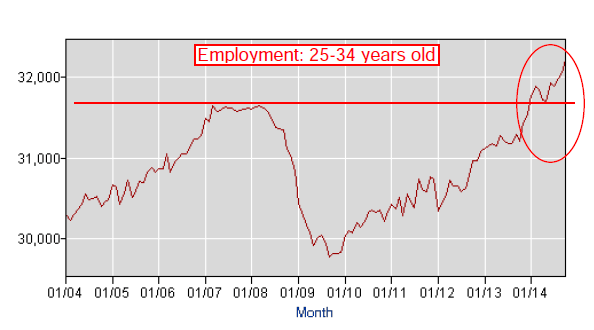
China Factory-Gate Prices Decline for Record 32nd Month
The producer-price index dropped 2.2 percent from a year earlier, the National Bureau of Statistics said in Beijing today, compared with the median projection of a 2 percent decline in a survey of analysts by Bloomberg News. Consumer prices rose 1.6 percent and the rate was unchanged from the prior month and matched economists’ estimates.
China Regions Show Economies Differ as Slowdown Deepens
Of China’s 31 provinces and municipalities, 19 recorded a slowdown, three posted the same pace and nine saw a pickup in the January-September growth rate from the first half, according to Bloomberg calculations of data released by the governments or state media. All are missing their own expansion targets.
Provincial outcomes are diverging as the economy heads for the slowest full-year expansion since 1990. While the industrialized northeast is bearing the brunt of a real estate collapse, some inland provinces are still boasting the heady growth rates of old, boosted by infrastructure investment. (…)
China Should Sit Out Asia’s Race to the Bottom
(…) The yen has tumbled toward a seven-year low against the dollar. Fearing a loss of competitiveness, regional rivals are starting to respond.
The Bank of Korea has taken rates down to the record 2 percent low seen in the depths of the financial crisis in 2009 and 2010. Bank of Korea Governor Lee Ju Yeol has said they are “not doing nothing” on the weak yen. The won has fallen 7.1 percent since August’s end.
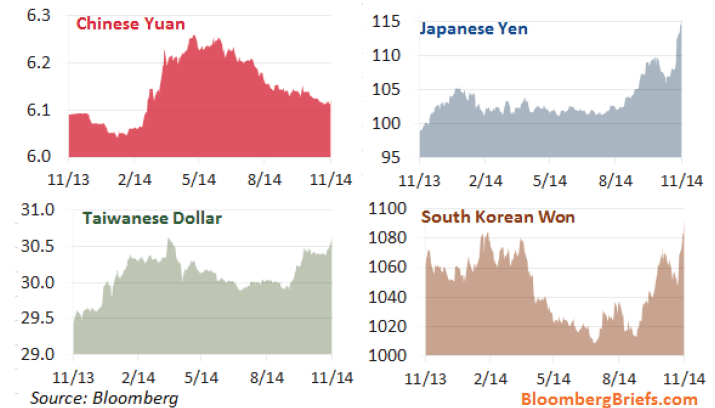
The big question for the region is whether China will join the race down. At first sight, the argument looks straightforward. Rate cuts would lower the cost of credit and push down the yuan — boosting investment at home and demand for Chinese products abroad. In fact, given costs as well as benefits to accelerated easing, China is more likely to hold the line on its existing policy.
China’s growth and employment are on track. GDP expanded 7.4 percent year on year in the first three quarters. That is basically in line with Premier Li Keqiang’s
target of growth “about 7.5 percent” for the year. The latest signs from the crucial real-estate sector are positive, with sales up in October. Labor markets remain
tight. It’s possible that a rate cut and weaker yuan would add to, rather than ease, the downward pressure. Lower bank deposit rates would encourage savers to shift into higher-yielding wealth management products. A weaker yuan would encourage funds to head offshore. In both cases, the result would be fewer funds for
banks to lend.A cut in interest rates would also push the government in the wrong direction on its bigger strategic objectives. Already swollen bank assets would swell even
further. Corporates would add to their pile of debt. More investment would add to overcapacity in industry and towers of unsold apartments.Not all the arguments point in the same direction. Oil prices have tumbled 17 percent in the last year. China cushions the pass-through of international oil prices
to domestic inflation by regulating gasoline prices. Still, lower oil prices mean a less inflationary environment and more room to cut rates.For now, though, with growth on track and costs as well as benefits from lower rates and a weaker yuan, Asia’s race to the bottom is one contest China can afford not to win.
Rear view mirror analysis. Things have changed for the worst lately in Europe, Russia, the Middle East and Africa. Japan’s devaluation drive is forcing all Asian countries to react.
Russia Says Sanctions Hurting as Bank Moves to Protect Ruble Russia’s financial guardians made their broadest acknowledgment yet that sanctions are sinking the economy, as the central bank moved to protect the ruble after the currency’s worst week in more than a decade.
The Bank of Russia said in Moscow today that gross domestic product will probably stagnate in 2015, highlighting the damage wrought by a slump in oil prices and international measures linked to the conflict in Ukraine. Governor Elvira Nabiullina said the ruble’s slide has gone too far and pledged to limit local-currency funding to ward off speculators. (…)
Forecasting that sanctions will last through 2017 and oil will average $95 a barrel, the Bank of Russia cut growth in its main 2015 view to zero and pushed back its medium-term inflation target of 4 percent by one year from 2016, according to the revised three-year monetary policy plan that it published today. (…)
Kuwait Oil Minister Sees No OPEC Output Cut at Next Meeting
(…) “I don’t think there will be any cut in the production,” Al-Omair said at a conference in Abu Dhabi in the United Arab Emirates. “We feel prices will settle down once surplus oil is absorbed.” (…)
Kuwait has no plans to cut its own crude production, which should increase to 4 million barrels from a current by 2020, Al-Omair said. Kuwait produced 2.85 million barrels a day in October, according to data compiled by Bloomberg. (…)
Wolfgang Münchau The euro is in greater peril than ever
(…) Today the eurozone has no mechanism to defend itself against a drawn-out depression. And, unlike two years ago, policy makers have no appetite to create such a mechanism.
(…) The main protagonists today are not international investors, but insurrectional electorates more likely to vote for a new generation of leaders and more willing to support regional independence movements.
In France Marine Le Pen, the leader of the National Front, could expect to win a straight run-off with President François Hollande. Beppe Grillo, the leader of the Five Star Movement in Italy, is the only credible alternative to Matteo Renzi, the incumbent prime minister. Both Ms Le Pen and Mr Grillo want their countries to leave the eurozone. In Greece, Alexis Tsipras and his Syriza party lead the polls. So does Podemos in Spain, with its formidable young leader Pablo Iglesias.
The question for voters in the crisis-hit countries is at which point does it become rational to leave the eurozone? They might conclude that it is not the case now; they might oppose a break-up for political reasons. Their judgment is prone to shift over time. I doubt it is becoming more favourable as the economy sinks deeper into depression.
Unlike two years ago, we now have a clearer idea about the long-term policy response. Austerity is here to stay. Fiscal policy will continue to contract as member states fulfil their obligations under new European fiscal rules. Germany’s “stimulus programme”, announced last week, is as good as it gets: 0.1 per cent of gross domestic product in extra spending, not starting until 2016. Enjoy!
What about monetary policy? Mario Draghi said he expected the balance sheet of the European Central Bank to increase by about €1tn. The president of the ECB did not set this number as a formal target, but as an expectation – whatever that means. The most optimistic interpretation is that this implies a small programme of quantitative easing (purchases of government debt). A more pessimistic view is that nothing will happen and that the ECB will miss the €1tn just as it keeps on missing its inflation target. My expectation is that the ECB will meet the number – and that it will not make much difference.
And what about structural reforms? We should not overestimate their effect. Germany’s much-praised welfare and labour reforms made it more competitive against other eurozone countries. But they did not increase domestic demand. Applied to the eurozone as a whole, their effect would be even smaller as not everybody can become simultaneously more competitive against one another.
Two months ago Mr Draghi suggested the eurozone fire in three directions simultaneously – looser monetary policies, an increase in public sector investments and structural reforms. I called this the economic equivalent of carpet-bombing. The response looks more like an economic equivalent of the Charge of the Light Brigade.
These serial disappointments do not tell us conclusively that the eurozone will fail. But they tell us that secular stagnation is very probable. For me, that constitutes the true metric of failure.
Big Banks Told to Hold Large Capital Cushions The world’s largest banks will have to hold 16-20% of their risk-weighted assets in equity and cancelable debt to shield taxpayers from big bills for bailing out failed banks during a crisis, according to a plan by global regulators.
(…) By implementing the proposed rule, alongside another one brokered in September that prevents derivative contracts being disruptively terminated if a systemic bank is being wound down, “we will move to a world where the largest, most complex banks can be resolved without the need for taxpayer support and without disruption to the wider system,” Mr. Carney said at a news conference in Basel, Switzerland.
Under the plan, the minimum so-called total loss absorption capacity, or TLAC, of the world’s top 30 banks should be between 16% to 20% of their assets weighted according to risk.
It should also be at least twice the Basel leverage requirement—the ratio of capital held by a bank against its total assets. If the leverage ratio is 3%, therefore, systemically important banks would have to hold at least 6% of their total assets as capital.
Instruments that will count toward TLAC include common equity Tier 1 capital—the highest-quality capital buffer banks keep to absorb losses on their assets. Eligible instruments should have at least one year of remaining maturity, according to the plan, while derivatives products, tax liabilities or insured deposits can’t count toward the minimum standard.
The FSB said the proposed minimum, however, doesn’t include equity used to make up other “regulatory applicable capital buffers”—the additional buffers certain systemically important banks need to hold.
This means large lenders may end up having to hold about 21% to 25% of their risk-weighted assets in instruments that can be “bailed in,” according to the proposal.
Meanwhile, to reduce the likelihood that the process of dealing with a major failing bank would harm the global banking system, the FSB said, it will be important to discourage large, international banks from holding instruments from other banks that can be bailed in if there is a crisis.
Under the proposed rules, significant subsidiaries in a broader banking group would have to “preposition” debt equivalent to 75-90% of the TLAC they would need to hold on a stand-alone basis.
This will likely help systemic banks based in emerging markets, such as China, which won’t initially be subject to the TLAC requirement, as it “levels the playing field appropriately” Mr. Carney said.
The plans were published ahead of a summit meeting of leaders of the Group of 20 major economies in Brisbane, Australia, this week and will be open for comment until February 2015. The FSB will undertake assessments to examine how the proposed plan will affect the financial system and the global economy. It aims to finalize the proposal by the next time G-20 leaders meet in 2015.
Banks will have to implement the rule by 2019 at the earliest.
EARNINGS WATCH
Revenue Softness Worries Investors As investors pore over third-quarter earnings reports, they are finding signs of corporate malaise, such as weak sales, that are raising concerns about the outlook for U.S. stocks.
While profit gains have generally been solid, many blue-chip companies are posting weak sales growth or outright year-over-year revenue declines, causing worries about their long-term growth prospects. Others are reporting earnings increases driven by factors that don’t reflect sustainable improvements in their business, such as share buybacks and cost-cutting efforts. (…)

Earnings for companies in the S&P 500 are on track to climb 7.7% in the third quarter from a year earlier, the sharpest year-over-year rise in any quarter so far this year, according to FactSet. (…)
Profit margins for the S&P 500 have grown to record levels, coming in at 10.1% of sales in the third quarter, according to FactSet. (…)
Revenue at S&P 500 companies is on track to grow 3.8% from a year earlier in the third quarter, down from 4.4% in the second and below the 4.8% average of the last five years, according to FactSet. Investors are left wondering how much deeper companies can cut and still wring out further expansion in earnings. (…)
Meanwhile, companies are contending with a stronger dollar and the slowdown in Europe and in once-booming economies like China and Brazil.
Companies in the S&P 500 derive almost one-third of their revenue from overseas, a figure that has grown steadily for the past 10 years, according to Mr. Glionna.
Troubles for some blue chips are already emerging. Coca-Cola Co. , which derived 58% of its net operating revenue from outside the U.S. in 2013, said third-quarter profit fell 14% and warned it will miss its profit target this year and in 2015. The company said economic weakness in Japan, Europe and emerging markets weighed on its results. (…)
Procter & Gamble Co. said Oct. 24 that its fiscal first-quarter profit fell 34% to $2 billion on flat sales of $20.8 billion. The company, which derived about 65% of sales from outside the U.S. in its last fiscal year, also cut its sales forecast and said it expected problems from the strengthening dollar. (…)
In the third quarter, buybacks have boosted earnings per share at S&P 500 companies by 2.35%, the highest level in more than two years, according to Barclays. (…)
Earnings outlook might be less rosy than investors think With the U.S. third-quarter earnings season almost at an end, many investors are breathing a sigh of relief as more companies surpassed profit expectations than in any quarter since 2010.
(…) Earnings growth for the fourth quarter now is estimated at 7.6 percent compared with an Oct. 1 forecast for 11.1 percent growth, Thomson Reuters data showed. For the 2015 first quarter, profit growth is seen at 8.8 percent, down from an Oct. 1 forecast for 11.5 percent growth.
Moreover, the magnitude by which fourth-quarter estimates are falling has increased compared with the previous quarter, said Nick Raich, chief executive officer of The Earnings Scout, a Cleveland-based independent research firm specializing in earnings trends.
In outlooks given by companies themselves – done by only a minority of companies – the news is not good. Negative outlooks outnumber positive ones for the fourth quarter so far by a ratio of 3.9 to 1, up from the third quarter’s ratio of 3.3 to 1, Thomson Reuters data showed. (…)
Here’s Factset’s actual data (which may vary from what you have read before) and its always thorough analysis:
With 89% of the companies in the S&P 500 reporting actual results for Q3 to date, the percentages of companies reporting actual EPS above estimates (77%) and actual sales above estimates (60%) are above historical averages.
In aggregate, companies are reporting earnings that are 4.6% above expectations. This surprise percentage is above the 1-year (+3.6%) average, but below the 5-year (+5.9%) average.
As a result of the upside earnings surprises, the year-over-year blended (combines actual results and estimated results) earnings growth rate for Q3 2014 has improved to 7.6% today relative to an expectation of 4.5% at the end of the quarter (September 30).
The year-over-year blended sales growth rate for Q3 2014 of 4.0% is slightly above the estimate of 3.8% at the end of the quarter.
Looking at forward estimates, analysts have cut estimates for Q4 2014, Q1 2015, and Q2 2015. For Q4 2014, Q1 2015, and Q2 2015, analysts are currently predicting earnings growth rates of 4.5%, 6.6%, and 8.0%, respectively. These earnings growth rates are well below the estimated growth rates of 8.4%, 9.6%, and 10.6% for these same three quarters back on September 30.
Analysts have also cut revenue estimates during the first month of the fourth quarter as well. For Q4 2014, Q1 2015, and Q2 2015, analysts are currently predicting revenue growth rates of 2.3%, 2.7%, and 2.3%. These revenue growth rates are also well below the estimated growth rates of 3.8%, 4.4%, and 3.6% for these same three quarters back on September 30.
Companies are also lowering expectations for the fourth quarter, as 55 companies in the index have issued negative EPS guidance for Q4, while 18 companies have issued positive EPS guidance.
But don’t fret too much about negative guidance; at this time last year, 86% of the 85 companies that had pre-announced were negative. This year, 75% of the 73 preannouncements were negative, a ratio in line with that of the previous 2 quarters.
What I find more worrisome is analysts revisions for Q4 earnings bringing total EPS growth from +8.4% to a low +4.5% as per Factset calculations, including estimates of +34% for Telecoms and +17% for Health Care. Excluding these two sectors, only Industrials (+8.5%) look to have solid growth in Q4. The other 7 sectors are expected to average zero growth in Q4. This is very poor breadth for a market selling at historically high multiples.
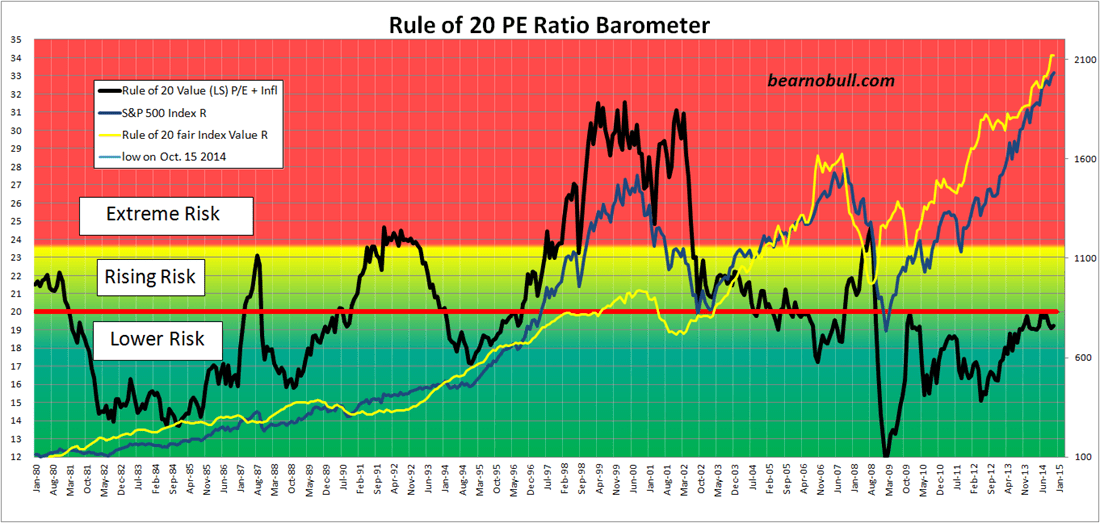
According to S&P, Q4 EPS are now estimated at $31.13, down 3.4% from September 30th and likely to come down some more, especially for energy and other commodity-sensitive companies but also, in my view, for industrial companies sensitive to export markets and to the automotive sector. Ward’s is now forecasting that U.S. vehicle production will decline at a 13.1% annual rate in Q4.
After The Jobs Report, the Investing Climate May Be Better Than Investors Think The jobs report was soft, with weaker wage growth and fewer jobs created in October than economists expected. For investors, however, the report was more positive than negative.
(…) For investors, however, the report was more positive than negative. It showed that wage gains still aren’t big enough to push inflation higher. Instead, the investing backdrop continues to be one of low inflation, moderate economic growth and low interest rates, all good for financial markets. It means the Federal Reserve can take its time raising rates next year. (…)
Even so, the fear on Friday was that soft wage gains and weak consumer spending could hurt some companies’ profits. With stock prices high, a problem with consumer spending would be bad news for the market. (…)
Heavy shelling renews Ukraine war fears Russia accused of supplying rebels with heavy weaponry
 How BOJ’s Kuroda Won Stimulus Japan’s central bank wasn’t planning to make policy changes at its Oct. 31 meeting, but as forecasts showed the economy slipping back toward deflation, Gov. Haruhiko Kuroda won a narrow vote to expand the bank’s stimulus program.
The main purpose of the Bank of Japan policy board meeting Oct. 31 was supposed to be updating economic forecasts, not making policy changes.
But as board members submitted their forecasts, an alarming pattern emerged, according to people familiar with the BOJ’s thinking. Members were marking down their price projections, with at least one seeing inflation slipping below a 1% annual rate for the fiscal year starting next April.
Japan was headed a step back toward the deflationary environment the central bank had pledged to eradicate—and worse, it would have to admit so publicly.
Gov. Haruhiko Kuroda, who had said for months that his plan to create 2% inflation was on track, now floated shortly before the meeting an audacious proposal: The Bank of Japan should expand the inflation-boosting package it initially launched in April 2013 by as much as one-third. Mr. Kuroda hoped to prompt new, more upbeat, forecasts that would reflect the mammoth cash infusion into the economy.
Staffers worked past midnight to craft a formal proposal. As the meeting opened in the eighth-floor conference room at 9 a.m. that Friday, Mr. Kuroda’s backers were hopeful he had the votes but nervous he might become the first BOJ governor in history to lose a vote. What followed was a wide-ranging debate that at times turned heated, according to people familiar with the central bank’s thinking, over the wisdom of moving so much, so quickly.
More than three hours later, a BOJ staffer circulated a tally sheet around the table, with each member signing his or her name under the support or opposition column. With the rest of the board split evenly, four to four, Mr. Kuroda cast the deciding vote in favor. New, updated forecasts were then ratified, with the price outlook nudged up a bit, allowing Mr. Kuroda to make a plausible case, when he met the press two hours later, that his price target was still within reach.
A dissection of the move, based on interviews with people familiar with the central bank’s deliberations, provides fresh insight into Mr. Kuroda’s strategy. He is determined to be pre-emptive—attempting to move ahead of any possible slip in the public’s expectations for inflation and any market expectations of fresh action.
That marks a sharp contrast with his predecessors, who often fell behind the curve. Helped by the element of surprise, the Oct. 31 actions pushed up Japanese stock prices almost 8% and lifted global markets. (…)
 ECB Unites Over Deflation Threat
 The central bank’s policy makers are unanimous in their readiness to back more stimulus if needed, ECB President
  Wait, wait. Later in the article:
  While bullish sentiment is at a lofty level, the decline in bearish sentiment was even more extreme. In the latest week, bearish sentiment dropped from 21.07% down to 15.05%. This is the lowest level of bearish sentiment in the entire bull market, and just the 10th time bearish sentiment dropped below 20%.