The enemy of knowledge is not ignorance, it’s the illusion of knowledge (Stephen Hawking)

It ain’t what you don’t know that gets you into trouble. It’s what you know for sure that just ain’t so (Mark Twain)

Invest with smart knowledge and objective odds

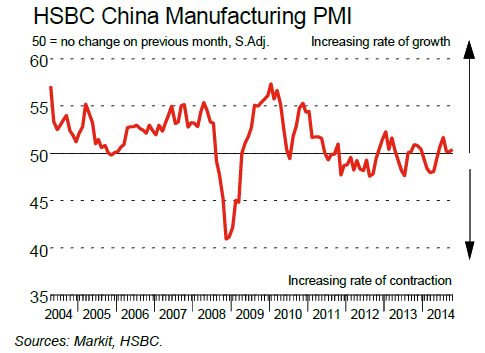
CHINA MANUFACTURING PMI AT 50.4

Chinese manufacturers again signalled only a fractional improvement in overall operating conditions in October. Output and new business both expanded at the slowest rates in five months, while new export order growth weakened from September’s recent peak to a modest pace. Relatively subdued market conditions led to a further reduction of staff numbers in October, while backlogs of work rose modestly. Meanwhile, average input costs and prices charged both declined at the
fastest rates since March.

After adjusting for seasonal factors, the HSBC Purchasing Managers’ Index™ (PMI™) posted at 50.4 in October, unchanged from the earlier flash reading. This was up slightly from 50.2 in September to a three-month high, but nonetheless continued to signal only a fractional improvement in the health of the sector.
image

Manufacturing output in China continued to increase in October, albeit at the weakest rate in the current five month sequence of growth. Where higher output was
noted, this was generally attributed to increased new order volumes. That said, the latter also expanded at the slowest rate in five months. Growth of new business
from abroad meanwhile slowed from September’s four-and- a-half year high to a moderate pace. Higher new export business was generally attributed by panellists to stronger client demand across a number of key export markets, though other firms cited relatively subdued market conditions.

Staffing levels were cut for the twelfth successive month in October, albeit at the slowest rate since July. Meanwhile, the level of work-in-hand rose at a moderate pace, with a number of panellists attributing the increase to sustained new order growth.

Purchasing activity increased across China’s manufacturing sector in October, as has been the case since May. That said, the rate of growth eased to a marginal pace that was the weakest in five months.

Stocks of inputs were meanwhile depleted for the third month in a row, amid reports of ongoing inventory adjustments. In contrast, stocks of finished goods rose for the first time in six months, albeit fractionally. Average cost burdens declined at the quickest rate since March in October, amid reports of lower prices for raw materials. Prices charged by manufacturing companies also declined markedly in October, which was partly attributed to attempts to gain new business.

The official version:

China’s official Manufacturing Purchasing Managers’ Index dropped to 50.8 in October from 51.1 in September, according to the China Federation of Logistics and Purchasing, which issues the data with the National Bureau of Statistics.

The latest manufacturing data showed almost across-the-board weakness and pointed to further problems ahead. The new orders subindex slipped to 51.6 in October from 52.2 in September, while the new export orders subindex dropped to 49.9 from 50.2. The subindex measuring production fell to 53.1 from 53.6, while employment was slightly improved, though still in contraction territory, at 48.4 against 48.2.

Zhao Qinghe of the National Bureau of Statistics said smaller companies were still facing difficulties amid the slower expansion and that “looking ahead there is a need for stepped up targeted measures.”
EUROZONE MANUFACTURING PMI NEAR STAGNATION

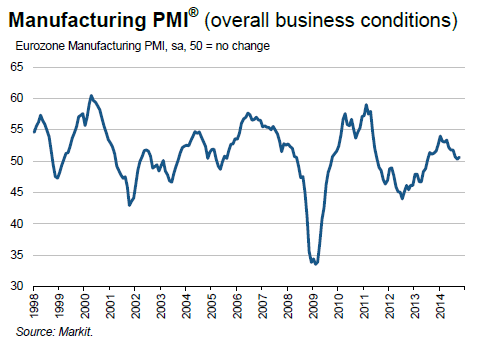
The eurozone manufacturing sector remained in a state of near-stagnation in October, as weak demand continued to restrict growth of both output and employment across the currency union. At 50.6 in October, up from September’s 14-month low of 50.3, the final seasonally adjusted Markit Eurozone Manufacturing PMI® registered only marginally above the neutral 50.0 mark. That said, the current sequence above the no-change level was extended to 16 months.

image

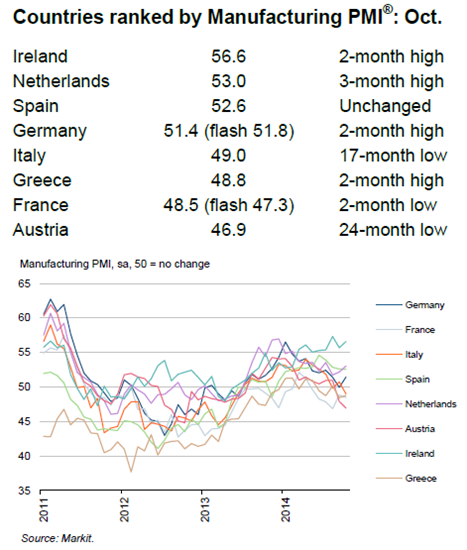
National PMI data again highlighted the ongoing performance disparities between countries. Four nations signalled expansion during October, with the Irish PMI remaining far out in front and ticking higher following a slight easing in September. The PMI for the Netherlands also gained, moving into second position, while the Spanish PMI held steady.

Germany was the only other nation to signal improved overall manufacturing performance in October. Of the remaining big-three nations, the downturn in France accelerated and Italy fell back into contraction. The rate of deterioration in Greece eased, while Austria fell further from the rest of the pack as its PMI sank to a two-year low.

The level of new orders at eurozone manufacturers declined for the second successive month in October, albeit to a slightly less marked degree than in the previous month. New orders fell in Germany, France, Italy, Austria and Greece, in contrast to the strong gains registered in Spain, the Netherlands and Ireland.
The weakness in overall new business inflows was mainly centred on domestic markets as new export orders* posted a modest gain.

The news from the external demand front was less than positive, however, as the latest increase was the slowest during the current 16-month sequence of growth. France and Austria both reported contractions in new export business. The remaining nations covered by the survey all reported increases, with solid growth in Spain, the Netherlands and Ireland, and comparatively modest expansions in Germany, Italy and Greece.

Manufacturing production rose for the sixteenth month running and at a slightly quicker pace than in September. Output growth rates accelerated in Germany, Spain, the Netherlands and Ireland. Production was scaled back further in France, Austria and Greece. Italy fell back into contraction following a 16-month sequence of growth.

October saw employment increase for the second month running. The pace of job creation remained near-stagnant, despite accelerating to a five-month high. The outlook for employment also remained muted, given the lacklustre trend in new orders and a further decrease in backlogs of work.

Payroll numbers in Germany and Ireland rose at the sharpest rates since January 2012 and May 2014 respectively. Slight gains were also signalled for Spain and the Netherlands. Job cuts were reported by France, Italy, Austria and Greece.

On the prices front, average input costs and output charges both declined in October. Lower purchase prices were often linked to reduced raw material costs and the decline in the price of oil. Lower output charges mainly reflected strong competition.

image