From Tokyo, where the typhoon will shortly hit “with much reduced strength” 
Disappointing industrial production trend points to deepening Italian recession
Data from ISTAT showed industrial production rising 0.3% in a bounce-back from a 1.0% decline in July. However, the improvement still left production running 0.6% lower in the third quarter so far compared to the second quarter. That leaves output on course for a second consecutive quarterly decline, following a 0.4% drop in the second quarter (and a flat first quarter).
Despite this rise in August, Italian industrial production is some 25.6% lower than its pre-recession peak, highlighting the severe damage done to the county’s productive capacity by the 2008 financial meltdown and ensuing debt crisis.
The industrial downturn therefore points to a deepening of Italy’s third recession since the financial crisis struck. GDP fell 0.1% in the first quarter and by 0.2% in the three months to June. These weak industrial production numbers, alongside a downturn in the PMI surveys, suggest GDP may have also fallen again in the third quarter.
It’s worth noting that the PMI had been more buoyant than the official GDP and industrial production data earlier in the year, notably so in the second quarter. This is likely to have been due to the official data being affected by an inadequacy of seasonal adjustment processes to fully account for an unusually high number of holidays in May and June. However, the concern is that the PMI is heading firmly down again from a recent peak seen in June. The PMI covering both manufacturing and services signalled a contraction for a second successive month in September, albeit only marginal, dropping to its lowest since last November.
China Central Bank Official: No Major Stimulus Needed in ‘Foreseeable Future’ The chief economist at China’s central bank said Saturday that he doesn’t see any reason for large-scale fiscal or monetary stimulus “in the foreseeable future” despite slowing growth in the world’s second-largest economy.
Speaking in Washington at a meeting of the Institute of International Finance, a financial-industry group, Ma Jun said the Chinese job market “looks pretty stable” despite wobbly economic growth. And, he said, leverage in certain sectors — including real estate, certain state-owned enterprises and local-government financing vehicles — was already too high, and that further lending to these areas should be avoided. (…)
China Trade Exceeds Expectations
(…) Exports rose 15.3% in September from a year earlier, according to data from the General Administration of Customs.
September’s export growth exceeded August’s 9.4% growth and was higher than the median forecast of 12.5% by The Wall Street Journal’s poll of 15 economists. China’s exports have been rising since April as the U.S. economy started to pick up, along with demand from parts of Asia and Europe.
Imports in September rose 7% from a year earlier, following a 2.4% decline in August. Economists were forecasting a drop of 2.4%. Increased imports saw China’s trade surplus narrow in September to $31 billion from $49.8 billion in August, which was below a median forecast for the surplus of $42 billion.
Customs spokesman Zheng Yuesheng attributed September’s strong exports to the government’s targeted support measures, reduced red tape and continued economic recovery abroad. (…)
China Set to Meet Growth Target
China will meet its growth target of around 7.5% this year helped by urbanization and economic restructuring, its central bank chief said.
However, a property market downturn, the government’s efforts to fight pollution and a slowing manufacturing sector are weighing on economic growth in the short term,Zhou Xiaochuan said in a statement released Monday on the central bank’s website. (…)
Premier Li Keqiang said last week that the government would tolerate a growth rate slightly below 7.5% and said the authorities plan to ramp up investment in projects such as water conservation and technology.
Mr. Zhou said since the country’s job market is stronger than expected and inflation remains at a relatively low level, the People’s Bank of China will continue with a prudent monetary policy, while pushing ahead with financial reforms and stepping up risk management. (…)
China’s state sector leaders embrace pay cuts ‘Supermanagers’ welcome move to cut their salaries by up to 60%
(…) According to local media reports, leaders of the country’s top 50 SOEs will face pay cuts of up to 60 per cent as the government imposes an annual pay cap of Rmb900,000. While President Xi Jinping first announced plans to rein in executive compensation in August, the new pay guidelines have not yet been released by the ministries of finance and human resources.
(…) “There is a large income gap in China that is having a negative impact on society. The salary gap between senior executives and average employees must be appropriate. If too small, it will lessen executives’ initiative. If too big, it will lead to social instability.”
According to a recent pay study co-authored by Mr Gao, senior executives at listed Chinese financial companies are paid 50 times as much as the average worker. (…)
OIL
Venezuela Seeks Emergency OPEC Meeting; Others See No Need
(…) Venezuela needs a price of $121 a barrel, according to Deutsche Bank, making it one of the highest break-even prices in OPEC.
But Iran, which needs $140 a barrel, according to analysts, said Tuesday that an emergency meeting wasn’t in the cards.
OPEC Members’ Rift Deepens A rift between OPEC members deepened over the weekend, as rival producers in the cartel moved in sharply different directions amid recently falling oil prices.
(…) Traders said Saudi Arabia is now asking for stronger commitments from some of its buyers in Europe, a move that would lock in those customers, including any new ones it would gain with recent price reductions.
Also on Sunday, Iraq’s State Oil Marketing Company cut the price of Basrah Light crude in November for Asian and European buyers by 65 cents to a discount of $3.15 a barrel below the Oman/Dubai benchmark for Asian customers and $5.40 below the Brent benchmark for European customers, according to official selling prices published by the company.
(…) on Sunday, Ali al-Omair, Kuwait’s oil minister, said there had been no invitation for such a meeting, suggesting the group would need to stomach lower prices. He said there was a natural floor to how low prices could fall—at about $76 to $77 per barrel—near what he said was the average production costs per barrel in Russia and the U.S.
“I don’t think there is a chance today that [OPEC] countries would reduce their production,” Mr. al-Omair said, according to the official Kuwait News Agency. A cut in OPEC production “may not necessarily boost prices” because of high output by other producers, he said. (…)
OIL PRICES: HOW LOW IS LOW?
Interesting and timely piece from Brian Hicks at U.S. Global Investors:
Looking at global oil demand, you can see it’s been unrelenting through recessions, through bull markets, bear markets, and it looks like it’s going to continue to go up at a fairly steady level based on latest data from the U.S. Energy Information Administration (EIA).
Below is a very important point to consider. Where oil prices are now, we’re getting to the area where production could be cut off because prices are not high enough to incentivize new development, new production and new drilling.
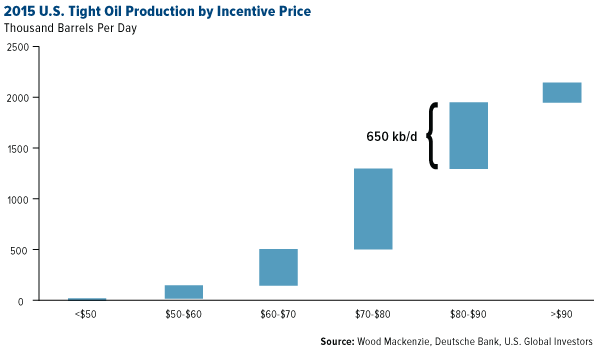
If you look at crude oil price somewhere in the area of $80 to $90, we have about 650,000 barrels per day of production that need to be supported at that particular level. So we really can’t go too much lower in terms of pricing. Otherwise, we would see a significant drop in the supply of oil.
Just to give you a sense of the scale here, we’re expected to grow demand by one million barrels per day, and we have 650,000 barrels that need an oil price north of $80.
Another significant factor is the price that’s necessary for countries that produce crude oil or export crude oil out of the Organization of the Petroleum Exporting Countries (OPEC) or non-OPEC.

On average, you need to see $95-per-barrel prices in order for these countries to balance their budgets-their fiscal budgets. What really sticks out is Russia and Saudi Arabia. They’re the two largest exporters of crude oil and, as you can see above, Russia requires an oil price north of $100, Saudi Arabia right at about $95 per barrel on a Brent basis, and we’re below that number now.
The next OPEC meeting is in November. I would be surprised if we did not see another production cut if oil prices remain at these levels. I think that OPEC and the Saudis need to come in and support prices even more so than they already have following the cut in August.
One area that’s been very topical and interesting as of late is the growth in U.S. crude oil production. It’s at a new 25-year high.

We’ve gone from basically 4.5 million barrels in 2008 to 8.5 million barrels. Energy stocks are no longer just the commodity play. They’re also a volume growth play.
You can see this paradigm shift in that many of these shale producers have gone out and invested a lot of capital over the years and now, over the next two years or so, we’re going to start to see a free cash flow payback on that initial investment and infrastructure in fracking and developing their resource.
Because they’re going to start seeing free cash flow, I think there’s the potential we could get a rerating in multiples to that cash flow. Instead of trading four to six times, maybe we trade higher, somewhere between seven or eight times due to that positive free cash flow metric.

Robert Shiller on What to Watch in This Wild Market
(…) CAPE “has more probability of predicting actual declines or dramatic increases” when the measure is at an “extreme high or extreme low.” For instance, CAPE exceeded 32 in September 1929, right before the Great Crash, and 44 in December 1999, just before the technology bubble burst. And it sank below 7 in the summer of 1982, on the eve of a 17-year bull market.
Today’s level, Prof. Shiller argues, isn’t extreme enough to justify a strong conclusion.
 This is what needs to be watched:
EARNINGS WATCH
The fun really begins this week with 55 companies (19.5% of the S&P 500 cap) reporting, including the 6 large banks. So far, 29 companies have reported and 19 beat (66%).
S&P just raised its estimate for Q3 EPS from $29.45 to $29.87 but let’s not hold our breadth on that for now.
At 1905, the S&P closed right on its (still rising) 200 day m.a.. Importantly, the Rule of 20 Index Value (yellow line) is also still climbing. This line can only decline if earnings drop or if inflation rises. Neither are taking place now and neither threatens to turn sour any time soon.
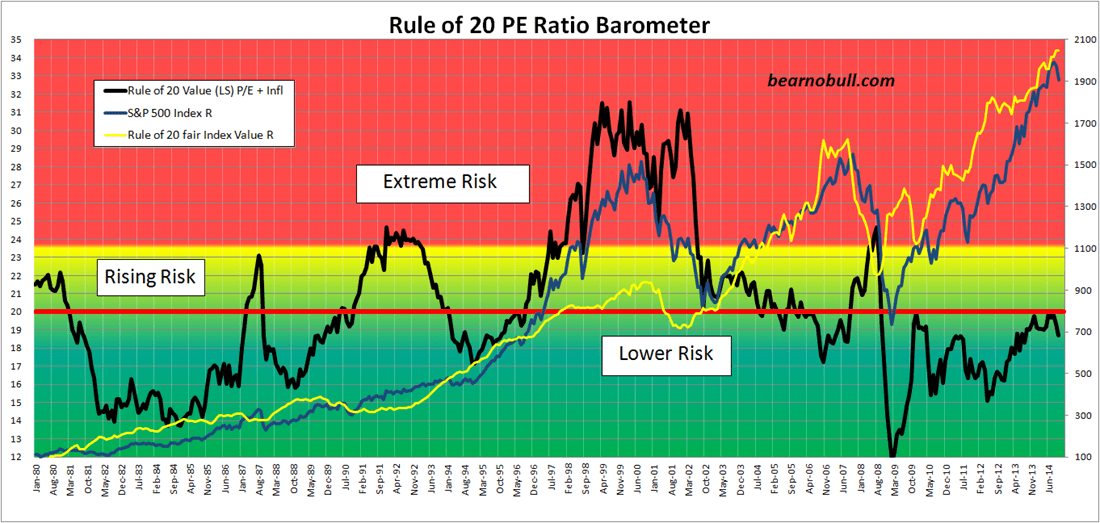
The risk to equities is thus mainly psychological. The U.S. economic background is not worsening even though its trading partners are weaker. Export orders from both the non-manufacturing and the manufacturing ISMs continued strong right into September. The U.S. domestic situation is solid and the big oil price drop is going to free over $50B in disposable income right on time for the year-end holidays.
WHOSE LINE IS IT ANYWAY?
Time for some technicals, if you care. These charts are from The Short Side of Long. The red line is mine however, just to show that line drawing is an art, not a science…
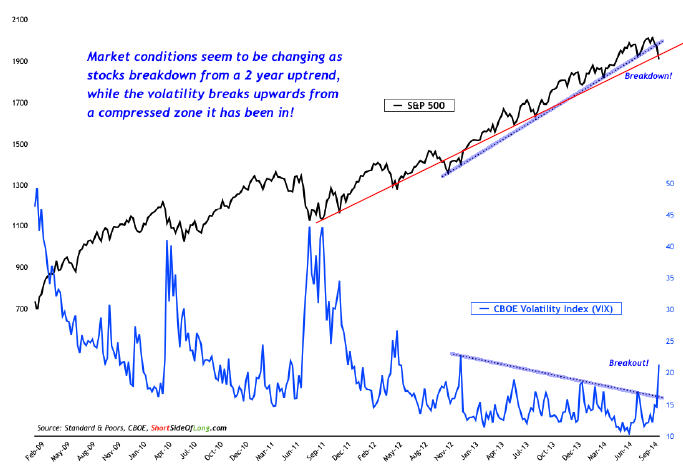
Oversold condition?


