Today: The 90% back in shape? How buybacks are boosting this market.
Industrial Production Falls in August U.S. industrial production fell in August for the first time since January, the latest sign of uneven improvement in the economy.
Industrial production, which measures the output of U.S. manufacturers, utilities and mines, fell 0.1% in August from the prior month, the Federal Reserve said Monday. Economists surveyed by The Wall Street Journal had forecast a 0.3% gain. July’s increase was revised down to 0.2% from 0.4% and August capacity utilization fell 0.3 percentage point to a 78.8% rate.
Manufacturing production, the biggest and most closely watched component of the overall figure, fell 0.4% last month after jumping 0.7% in July thanks to strong output from the automobile factories. Auto production can be volatile this time of year because of the shifting timing of summer shutdowns. Output for the smaller mining and utilities sectors expanded by 0.5% and by 1%, respectively.
Excluding autos, factory output rose by 0.1% in both July and August. It had expanded by 0.3% in the prior three months. (Chart from Haver Analytics)

Empire Manufacturing Beats Expectations

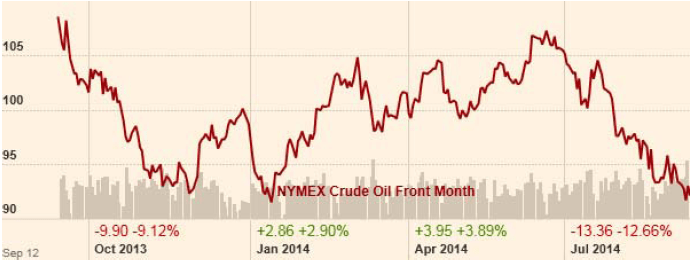
Oil Prices Sink as Global Supplies Rise
Benchmark U.S. oil-futures prices approached a 16-month low for the second time in three trading sessions on Monday before recovering. Oil for October delivery ended at $92.92 a barrel, down more than 13% from highs for the year hit in June.
Both U.S. and world prices have tumbled over the past few months, as weak demand and robust global production left extra crude sloshing around the market. The glut is having ripple effects in the U.S. Stockpiles in one of the nation’s biggest storage hubs are rising, reinforcing the downward pressure on U.S. prices, analysts say.
Gasoline prices fell to a national average of $3.39 a gallon Monday, according to AAA, and are running nearly 4% below year-ago levels. (Charts from Ed Yardeni)


The Return of the Currency Wars
(…) when individual countries lean heavily on pushing their currencies down, that tends to shift demand from one place to another rather than increasing the total. That is a “currency war.” And we may be on the verge of one. Last time, the emerging markets were doing the complaining; this time, it may be the U.S. (OK, I’m oversimplifying, but only a bit.)
Japan has already managed to depreciate its currency. The yen is at a six-year low against the dollar. There is a fine line between pursuing expansionary monetary policy which works (in part) by reducing a country’s currency, and making currency depreciation a primary goal. The U.S. and Europe have tolerated the sinking yen largely because they saw it as part of Prime Minister Shinzo Abe’s broader effort to resuscitate the Japanese economy.
Now the spotlight is shifting to Europe. Europe is growing painfully slowly, if at all. Unemployment in the countries that share the euro is 11.5%. Among the under-25 crowd, nearly one in four is out of work. (…)
But what appears to be economically necessary is not politically possible. (…)
So what’s the ECB to do? Push down the euro to try to juice the eurozone’s exports. That appears to be one of ECB President Mario Draghi’s current objectives, and it’s one he can achieve with words even if he can’t get his policy council to agree on printing a lot of euros. It certainly is appealing to the French, who’ve long seen the currency as a useful economic instrument.
And the markets are getting the message. The euro, which was trading above $1.38 for most of the spring, has fallen below $1.30 – and Goldman Sachs economists predict it’ll fall to $1.15 by the end of 2015.
For now this isn’t a big threat to the U.S. economy. The U.S. dollar has been strengthening for some time, initially because nervous investors were looking for safety and more recently because markets expect the Fed to begin raising interest rates from rock-bottom levels next year, well before the ECB does.
Although there are always manufacturers complaining that the dollar is hurting their exports and there are long-standing complaints about China’s manipulation of its currency to favor its exports, the dollar hasn’t really been a big political or economic issue in the U.S. lately.
Perhaps because there has been so much else to worry about; perhaps because the dollar’s attractiveness has helped the U.S. Treasury lure foreigners to lend billions of dollars at very low rates. U.S. exports have been growing; they contributed 1.3 percentage points to the 4.2% annualized increase in gross domestic product in the second quarter. But that could change if Japan and Europe continue to nudge their currencies down as a substitute for economic policies more friendly to global economic growth.
CONSUMER SENTIMENT
I don’t care much for consumer sentiment surveys since they are coincident indicators at best. However, the breakdown in the recent U. of Michigan survey is interesting: Families with income under $75k reported a sharp rise in confidence to its best reading since May 2007! Same for the 35-54 age group!
Meaning: maybe the ten-percenters will no longer be alone in supporting the economy.
Now, look at this chart from Alexander Ineichen (via John Mauldin) and try to figure out (1) how bond yields can go much lower and (2) why bond yields should not go much higher as the Fed get his foot off the pedal.
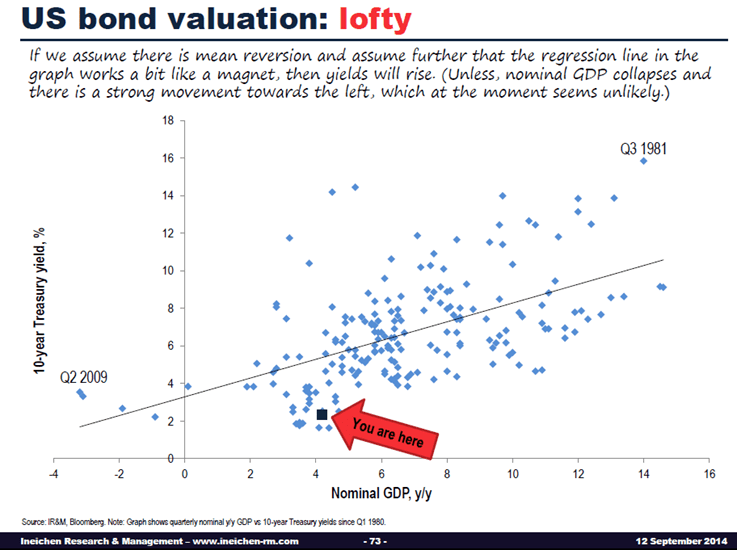
WOW!
From ISI: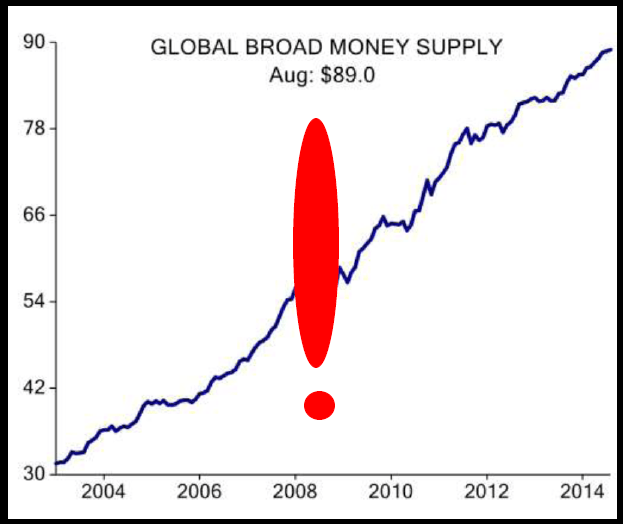
CHEERLEADING!
 Goldman: Here’s How Stocks Perform Before and After Fed Raises Rates With the focus shifting to when the Federal Reserve will start raising short-term interest rates, Goldman Sachs Group Inc. offers a road map for investors on how stocks perform before and after such a move.
“As in 1994 and 1999, the 2004 experience suggests the S&P 500 will rise during the next 12 months, cyclical sector leadership, and low valuation outperformance relative to high valuation stocks.”
In the three prior instances the Fed started raising rates, the S&P 500 has averaged a 3% gain in the three months prior to the first rate increase, according to Goldman. By comparison, it averaged a 4% drop in the three months following such a move. (…)
But as Goldman puts it, these historical comparisons offer a “relevant guide” to what could happen next. (…)
Sigh! Another very shallow analysis, this one looking at 3 periods, and self-qualified as a “relevant guide”. For a complete and unbiased analysis, see EQUITIES AFTER FIRST RATE HIKES: THE CHARTS SINCE 1954
Alibaba Raises IPO Price Range
 Stock Buybacks Buoy Market U.S. corporations are buying their own shares at the briskest clip since the financial crisis, helping fuel a stock rally amid a broad trading slowdown.
Corporations bought back $338.3 billion of stock in the first half of the year, the most for any six-month period since 2007, according to research firm Birinyi Associates. Through August, 740 firms have authorized repurchase programs, the most since 2008.
The growth in buybacks comes as overall stock-market volume has slumped, helping magnify the impact of repurchases. In mid-August, about 25% of nonelectronic trades executed at Goldman Sachs Group Inc., excluding the small, automated, rapid-fire trades that have come to dominate the market, involved companies buying back shares. That is more than twice the long-run trend, according to a person familiar with the matter.
Companies with the largest buyback programs by dollar value have outperformed the broader market by 20% since 2008, according to an analysis by BarclaysBARC.LN -0.61% PLC. (…)
According to Barclays, companies in the second quarter spent 31% of their cash flow on buybacks, the most since 2008 and up from 14% at the end of 2009. At the end of the second quarter, nonfinancial companies in the S&P 500 index held $1.35 trillion of cash, down from a record of $1.41 trillion at the end of last year, according to FactSet. (…)
Chip Gibbs, a managing director at Bank of America Merrill Lynch and head of the firm’s buyback business, said he gets more phone calls from corporate clients wanting to execute buybacks on days when shares pull back.
When stock prices dip, “companies get more aggressive,” said Mr. Gibbs.
Some companies have been buying large chunks of stock. International Business Machines Corp. IBM +0.28% , long one of the most active corporate share repurchasers, in the first quarter of 2014 spent $8.2 billion repurchasing 45.2 million shares. That means the company was the buyer of more than 13% of all IBM shares that changed hands in the first quarter.
IBM is the No. 2 buyer of its own stock over the past 12 months, scooping up $19.5 billion, according to Barclays. Apple Inc. AAPL +0.07% is first, buying $32.9 billion of its own shares. (…)
During the first quarter, when IBM accounted for one in eight open-market purchases of its stock, shares of the Armonk, N.Y., company rose 2.5%, beating the S&P 500’s 1.3% gain. (…)
 AB InBev Weighs SABMiller Bid Worth Up to $122 Billion
 In a speech at the
 OECD Cuts Growth Forecasts
 Bank of America, J.P. Morgan Move Forward Fed Forecasts
 Record S&P 500 Masks 47% of Nasdaq Mired in Bear Market
 Please, read this:
 (Tks for that Gary)