 ‘Black Friday’ Fades for Retail Sales Spending over the Thanksgiving weekend fell 11%, the National Retail Federation said, a sign the four-day shopping bonanza may be losing its punch.
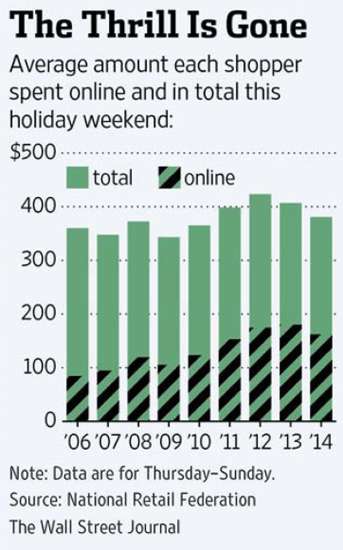
(…) The retail trade group said the number of people who went shopping over the four-day weekend declined 5.2% from last year to 134 million. (…)
ShopperTrak, which monitors shopper visits at tens of thousands of brick-and-mortar sites, said sales over Thursday and Friday slipped 0.5%. Data from International Business Machines Corp. , based on its survey of online transactions at 800 retail websites, showed online sales rose more slowly on Thanksgiving and Black Friday than they did last year. (…)
Oil Slide Deepens, Global Markets Fall The persistent slump in oil prices continued to weigh on global markets, hammering the Russian ruble in particular.
Fresh Signs of Global Slump Challenge U.S. Economic prospects are flagging across Europe, Japan and big emerging markets such as India, a turn that presents fresh challenges to the relatively robust U.S. economy.
(…) The low-growth outlook is raising questions over whether weak demand could wash onto U.S. shores in the coming months, even as American businesses and consumers benefit from falling gasoline prices heading into the holiday shopping season. (…)
Economists at Oxford Economics estimated in a report Friday that oil prices at around $60 a barrel over the next two years would offer “a significant strengthening” of economic growth “for most of the major advanced and emerging economies.”
Growth could rise by 0.4 percentage point in China and the U.S. above current expectations, they said. Lower energy costs could also raise growth by 0.1 to 0.2 percentage point in Europe and Japan.
At the same time, falling inflation expectations were likely to strengthen the existing bias by central banks to ease money supplies, said economists at Barclays, providing added fuel to economies alongside lower energy prices.
The U.S. economy is better insulated from a downturn in global growth because, among the world’s major economies, it is less reliant on overseas export demand. Exports account for only about 14% of U.S. gross domestic product, —the lowest for any developed nation—and well below the 51% for Germany or 26% for China, according to the World Bank. (…)

Eurozone Manufacturing Halts
Note: I am travelling today. Here’s the link to the Markit Eurozone survey.
The headline measure from data firm Markit’s monthly survey of purchasing managers of around 3,000 manufacturers fell to 50.1 from 50.6 in October, having been reduced from a preliminary estimate of 50.4.
Renewed weakness in the sector was driven by Germany, the eurozone’s largest economy. Its PMI fell to 49.5, the lowest in 17 months. Activity in the French and Italian manufacturing sectors had already begun to decline before November. (…)
The difficulties facing French automobile makers are an example of the broader challenges in the eurozone’s manufacturing sector, as households continue to be hit by high levels of unemployment. New registrations of personal cars fell 2.3% year-over-year in November to 135,070 units, after a 3.8% decline in October, the country’s car manufacturers association said Monday.
The survey suggests that a recovery in manufacturing activity is unlikely in coming months, with new orders dropping at the fastest pace since April 2013. In particular, Markit said export orders were “subdued” despite the depreciation of the euro since May, which policy makers had hoped would aid the sector.
Of direct concern to the ECB, manufacturers cut their prices for the third straight month, an indication the eurozone won’t soon emerge from a period of very low inflation that has entered its second year. (…)
But Draghi stands ready…
ECB’s Lautenschlaeger Rebuffs QE as German Opposition Grows
European Central Bank Executive Board member Sabine Lautenschlaeger said quantitative easing isn’t the right policy choice for the euro area currently, hardening a split among officials over the right response to slowing inflation.
“A consideration of the costs and benefits, and the opportunities and risks, of a broad purchase program of government bonds does not give a positive outcome,” Lautenschlaeger, a former Bundesbank vice president, said at an event in Berlin today. “There are very few shared competencies in fiscal policy. As long as this is the case, the ECB’s purchase of government securities is inevitably linked to a serious incentive problem.”
Lautenschlaeger’s comments signal she’s become ECB President Mario Draghi’s highest-ranking opponent in the debate over introducing QE to the euro area. They echo the position of Bundesbank President Jens Weidmann, who has said QE diverts attention from the need for governments to make structural adjustments to their economies. (…)
Lautenschlaeger’s comments impinge on the customary “quiet period” in the week before monetary-policy meetings when officials refrain from speaking on possible measures. The ECB’s Governing Council gathers in Frankfurt on Dec. 4.
Italian Unemployment Rate Rises to Record, Above Forecasts
The unemployment rate rose to 13.2 percent from a revised 12.9 percent the previous month, the Rome-based national statistics office Istat said in a preliminary report today. That’s the highest since the quarterly series began in 1977.
The youth unemployment rate for those aged 15 to 24 rose to 43.3 percent last month from 42.7 percent in September, today’s report showed.
 Savings Rate Portends Healthy Holiday Spending
The personal savings rate was on the rise earlier this year, climbing from 4.8% in March to 5.6% in September, the highest rate in nearly two years. But new revisions from the Commerce Department show these gains were illusory. The savings rate was dialed down to 5% in September and held steady at that level in October.
Instead of saving that money, consumers bought more than previously thought, with spending up 2.2% in the third quarter, up from a previous estimate of 1.8%. (…)
Mortgage Lenders Set to Relax Standards Some of the largest U.S. mortgage lenders are preparing to further ease standards for borrowers after the release of new guidelines this month from mortgage giants Fannie Mae and Freddie Mac.
(…) The new guidelines, to take full effect Dec. 1, resulted from an agreement in October meant to clarify when lenders would be penalized for making mistakes on mortgages they sell to Fannie and Freddie. Lenders have blamed the lack of clarity for tight credit conditions that have made it difficult for many consumers to qualify for a mortgage.
Relaxing the lending standards potentially could make it possible for hundreds of thousands of additional consumers to get mortgages.
Laurie Goodman, director of the Housing Finance Policy Center at the Urban Institute, said the moves are “going to be big,” but she added that “it’s going to take time” to see the full impact of the changes. (…)
Some lenders, including Wells Fargo & Co. and SunTrust Banks Inc., said borrowers should begin to see initial changes in a few weeks, including faster turnaround times for mortgage applications to be processed.
Lenders also are expected to widen the scope of the types of borrowers they will accept by reducing credit-score requirements and giving greater leeway to consumers whose credit history suffered because of one-time events, such as a job loss or big medical bill. (…)
Not all lenders are poised to relax their underwriting rules. On an earnings call a few days after the agreement was announced, U.S. Bank Chief Executive Richard Davis called it “a good sound bite” and indicated that his bank wasn’t prepared to make changes.
“Unless we are convinced that the rules are going to be permanent and there is not going to be a look back or a reach back in future times…we are simply going to stay on the sidelines in the concerns of both compliance risks and other uncertainties,” said Mr. Davis.
“You won’t see us start to expand our criteria much past what we’ve done,” said Bank of America Chief Executive Brian Moynihan at an investor conference this month. (…)
China Factory Gauge Drops as Shutdowns Add to Slowdown:
Here’s the link to Markit’s China survey.
The government’s Purchasing Managers’ Index fell to an eight-month low of 50.3 in November, compared with the 50.5 median estimate of analysts in a Bloomberg survey and October’s 50.8. Readings above 50 indicate expansion.
The government ordered factories in Beijing and surrounding regions to shut down during the Asia-Pacific Economic Cooperation forum to curb pollution.
Moody’s Downgrades Japan’s Credit Rating Moody’s Investors Service downgraded Japan’s credit rating Monday, highlighting the challenges facing Prime Minister Shinzo Abe as he tries to stoke inflation and growth.
Moody’s cited heightened uncertainty over Japan’s ability to cut its fiscal deficit after Mr. Abe decided last month to delay an increase in the national sales tax scheduled to take effect next year.
The difficulty of the balancing act facing the Japanese government—fueling growth while acting with fiscal responsibility—was reflected in the lower rating, Thomas Byrne, senior vice president of the sovereign risk group at Moody’s, told reporters in Tokyo after the announcement.
“The government has to in effect put one foot on the brake and another on the accelerator,” he said.
Moody’s acknowledged that delaying the tax increase “could have merit” if growth and tax revenues rise as a consequence, but said a second factor in its downgrade was uncertainty over whether the government’s growth policies would work in the medium term.
Market rout as oil fall hits energy groups Crude price plunge sparks warnings of capital spending cutbacks
(…) The price fall has sent a chill through the US shale sector, which had driven US oil production to its highest level in more than three decades. Analysts at Tudor Pickering Holt, the energy investment bank, warned that, with US crude at or below $70, “no basin is safe” from cuts in drilling activity. WTI, the US benchmark, is currently trading below $67 a barrel.
The Bakken shale of North Dakota and the Mississippian Lime region of Oklahoma would be among the regions bearing the initial brunt of the slowdown, they said.
The critical factor determining the pace of the slowdown will be the debt levels of the US independent oil and gas companies that have led the shale boom. With oil at $70, exploration and production companies will cut back spending on new wells to prevent their debt burdens rising.
Wood Mackenzie, the energy consultancy, said if Brent stayed below $75-80, US shale oil supplies could be reduced by 0.6m b/d by the end of 2015.
Other high-cost sources of oil, such as Canadian oil sands, could be affected. Andrew Leach of Alberta University said that production of bitumen by mining was typically only viable at over C$50 per barrel, the current market price. He added: “If we see sustained low prices [for conventional oil] some oil sand projects will have to stop.”
Arctic exploration could also be hit if crude stays low. Mr Fedun told Bloomberg he did not expect the development of oil reserves in the Arctic on a significant scale to happen within his lifetime.
Oswald Clint of Bernstein Research warned that the response would be similar to 2009, when non-Opec capital expenditure, excluding acquisitions, fell by 16 per cent or $100bn after the oil price plunged from record highs. (…)
(…) India and Malaysia have already seized the opportunity of falling prices to abandon fiscally damaging subsidies on diesel, while Indonesia has cut its fuel payouts. A lower bill for imported crude oil has benefited the trade accounts of Japan and China. (…)
Indonesia was able to erase $8bn off the bill for imported oil earlier this month when the government increased the price of subsidised petrol by more than 30 per cent.
The further drop in the oil price since then will give President Joko Widodo extra fiscal space at a time when economic growth has fallen to a five-year low of 5 per cent.
“The savings from the fuel price hike were about 1.1 per cent of gross domestic product but now the savings could be up to 1.5-2 per cent of GDP,” said Santitarn Sathirathai, an economist at Credit Suisse in Singapore. “That is free fiscal ammunition that they can use to support growth.” (…)
Consumers in China, the world’s second-largest economy, are temporarily insulated from sharp international oil price fluctuations because local prices are set only periodically by the government. (…)
-
Russian Recession Risk at Record as Oil Price Saps Economy
-
Oil Rout Ripples Through Latin America as Projects Slow
-
Venezuela Plans To Slash Spending
(…) There will be no cuts in the social programs that have kept the ruling socialist party popular among Venezuela’s poor, Mr. Maduro promised workers.
He also reiterated that his finance minister, Rodolfo Marco, will soon head to China to seek more financing from the country, which has pumped nearly $50 billion in loans into Venezuela since 2007. (…)
(…) “What I do believe is that you will have now a pause in some activities and there will be a muting impact on the economy,” Murray Edwards, founder and chairman at Canadian Natural Resources Ltd., one of the country’s largest energy firms, told The Globe and Mail on Friday.
“Projects will be deferred, capital budgets will be reduced and employment growth will not be as robust as it otherwise would have been. … That will be around so long as you have this volatile oil price; in other words, we don’t have some stability at a price so guys can plan for the long-term.”
The same financial impact goes for the Alberta government. Every time the price of oil sheds a dollar, Alberta loses out on $215-million (Canadian) in revenue, according to Premier Jim Prentice.
Mr. Edwards said the industry better get used to it. “I think we’ve got some tough slugging to go here for a period of time,” he told reporters at the Bennett Jones Lake Louise World Cup Business Forum. “OPEC has clearly indicated that they’re not going to reconvene for six months, that there will not be a change, and the price has dramatically fallen.”
Nancy Southern, Atco Ltd.’s chief executive, said her company is already seeing the effect of low prices. “We’re noticing deferrals and delays. Not just the oil sands, even the tight gas, shale gas drilling,” she told The Globe and Mail at the business forum. “We thought [liquified natural gas] was going to go ahead. Everybody was very bullish on the LNG development and, with the delays on approvals and pipelines and discussions and coming to agreement with First Nations and indigenous people, I think there is a sense that maybe we better take this a little slower.” (…)
But oil’s rapid descent has reversed assumptions used to justify investment decisions made only a short while ago, underscoring risks to profitability.
When Suncor Energy Inc. said it would build its proposed $13.5-billion Fort Hills bitumen mine last October, the Calgary-based company said it expected the project to yield a 13-per-cent rate of return. That was based on a bitumen price of $60.50 (U.S.) a barrel. On Friday, the implied value of bitumen was about $45, according to numbers crunched by University of Alberta energy economics professor Andrew Leach.
With operating costs pegged at $24 a barrel, Suncor would still make money from Fort Hills at today’s prices. “They just wouldn’t be making as much money,” Mr. Leach said. “It’s just less profitable.” Fort Hills is expected to start producing oil in 2017.
Existing oil sands operations are somewhat shielded from pain in part because the big money has already been spent building the projects and operating costs are under $40 to $45 a barrel. (…)
The loonie typically drops in value as the price of oil falls. That can help insulate Canadian companies because they generate revenue in U.S. dollars and pay expenses in Canadian dollars.
“But the big growth on the oil side has been out of the oil sands, and the cost structure there has been an issue, and it is not as profitable at $70,” said Ian Dundas, chief executive officer of Calgary-based oil producer Enerplus Corp. “These are big, multiyear decisions, but there’s no question that those economics are tighter than they have been before. And the longer we stay at this level, the more you start to see that growth moderate.” (…)
 After Opec: quantitative greasing
(…) Spare a thought for Opec producer nations themselves, then. They will have fewer petrodollars to rub together if prices stay low. Citi estimates that petrodollar assets earned on oil exports rose by roughly $500bn each year during the past half-decade, with crude near $100 a barrel.
This pile has been invested to a great extent in safe assets such as Treasuries and bank deposits (the resting places, for example, of half of Saudi Arabia’s $750bn oil surplus). Demand for bonds may profoundly alter too if fewer petrodollars are sloshing around to chase them. That volatility will not just be limited to the oil market.


 But the WSJ omits saying that retail sales had dropped 2.8% in September…