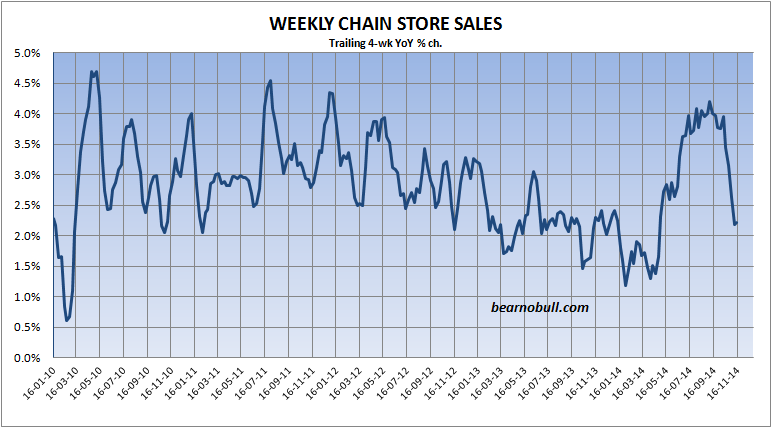
Today: Retail sales. Falling oil prices could prove negative. The increasingly lonesome cowboy. Earnings.
The media and most analysts are looking at the latest retail sales data with a positive lens, even though the oil tax cut is not flowing through retailers’ registers just yet.
 (…) retail and food services sales rose a seasonally adjusted 0.3% in October, matching their 0.3% decline a month earlier. Excluding a 1.5% decline in sales at gas stations, retail spending rose broadly by 0.5% after declining 0.2% in September. From a year earlier, retail sales rose 4.1% in October and jumped 5.1% excluding gas. (…)
Sales at restaurants and bars increased 0.9% in October on top of a 0.7% gain in September. Food-services sales over the past three months are up 7.1% from the same period a year earlier. (…)
Motor-vehicle and auto-parts sales rose 0.5% in October from the prior month, partially reversing a 1.2% slide in September.
Some other lenses (annualized rates, last 4, 3, 2 months respectively):
- Total retail sales ex-gasoline: +4.5% +4.8% +2.0%
- #1 ex-grocery stores: +6.5% +4.9% +3.4%
- #2 ex-food & beverage stores: +4.2% +4.1% +0.5%
 In September and October, the oil tax cut has been spent mainly on groceries and drinks…
U.S. Import Prices Post Largest Monthly Drop in Two Years Prices of imported goods in October posted their largest monthly decline in more than two years, the latest sign that lower oil costs and weak overseas economies are holding down U.S. inflation.
Import prices fell 1.3% from September, the Labor Department said Friday. Compared with one year earlier, prices fell 1.8%, matching the largest annualized decline since November 2013.
Excluding petroleum, import prices were down 0.1% from the previous month and up 0.5% from a year earlier. Consumer goods prices excluding cars rose 0.7% from a year earlier.
This goes against the grain:
Falling Oil Prices: The Downside While consumers should gain from cheaper gasoline, the decline in oil prices could have a negative impact on the overall U.S. economy.
(…) In her latest MacroMavens missive, Stephanie Pomboy cites a report from the Manhattan Institute stating that “without the $300 to $400 billion yearly increase in output from oil and gas production, [economic] growth would still be negative.†Since U.S. oil production started to surge in 2012, the longstanding inverse relationship between the economy and crude prices has shifted, she points out with her usual perspicacity.
“Lower oil prices are now a net negative,†she continues. The New Normal is that “the hit to domestic energy producers is greater than the benefit of lower prices to energy consumers.†That also is the conclusion of an analysis from a major institutional investor group (whose name dare not be divulged in print). Putting pencil to paper, or more likely keyboard to spreadsheet, the group reckons that the drop in prices at the pump initially will boost real U.S. economic growth by 0.25%. Without further declines, however, that boost will fade.
Lower oil prices will then exert a larger, more sustained drag on the economy as they flow through to the energy sector. Some 30% of U.S. shale-oil production is noneconomic at current prices, the group calculates. And, unlike traditional oil production, shale plays require a continual, high level of investment to maintain output. The reduction of this spending could be a drag of 0.5% on real gross domestic product growth—twice the benefit to consumers.
In nominal terms, the drop in oil prices makes this more acute. This group estimates that there would be a “material hit to income growth of 1% to 1.5%†measured in current dollars. And current dollars are what many of these highly leveraged oil producers need to service their substantial debt. As our colleague Michael Aneiro describes in this week’s Current Yield column, the high-yield bond market is heavily populated by energy companies, which availed themselves of copious credit to fund the expansion that has produced the sector’s growth. (…)
 Japan Falls Into Recession A sales tax increase pushed Japan’s economy into a recession in the third quarter, setting the stage for Prime Minister Shinzo Abe to postpone a second increase in the sales tax.
Real gross domestic product fell 1.6% on an annualized basis in the July-September period, following a 7.3% contraction in the previous quarter. That means Japan met one definition of a recession: two consecutive quarters of contraction.
None of the 18 economists surveyed by The Wall Street Journal had forecast a contraction; the median forecast was for a 2.25% expansion.(…)
Private housing investment fell an annualized 24% in the July-September quarter, according to Monday’s data.
Mr. Abe’s advisers said last week that if the growth figure was weak, Mr. Abe would postpone by 18 months a plan to raise the sales tax further to 10% in October 2015, and they said he would call elections in December. Local media said on Monday that the prime minister would announce both moves on Tuesday and set Dec. 14 as the election date for parliament’s lower house, which chooses the prime minister.
Mr. Abe’s ruling Liberal Democratic Party enjoys an overwhelming majority in the lower house and is unlikely to lose it because opposition parties are weak.
CHINA: SLOW AND SLOWER
The Not-So-Mighty Chinese Consumer Evidence is stacking up that Chinese consumers are cutting back on everyday purchases, a worrying prospect for investors
 (…) Gauging Chinese retail sales is difficult. Official retail-sales data have slowed but are still showing low double-digit-percentage growth. These figures are flawed, however, because they include certain government and wholesale purchases, while excluding services such as haircuts. Alternate readings are hardly encouraging. Nielsen estimates that total sales in China of fast-moving consumer goods, including things like food and toiletries, rose just 3% from a year earlier in the three months to September, compared with double-digit-percentage rates in 2012.
Wal-Mart Stores said Thursday that China comparable-store sales fell 2.3% from a year earlier in the three months to October due to “government austerity, reduction in gift card sales, and deflation in key categories such as dry grocery, liquor and consumables.†One of China’s largest hotel operators, China Lodging Group , said this week that it wouldn’t meet its full-year revenue target because of macro headwinds.
Unilever said last month that China sales fell about 20% in the third quarter, due to a “sharp market slowdown†that led to destocking by merchants. Colgate Palmolive ’s Asian sales rose just 1% in the quarter, with gains in India offsetting declines in the Greater China region.
SABMiller , which with a Chinese partner owns best-selling Snow beer, said China lager volumes declined in the six months to September, blaming cool summer weather. reported that declines in VIP gambling spread for the first time to mass-market visitors last month. Car sales have slowed, too. (…)
Official data show inflation-adjusted urban disposable income rose 6.9% from a year earlier in the first nine months of the year, down only slightly from 7% for all last year, but a substantial slowdown compared with 9.6% growth in 2012. (…)
THE FATHOM CHINA INDICATOR IS SCARY
Before he became Premier, it was leaked that Li Keqiang had said he had little faith in China’s official GDP figures. He preferred instead to look at electricity consumption, at rail freight volumes and at credit growth. At Fathom, we have constructed our own China Momentum Indicator (CMI), using these variables, and estimating the appropriate weights and seasonal factors. As our chart shows, the CMI has on occasion led the official statistics, while at other times it has been coincident. (…) (AlphaNow)

Not so scary but trending similarly is the Bloomberg GDP estimate (courtesy of Ineichen Research & Management).


 Spreading deflation across East Asia threatens fresh debt crisis Asia’s currency skirmishes are happening in a region of festering grievances and territorial disputes, with no Nato-style security structure to dampen down fires
Deflation is becoming lodged in all the economic strongholds of East Asia. It is happening faster and going deeper than almost anybody expected just months ago, and is likely to find its way to Europe through currency warfare in short order.
Factory gate prices are falling in China, Korea, Thailand, the Philippines, Taiwan and Singapore. Some 82pc of the items in the producer price basket are deflating in China. The figures is 90pc in Thailand, and 97pc in Singapore. These include machinery, telecommunications, and electrical equipment, as well as commodities.
(…) This risks a “rapid worsening of the debt dynamic†for a string of countries that allowed their debt ratios to reach record highs during the era of Fed largesse. Debt levels for the region as a whole (ex-Japan) have jumped from 147pc to 207pc of GDP in six years.
(…) They are trying to deleverage, but the slowdown in nominal GDP caused by falling inflation is always one step ahead of them. (…) If this sounds familiar, it should be. It is exactly what is happening in Italy, France, the Netherlands, and much of the eurozone.
 The Japanese know what it is like to be on the receiving end. A recent study by Naohisa Hirakata and Yuto Iwasaki from the Bank of Japan suggests that China’s weak-yuan policy – a polite way of saying currency manipulation to gain export share – was the chief cause of Japan’s deflation crisis over its two Lost Decades.
The tables are now turned. China itself is now one shock away from a deflation trap. Chinese PPI has been negative for 32 months as the economy grapples with overcapacity in everything from steel, cement, glass, chemicals, and shipbuilding, to solar panels. It dropped to minus 2.2pc in October. (…)
Consumer prices are starting to track factory prices with a long delay. Headline inflation dropped to 1.6pc in October. This is so far below the 3.5pc target of the People’s Bank of China that it looks increasingly like a policy mistake. Core inflation is down to 1.4pc.

Larry Brainard from Trusted Sources says China is sliding towards a European debt-compound trap. “It’s arithmetic. Deflation will kill you if you’re leveraged. It is just a question of how quickly. We don’t know how big the problem is because China is playing a game of three-card Monte and moving the debt to different buckets,†he said.
“The bottom line is that PPI deflation increases the cost of leverage across the board. The risk is that it sets off a self-reinforcing cycle of debt defaults and rising non-performing loans that runs out of the control of the authorities. China will have to cut rates,†he said.
Asia is not yet in a full-blown currency war, but no country can stand idly by as neighbours dump toxic deflationary waste on their front lawn. Korea has threatened to force down the won, pari passu with the yen. The central bank of Taiwan has been intervening.
These skirmishes are happening in a region of festering grievances and territorial disputes, with no Nato-style security structure – or for that matter EU-style soft governance – to damp down fires. The spokes of the diplomatic wheel connect by a perverse geography to Washington, a city retreating from Pax Americana. (…)
China is in effect strapped to the rocketing dollar through its quasi-peg, increasingly a torture machine. George Magnus from UBS says this cannot continue. “What is happening in the property market is the tip of the iceberg for the whole economy. China will have to resort to monetary reflation over the winter, and I think this will include a lower yuan. We are heading into a currency war,†he said.
This looks all too like a replay the East Asia storm of 1998, when a tumbling yen triggered a Chinese banking bust and pushed Beijing to the brink of devaluation. Washington defused the crisis by stabilizing the yen, and by promising China membership of the World Trade Organisation.
It will be harder to repeat that trick in these deflationary times. The clear danger is that China will feel compelled to defend itself, throwing its huge weight into a beggar-thy-neighbour battle across East Asia.
Should that happen, the mother of all deflationary shocks will roll over Europe before the EU authorities have even got out of bed.
NOT SCARY ENOUGH?
The highly respected BCA Research has an index of Emerging Market- ex-China economies:
EM economies ex-China are slowing to a “new, normal growth†phase, which will keep bulks and base metals under pressure this year and next. These economies join China in a broad-based EM slow-down, which will increase the supply-side slack in metals generally, and stretch out supply and inventories globally.
Private and public spending is ratcheting lower in EM ex-China markets. Real capital expenditures dipped into negative territory year-on-year as 2014H2 opened, while real private consumption decelerated to ~ 3% y-o-y.

Bundesbank Sees Limp 4Q But Still Opposes Stimulus Germany’s economy is likely to limp along in the fourth quarter given tepid global demand and the lack of tangible recovery in most EU countries, the Deutsche Bundesbank said in its monthly report.
(…) “The further deterioration in economic expectations and the stagnation of new orders point to a rather sluggish course of economic development in Germany until at least the end of 2014,†the German central bank said in the report. (…)
But the Bundesbank repeated its opposition to increased spending to promote growth.
“An additional debt-financed economic stimulus package would do little to benefit either Germany’s economic situation or the rest of the euro area in view of the comparably small boost it could be expected to provide,†it said.
There is adequate leeway for fiscal policy to strengthen growth by improving the budget structure and making the government as well as infrastructure more cost-effective, it added.
Thailand is heading for a second straight year of slumping exports, something the onetime tiger economy hasn’t experienced in at least two decades and a loss that magnifies challenges for the military-run government.
Shipments abroad, which make up the equivalent of about 70 percent of the economy, have shrunk in six out of nine months this year and will probably contract in 2014, according to the central bank. That’s in comparison to an annual average pace of growth of about 13 percent in the period 2002 to 2012. (…)
Gross domestic product expanded 0.6 percent in the three months through September from a year earlier, the National Economic and Social Development Board said in Bangkok today. That is slower than a median estimate of 1 percent in a Bloomberg News survey. The economy grew 1.1 percent from the second quarter, compared with a median estimate of 1.5 percent. (…)
Thailand has been losing its export competitiveness in electronics in the last three years, especially in the manufacture of hard disk drives as companies failed to adjust production to meet shifts in consumer preferences, the central bank said in a report in June. Investment in research and development has lagged that of countries such as Singapore, Malaysia and Indonesia, while local firms have invested more overseas because of tax incentives and higher wages, it said. (…)
North Dakota Drilling Rig Count Drops The number of rigs drilling for Bakken Shale oil in North Dakota has dropped sharply as a result of the decline in crude oil prices, a development that may affect the state’s budget, a state official said.
The number of rigs drilling for Bakken Shale oil in North Dakota has dropped sharply as a result of the decline in crude oil prices, a development that may affect the state’s budget, the head of the North Dakota Department of Natural Resources said Friday. (…)
Crude oil output in the state hit a record 1.18 million barrels a day in September, the latest figure available, but the number of drilling rigs has dropped from 195 that month to 186 currently, according to state data. That was down from a high of 218 rigs in May 2012. (…)
The state’s rig count may drop further as contracts aren’t renewed over the next few months if oil prices remain at current levels or fall further, Mr. Helms said, adding that major rig operators already expect to deploy fewer rigs next year. “Many of them are scaling their plans back at this point,†he said. (…)
The average realized break-even price for oil in North Dakota is about $35 a barrel, but 15% of total production in the state has a break-even price above $87, according to state data.
Falling Oil Prices Test OPEC Unity The Organization of the Petroleum Exporting Countries knows it must cut production to lift prices. Unclear is whether its members will agree.
(…) The group now pumps about half a million more barrels a day than its target of 30 million barrels a day, according to the International Energy Agency. Members are considering a commitment to rein in production to the group’s target level, OPEC delegates said, effectively cutting production sharply. (…)
Privately, Saudi Arabia doubts the 11 other OPEC members would live up to a collective commitment to cut output, according to Saudi officials and Saudi oil-industry executives. And Riyadh isn’t willing to bear the pain of a unilateral cut, these officials and executives said, fearful of losing customers amid the current squabbling.
The uncompromising Saudi stance stems from the 1980s, when Saudi Arabia cut production sharply to bolster oil prices as substantial new oil supply emerged from the North Sea and the U.K.
Instead of standing by Riyadh, other OPEC producers kept pumping and tried to wrest away market share.
“Saudi Arabia has definitely made it clear that defending the oil market is a collective responsibility, and no member country should expect Saudi Arabia to swing alone,†said Mr. Sabban, the former aide to Mr. Naimi. “If there is no agreement on this very basic principle, then Saudi Arabia will continue defending its market share.†(…)
There is also Russia and Iran in this picture…
EARNINGS WATCH
Factset’s tally:
With 92% of the companies in the S&P 500 reporting actual results for Q3 to date, the percentage of companies reporting actual EPS above estimates (77%) is above historical averages, while the percentage of companies reporting actual sales above estimates (59%) is equal to historical averages.
As a result of the upside earnings surprises, the year-over-year blended (combines actual results and estimated results) earnings growth rate for Q3 2014 has improved to 7.9% today relative to an expectation of 4.4% at the end of the quarter (September 30).
The year-over-year blended sales growth rate for Q3 2014 of 4.0% is slightly above the estimate of 3.8% at the end of the quarter.
For Q4 2014, Q1 2015, and Q2 2015, analysts are currently predicting earnings growth rates of 4.2%, 6.5%, and 7.8%, respectively. These earnings growth rates are well below the estimated growth rates of 8.3%, 9.6%, and 10.5% for these same three quarters back on September 30.
Analysts have also cut revenue estimates during the first month of the fourth quarter as well. For Q4 2014, Q1 2015, and Q2 2015, analysts are currently predicting revenue growth rates of 2.1%, 2.6%, and 2.2%. These revenue growth rates are also well below the estimated growth rates of 3.8%, 4.4%, and 3.6% for these same three quarters back on September 30.
For Q4 2014, 62 companies have issued negative EPS guidance and 19 companies have issued positive EPS guidance.
At 76.5%, the negative guidance ratio is in line with that of the previous 2 quarters and below that of the last two years.

 If not, it will be the worst Christmas for retail margins…FYI, real retail sales were up only 2% YoY during Christmas 1996 and 1997. Sales were pretty strong in 1999 but cratered in 2000. Christmas 2004 was good but 2006 was pretty weak. Don’t hang your hat on this “indicator”.