I am writing this in Kyoto, Japan where the more than 1600 temples and 200+ shrines render life much more serene than in financial markets. Not as complete as usual, but I hope this helps.
Deflation Risk Feeds Global Fears Behind the spate of market turmoil lurks a worry that top policy makers thought they had beaten back a few years ago: the specter of deflation.
(…) The deflation concern is particularly pronounced in Europe and Japan, two economies where policy makers are struggling to come up with solutions to counter especially slow economic growth.
However, recent declines in commodities prices suggest that downward pressure on inflation—if not all-out deflation—could become a wider-ranging phenomenon, and one with some mixed implications for economies like the U.S. and emerging markets. (…)
The deflation concerns are particularly acute in Europe, where annual inflation in the 18 nations that use the euro was 0.3% last month, a five-year low that is far below the European Central Bank’s target of just under 2%. (…)
“Market valuations, especially for rich countries, have been well above what was warranted by fundamentals. What kept them up there was a belief that central banks were markets’ best friends,” said Mohamed El-Erian, chief economic adviser at Allianz Group. “Most people now recognize that the ability of central banks to address what ails the global economy is weaker than they believed.” (…)
The U.S. confronts much different circumstances than Europe and Japan. U.S. inflation had been rising toward the Fed’s 2% objective earlier this year but now faces a downward tug amid the weakening global growth and a strengthening U.S. dollar. The Labor Department reported Wednesday that producer prices in the U.S. fell in September. Sharp drops in commodities prices this month could add to downward pressure.
Yet falling commodities prices have silver linings. For one, the decline is being driven in part by a U.S. energy production boom—not just sagging global demand for goods. Moreover, falling gasoline prices are a boon to U.S. consumers: One rule of thumb is that every one-cent drop in the price of gasoline amounts to a $1 billion boost to U.S. household incomes, and gasoline prices have dropped by 13 to 17 cents from a year ago, according to the automobile group AAA. (…)
The U.S. Goods PPI ex-food, ex-energy was actually up 0.2% in September and is up 0.4% in the last 3 months (1.6% annualized). Services PPI declined 0.1% after rising 0.4% in the previous 2 months. Declining food and energy prices will free much money for discretionary spending in coming months. Let’s see how consumers behave. In the past, the U.S. consumer has tended to spend up.
Europe does not benefit as much from falling oil prices since taxes are a much large piece of the retail price than in the U.S..
Consumer Caution Dents Retailers’ Holiday Hopes Spending at U.S. retailers declined in September, raising concerns about the strength of American consumers heading into the holiday-shopping season.
Retail sales fell 0.3% in September, the Commerce Department said Wednesday. The broad-based decline came alongside weakening consumer confidence and minimal wage growth that has weighed on the recovery in recent years.
While spending at retailers is up 4.3% from a year earlier, double the pace of inflation, the September stumble continues a choppy pattern that shows many Americans are cautious heading into the holiday shopping season. (…)
A slowdown from strong summer auto sales, falling gasoline prices and the timing of Apple Inc.’s iPhone 6 release all played a role in the latest data. Earlier concerns of a consumer slowdown in July were eased when sales for that month were revised up to a respectable 0.3% gain from an initial flat reading. (…)
Wal-Mart Stores Inc., WMT -3.57% citing what it called a tougher sales environment than it had anticipated, cut its forecast for sales this year and doesn’t see much improvement in 2015. Wal-Mart said it expects sales to grow by 2% to 3% for the current fiscal year, down from the 3% to 5% sales growth it initially expected. (…)
Seasonally adjusted retail sales declined in most categories in September, though sales did jump 3.4% at electronics and appliance stores. Purchases of Apple’s new iPhone, which went on sale Sept. 20, likely contributed. Sales at nonstore retailers, a category including online shopping, fell 1.1% on the month. That could reflect back-ordered phones that were purchased, but not delivered, before Oct. 1.
Motor vehicle and parts sales fell 0.8% in September, the first decrease in the category since January. Still, auto sales, which rose 9.5% from a year earlier, have been a bright spot for the economy as Americans replace aging vehicles.
Sales at gasoline stations were down 0.8% from August. Average gasoline prices fell 40 cents per gallon by the end of September from their spring peak, according to the U.S. Energy Information Administration.
This last line is not to be overlooked as lower gasoline prices are impacting total sales. Gas station nominal sales are falling rapidly and will continue to drop in coming months. While this negatively impacts the overall stats, it frees much money for discretionary spending.
From Haver’s table below, here are the facts: total retail sales are are up 0.6% Q3, 0.3% ex-autos but 0.8% ex gaz and building supplies (+3.3% annualized)

Amazon to Hire 80,000 Holiday Workers Amazon plans to hire 80,000 seasonal workers for its warehouse network in the U.S., representing a 14% increase from last year as the company brings its massive distribution facilities closer to urban centers.
U.S. Producer Prices Unexpectedly Slip; Core Index Unchanged
U.S. Small Business Optimism Retreats; Pricing Power Deteriorates Further
U.S. Gasoline and Crude Oil Prices Reach New Lows
Saudis prepared for $80 oil in bid to retain market share: sources
(…) Saudi officials have given a different message in meetings with investors and analysts: the kingdom, OPEC’s largest producer, will accept oil prices below $90 per barrel, and perhaps down to $80, for as long as a year or two, according to people who have been briefed on the recent conversations.
The discussions, some in New York over the past week, offer the clearest sign yet that the kingdom is setting aside its longstanding de facto aim of holding prices at around $100 a barrel for Brent crude in favor of retaining market share in years to come.
The Saudis appear to be betting lower prices – which could strain the finances of some members of the Organization of the Petroleum Exporting Countries – will be necessary to pave the way for higher revenue in the medium term, by curbing new investment and further increases in supply from places like the U.S. shale patch or ultra-deepwater, according to the sources, who declined to be identified due to the private nature of the discussions. (…)
On Sunday, Ali al-Omair, oil minister of Saudi Arabia’s core Gulf ally Kuwait, appeared to be the first to articulate the emerging view of OPEC’s most influential member, saying output cuts would do little to prop up prices in the face of rising production from Russia and the United States.
“I don’t think today there is a chance that (OPEC) countries would reduce their production,” state news agency KUNA quoted him as saying.
Omair said that prices should stop falling at around $76 to $77 a barrel, citing production costs in places such as the United States, where a shale oil boom has unexpectedly reversed dwindling output and pushed production to its highest level since the 1980s. (…)
Oil prices: Saudi slick measures
In April 1986, US jets bombed Libya, George Michael’s “A Different Corner” topped British pop music charts, and Chernobyl’s fourth reactor exploded. Oil prices also fell below $10 a barrel for the first time in a decade. Years before, Saudi Arabia had tried to cut output to counter the rise of North Sea crude and energy efficiency in the west. By 1985, this had failed. (…)
52-Week Lows in the Energy Sector Exceed 40%
No sector of the market has been harder hit in the last several days than the Energy sector, and with its decline, the list of new 52-week lows has been steadily expanding. In Wednesday’s trading, 42% of the stocks in the S&P 500 Energy sector hit 52-week lows. As shown in the chart below, the net reading of 52-week highs (percentage of 52-week highs minus percentage of 52-week lows) for the sector is now at its most negative levels in over three years since the aftermath of the US debt downgrade. We still have a ways to go before getting below those levels, and let’s just hope the days when every stock in the sector trades at a 52-week low simultaneously aren’t seen again for a very long time.

Stocks Swoon in Frenzied Trading Frenzied trading swept global financial markets, with the Dow industrials tumbling as much as 460 points before partially recovering and investors scrambling to buy safe-haven government bonds.
Wednesday’s session briefly saw U.S. Treasury yields plunge to their lowest level in 16 months, in what traders said was the sharpest move in years, and the S&P 500 stock index wipe out its gains for 2014. Then both markets made U-turns. Oil prices continued this month’s deep slide, with Nymex crude falling six cents to $81.78 a barrel, off 24% since June.
While disappointing economic news in Europe and the U.S. provided the backdrop for Wall Street’s most turbulent day since 2011, traders said the outsize moves were magnified by hedge funds and other short-term players bailing out of money-losing investments. Traders expressed amazement at the wild ride, which came on enormous trading volume for both stocks and bonds. (…)
Feeding the gloom Wednesday morning was weaker-than-expected news on U.S. consumer spending, as retail sales fell 0.3% for September from the prior month. In addition, German data showed consumer prices holding at low levels last month, stoking fears of deflation, a damaging cycle of falling prices and spending. (…)
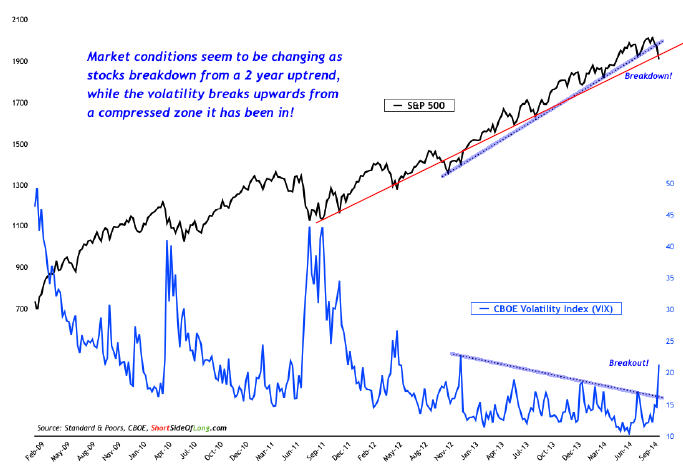
Since hitting an all-time high Sept. 18, the S&P 500 is down 7.4%, thanks in part to its 0.8% slide Wednesday, making for the sharpest pullback for the benchmark since late 2012. Over the past year, however, the S&P 500 remains up 8.2%. (…)
EARNINGS WATCH
From RBC Capital Markets:
- 14.9% of the S&P 500’s market cap (49 companies) has reported. So far, earnings are beating by 5.6% while revenues have surprised by 1.3%.
- Expectations are for revenue, earnings and EPS growth of 4.1%, 5.7% and 7.6%, respectively. Assuming an historical beat rate, EPS will likely come in closer to 10%.
Where Do Stocks Go From Here?
(…) “I think we may have seen the worst of the selloff, but I think the market is going to continue to be volatile here,” said Leo Grohowski, chief investment officer at BNY Mellon Wealth Management, which oversees about $190 billion in New York. (…)
Leo really said: “I have no clue where stocks go from here”.
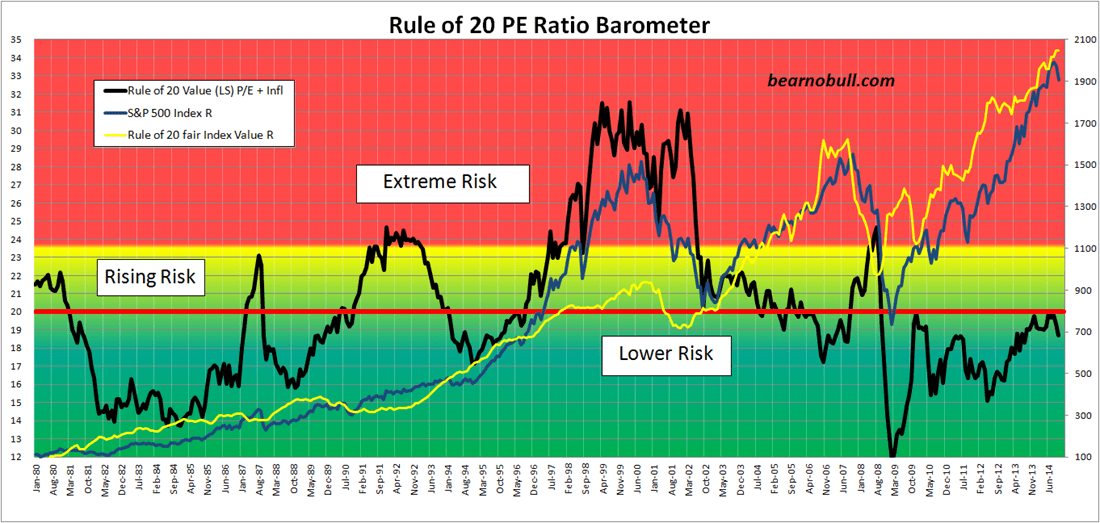
The only way to answer the question is to look at the risk/reward equation. The Rule of 20 P/E is now 18.06, down from 20.0 last June. If it retreats between 16 and 17x like in the last correction, we have another 10% to lose. On current estimates for Q3, we would lose 7%. On the other hand, the current upside to “fair value” is 15% (2106). The last time we had such upside potential was in February 2013.

Market Tumult Squeezes Big Banks
(…) Bank stocks were hammered Wednesday harder than the overall stock market, as investors, surprised by the sudden plunge in yields, questioned rosy scenarios that had forecast that bank earnings would rise along with interest rates next year.
The KBW Bank Index fell 3.34%, its worst drop since November 2012, compared with a 1.1% drop in the Dow Jones Industrial Average. (…) For the year, the Dow is off 2.6%, while the bank index has fallen 4.2%. (…)
Banks had been eager for higher interest rates because the rates they charge borrowers for loans would rise faster than the rates they pay out to depositors. (…)
Wells Fargo WFC -2.01% & Co. said Tuesday that its net interest margin had slid to 3.06% in the third quarter from 3.39% in the third quarter of last year and 4.27% in the first quarter of 2010. It was the bank’s lowest net interest margin in at least the past three years.
If the rates continue to stay low, Wells Fargo will take a variety of steps, including being “much more vigilant on expenses,” said the bank’s chief financial officer, John Shrewsberry, on a call with analysts to discuss the company’s third-quarter earnings. (…)
On Wednesday, Bank of America’s Mr. Thompson, said: “We continue to remain positioned to benefit as interest rates move higher, particularly from the short end of the curve,” meaning increases in short-term interest rates.
But in response to an analyst’s question, he said that the bank’s net interest income could fall $100 million below the third quarter under a more cautious rate scenario. Bank of America’s stock fell 4.6% on Wednesday. (…)
Mike Mayo, an analyst at CLSA, said that the fear in the markets now is that the U.S. may be sliding into a deflationary environment, similar to what Japan has experienced. This would slow growth even further and cut bank earnings prospects. (…)
Keefe, Bruyette & Woods said in a recent report that it still expects a two-percentage point increase in the Fed’s short-term rates by 2016.
But Keefe Bruyette added that while bank earnings could rise from 3.2% to 5.4% if rates do still rise, they could drop anywhere from 4% to 9.4% in 2016 if they stay low.

BAC bank funded $11.7 billion in mortgages during the third quarter, down from $22.6 billion a year ago. Results were higher than the second quarter, which had $11.1 billion in mortgages.
Netflix Shares Plunge 25% as User Growth Disappoints
With Stock Prices Tumbling, Investors See Fed Pushing Back Rate Hikes
Stock Market Blowout Isn’t Keeping Dallas Fed Leader Fisher Up At Night
“A market correction doesn’t mean the economy is in trouble,” Mr. Fisher said in an interview on Fox Business Network Wednesday. “Without mentioning any companies in particular, prices are getting more rational and some very good companies are even being mispriced to the down side,” he said.

 Below is a very important point to consider. Where oil prices are now, we’re getting to the area where production could be cut off because prices are not high enough to incentivize new development, new production and new drilling.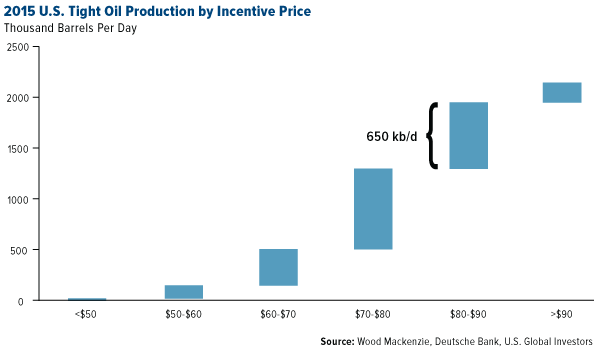


 This is what needs to be watched: