The enemy of knowledge is not ignorance, it’s the illusion of knowledge (Stephen Hawking)

It ain’t what you don’t know that gets you into trouble. It’s what you know for sure that just ain’t so (Mark Twain)

Invest with smart knowledge and objective odds

NEW$ & VIEW$ (10 OCTOBER 2014)

Global growth fears weigh on oil prices Brent benchmark falls below $90 to lowest level since December 2010

(…) Crude has declined sharply since Saudi Arabia cut prices to customers last week, signalling what analysts called a price war among members of the Opec cartel. The US this week reported oil production had hit 8.9m barrels per day, the highest in nearly three decades.

The bearish view was reinforced on the first day of a widely attended industry annual seminar hosted by Pira, the energy consultancy, in New York, said a person familiar with the proceedings. “The vast majority of the participants are bearish and the presentations have been extremely bearish as well. I suspect participants are leaving the sessions and selling,” this person said.

Another factor hastening oil’s fall may have been a large number of outstanding put options for oil, which entitle the holder to sell at a given price. Traders that had sold puts to clients were forced to sell futures to hedge risks as Brent broke below $90, pushing prices lower, market participants said. (…)

Saudi Arabia absorbs lower oil prices

(…) For better or worse, the consensus view is that Saudi Arabia is trying to grab (or at least protect) market share by maintaining production and lowering its official selling prices to Asia – arguably the only growth market for oil. (…)

But some oil market watchers are not convinced by this explanation. They think there is more to Saudi Arabia’s reluctance to lower production.

Conspiracy theory 1:

The reason why the Saudis are holding out is because they could be in a tie-up with the US, in a bid to hurt Russia amid the crisis in Ukraine. The drop in oil prices has meant a big hit to Russian government coffers. Half of the Kremlin’s revenues are generated by oil and oil-indexed gas exports (which make up two-thirds of all Russian exports).

Problem here is that the US too needs higher crude prices to sustain its unconventional oil production.

Conspiracy theory 2:

On the other side of the spectrum there is the argument that this is an attack on the US shale industry, which, some argue, has eroded the importance of Saudi Arabia and other Gulf producers. A sustained slump in the price of oil could put many drillers and others working the US “tight” oil sector in a tough spot, curtailing production.

But this tactic would require a stronger will. Given the large productivity gains in US shale oil production in the past few years much further drops in the price would be needed – at around $85 a barrel – for a longer duration, before the industry’s cost curve is really disrupted. Also, this strategy would only stall production, not halt it completely.

So what is going on? Cooler heads say it is all about discipline within the Opec cartel.

Saudi Arabia has traditionally been the country relied upon to balance the market. When the market was over supplied, Saudi Arabia cut production, and when disruptions occurred (such as with Libya after the Arab Spring and Nigeria as a result of crude theft in recent years) it would pump out more.

Saudi Arabia is no stranger to using its influence and for a long time has shaped Opec policy. But the prospect of greater Opec supplies (from countries including Libya, Iraq and potentially Iran) will mean Saudi Arabia needs to ensure fellow members fall in line with future production targets and cuts, even if their domestic economies remain weak.

German export fall adds to recession worries, but trend not really so bad

Among the chorus of recession forecasters based on superficial analysis, Markit brings its more balanced views:

German exports plunged 5.8% in August, adding to fears that the eurozone’s largest member state is sliding back into recession. The news follows data showing similar slumps in factory orders and manufacturing output.

However, difficulties in estimating for changing holidays urge caution in relying too heavily on the official data, suggesting the August drop overstates the deteriorating trade position and chance of recession. But PMI survey data confirm that a weakening trend is clearly evident, especially in industry and that, if not contracting, the economy is certainly cooling.

Data from the Federal Statistical Office showed the 5.8% drop in exports in August was the largest since January 2010, but the decline was in part due to the timing of school holidays. In many Länder, the holidays were later than usual. Such shifting holiday trends are difficult for standard seasonal adjustment techniques to make full allowance for.

A better indication of the underlying trend can often be gained by looking at the pattern over several months. Some reassurance can be gained from the fact that exports in July and August combined are running 2.0% higher so far in the third quarter compared to the second quarter. However, even this rebound does not provide a true picture of the trend, because the second quarter had also been affected by holidays. Exports rose a mere 0.5% in the second quarter, a period when GDP fell 0.2% and manufacturing output dropped 0.6%, in part due to an unusually high number of public holidays

The true export picture is therefore most likely something in between the steep decline signalled by the August data and the 2.0% growth seen in the third quarter so far. Fears of a recession may therefore be exaggerated.

PMI survey data add further clues as to the business trend in Germany, offering the advantage of tending to be less affected than official data by special factors such as changing holiday patterns. The PMI data suggest that the economy rebounded modestly in the third quarter, but that the recovery is all-too dependent on the domestically-focused services sector. Manufacturing growth slowed to stagnation in September, and goods exports barely rose, according to PMI respondents, staging the worst performance for 14 months. The deteriorating picture from the PMI surveys is one of German industry suffering from headwinds such as sanctions with Russia and ongoing economic malaise in its euro area partners, notably France and Italy.

Even if a technical recession is avoided, policymakers will no doubt be concerned by the loss of momentum in the euro area’s largest member state.

NEW$ & VIEW$ (9 OCTOBER 2014)

Jobless Claims Fall to 287,000
Fed Wary on Weak Global Growth, Strong Dollar Fed officials have become more concerned that weak overseas growth and a strengthening U.S. dollar will crimp the domestic economy and hold down inflation, making them more inclined to stick to low interest rates.

(…) Angst about global growth and the economic impacts of a strong dollar represent a meaningful development in the Fed’s running debate about when to raise short-term interest rates from near zero.

“Some participants expressed concern that the persistent shortfall of economic growth and inflation in the euro area could lead to a further appreciation of the dollar and have adverse effects on the U.S. external sector,” according to the minutes. “Several participants added that slower economic growth in China or Japan or unanticipated events in the Middle East or Ukraine might pose a similar risk.” (…)

There are plenty of benefits from a strong currency. It goes hand-in-hand with capital inflows, which could spur domestic investment and are a signal of a stronger domestic economy. It also tamps down inflation and takes pressure off the central bank to push up interest rates.

But Fed officials have been trying to push inflation up, not down, of late. Consumer-price measures have run below their 2% goal for more than two years, which is why officials could become concerned about a strong dollar’s effects. By pushing up the cost of exports, a strong dollar also hurts the U.S. trade position and growth outlook.

Jon Faust, director of the Center for Financial Economics at Johns Hopkins University and a former Fed adviser, said the stronger dollar has in effect already made U.S. financial conditions more restrictive without the Fed’s doing anything to interest rates. (…)

Sarcastic smile I respectfully beg your pardon. The Fed release was in mid afternoon while the equity rally started at 11:05 a.m. Maybe just a coincidence but iIt so happened that Bearnobull’s New$ & View$ was published shortly before 11:00 and reached subscribers’ mailbox at exactly 11:05. Must have been a relief rally as the post suggested that this was not a 1987 redux. Winking smile

THE U.S. DOLLAR IN THE PROPER PERSPECTIVE

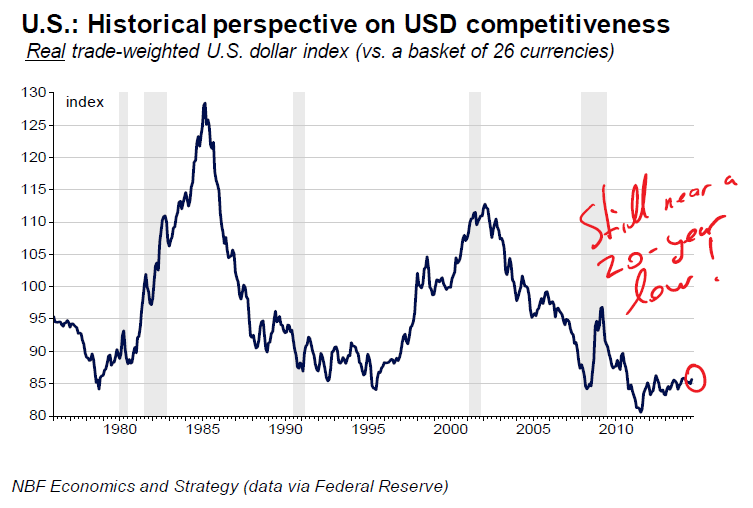
For some investors, a stronger greenback combined with Fed rate hikes is synonymous with a double whammy for the U.S. economy and global growth. At this juncture we think these fears are overblown. As today’s Hot Charts show, the broad USD index is still hovering near a generation low in real terms. As for competitiveness, we doubt very much that a 10%-20% appreciation of the currency would jeopardize the U.S. expansion – exports as a percentage of GDP is the lowest among G7 countries at 14% (compared to 31% on average) – especially if offsetting factors are at work. For one, commodity-consuming countries will most likely welcome the recent declines of food and energy prices, which have coincided not only with a stronger greenback but with a record crop year in the U.S. and an easing of geopolitical tensions. For another, the decline of global bond yields resulting from unconventional monetary policy in the euro zone will help reduce the burden of consumer and government debt and improve the transmission of monetary policy on the real economy. (NBF)

image

Manufacturing Wages Rise Fast in Some States Manufacturing wages are rising rapidly in some big industrial areas as skills shortages and falling jobless rates force firms to pay up to attract workers.

(…) In Texas, wages for all types of production workers in factories grew an average of 6.3% from a year earlier, compared with nationwide overall private-sector wage growth of 2.3%, according to U.S. government data for the three months ended Aug. 31. Factory-wage growth was 4.4% in Washington State, 4% in Oregon and 3.1% in Indiana in that period. (…)

The wage growth applies to a wide range of manufacturing jobs—from machine operators and repair people to electricians and engineers—and not just to specialties such as welding, where shortages are acute. It also comes in spite of two-tiered wage scales in some industries in which new hires start at much lower pay, a practice that has long restrained wage growth. In auto-dominant Michigan, where two-tier wage systems are common, wage growth for manufacturing workers was 2.5% in the three-month period, compared with the national average of 1.6% for manufacturing wages.

Around the country, some manufacturing companies are looking at apprentice programs and offering cash incentives to workers who refer good job candidates. In markets where labor is particularly tight, workers are job hopping for higher pay.

“What we mainly need is welders,” said Terry McIver, chief executive and owner of Loadcraft Industries Ltd., a maker of parts for oil rigs in Brady, Texas. Loadcraft, with more than 400 employees and annual sales of around $80 million, has had to use welders from temporary-help agencies at a cost of around $37 an hour, or nearly double the wage cost for staff welders. Mr. McIver said he is looking at the possibility of buying robotic welding equipment and bringing in workers from Mexico. (…)

Steve Van Loan, president of Sullivan Palatek Inc. in Michigan City, said job hopping is becoming more of a problem. “They get an offer for more money across town, and they’re gone,” he said. Wages on average at his firm, which makes compressors that power drills and other tools, are rising 4% to 5% this year, compared with 2% to 3% in recent years, Mr. Van Loan said. (…)

Job hoppers tend to have much higher wage growth than workers who stay in the same post. Data from the payroll-services firm ADP LLC, released Wednesday, show that hourly wages for manufacturing workers who recently switched to a new employer rose an average of 4.2% in the third quarter. The year-earlier average was 3.6% for such job switchers. (…)

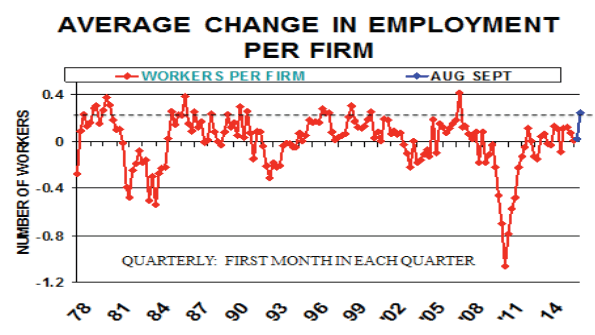
Chart for the FOMC from the NFIB:image

BTW:

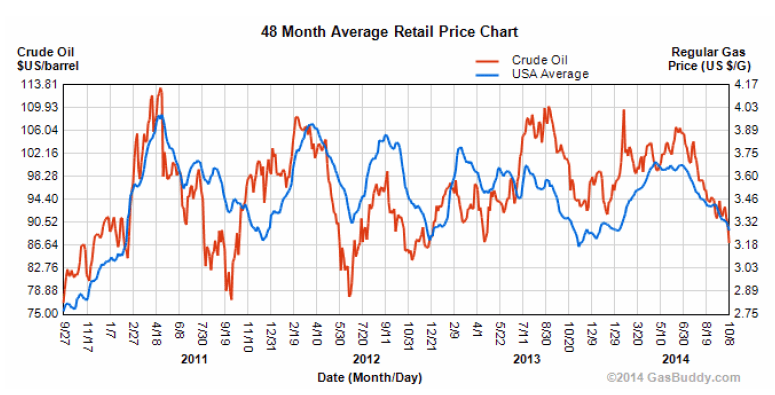
  • Gasoline futures currently suggest gas prices of $3.00 by end of November, a level last seen at the end of 2010.

image

  • Meanwhile, mortgage rates are close to breaking below 4.0% (4.01% on the 30yrs yesterday).

German recession fears mount as exports plunge  German exports plunged in August by their largest amount since the height of the financial crisis and leading institutes slashed their forecasts for growth, fuelling a debate on whether Berlin is doing enough to prop up Europe’s economy and its own.

Exports slumped by 5.8 percent, the biggest drop since January 2009, in the latest sign that Europe’s largest economy is faltering amid broader euro zone weakness and crises abroad that have battered confidence and led German firms to postpone investment plans. (…)

The Federal Statistics Office said late-falling summer vacations in some German states had contributed to a fall in both exports and imports, but the figures still painted a gloomy picture for an economy that until recently was hailed in Berlin as Europe’s “growth locomotive”.

Earlier this week, industrial orders and output data suffered their steepest drops in more than five years.(…)

Is Japan’s Economy on the Verge of a Recession? The “r” word is on the lips of economists again in Japan: Did an April sales tax increase send the world’s third-largest economy into recession?
Rising Dollar Could Hit Tech, Industrials, Says S&P Capital IQ The rising dollar could dent sales results this earnings season, as we wrote today. While analysts say it won’t push results into the red, it could take shareholders of large technology and industrials firms off-guard.

While effect of a rising greenback on company sales is tough to pinpoint, it will probably be small for the S&P 500 on whole, according to analysts at S&P Capital IQ. They found that 2% of third-quarter sales could be lost in translation, when companies report sales made in foreign currencies back into U.S. dollars. That would cut into yearly growth in sales by just 0.1%.

But plenty of large individual firms do a significant chunk of business abroad. Intel, for example, got 56% of its sales from Asia in the last fiscal year, according to S&P Dow Jones Indices.

So the surprisingly strong dollar could lead some firms to miss analysts’ estimates, which sometimes leads to selling. The sectors that are most at risk for surprisingly weak sales are technology and industrials, S&P Capital IQ found. (…)

From Island with a palm tree to Lightning Lightning Lightning Wish us well: flying to Japan, along with this guy: Typhoon Vongfong

Infrared Satellite: Vongfong