Today: U.S. housing: as bad as it looks? China stimulus coming. Corporate 1984. Death crossing. Crash babbles.
U.S. Home Sales Falter as Investors Pull Back The U.S. housing market lost momentum in August as investors pulled away, weighing on existing-home sales and raising doubts about the sector’s underlying strength.
Sales of previously owned homes fell 1.8% from July to an annual rate of 5.05 million, the National Association of Realtors said. That ended four months of gains and pushed sales down 5.3% from a year earlier.
The decline reflected fewer purchases by investors, who helped fuel the housing-market rebound. The share of overall sales that went to investors fell to 12% last month, the lowest level since late 2009. Investors accounted for as much as 23% of sales in early 2012 as they bought up properties, many in foreclosure, at bargain prices. (…)

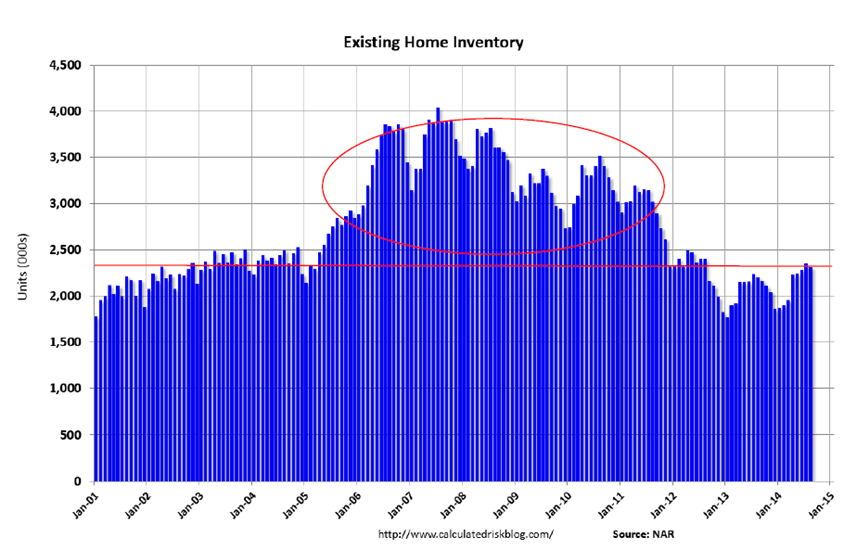
Monday’s report suggested tight inventory may be weighing on sales. The number of for-sale homes has risen 4.5% over the past year to 2.31 million in August, but the level is still low by historical standards. Economists say many prospective buyers want to see more options than the market currently offers before they sign a contract. (…)
These are the same economists who were saying last year that higher mortgage rates would not impact demand much. I am wondering if we are not making too much of the apparent low home inventory, simply assuming that the inventory level of 2006-2011 is “the normal inventory level”. This CalculatedRisk chart suggests that we may well be at the normal level, whatever economists say prospective buyers need.
CR’s calculations point to a stabilisation of “normal demand”:
And another key point: The NAR reported total sales were down 5.3% from August 2013, but normal equity sales were probably up from July 2013, and distressed sales down sharply. From the NAR (from a survey that is far from perfect):
“Distressed homes – foreclosures and short sales – represented 8 percent of August sales, remaining in the single-digits for the second straight month and down from 12 percent a year ago. Six percent of August sales were foreclosures and 2 percent were short sales.”
Last year in August the NAR reported that 12% of sales were distressed sales.
A rough estimate: Sales in August 2013 were reported at 5.33 million SAAR with 12% distressed. That gives 640 thousand distressed (annual rate), and 4.69 million equity / non-distressed. In August 2014, sales were 5.05 million SAAR, with 8% distressed. That gives 404 thousand distressed – a decline of over 35% from August 2013 – and 4.65 million equity. Although this survey isn’t perfect, this suggests distressed sales were down sharply – and normal sales flat or down slightly.
CHINA STIMULUS UNDERWAY
China Beige Book Shows Economy Stuck in Low Gear China’s economy remained stuck in “low gear” this quarter, with struggling retail and residential real-estate industries countering improvements in manufacturing and transportation, a private survey showed.
Growth in investment slowed further, borrowing costs rose and the share of firms applying for and getting bank loans remained at “rock bottom levels,” according to the China Beige Book, a report published quarterly by New York-based China Beige Book International. In contrast, hiring picked up and corporate profit margins improved, suggesting widespread government efforts to reignite growth are unlikely, it said.
“The absence of deteriorating conditions for most firms, both in terms of hiring and margins, does much to explain Beijing’s reluctance to introduce more large-scale stimulus,” Leland Miller, China Beige Book International president, said in a statement with Craig Charney, research and polling director. (…)
China’s biggest banks plan to lower interest rates on home mortgages, state media reported on Tuesday, highlighting Beijing’s concerns about the flagging property market and its impact on the broader economy.
Bankers said the move on its own may do little to prop up the market, but could signal that stronger government action is on the horizon.
China’s big four state-owned banks will allow people to enjoy the discounted rate available to first-time homebuyers, even if the buyer already owns a flat, the official Shanghai Securities News said, citing an unnamed person at a major bank.
The banks will also increase that discount to as much as 30 per cent off the central bank’s benchmark, up from 15 per cent previously, the newspaper reported.
A 30 per cent discount off the People’s Bank of China’s benchmark long-term lending rate of 6.55 per cent implies an interest rate of 4.59 per cent – below the weighted-average rate of 6.96 per cent for all loans.
Moody’s estimates that real estate and related sectors contribute 25 per cent to China’s gross domestic product, and the country’s housing decline has contributed to a broader slowdown in factory output and investment.
“If confirmed, this will be the first time in the past half year that the central government announces supportive measures – not just the local governments – raising some people’s hope that there may be more central government support if the housing market does not recover,” Du Jinsong, a property analyst for Credit Suisse in Hong Kong, wrote in a note. (…)
Not raining stimulus measures yet, but it often begins with a drizzle…
“CORPORATE 1984”:
New U.S. Inversion Rules Drag Down Shares of Deal Targets A handful of companies that investors once viewed as ripe for a takeover by U.S. rivals aren’t looking so attractive after the White House unveiled a sweeping effort at cracking down on cross-Atlantic mergers.
Specifically, today’s Notice will:
· Prevent inverted companies from accessing a foreign subsidiary’s earnings while deferring U.S. tax through the use of creative loans, which are known as “hopscotch” loans(Action under section 956(e) of the code)
· Prevent inverted companies from restructuring a foreign subsidiary in order to access the subsidiary’s earnings tax-free(Action under section 7701(l) of the tax code)
· Close a loophole to prevent an inverted companies from transferring cash or property from a CFC to the new parent to completely avoid U.S. tax (Action under section 304(b)(5)(B) of the code)
· Make it more difficult for U.S. entities to invert by strengthening the requirement that the former owners of the U.S. entity own less than 80 percent of the new combined entity:
From the FT:
The Treasury is cracking down on techniques that allow inverted companies to get access to billions of dollars of offshore cash without paying US tax. One popular technique that involves lending the offshore cash to the new foreign parent will be blocked. Other strategies that result in the new foreign parent taking control of the offshore cash will also be shut down. The Treasury is also plugging some loopholes in its longstanding anti-inversion rules that require shareholders of the foreign partner to own more than 20 per cent of the new company.
- Is the wave of inversions now over?
No. In spite of the Treasury’s grandiose announcement – which came with a public endorsement from President Barack Obama – its measures do not constitute a wide-ranging or irresistible crackdown. This is partly because executive authority is, by definition, more limited than legislation from Congress. “My gut tells me this isn’t going to stop any deals,” says Stephen Myrow, a former Treasury official. “Companies will be able to restructure the deals around it.” Corporate executives, after all, pay their tax lawyers and bankers to stay one step ahead of the rules. That said, the Treasury’s move could have a chilling effect by stirring up another round of anti-inverter publicity, which companies do not want to be caught up in.
For the second week in row, small cap stocks started off the week on a poor note and fell by more than 1%. In the process of today’s decline, the Russell 2000’s 50-day moving average (DMA) crossed down below its 200-DMA. This ‘death cross’ as it has been called, has been getting a lot of talk for its supposed future bearish implications.


CRASH BABBLES
Strangely, as I finalize this, the S&P 500 is in the red at 1987! As we get closer to the end of the dreaded September, scaremongers are raising the specter of a repeat of the 1987 crash. Yesterday, I stumbled on a strange post by one Ben Carlson who seems to want himself reassuring:
(…) Interestingly enough, on a price basis the S&P finished the year basically flat, but on a total return basis, with dividends, was up around 5%. Doesn’t matter — crash, crash, crash is all anyone remembers.
It’s also worth noting that Black Monday didn’t even really derail the market. Here’s the S&P over a six year period from 1987 through 1992:

Now 1987 looks a little more manageable. Still a huge drop, but in the context of a market that was up over 120% or 14% a year from the start of 1987 through the end of 1992, not too bad. No one talks as much about the gains, but investors will always speak of the huge Black Monday crash. This is a classic case of short-term myopic loss aversion overwhelming long-term market gains.
You could actually argue that the 1987 crash was a good thing for the markets. It knocked some of the wind out of its sails after more than doubling from 1982-1986. (…)
This reminded me of this other post, written on October 19, 2012 by Joshua Brown:
(…) October 1987 doesn’t even show up on a monthly chart. I was ten years old, and sure, I didn’t lose any money that day but I’m sure my dad did. And you know what? It didn’t matter, the market came back within weeks – WEEKS – and had no more long-lasting impact on the economy than the May 2010 flash crash, essentially zero impact. There was no accompanying recession leading to the crash or following it. Everyone had a job and commerce was booming all across the country. So Eastman Kodak went down 12 points, BFD.
The Crash of 1987 is one of the biggest non-event events of all time.
(…) the fetishization of a relatively minor, short-term event is a bit overdone. Especially for traders and investors of my generation who have been through the 80% slow-motion Nasdaq crash of 2000 – 2002, which was punctuated by Enron, Worldcom and 9/11. That ’87 sh*t is a joke compared to that. And obviously 2008 is, well, 2008. Nuff said. (…)
Nuff said, indeed. Obviously, at 10, one makes little difference between Fridays and Mondays. At 10, time is meaningless and goes ever so slowly. And money and savings are only concepts. The nearly two years it took to break even seems much less painful when measured in weeks – WEEKS –, assuming one was not so scared during the WEEKS and sold out.
Of course, anybody can plot charts where “a relatively minor, short-term event” does not appear to “even really derail the market”. And it is not because one has lived the Enrons and 2008 that one can better appreciate other “a bit overdone” events.
BTW, one of Mr. Brown’s lessons from “one of the biggest non-event events of all time” is that
It is a reminder that any market sell-offs of greater than 20% must be bought immediately, blindly and without hesitation, regardless of how much worse it seems things may get.
Hmmm. Needless to say, the lessons of 2000-2002 and of 2008 were not enough for him.
I was managing pension fund equities in 1987 and I will always vividly remember Black Monday, as I stood in the trading room, reading the DJ news wire, and my trader said she was seeing NO bids at the opening bell, and over a third of the S&P 500 stocks were not even trading at 10:30 while other stocks were off 20%+ with bid-ask spreads as large as the Grand Canyon. I also lived the Nasdaq debacle and 2008 and they were painful enough. But Black Monday was “special”.
Today, given how individual investors have deserted the market, a repeat of 1987 would be really, really bad.
Nuff said. 
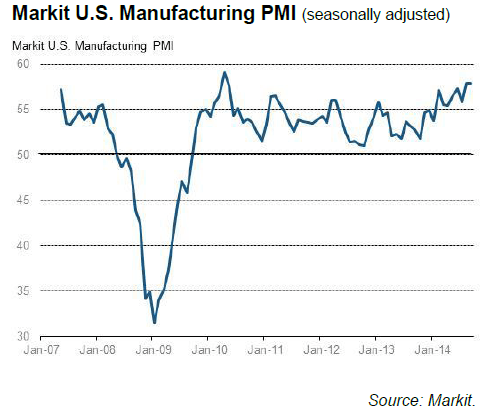
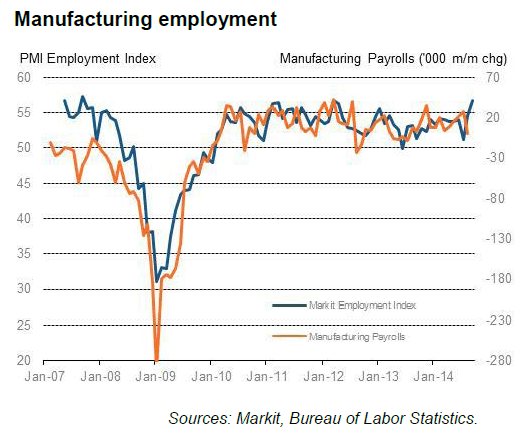
Increased levels of new work from both domestic and export clients contributed to a robust and accelerated pace of job creation in September. Payroll numbers rose at the fastest rate since March 2012 (and joint-strongest rise for seven years), with survey respondents citing improving demand conditions and associated efforts to boost capacity.
 Russell 2000 Bearish Crossovers