The enemy of knowledge is not ignorance, it’s the illusion of knowledge (Stephen Hawking)

It ain’t what you don’t know that gets you into trouble. It’s what you know for sure that just ain’t so (Mark Twain)

Invest with smart knowledge and objective odds

NEW$ & VIEW$ (22 APRIL 2014)

Conference Board Leading Economic Index Increased in March

The Conference Board LEI for the U.S. increased for the third consecutive month in March. This month’s gain in the leading economic index was driven by positive contributions from all the financial and labor market indicators. In the six-month period ending March 2014, the LEI increased 2.7 percent (about a 5.6 percent annual rate), slower than the growth of 3.3 percent (about a 6.6 percent annual rate) during the previous six months. In addition, the strengths among the leading indicators remain widespread.

Click to View

Click to View

No recession in sight.

Chicago Fed: Economic Growth Moderated in March

Led by declines in production-related indicators, the Chicago Fed National Activity Index (CFNAI) decreased to +0.20 in March from +0.53 in February. Two of the four broad categories of indicators that make up the index made positive contributions to the index in March, and two of the four categories decreased from February.

The index’s three-month moving average, CFNAI-MA3, increased to a neutral reading in March from -0.14 in February, marking its third consecutive nonpositive value. March’s CFNAI-MA3 suggests that growth in national economic activity was at its historical trend. The economic growth reflected in this level of the CFNAI-MA3 suggests limited inflationary pressure from economic activity over the coming year.

The CFNAI Diffusion Index increased to +0.04 in March from -0.14 in February. Fifty-one of the 85 individual indicators made positive contributions to the CFNAI in March, while 34 made negative contributions. Thirty-three indicators improved from February to March, while 51 indicators deteriorated and one was unchanged. Of the indicators that improved, nine made negative contributions.

Click to View

Builder’s Weak Results Hammer Hopes for Spring Home-Sales Pickup

NVR, which builds homes under the brands Ryan Homes, NVHomes, Fox Ridge Homes and Heartland Homes, on Monday said its sales contracts signed in the first quarter declined 5.3% from the same period a year earlier. That decline was slightly greater than analysts’ consensus forecast of a 4% drop.

More troubling is that the weak showing came as NVR boosted its count of communities where it is building by nearly 11%. That means NVR’s sales on a per-community basis – which, akin to retailers’ same-store sales figures, is a measure closely watched by investors – declined by 14%.

Together, the readings offer the latest evidence that the spring selling season– a crucial period for sales because families typically want to lock into a school district by the end of summer—will fail to meet industry expectations. (…)

NVR’s first-quarter struggles bolster the theory that more than just bad weather hampered the housing market in the first quarter. Many observers say that lofty home prices, still-tight mortgage qualification standards and the sluggish economic recovery are hindering both new and existing home sales.

“If anything, [NVR’s results] probably tell you that the spring season so far is lukewarm,” said Alex Barron, president of Housing Research Center. “In all of the markets that we track, the first couple of months [of the year] were weak, March was significantly better and April so far seems to be so-so.”

NVR didn’t fully blame its first-quarter shortfall on bad weather. An NVR spokesman declined to comment. But Wells Fargo Securities analyst Adam Rudiger reported in note to clients Monday that NVR executives told him “it was too early to tell if the spring season was simply delayed due to weather or if it was more a sustained period of weakness.”

(…) March typically is the first big sales month of the spring.

Thomas Lawler, an independent housing analyst based in Leesburg, Va., noted that many of NVR’s communities are clustered in the mid-Atlantic states, which suffered harsh weather in the first quarter. However, weather can’t be the only factor behind NVR’s weak quarter, he said. (…)

Ms. Yellen was right, we need more data…

Here’s some advanced data for April:

WEEKLY CHAIN STORE SALES

Chain store sales rose 1.2% YoY in January (4wk m.a), 1.9% in February and 1.1% for March/April combined (to Apr. 19) to account for different Easter timing.

image

Gasoline Prices Rise as U.S. Increases Gas Exports Drivers in the U.S. are facing rising gasoline prices ahead of summer-vacation season, just as refiners here are shipping more gas to other countries.

A new pipeline, built to release a glut of crude oil that was stuck in the middle of the country, is now feeding oil to refineries on the Gulf Coast that churn out gasoline and diesel. While these fuels still make their way to the Southeast and the East Coast, growing amounts are being sold to Mexico, the Netherlands, Brazil and other countries. (…)

Gasoline stockpiles nationwide are at their lowest point for this time of year since 2011, according to the U.S. Energy Information Administration. Meantime, the retail price for a gallon of regular gasoline averaged $3.68 on Monday, up 4.2% from a year ago, according to the EIA. That is the highest price since March 2013. (…)

Total petroleum exports, mostly gasoline and diesel, averaged about 3.6 million barrels a day last week, according to the EIA, up 25% from the same period last year. The figure includes a small amount of oil exports that are allowed by the U.S. government, which effectively banned them in 1975.

Research firm ESAI Energy estimates that the U.S. will become a net gasoline exporter by next year.

(…) Citing low levels of gasoline supplies, some fund managers say pump prices are unlikely to weaken until after the summer vacation season.

As a group, hedge funds and other money managers held $9.3 billion of bullish bets on Nymex gasoline prices, the most in a year, according to the U.S. Commodity Futures Trading Commission. (…)

The EIA expects prices at the pump to average $3.57 between April and September, a penny less expensive than last year, citing lower international oil prices. AAA forecasts gas prices to average between $3.55 and $3.75 a gallon this summer, but if crude-oil prices stay as high as they are, prices at the pump could rise more, Ms. White of AAA said. (…)

Miles driven chart from Doug Short:Click to View

Netflix Previews a Price Increase Netflix said it plans to increase its U.S. prices for new members by a dollar or two.

Netflix said the price increase for the $7.99 a month service, the first since 2011, would help pay for its continued investment in original programs, including series such as “House of Cards” and “Orange Is the New Black.”

That would be a 12.5-25% price increase for Netflix’ 34 million paid subs.

Labor Shortages Pop Up, but Wage Growth Still Lags

One interesting item in the Federal Reserve‘s beige book, released last week, was a report from the Minneapolis Fed that “in the energy-producing areas of North Dakota, the U.S. Postal Service and its union recently agreed to pay increases of up to 20% for rural carriers.” According to the Associated Press, the postal service is having a hard time, competing even with fast-food restaurants to find workers in western North Dakota, the site of the Bakken oil fields and a state with a 2.6% jobless rate.

When demand for labor outstrips supply, wages rise. And the Fed is looking closely at wage trends to determine how much slack there is in the labor markets.

Other enterprises are facing a shortage of some skilled workers. The first-quarter survey by professional-services firm PwC shows 28% of U.S. multinational manufacturers expect the lack of qualified workers will be a barrier to growth in the next year. That is the highest reading since 2007, just as the last expansion was unraveling.

According to the March survey done by the National Association for Independent Business, a net 22% of small-business owners say they have positions they cannot fill right now because there are few or no qualified applicants for the opening. That is up from a single-digit response rate at the start of the recovery.

However, while demand for certain skills is running ahead of supply, for most occupations there remains an excess of labor. Consequently, when it comes to setting pay, the advantage remains with the employer rather than the employee.

For instance, only 12% of the executives polled by PwC think the pressure for increased wages will be a barrier to growth in the next year. The NFIB says a rising share of small businesses are increasing compensation but that is up from a low rate earlier in the recovery, and the percentage is still below the numbers posted in the last expansion.

For the entire private sector, Labor Department data show the yearly growth in average hourly pay has been stuck at about 2% for most of the recovery even as the unemployment rate has fallen. As is true in good times and bad, certain workers are doing much better, while other workers are falling behind. A changing economy creates winners and losers.

Amazon Sales Take a Hit in States With Online Tax

Amazon.com Inc. (AMZN) is taking a hit in states that are collecting an online sales tax.

In one of the first efforts to quantify the impact of states accruing more tax revenue from Web purchases, researchers at Ohio State University published a paper this month that found sales dropped for Amazon when the online charge was introduced. In states that have the tax, households reduced their spending on Amazon by about 10 percent compared to those in states that don’t have the levy. For online purchases of more than $300, sales fell by 24 percent, according to the report titled “The Amazon Tax.”

The findings add to concerns about how much the world’s largest online retailer can expand. The Seattle-based company, which reports quarterly earnings on April 24, has been grappling with decelerating revenue growth amid heavy spending by Chief Executive Officer Jeff Bezos on new initiatives. Amazon has enjoyed an edge against brick-and-mortar retailers because consumers didn’t have to pay a sales tax for purchases from the e-commerce site, yet that has eroded as states including California and Texas have unveiled the levies.

“There is no ambiguity,” Brian Baugh, one of the report’s authors from Ohio State’s Fisher College of Business, said in an interview yesterday. “It has been their competitive advantage.”

The push by states to collect taxes on Internet purchases has gathered momentum in the past few years. Amazon collects sales tax in 20 states, according to its website. More are set to follow as the company has become a popular target to help state governments generate more revenue to cover budget shortfalls; Florida is set to begin charging a tax on May 1. States lose an estimated $23 billion a year in uncollected sales taxes from Web retailers. (…)

Some analysts have previously said the online taxes had a minimal effect on Amazon’s sales. In a 2012 report, Matt Nemer, an analyst at Wells Fargo & Co., said consumers in Texas, which had recently introduced the levy, generally weren’t aware of the tax and doubted it would “materially impact” Amazon’s revenue.

The Ohio State University researchers who wrote this month’s paper tracked the spending of about 245,000 households that shelled out at least $100 on Amazon during the first six months of 2012, and then kept tabs on them through the end of 2013. About a third of the subjects lived in California, New Jersey, Pennsylvania, Texas and Virginia — states where new tax laws were implemented during that time.

In addition to quantifying the sales impact, the researchers also concluded that brick-and-mortar stores didn’t hugely benefit from households reducing their spending on Amazon. That’s because many shoppers simply turned to online alternatives.

In total, brick-and-mortar retailers enjoyed a 2 percent bump in purchases in states that introduced an online sales tax, while competing online retailers got a 20 percent increase, the study found.

The biggest sales uptick — 61 percent for big-ticket items — went to merchants that use Amazon Marketplace. These outfits pay Amazon a fee to offer products through the Amazon website, yet don’t collect taxes. The products are typically available alongside Amazon’s own listings.

That means Amazon still indirectly benefits, since it collects a fee from merchants on its marketplace.

“If they make one extra click on Amazon, they can continue to realize these tax savings while still enjoying the whole Amazon ecosystem,” Baugh said.

Yuan Falls to 14-Month Low

China’s yuan fell to its weakest level in more than a year Tuesday as Beijing signals it isn’t done pushing the currency lower, a move aimed at shaking out speculators who bet on gains and flood the economy with excess cash.

The yuan fell as low as 6.2390 versus the dollar in the afternoon, its lowest level since February 2013, bringing losses for the year to 3% and making it the worst performing currency in Asia. The losses were triggered after The People’s Bank of China set the morning daily reference rate weaker for a third trading session.

Iraq Oil Output Exceeds Hussein Era

The problem: getting it out of the country.

Iraqi oil fields pumped 3.6 million barrels of crude a day on average in February, 50% more than four years ago. That beat—if only for a month—the country’s annual-output record, 3.5 million barrels a day, in 1979 during Iraq’s petroleum heyday.

But Iraq’s government has been slow to modernize the infrastructure to move that oil from wells to tankers. (…) Underscoring the industry’s fits and starts, Iraqi production fell last month by some 340,000 barrels a day, a decline of more than 9% from the February high, according to the International Energy Agency. An attack on an oil-export pipeline in northern Iraq was to blame.

Iraqi officials often order foreign operators to cut output from some of the country’s biggest fields ahead of bad weather or amid equipment breakdowns, Western executives working in Iraq say. “They don’t have the storage,” says Diane Munro, an oil-market analyst at the IEA. “They have problems at the pumping stations.”

The stakes aren’t just high for Baghdad. A global oil market has quietly grown dependent on rising Iraqi supplies. Coupled with the boom in U.S. shale-oil production and oil-sands output in Canada, growing Iraqi production has helped stabilize prices amid climbing global demand and big disruptions in places like Libya and Syria.

The IEA forecasts that Iraq will be the single largest contributor to global-production growth over the next 20 years. The agency is counting on steep Iraqi growth in its long-range price forecasts, predicting the country will produce about eight million barrels a day by 2035. But it warns that if Baghdad falls short of that target by three million barrels a day, global oil prices will be 10% higher than they would have been.

Growing Iraqi output is also crucial for Baghdad and Washington. Oil sales supply about 90% of Iraq’s budget, making them a key pillar of stability.(…)

Infrastructure isn’t the only problem. Bureaucracy, corruption and violence are all getting in the way of increasing exports. Last year, oil-field service companies Schlumberger Ltd. and Baker Hughes Inc. temporarily suspended operations in Iraq amid widespread religious protests.

Shell’s Mr. Njikamp says equipment routinely sits for three weeks at a dock near Majnoon waiting for customs clearance. (…)

Russia Could See Second-Quarter Recession

According to the Economy Ministry, Russia’s economy shrank by 0.5% in the first three months this year compared with the preceding quarter and is on track to post growth of around 0.5% in the whole of 2014.

The Economy Ministry has projected a 1.8% decrease in gross domestic product this year if net capital outflow stays at the levels of the first quarter—more than $60 billion. Mr. Oreshkin said his ministry expected net capital outflow to slow substantially and reach no more than $80 billion.

Speaking of inflation, Mr. Oreshkin said that inflation is set to peak in May or June, reaching 7.5% on the year, and then inflation will gradually subside below 6% in the whole of 2014.

EARNINGS WATCH

S&P updated its database as of April 17 after 84 companies reported. The beat rate is 63% and Q1 EPS are expected at $27.50, up $0.25 from the estimate on April 10 and only $0.10 lower that the estimate at the end of Q1. It’s early but so far, so good…

Factset provides more details:

Overall, 82 companies have reported earnings to date for the first quarter. Of these 82 companies, 66% have reported actual EPS above the mean EPS estimate and 34% have reported actual EPS below the mean EPS estimate. The percentage of companies reporting EPS above the mean EPS estimate is below both the 1-year (71%) average and the 4-year (73%) average.

In aggregate, companies are reporting earnings that are 1.9% above expectations. This surprise percentage is below both the 1-year (+3.1%) average and the 4-year (+5.8%) average.

In terms of revenues, 50% of companies have reported actual sales above estimated sales and 50% have reported actual sales below estimated sales. The percentage of companies reporting sales above estimates is below both the 1-year (54%) average and the 4-year average (58%).

In aggregate, companies are reporting sales that are 0.3% below expectations. This surprise percentage is below the 1-year (+0.3%) average and below the 4-year (+0.6%) average.

The blended earnings decline for the first quarter is -1.3% this week, lower than the decline of -1.7% last week. If this is the final percentage for the quarter, it will
mark the first year-over-year decrease in earnings since Q3 2012 (-1.0%).

The blended revenue growth rate for Q1 2014 is 2.1%, below the estimated growth rate of 2.4% at the end of the quarter (March 31).

At this point in time, 15 companies in the index have issued EPS guidance for the second quarter. Of these 15 companies, 9 have issued negative EPS guidance and 6 have issued positive EPS guidance. Thus, the percentage of companies issuing negative EPS guidance to date for the first quarter is 60% (9 out of 15). This percentage is below the 5-year average of 65%.

Although companies are reporting an earnings decline (-1.3%) for Q1, earnings growth for the S&P 500 is projected to be much higher for the remainder of the year. For Q2 2014, Q3 2014, and Q4 2014, analysts are predicting earnings growth rates of 7.6%, 10.7%, and 11.0%. For all of 2014, the projected earnings growth rate is 8.2%.

Two In Five Americans Now Earn Degrees After High School The steady increase in the proportion of Americans earning degrees after high school graduation continued in 2012 for the fifth straight year.

The jump to 39.4% is an increase of 0.7 percentage point over 2011, according to the annual Lumina Foundation report “A Stronger Nation.” That marked the largest one-year gain in the last five years since the foundation started tracking the figure. The report indexes education completion of Americans 25 to 64 years old.

Educational attainment remains deeply impacted by race and geography. While 44% of whites and 59% of Asians have a post-secondary degree, just 20% of Hispanics and 28% of blacks have one. (…)

From my April 7 post THE U.S. LABOR MARKET: WHERE IS GODOT?

(…) in 2010, nearly 70% of bachelor’s degrees were in social sciences, psychology, visual and performing arts and communication and journalism while less than 25% graduated in engineering (13%), computer sciences (7%) and maths (3%). Americans appear ill-prepared for a new on-going revolution in the job market spurred but the powerful combination of data, software and sensors (…)

Hopefully, these ratios have changed in recent years. From The Economist (The future of jobs, The onrushing wave):

The combination of big data and smart machines will take over some occupations wholesale; in others it will allow firms to do more with fewer workers. Text-mining programs will displace professional jobs in legal services. Biopsies will be analysed more efficiently by image-processing software than lab technicians. Accountants may follow travel agents and tellers into the unemployment line as tax software improves. Machines are already turning basic sports results and financial data into good-enough news stories.

Jobs that are not easily automated may still be transformed. New data-processing technology could break “cognitive” jobs down into smaller and smaller tasks. As well as opening the way to eventual automation this could reduce the satisfaction from such work, just as the satisfaction of making things was reduced by deskilling and interchangeable parts in the 19th century. (…)

NEW$ & VIEW$ (21 APRIL 2014)

U.S. Gasoline Prices Rise to 13-Month High in Lundberg Survey

The average price for regular gasoline at U.S. pumps jumped 8.5 cents in the past two weeks to a 13-month high of $3.6918 a gallon, according to Lundberg Survey Inc.

The survey covers the period ended April 18 and is based on information obtained at about 2,500 filling stations by the Camarillo, California-based company.

Prices are the highest since March 22, 2013. The average is 15.55 cents higher than a year ago, Lundberg said. Gasoline has risen 39.74 cents a gallon since bottoming out in February and is up 43 cents this year.

“The most important factor right now in this rise is crude oil, which rose by a very similar amount to the street-price move,” Trilby Lundberg, the president of Lundberg Survey, said in a telephone interview yesterday. “From here, we will probably see very little increase, if any, with the big caveat of course being crude. If crude prices climb even higher, then this may not be the peak.”

Pointing up An “extremely robust” rise in U.S. gasoline demand may have also helped increase retail prices, according to Lundberg. Demand for the motor-fuel in the last four weeks is up 4.6 percent from the same period a year ago, Energy Information Administration data show.

Here’s the chart, courtesy of gasbuddy.com. Gas prices have jumped 11% since the end of January.image

Data, Anecdotes Indicate ACA Damping Hiring, Wages

Bloomberg economist Richard Yamarone:

(…) Several business people have cited the Affordable Care Act (ACA ) as the primary obstacle to hiring and capital spending. Essentially the ACA forces any business with more than 50 employees working more than 30 hours a week to offer some form of healthcare to its staff. Since reducing staff below 50 is not an option for some restaurant chains, such as Darden Group which employs more than 200,000 people, cutting hours worked is the only viable move. The data support this: hours worked in the retail and leisure and hospitality sectors are below 30 hours a week and hiring has increased in these two industries.

During March, the leisure and hospitality group added 29,000 positions, while retailers increased payrolls by 21,300. Combined, these two industries account for 25 percent of all private workers, so it is a significant percent of the labor market. The data support this trend of increased low-wage hiring in avoidance of the ACA mandate. (…)image

Pretty clear, isn’t it?

Mortgage Lenders Ease Rules for Buyers Mortgage lenders are beginning to ease the restrictive lending standards enacted after the housing boom turned to bust, a sign of their rising confidence in the housing market

Or a sign of weak demand.

(…) One such lender is TD Bank, Toronto-Dominion Bank‘s U.S. unit, which on Friday began accepting down payments as low as 3% through an initiative called “Right Step,” geared toward first-time buyers and low- and moderate-income buyers. TD initially launched the program last year with a 5% down payment. It keeps the product on its books and doesn’t charge for insurance. Borrowers also don’t need to put down any of their own cash if a family, state or nonprofit group provides a down-payment gift.(…)

Valley National Bank, a community bank based in Wayne, N.J., lowered down-payment requirements to 5% from 25% this month on mortgages for certain buyers in New York, New Jersey and Pennsylvania. Next month, Arlington Community Federal Credit Union, based in Arlington, Va., will begin accepting 3% down payments on mortgages up to $417,000, down from 5%.

Low-down-payment mortgages never went away after the housing bust. Instead, they shifted from private lenders to the Federal Housing Administration, which insures loans with down payments of just 3.5%.

Over the past year, however, more than one in six loans made outside of the FHA included down payments of less than 10%, the highest share since 2008, according to figures from data firm Black Knight Financial Services. That still is lower than the nearly 44% of the market they accounted for at the peak of the housing bubble in early 2007. (…

Another sign that banks could get less picky: Credit scores for borrowers seeking conventional mortgages also are easing. Scores on purchase mortgages stood at 755 in March, down from 761 a year earlier, according to data from Ellie Mae, a mortgage-software provider. Those on purchase loans backed by the FHA dropped to 684, compared with 696 one year earlier. (Under a system devised by Fair Isaac Corp., credit scores run on a scale from 300 to 850.)

Smaller lenders are accepting even lower scores. Average credit scores on purchase loans closed through a consortium called LendingTree fell to 679 in March, down from the year-earlier 715.(…)

While smaller lenders are trying to appeal to first-time buyers, larger lenders are gradually reducing down payments for jumbo loans—those too large for government backing—to woo wealthy customers. EverBank began accepting down payments of 10.1% for jumbo borrowers with strong credit this year, down from 20%, and Wells Fargo reduced to 15% from 20% its minimum down payment for jumbos last year. Bank of America made the same change for mortgages of up to $1 million. (…)

Japan posts largest-ever trade deficit Deficit has ballooned wider under Abenomics

(…) The gap between the value of Japan’s exports and that of its imports grew by more than two-thirds in the 12 months through March, to Y13.7tn ($134bn), according to government data released on Monday. It was the third consecutive fiscal year of deficits, the longest streak since comparable records began in the 1970s. (…)

Japanese export volumes have barely risen and the yen value of goods shipped to foreign markets has increased much more slowly than the value of imports.

Exports actually declined slightly by volume in January-March compared with the previous quarter, by 0.2 per cent on a seasonally adjusted basis, according to calculations by Credit Suisse, even as imports grew 4.5 per cent. (…)

Japan’s energy import bill has risen sharply in the wake of the Fukushima nuclear accident in 2011. All of the country’s operable atomic reactors are offline pending safety reviews, robbing Japan of a power source that provided 30 per cent of its electricity before the disaster.

Utilities have been forced to buy more foreign oil and gas to make up the difference, and a weaker yen has made each barrel that much pricier. National fuel imports jumped 18 per cent by value last year, according to Monday’s trade data. (…)

Overall Japanese exports increased 0.6 per cent by volume last fiscal year, Monday’s data showed, leading to a 10.8 per cent rise by value in light of the weaker yen. Imports rose 2.4 per cent by volume and 17.3 per cent by value.

Taiwan Export Orders Grow in March

Taiwan’s March export orders grew at the fastest pace in three months, adding to signs that the island is benefiting from recoveries in developed economies. Export orders, an early indicator of actual exports, rose 5.9% in March from a year earlier to US$37.9 billion, after a 5.7% February on-year rise, the Ministry of Economic Affairs said Monday.

Export orders placed with Taiwan are closely watched as a bellwether for the global economy and particularly the tech industry. (…) In the nine months since July, export orders from Europe and the U.S. rose nearly 4% on year, while those from China, Taiwan’s biggest export market, grew only 1.4%. (…)

In March, orders from Europe rose 8.9% from a year earlier, picking up from 1.3% on-year growth in February. Orders from Japan rose 18%, which was an improvement from February.

Sad smile Orders from the U.S. were up 1.0%, following February’s 2.3% rise. Orders from China and Hong Kong rose 3.1% in March, slowing from February. Demand from China tapered off in March as China’s recent economic data pointed to weaker growth.

Orders for electronic products including semiconductors—roughly a quarter of total orders—rose 10.1%, following a 15.4% increase in February.

Orders for information and communication products like smartphones and components—also about a quarter of orders—gained 8.6% from a year earlier, after rising 3.2% in February.

New Tax Bug Bites Tech Firms First-quarter corporate earnings are getting clipped after Congress allowed a key tax credit to expire at year-end. Google is among the latest to cite the expired research-and-development tax credit for affecting its financial results.

The Internet search company Wednesday reported a first-quarter tax rate of 18%, up from 16% for all of 2013. Chief Financial Officer Patrick Pichette called out the expired credit on a conference call as one of the reasons for the higher rate.

If Google’s tax rate had remained 16%, its first-quarter earnings per share would have been $5.50, instead of the $5.33 Google reported.

Google isn’t the only one warning investors about a higher tax rate as a result of the expired credit. A spokeswoman for software maker Citrix Systems Inc. CTXS +0.16% said the expired credit is one reason the company projects its tax rate this year will increase to 19% from 13%. Set-top box maker Arris Group Inc.ARRS +1.92% said its per-share earnings will be 12 cents lower over the course of 2014. Analysts have projected 65 cents per share for the company, according to Capital IQ.

Others companies that have cited the tax impact of the expired credit include tool maker National Instruments Corp. NATI +0.88% , chip maker Atmel Corp. ATML +1.66% and spice maker McCormick MKC -0.21% & Co.

In most cases, the effect of the expired credit will be small. Semiconductor company Intel Corp. INTC +0.41% is one of the nation’s biggest spenders on research and development. A spokeswoman says the credit is typically worth more than $150 million a year to the company. Intel in 2013 reported net income of $9.6 billion.

The R&D tax credit, first enacted in 1981, has lapsed nine times since then. But it has always been renewed, with the credit typically made available retroactively.

Most recently, Congress renewed the credit in January 2013 and allowed companies to claim it retroactively for 2012. The credit had previously expired at the end of 2011.

That led to an accounting quirk early last year where many companies could claim five quarters of the credit in the first quarter of 2013.

Earlier this month, the Senate Finance Committee proposed renewing and expanding the credit through Dec. 31, 2015. The Senate proposal would expand the credit to let small companies—many of whom aren’t profitable and don’t pay income taxes—apply the credit to payroll taxes. (…)

Banks warn as low rates squeeze returns Average net interest margin falls to 2.64% at biggest US banks

(…) For the biggest four US banks with major consumer lending businesses, Wells Fargo, Bank of America, JPMorgan Chase and Citi, the average net interest margin fell to 2.64 per cent in the first quarter, the lowest level in at least a decade, according to data compiled by Keefe, Bruyette & Woods and SNL Financial.

The continued decline is surprising analysts who expected the Federal Reserve’s withdrawal of economic stimulus to lead to higher rates and better profit margins at the biggest US banks.

“There’s no sign that there’s a bottoming out in the Nims yet,” said Frederick Cannon, a bank analyst at Keefe, Bruyette & Woods. “What we’ve seen is tapering not having the effect that was expected.”

The yield on US 10-year Treasury bonds has fallen from 3 per cent in January to 2.7 per cent, even as the Federal Reserve has reduced its bond purchases. (…)

Rates on US Treasuries fell in the first quarter as there was higher demand from large pension funds and political turmoil in Ukraine spurred a shift to safer assets.

Banks’ other lever to improve margins – paying less to customers for deposits – has proved difficult because they are already so close to zero given the prolonged period of low rates since the financial crisis.

John Gerspach, Citi’s chief financial officer, told analysts last week: “We expect our net interest margin to decline by several basis points, likely followed by a modest increase in the back half of the year.”

Bruce Thompson, finance chief at BofA, said: “You would expect to see the Nim in the second quarter moderate a little bit.” (…)

At Wells Fargo, the total average loan yield fell 7 basis points in the first quarter from the previous quarter while the Nim fell to a low of 3.18 per cent.

The net interest margins of 33 US banks that have already reported their earnings fell by a median 3 basis points in the first quarter to 3.38 per cent, according to KBW Research and SNL Financial, showing that Nims have not quite ended their downward slide. (…)

Italy Cuts Taxes to Boost Economy

Italy’s government on Friday approved the country’s first extensive income-tax cuts in more than a decade, a move expected to give up to €80 a month in extra cash to three-quarters of the workforce.

The cuts are worth €10 billion ($13.8 billion) over a year and will go into effect next month. Prime Minister Matteo Renzi has said the measure is aimed at voters heading to the polls for the European Parliament elections in May. It is also meant to boost domestic demand and ease Italy’s dependence on export-led growth as foreign demand shows signs of slowing.

Mr. Renzi, whose center-left Democratic Party is currently enjoying record-high support in opinion polls, is making a high-stakes bet with the move, given his administration hasn’t identified all the budgetary savings required to fund the tax cuts on a permanent basis.

“These aren’t one-off tax cuts, they’re structural,” Mr. Renzi said.

He outlined €6.9 billion in targeted measures that would help lessen the impact on the state’s finances. Among them are plans to implement a maximum salary cap of €240,000 for public servants and €2 billion in savings on government purchases.

The government will also oblige local administrations to cut spending and make all their expenditures public. Otherwise, they face reduced transfers from the central government. (…)

The income-tax cuts will result in up to €1,000 in additional annual take-home pay for workers with salaries of up to €28,000 a year. Italian employees typically face tax rates of 50% and higher when the country’s stiff payroll contributions are included. The government hopes that by targeting the tax cuts at the medium and lower end of the wage spectrum they will boost consumption, which the Bank of Italy said remains 7% below its level in 2007. (…)

Sleepy smile Obama Extends Review of Keystone

The Obama administration is indefinitely extending its review of the Keystone XL pipeline, likely delaying a decision on the project until after November’s U.S. midterm elections. (…)

SENTIMENT WATCH
  • Why This Bull Market Feels Familiar It Has Lots in Common With the ’90s Rally, but With Stronger Headwinds

(…) The middle of the 1990s in particular was especially good for investors, with stocks posting big gains despite a slow-growth economy dubbed the “jobless recovery.”

“While hoping the finale doesn’t also repeat, we are seeing a lot of similarities between today’s environment and the mid-1990s,” says Liz Ann Sonders, chief investment strategist at Charles Schwab.(…)

From 1990 through 1999—when the Internet stock bubble began to dominate the market—the S&P 500 more than tripled.

Much of those gains came in the years from 1995 through the end of 1998, when the S&P 500 rose an average of 28% a year. The stock market became dominated by a “buy the dip” mentality. Optimistic investors saw every downturn as an opportunity to buy more stocks—until the spring of 2000, when the dip turned into a crash.

“One similarity, which is also a lesson for today, is that there weren’t many pullbacks,” says Robert Doll, chief equity strategist at Nuveen Asset Management. Another dynamic, Mr. Doll recalls, is that before the tech bubble, leadership of the rally would rotate among sectors. That’s something that has been the case of late, he says. A concern among some investors is that it will be difficult for the rally to continue, with valuations having risen sharply over the past year.

In the mid-1990s, however, valuations were only slightly higher. From 1995 through the end of 1997, stocks in the S&P 500 traded at an average of 17.9 times the previous 12 months’ earnings, according to Standard & Poor’s. Today, the S&P 500 is at 17.4 times trailing earnings.

Ms. Sonders says the economic backdrop of the mid-1990s echoes today’s. “Like then, we are in a post-financial-crisis period accompanied by a ‘jobless,’ disinflationary recovery,” she says.

Of course, today’s economy is facing more significant headwinds than those that followed the savings-and-loan crisis of late 1980s. The July 1990-March 1991 recession was relatively shallow and short.

But like today, in the mid-1990s investors worried about the slow pace of employment growth and the prevalence of low-paying jobs among those positions being created.(…)

Aside from the 1997-98 Asian financial crisis, which sent a scare through global financial markets, the main hiccup for stocks came in 1994.

The cause was a jump in bond yields as the Federal Reserve began to raise interest rates faster than had been expected. From the end of January 1994 through the end of June, the S&P 500 lost 7.8%.

But that didn’t end the bull market. “If rates go up in line with improvement in the economy, that’s a good market environment for stocks,” says Ms. Sonders.

The lesson for investors today is that rising rates may pose a hurdle, but don’t have to mean the end of a bull market, says Mr. Piantedosi. “Once the Fed did what they needed to do with rates, we took off from there,” he says.

Still, Fed policy in the 1990s looked nothing like today’s stance at the Fed.

And there are other headwinds today that didn’t exist in the 1990s, Ms. Sonders notes. Profit margins are higher today, making it harder to generate profit gains. And economically, income inequality is greater now than two decades ago.

Another difference from the 1990s is that many stock investors are still wary after the bear markets of the early 2000s and the financial crisis.

Ultimately, whether stocks continue their bull market will depend on the fundamentals, not just similar charts, says Mr. Doll. “In order to get continued decent markets, I do think we need to see some more improvement in the economy and earnings growth,” he says. “But I think we’ll get it.”

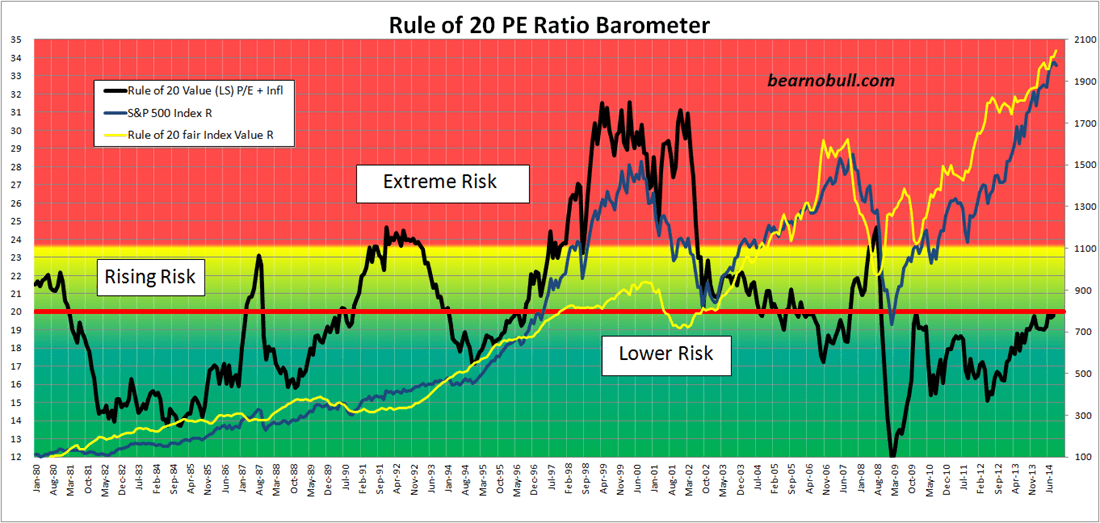
Punch In reality, as the chart below clearly illustrates, the end of the 1990s was actually a once-in-a-lifetime event. After the mild 1990 U.S. recession, valuations rose above the “20 Fair Value” line early in 1991 and equities returned some 5% annually until mid-1994 when the Rule of 20 P/E dropped below 18. Earnings jumped 40% during the following 30 months under stable 2.5% inflation, bringing the Rule of 20 P/E back to 20 by December 1996. Equities then roared ahead 25% during the next 9 months, crossing the yellow/red border into what Greenspan called “irrational exuberance” which brought the Rule of 20 P/E to 31.5.

image.

Two major events characterized the 1995-2000 period:

  • profits rose 65% over 5 years while inflation declined from 3% to 1.5% (Oct. ‘98)
  • the growth of the internet mesmerized investors to the point where everything that was even remotely internet-related got valued into the stratosphere.

I can’t say whether the current social media craze will develop like the internet craze but I doubt that S&P 500 profits can jump 65% over the next five years without a meaningful acceleration in inflation. Recall that the rise in profit margins from their trough in 1991 to their peak in early 1998 accounted for 55% of the earnings advance during that period. The margin effect has been played out this cycle as EBIT margins troughed at 9.5% in 2009 and peaked at 15% in 2011, edging down to their normal cyclical high of 14% since. Profit growth is thus more likely to grown in line with nominal GDP growth until the next cyclical downturn.

It is also doubtful that inflation will decline much from current levels. In fact, it is much more likely to rise, if only because that is what the world’s major central banks are openly targeting. Similarly, we should also expect that long-term interest rates will rise over the next few years as tapering continues and inflation accelerates. That would be contrary to the drop in Treasury yields from nearly 9% in mid-1990 to 4.5% at the end of 1998.

In all, if this bull market feels familiar, it is only because of the growing cheerleading from the media and because of what follows. Please read on:

(…) More than 85% of investors are feeling optimistic about the investment landscape, and 74% think stocks have the greatest potential of any major asset class, according to a survey of 500 affluent investors released Monday by Legg Mason Global Asset Management. The survey was conducted in December and January. (…)

Lance Roberts comments:

However, the idea that individual investors are still “out of the market” should be taken with a bit of caution. The chart below is data compiled by the American Association of Individual Investors (AAII) which surveys it membership on portfolio allocation.  The data is compiled and released monthly.

With cash hovering at the lowest levels since the “Tech Wreck,” and equity exposure at the highest, investors are more than just “warming up” to equities. They are effectively“all in” with respect to the financial markets. An analysis of investor sentiment (both professional and individual) and rising leverage confirm the same. 

What is clear in all of this analysis is that investor behavior tends to be exactly the opposite of what it should be. (…)

  • Mutual Funds Moonlight as Venture Capitalists BlackRock, T. Rowe Price Group and Fidelity Investments are among the mutual-fund firms pushing into Silicon Valley at a record pace, snapping up stakes in high-profile startup companies.

Last year, BlackRock, T. Rowe, Fidelity and Janus Capital Group Inc. together were involved in 16 private funding deals—up from nine in 2012 and six in 2011, according to CB Insights, a venture-capital tracking firm.

This year, the four firms already have participated in 13 closed deals, putting 2014 on track to be a banner year for participation by mutual funds in startup funding. On Friday, T. Rowe was part of an investor group that finished a deal to pour $450 million into Airbnb, said people familiar with the matter.

Last week, peer-to-peer financing company LendingClub Corp. raised $115 million in equity and debt, the bulk of which came from fund firms including T. Rowe, BlackRock and Wellington Management Co.

Investors put money into venture-capital funds knowing it is a bet that a few untested companies will become big winners, making up for many losers. But mutual funds, the mainstay of the U.S. retirement market with $15 trillion in assets, aren’t typically supposed to swing for the fences. Instead, they put most of their money into established companies with the aim of making steady, not spectacular gains. (…)

But these deals are more opaque than most fund investments: Fund firms aren’t required to immediately disclose such investment decisions to investors, and privately held companies are also more challenging to value, making it more difficult to gauge how a stake is performing. (…)

Hmmm….