The enemy of knowledge is not ignorance, it’s the illusion of knowledge (Stephen Hawking)

It ain’t what you don’t know that gets you into trouble. It’s what you know for sure that just ain’t so (Mark Twain)

Invest with smart knowledge and objective odds

NEW$ & VIEW$ (30 JULY 2014)

Home-Price Growth Slows

A survey covering 10 major U.S. cities increased 9.4% in the year ended in May, said theS&P/Case-Shiller Home Price Index survey released Tuesday. The 20-city price index increased 9.3%.

On an unadjusted basis, the 10-city index and the 20-city composite each increased 1.1% in May over April. Seasonally adjusted, both indexes declined 0.3%.

Consumer Confidence Surges

Generally pretty useless because it is coincident but these breakdowns are interesting:

image

image(Haver Analytics)

U.S., EU Turn Up Heat to Punish Russia Over Ukraine The U.S. and the European Union adopted sweeping economic sanctions against Russia to punish Moscow’s unbending stance in the Ukraine conflict.

The trade and investment restrictions that EU governments, after much agonizing, agreed upon mark a major escalation of sanctions against Russia, which so far have been mostly token measures targeting individuals. New measures hitting Russia’s banks, oil industry and military could increase financial strains in its already sluggish economy while withholding technology that the nation’s modernization relies on.

The U.S. followed the EU’s move by announcing similar sanctions against Russian banks as well as the energy, arms and shipping sectors.

(…) Despite the growing economic squeeze on Russia—with its unpredictable fallout for the EU’s own markets, trade and growth—many EU officials believe they have only limited influence over the Kremlin.

Some EU officials voiced fears on Tuesday that Mr. Putin appears to be preparing Russians for international isolation. In Russia too, analysts said Mr. Putin was more likely to increase aid to the rebels in Ukraine in response to Kiev’s military offensive than he was to back down.

“There are no signs that we will soon get another chance to find a political solution” to the Ukraine conflict, said Gernot Erler, the German government’s coordinator for Eastern European issues. The governments in Moscow and Kiev are both “digging in,” he said.

(Bespoke Investment)

 
Banks in Euro Zone Ease Credit Standards

According to the ECB’s quarterly bank-lending survey, credit standards on loans to businesses eased for the first time since 2007. The difference in the percentage of banks reporting tighter lending standards and those reporting looser ones was -3%, the ECB said. That compared with a slight net tightening in the first quarter.

Bank lending to households and businesses was down 1.7% compared with a year earlier, the ECB said last week. That compared with a 2% annual decline in May. The improvement from May was due to a slight pickup in lending to households and a more modest drop in business lending.

According to Wednesday’s survey, banks continued to make it easier for households to obtain loans. Meanwhile, “net demand continued to be positive for loans to both enterprises and households and recovered further,” the ECB said.

Spain Growth Beats Bank of Spain Estimate Even as Prices Fall Spanish second-quarter growth beat the Bank of Spain’s estimate as economists say domestic demand supported a recovery in the euro region’s fourth-largest economy even as prices fell this month.

The Madrid-based National Statistics Institute today said that gross domestic product rose 0.6 percent from the first quarter, more than the forecast of 0.5 percent released last week by the Bank of Spain. Consumer prices fell 0.3 percent from a year ago in July, INE said in a separate release.

Households had no savings in the first quarter for the first time since the start of the series in 2000, INE data showed on July 2. Gross available income fell 2.7 percent from a year ago while spending rose 1.9 percent, it said.

Pointing up Spanish retail sales rose in June from a year ago by 0.2 percent, INE said yesterday. That’s the third straight month it’s increased, and the longest period of gains since 2007.

But Spanish retail sales sank 0.7% M/M in June after jumping 2.1% in the previous 2 months. (Chart from Haver Analytics)

large image

Bonds Surge From U.S. to Germany on Outlook for Record-Low Rates Bonds are rallying from the U.S. to Germany to Australia amid speculation the Federal Reserve will disappoint investors looking for signals it’s moving closer to raising interest rates from a record low.
image
David Bowers: 3 reasons why the bond bull market is ending

(…) First, we believe that a major regime shift in the conduct of monetary policy is under way, with negative implications for bonds. (…)

They now need central banks to adopt “debtor friendly” monetary regimes committed to robust nominal GDP growth, and tolerant of higher wage growth. This is no longer a world where inflation is capped at 2 per cent; it is one where 3-4 per cent inflation is openly discussed .

The second reason why yields may have troughed is that the US labour market is tightening faster than expected. (…)

True, payrolls have not grown as rapidly or as dramatically, which suggests some impact from a declining participation rate. But what is striking is how the short-term unemployment rate (people out of work for less than six months) is just 0.7 percentage points away from its all-time low.

This has been an important leading indicator of wage growth. It would not surprise us if wages grew in excess of 3 per cent in 2015 – consistent with recent National Federation of Independent Business surveys that show US firms under growing pressure to raise compensation.

Stronger wage growth and an unemployment rate below 5.5 per cent are likely to bring forward expectations of a normalisation of US monetary policy. The more the Fed drags its feet, the more twitchy bond investors could get.

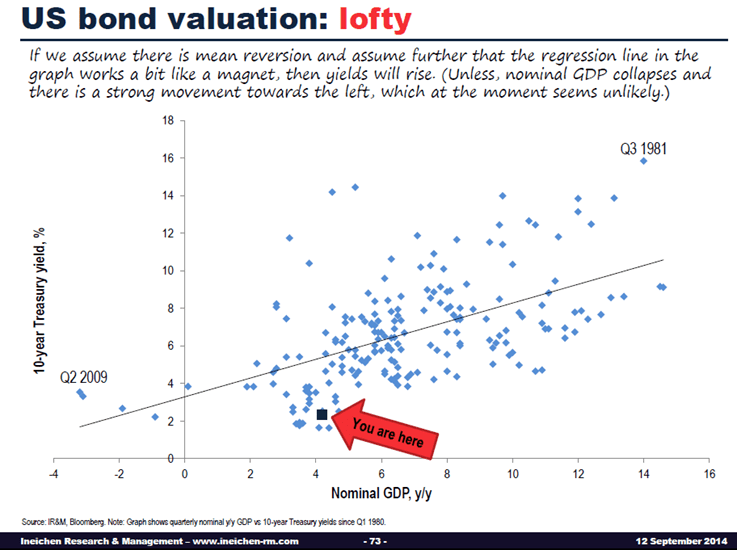
The third reason is that bond yields are starting to be constrained by their historical relationship to trend core inflation and to trend nominal GDP. Over the past 40 years, 10-year yields have never gone below trend core inflation (defined as its five-year compound average growth rate) apart from a brief moment in 2012.

With trend inflation currently 1.7 per cent and rising, it looks unlikely that yields will fall back to 2012’s 1.4 per cent trough. But, more importantly, yields are starting to be constrained by trend nominal GDP. For 45 years they have rarely traded below 70 per cent of trend nominal GDP, or more than 40 per cent above it.

This relationship has survived five years of quantitative easing, and currently indicates a floor for yields at around current levels. Should trend nominal GDP head towards 5 per cent, we would expect that “floor” to move up towards 3.5 per cent. (…)

Mohamed El-Erian: Preserve gains against market shakeouts

(…) However, high market valuations render investor portfolios more vulnerable to policy mistakes, market accidents and exogenous shocks. To help protect themselves, investors should consider enhancing the resilience of their portfolio management, in four ways.

First, when it comes to continuing to generate attractive risk-adjusted returns, sector- and security-specific portfolio differentiation (or what is known as “alpha” in the marketplace) is now even more important given the more limited scope for positive market-wide moves (“beta”). Investors need to be more event driven, including opportunities related to M&A (which will continue to grow to levels not seen since the global financial crisis) and disruptive technologies.

Second, rather than benefit from Fed actions, some foreign markets have struggled to navigate adverse spillover Fed effects. Within this group, the better-managed emerging economies (such as Mexico), as well as those likely to respond better after initial slippages (such as Brazil) remain attractive, warranting greater global diversification of equity portfolios with excessive home bias.

Third, and more generally, investors need to resist the temptation of adding risk based only on relative valuations. They also need to ensure the risk they are taking is warranted by current market prices. If they fail to do so, they will end up exposed to what investors in high-yield bonds have discovered the hard way in recent weeks – namely, how an obsession with relative values leads to overextended absolute valuations and, subsequently, discomforting market corrections.

Finally, this is the time to build greater flexibility in asset allocations. This can take the form of larger cash buffers, cash equivalents and other short-dated liquid bonds, all of which facilitate portfolio repositioning to exploit what is likely to be a series of quite indiscriminate market shakeouts.

For more sophisticated investors, this can be achieved through option positions that monetise as market volatility picks up and valuations dip.

EARNINGS WATCH

We are now two-thirds into the season as 66% of the S&P market cap have reported (281 companies). RBC Capital now sees EPS up 8.9% Y/Y (8.8% yesterday). Ex-Financials: +3.9%.

Consensus was +4.9% heading into the quarter.

NEW$ & VIEW$ (29 JULY 2014)

U.S. Pending Home Sales Slip The number of contracts signed to buy previously-owned homes slipped in June, a sign the housing recovery remains choppy despite a retreat in interest rates.

An index of pending home sales, reflecting purchases under contract but not yet closed, fell 1.1% to a reading of 102.7 in June from May, ending three months of gains, the National Association of Realtors said Monday. Compared with a year ago, pending-home sales were down 7.3% last month.

Monday’s report showed pending sales in June fell 2.9% in the Northeast region, rose 1.1% in the Midwest, fell 2.4% in the South and were mostly flat in the West. (Chart from Haver Analytics) large image

Businesses and households are increasing their leverage

The latest PMI surveys for the U.S. suggest that economic activity was strong in July in both the manufacturing and service sectors. Be that as it may, some investors are becoming concerned that the new production will only end up in inventories because of lacklustre spending by businesses and households. Such a development would of course jeopardize the outlook for growth and profits. Fortunately, the latest data for U.S. commercial banks are consistent with increased spending, not less. As today’s Hot Charts show, loans & leases remain on a significant uptrend in July. What’s more, the improvement is widespread with both consumer and commercial & industrial loans showing sizeable increases. Our view is that increased leverage is a necessary condition for the economy to grow above potential in H2 2014 So far so good. (NBF)

image

Here’s why:

NORTH AMERICAN CONSUMER CONFIDENCE RISES

Nielsen’s latest consumer survey reveals a marked change in financial conditions and spending intentions in North-American consumers:

Almost half of Americans (49%) believed it was a good/excellent time to spend, which is the highest level reported since 2006 and up 6 percentage points from the first quarter of 2014 (43%). Optimistic perceptions of job prospects and personal finances also rose in the second quarter. While the outlook for jobs (46%) was still below pre-recession levels (63%), the sentiment represents a significant improvement from 2009, when it was at 20 percent. Almost two-thirds of U.S. respondents (64%) said their personal finances were in good order, a rise of 5 percentage points from the first quarter.

image

In Canada, 62 percent of respondents were optimistic about personal finances, and 46 percent indicated positive buying intentions, up 5 and 4 percentage points from the first quarter, respectively. However, the outlook for jobs trended slightly downward, declining 2 percentage points to 50 percent.

This slow grind must be helping (from Sentier Research):

INFLATION WATCH
Wage growth picking up in some sectors

(…) Pay hikes have picked up in sectors such as leisure and hospitality, business services, construction and retail, Labor Department figures show. (…)

Wages in leisure and hospitality were up 2.7% in June from a year ago, vs. a 0.6% annual increase in June 2013. Hotels have benefited from a surge in both business and vacation travelers, pushing occupancy rates to pre-recession levels, says Randy Pullen, CEO of WageWatch, a consulting firm. He cited intensifying competition for front desk agents and housekeepers.

“The opportunity for advancement and earning well above minimum wage is ripe in our industry,” says Katherine Lugar, CEO of the American Hotel and Lodging Association.

Other sectors lifting pay:

• Salaries for professional and business services — a category that includes architects, engineers and accountants — were up 2.4% in June from a year ago, vs. a 1.6% annual rise in June 2013.

• Annual construction industry raises averaged 2.2% in June, vs. 1.6% a year ago. Thousands of construction workers left the industry after the mid-2000s real estate crash, leaving a shortage in many areas as housing picks up.

• In retail, annual raises averaged 2.2% last month, up from 1.8% a year ago. As in other industries boosting pay, retail unemployment has fallen sharply the past year — to 5.9% from 7.3% for the sector.

Wage growth often lags a decline in unemployment by a year, so bigger gains lie ahead, Dales says.

Another positive omen: Annual raises for the top 20% of sectors with the highest pay averaged 3% in May, nearly double the year-ago rate, says Wells Fargo economist Jay Bryson. “We believe it’s going to spread,” he says.

Pay up! The companies charging you more

Inflation is mild? That’s what the government says, but investors paying attention to earnings calls are hearing something they haven’t heard in a awhile: Some bold companies are raising prices.

Companies aren’t required to disclose price hikes, but attentive investors can find clues of where they’re happening. Companies like burrito chain Chipotle (CMG), cigarette maker Philip Morris International (PM) and health-care goods seller Allergan (AGN) told investors during second-quarter conference calls how they’ve been successfully jacking up prices or selling more high-priced items.

At least 11 companies in the Standard & Poor’s 500 mentioned raising prices during conference calls over the past three weeks. The number is relatively small, but investors hope there’s more to come, since it’s still early in the reporting season and more than half the companies in the S&P 500 have yet to report.

Price increases could be a major boost for corporate profit. The ability to raise prices is a major shift investors have been hoping for throughout the recovery. Much of the earnings gains during the recovery have been due to cost cutting. But if companies are finally in the position to increase prices, that could give the bottom line at companies a whole new driver. (…)

The companies that talked about prices during the past three weeks — saw their gross margins rise 2.6%. That well outstrips the 0.2% decline in gross margins by the 181 non-financial companies that have reported second quarter results so far. (…)

BTW, Transforce Inc., a Canadian trucking company operating throughout North America, revealed last Friday that it is now finally seeing pricing power, confirming findings by Cass continually reported here (last time within NEW$ & VIEW$ (8 JULY 2014)).

Truckload linehaul price index

Punch Fed’s Richard Fisher: The Danger of Too Loose, Too Long

(…) Some are willing to tolerate the risk of financial instability because the Fed has yet to fulfill the central bank’s mandate of “promot[ing] effectively the goals of maximum employment and stable prices.” Where do we stand on those two fronts? Answer: closer than many think.

While it is difficult to define “maximum employment,” labor-market conditions are improving smartly, quicker than the principals of the Federal Open Market Committee expected. The commonly cited household survey unemployment rate has arrived at 6.1% a full six months ahead of the schedule predicted only weeks ago by the central tendency of the forecasts of FOMC participants. The U.S. Bureau of Labor Statistics’ so-called Jolts (Job Openings and Labor Turnover Survey) data indicate that job openings are trending sharply higher, while “quits” as a percentage of total separations continue to trend upward—a sign that workers are confident of finding new and better opportunities if they leave their current positions.

Wages are beginning to lift. Median usual weekly earnings collected as part of the Current Population Survey are now growing at a rate of 3%, roughly their pre-crisis average. In short, the key variable of the price of labor, which the FOMC feared was stagnant, is beginning to turn upward. It is not doing so dramatically, but wage growth is an important driver of inflation.

The FOMC has a medium-term inflation target of 2% as measured by the personal consumption expenditures (PCE) price index. The 12-month consumer-price index (CPI), the Cleveland Fed’s median CPI, and the so-called sticky CPI calculated by the Atlanta Fed have all crossed 2%, and the Dallas Fed’s Trimmed Mean PCE inflation rate has headline inflation averaging 1.7% on a 12-month basis, up from 1.3% a few months ago. PCE inflation is clearly rising toward our 2% goal more quickly than the FOMC imagined.

I do not believe there is reason to panic on the price front. But given that the inflation rate has been accelerating, this is no time for complacency either. Some economists have argued that we should accept overshooting our 2% inflation target if it results in a lower unemployment rate. But the notion that we can always tighten policy to bring down inflation after overshooting full employment is dangerous. Tightening monetary policy once we have pushed past sustainable capacity limits has almost always resulted in recession, the last thing we need.

So what to do? My sense is that ending our large-scale asset purchases this fall will not be enough. The FOMC should consider tapering the reinvestment of maturing securities and begin incrementally shrinking the Fed’s balance sheet. Some might worry that paring the Fed’s reinvestment in mortgage-backed securities might hurt the housing market. But I believe the demand for housing is sufficiently robust to continue improving despite a small rise in mortgage rates. Then early next year, or potentially sooner depending on the pace of economic improvement, the FOMC may well begin to raise interest rates in gradual increments. (…)

Strong warning, isn’t it? Even at the risk of further hurting housing.

Companies warn of sanctions impact BP and Renault say sales threatened

BP and Renault have become the first large European companies to warn of the potential impact of sanctions against Russia on their businesses as the EU and US prepare to impose far-reaching restrictions on Russian companies operating in the west.

French carmaker, Renault saw its shares fall 4 per cent after it said sales in Russia had fallen in the first half of this year and warned worse was to come.

Global Inflation Eases

The Organization for Economic Cooperation and Development Tuesday said the annual rate of inflation in its 34 members was unchanged at 2.1% in June, while in the Group of 20 leading developed and developing economies fell to 2.9% from 3.0%. The G-20 accounts for 90% of global economic activity.

According to the OECD, five of its members experienced a decline in prices over the 12 months to June, all of those being in Europe; Estonia, Greece, Portugal, Slovakia and Hungary.

Differences in the paths of food and energy prices are a major reason for Europe’s lower inflation rates. Across the 28-member European Union, food prices fell by 1.1% in the 12 months through June, while in the OECD as a whole, they rose by 2.1%. EU energy prices rose by just 0.1% over the course of the year, while in the OECD as a whole, they rose by 3.1%.

While the “core” rate of inflation that excludes energy and food prices was 1.9% in the U.S., it was 0.9% in the EU.

Weather experts lower El Niño forecasts Likelihood of destructive Pacific weather phenomenon scaled down
EARNINGS WATCH

Pointing up RBC Capital says that 58% of the S&P 500’s market cap (238 companies) has reported. EPS is on track to rise 8.8% Y/Y. Earnings ex-financials have surprised by 3.9% so far. Revenues have beaten by 0.7% while margins have contributed 3.2%.