The enemy of knowledge is not ignorance, it’s the illusion of knowledge (Stephen Hawking)

It ain’t what you don’t know that gets you into trouble. It’s what you know for sure that just ain’t so (Mark Twain)

Invest with smart knowledge and objective odds

YOUR DAILY EDGE: 18 FEBRUARY 2025

Retail sales dragged down by weather and LA fires

We thought a soft January retail sales report was likely given the cold weather and the Los Angeles fires, but it is worse than even our pessimistic forecasts.

Headline sales were down 0.9% month-on-month in nominal terms (consensus -0.2%) while the control group that excludes the volatile autos, food service, building materials and gasoline and supposedly better tracks broader consumer trends fell 0.8% (consensus +0.3%).

As these are nominal value changes and we know prices rose 0.5% MoM according to the CPI report, this implies very weak volume sales growth. It is the volume measure that feeds through into GDP growth.

Auto sales fell 2.8% MoM, largely because of a big unit volume drop, which we already knew about, while furniture dropped 1.7%, electronics fell 0.7%, health spending fell 0.3%, clothing down 1.2%, sporting goods dropped 4.6% and internet sales fell 1.9%.

Surprisingly, eating and drinking out actually rose 0.9% – we had expected this to drop because of very cold weather and there was a sense that the Los Angeles fires would also have a depressing effect, but somehow this was one of the very few sources of strength. (…)

Keep in mind that retail sales rose 7.4% annualized in Q4 after 5.4% in Q3. January’s softness is no big deal in this context.

On a YoY basis, sales were up 4.2% in January, the average of the last 3 months and up from 2.3% on average in the previous 3 months. Labor income (black) is up 5.0% in the last 3 months.

image

Bank of America data:

Consumer spending started 2025 on solid footing, following a strong end-of-year performance in 2024. Spending per household was up 1.9% year-over-year (YoY) in January, following the 2.2% YoY rise in December, according to Bank of America aggregated credit and debit card data. While on a seasonally-adjusted (SA) basis spending per household was down 0.4% month-over-month (MoM) in January, the three-month seasonally-adjusted annualized rate (SAAR) was up a solid 2.8%. (…)

image

According to Bank of America aggregated card data, the wintery weather in the South had the greatest impact on in-person retail spending throughout the region. While in-person retail spending growth in southern states was a full percentage point lower than the overall US, it appears many Southerners stayed at home and shopped online instead.

We’re Headed Toward a Landlord-Friendly Era. Expect Higher Rent Prices. Prospect of rising apartment rents could further stoke inflation and give the Fed another reason to pause

A spike in rents during the early years of the pandemic sparked a historic apartment construction boom in 2023 and 2024. That crush of new inventory, especially in hot Sunbelt markets like Austin and Phoenix, led to oversupply and caused rents to fall in much of the country.

But more people now are renting longer, as mortgage rates stay high and the costs of homeownership remain unaffordable for many Americans. Landlords say that the new construction pipeline should be mostly drained by year-end, setting the stage for rents to rise nationwide later this year. (…)

Rising rents would complicate the inflation picture and likely give the Federal Reserve another reason to pause on future rate cuts. Shelter costs account for roughly a third of the consumer-price index, which means that a significant portion of the overall inflation measure is attributed to housing costs. (…)

Shelter costs increased 4.4% in January from last year. That was the smallest annual uptick since January 2022, and well below the peak period of 2023, according to the Bureau of Labor Statistics.

Now, the looming prospect of higher rents could reverse that progress. Rents have already been on a steady climb in certain parts of the country where new supply has been more muted, such as the Midwest, Northeast and parts of the West Coast.

By the end of this year, every major metropolitan market is expected to see positive rent growth, said Jay Lybik, national director of multifamily analytics at CoStar.

image

President Trump’s policy mix, meanwhile, might slow the pace of new construction even further. Migrant deportations and threats to hit Canada and Mexico with tariffs would likely boost the cost of construction labor and materials as well as delay building timelines.

The U.S. depends on Canada and Mexico for roughly 25% of its building material imports, according to the National Association of Home Builders. And undocumented workers make up about 13% of the construction workforce. (…)

And demand for rentals is rising steadily. The multifamily vacancy rate is now below its long-term average for the first time in about two years.

More tenants are in heated battles for vacant space. Last year, an average of nine prospective renters were competing for every open apartment unit on the market, according to RentCafe. (…)

Multifamily asking rents are still trending relatively flat nationally, but they are headed upward. On average, apartments were three dollars more expensive nationwide in January, the first increase in six months, according to property data firm Yardi Matrix.

Apartment absorption, a metric of rental demand that measures the change in how many units are leased, was higher last quarter than any other fourth quarter since at least 1985, according to real-estate firm CBRE. (…)

SENTIMENT WATCH

Risk appetite slumps in February as investors reassess policy impact

Risk appetite among US equity investors has slumped in February amid a re-evaluation of policy impact, according to the latest S&P Global’s Investment Manager Index™ (IMI™) survey. The IMI’s headline Risk Appetite Index has fallen from +15% in January to -27% in February.

image

The sharp decline signals a return to risk aversion on balance, contrasting with the revival of risk appetite seen in the prior three months following the Presidential election.

February’s reading takes risk appetite further from December’s 44-month high, down close to the level plumbed last September. In fact, since data were first collected in October 2020, only four months have recorded higher risk aversion than that currently being reported.

February has also seen investors’ expectations of US equity returns over the coming month turn sharply negative, falling further from the near-survey high recorded back in November to now sit at one of the most pessimistic levels in over four years of survey history.

The single biggest change to investors’ views on what’s driving the markets is a perceived deterioration in the political environment, which is now reported as the biggest drag on US equities barring only concerns over high valuations – albeit with concerns over the latter now at the highest since the survey began in October 2020.

image

However, February has also seen a major reassessment of the US macroeconomic environment, which investors now perceive to be only a negligible positive driver of equity returns. In contrast, the prior two months had witnessed investors consider the US economy the most important driver of equities. February is likewise seeing investors report the global macro environment as an increasing drag on US equities.

Concerns are focused on tariffs and the scope for escalatory trade protectionism to weaken economic growth both within the US and globally, with concerns also intensifying in relation to second-round effects, such as higher US inflation and an accompanying hawkishness from the Fed. Whereas late-2024 saw investors view central bank policy as a key driver of equity returns, Fed policy has now been viewed as a drag for two successive months.

Similarly, despite pledged tax cuts, fiscal policy is now perceived as a drag on equities in February, exerting its biggest pull for over a year.

That leaves shareholder returns and equity fundamentals as the only two significantly perceived market drivers in February. Moreover, in both cases, these are viewed as exerting a reduced influence compared with January, especially in the case of fundamentals, which has in turn been reflected in lower earnings expectations. When asked about the key risks to dividend growth, investors remained cautious, citing the uncertainty at play given the increased risks for prolonged tariff implementation.

image

image

Yet, equity flows are positive and rising everywhere…

image

  • Investors Buy Stocks as Cash Levels Hit 15-Year Low: BofA Survey – Bloomberg: “Investors are bullish, long stocks and short everything else, with cash levels hitting 3.5%, their lowest level since 2010, Bank of America says. Strategists led by Michael Hartnett write equity investors rotate to bond-sensitive assets and Europe as 82% of respondents see no recession, 77% expect Fed cuts.”

While the nearly 300 participants to S&P Global’s Investment Manager survey with $3.5T AUM are getting cautious on earnings growth, actual earnings are literally booming:

EARNINGS WATCH

image383 companies in the S&P 500 Index have reported earnings for Q4 2024. Of these companies, 74.4% reported earnings above analyst expectations and 17.5% reported earnings below analyst expectations. In a typical quarter (since 1994), 67% of companies beat estimates and 20% miss estimates. Over the past four quarters, 78% of companies beat the estimates and 17% missed estimates.

In aggregate, companies are reporting earnings that are 6.3% above estimates, which compares to a long-term (since 1994) average surprise factor of 4.2% and the average surprise factor over the prior four quarters of 6.6%.

Of these companies, 62.8% reported revenue above analyst expectations and 37.2% reported revenue below analyst expectations. In a typical quarter (since 2002), 62% of companies beat estimates and 38% miss estimates. Over the past four quarters, 62% of companies beat the estimates and 38% missed estimates.

In aggregate, companies are reporting revenues that are 1.1% above estimates, which compares to a long-term (since 2002) average surprise factor of 1.3% and the average surprise factor over the prior four quarters of 1.2%.

The estimated earnings growth rate for the S&P 500 for 24Q4 is 15.3%. If the energy sector is excluded, the growth rate improves to 18.7%. Surprised smile

The estimated revenue growth rate for the S&P 500 for 24Q4 is 4.9%. If the energy sector is excluded, the growth rate improves to 5.5%.

The estimated earnings growth rate for the S&P 500 for 25Q1 is 8.5%. If the energy sector is excluded, the growth rate improves to 10%.

Analysts are revising downward, in all sectors but 3 (Comm. Services, Tech and Utes).

image

image

image

Preannouncements are not worsening:

image

Forward earnings don’t assume lower tax rates which, if enacted, could boost annual earnings by 5% according to Goldman Sachs.

image

2025 earnings are seen rising 11.3% and 18.3% for Comm. Services and Tech respectively. All other sectors: +9.2%, ex-Energy: +9.8%.

Trailing EPS are now $244.36. Full year 2024: $245.56. Forward EPS: $270.46e (down from $272.92 last month). Full year 2025: $270.95e.

image

image

Always grateful to Ed Yardeni, the S&P 500 ex-Megacaps-8 P/E is 19.7. The red line above is at 20.0.

The Equal-weigh P/E is 17x. Sounds more reasonable … until you compare that with history:

image

Price/Sales charts like this one are very popular these days…
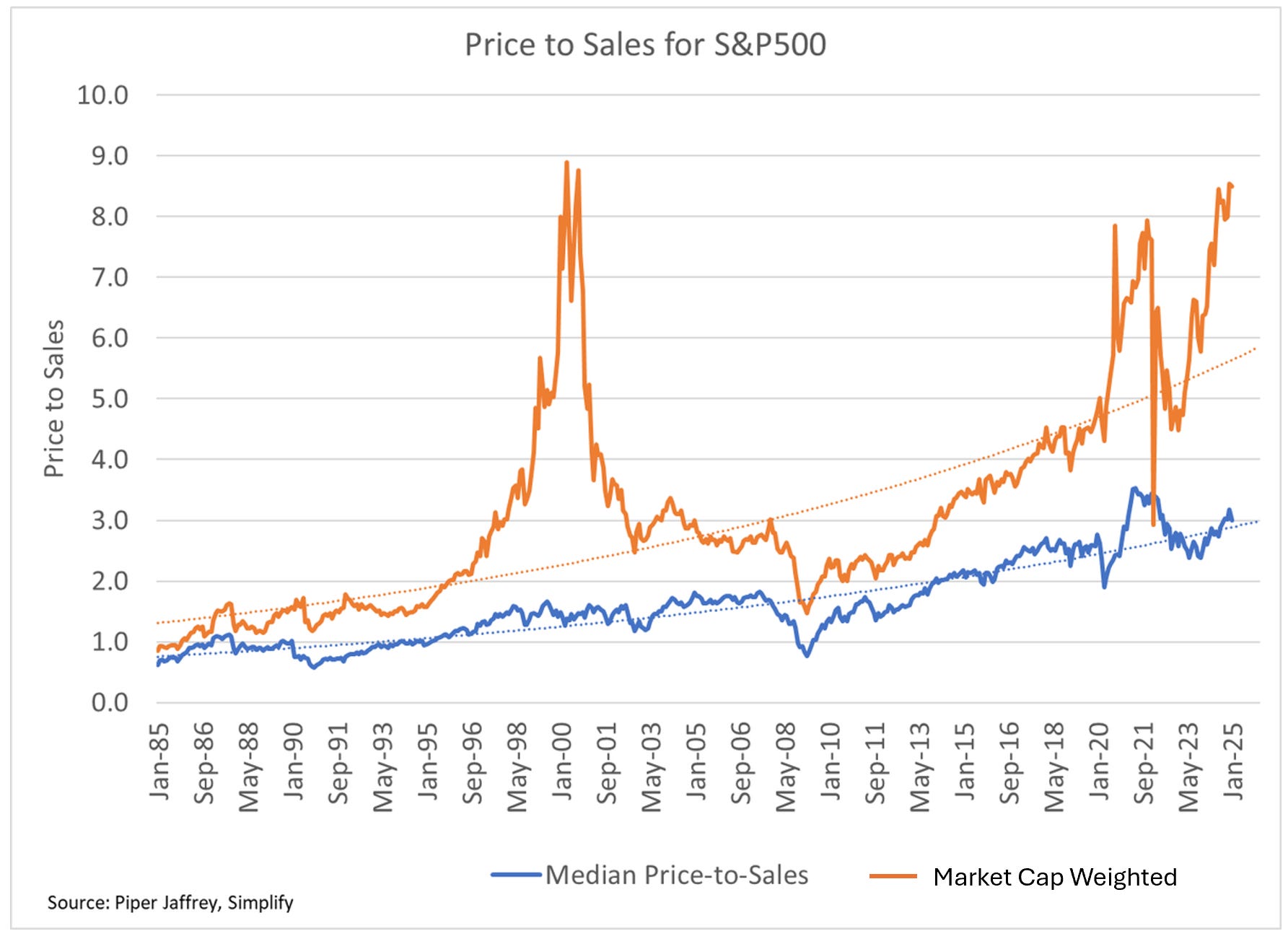
Source: @profplum99 Michael W. Green

… but P/S measures must always come with profit margins since a dollar of sales with 26% margin is worth much more than a dollar of sales with 12% margins, isn’t it?. Ed Yardeni has these 2 charts:

The Megacap-8’s P/S is 7.4x, nearly double pre-pandemic levels. Their profit margins grew from 18% to 26% in that period! Non-Megacap-8 margins have only crawled back to their 2018 level where they seem to be stalling.

The current narrative that equity markets are broadening is not supported by expected revenue growth rates, unless inflation materially slows down, or profit margins suddenly turn upwards.

image

Non-Megacaps are much more economy sensitive than tech companies, thus carrying many uncertainties (tariffs war, inflation, interest rates).

image

But the market has largely ignored rising policy uncertainty, so far.
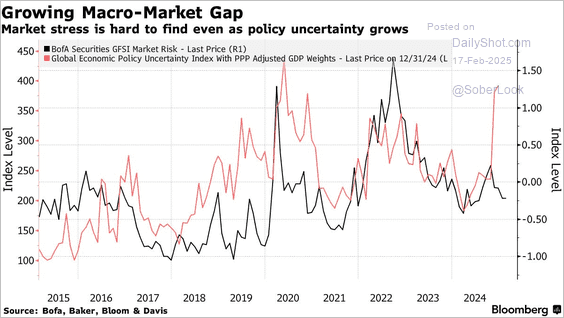
Source: @markets   Read full article

US companies falling behind on loans at fastest pace in almost a decade Experts warn tariffs and stubbornly high interest rates could worsen debt distress in 2025

(…) US business borrowers were at least one month late on more than $28bn in bank debt at the end of 2024, up $2.2bn in the final three months of the year and $5.4bn from a year earlier, according to newly released bank regulatory data collated by BankRegData. The data does not include loans from direct lenders and private credit funds, which are an increasingly bigger portion of corporate lending. (…)

“Large companies are doing fine, but there are a growing number of small and midsized companies that the economy is not providing enough help.”

image

As of Q3’23, delinquency rates were not alarmingly high even for smaller companies:

image
  • Junk Bond Guru Sees Rising Distress Ahead as Banks Tighten Lending (Thanks Terry)

The strong US economy has left distressed debt investors starved of opportunity but that may be about to change, according to veteran high-yield analyst Marty Fridson.

The latest Federal Reserve survey of senior loan officers showed banks raising standards by the most in three years when they’re lending to medium-sized and larger companies. That’ll put the squeeze on borrowers already grappling with higher funding costs and global volatility from escalating trade wars.

“At the margin, a tightening of credit standards puts more companies in serious risk of default,” said Fridson, a former strategist at Merrill Lynch whose debt analysis has been studied by Wall Street for decades.

There’s a correlation of about 0.7 between lending standards and the level of distress in credit markets, Fridson’s data going back to 1997 show. (…)

Of course, the latest Fed survey data may just be a blip — lending standards have been in decline since September 2023 and could loosen up again if banks see beyond trade war volatility and get confident that the US is on a sustainable long-term growth path. Other tailwinds include ample global demand for yield from US issuers and private markets, where there’s a lot of dry power available that offers a lifeline to some struggling borrowers.

But the biggest move up in lending standards since the fourth quarter of 2022 adds pressure to the weakest companies with nearby debt maturities. For some, refinancing costs are unsustainably high, just as new trade and immigration policy threaten to put pressure on input costs and therefore earnings, making debt markets less predictable.

At the same time, corporate bond spreads remain close to the pre-financial crisis tights they hit last year. The narrow gap between risk premiums on notes of different credit quality highlight the fact that there is much more demand for high-yielding debt than net new supply. (…)

An Investing Riddle: Stocks Are in Turmoil but Stock Markets Aren’t While the S&P 500 has been unruffled by DeepSeek and the tariff war, stocks in the index have been volatile and uncorrelated

imageJudging by the S&P 500’s 4% year-to-date gain, it is hard to glean that it has recently been hit by two big shocks: the rise of Chinese artificial intelligence and the Trump administration’s tariff war. Investors don’t seem concerned about uncertainty ahead either: The Cboe Volatility Index, or Vix, dubbed the market’s “fear gauge,” briefly hit 18.6 earlier this month, but has since fallen to 15. The historical average is 19.5.

What is truly weird, though, is that while S&P 500 volatility has been contained, the stocks that are part of it have been bouncing wildly. Drops in some have offset surges in others, and vice versa. Take the “Magnificent Seven” technology-heavy companies: Collectively, they are down 2.7% from the close of Jan. 24, when China’s DeepSeek first spooked investors. But Alphabet is down 7.5% and Meta Platforms is up 13.8%. (…)

It isn’t that investors have sold all AI-related companies and bought everything else. Stocks within the Magnificent Seven have become less correlated to one another than during most of the past decade. (…)

Also, this isn’t just about technology. Wolfe Research created a basket of U.S. stocks that contains companies seen as particularly vulnerable to protectionist policies—including Caterpillar, Hasbro and Dollar General. An analysis of the basket shows low correlations, even as the pace of tariff pronouncements from the Trump administration has accelerated. The same thing is happening across sectors of the S&P 500 and within European equity markets. (…)

Left hug Right hug Xi’s Embrace of China Tech CEOs Spurs Hope of Big Economic Shift

President Xi Jinping’s embrace of Chinese tech bosses in a rare public meeting is fueling hope Beijing is shifting its stance to give the private sector a freer hand as it fights a trade war with Donald Trump.

Four years after launching a regulatory crackdown that plunged the tech sector into turmoil, China’s top leader sat down publicly for the first time with Alibaba co-founder Jack Ma, whose firm bore the brunt of that campaign. Also on the guest list Monday were rising stars from robotics start-up Unitree, electric car giant BYD Co. and AI newcomer DeepSeek — firms rolling out world-beating innovations despite US export controls.

While a similar show of support from Xi in 2018 proved fleeting, developing national tech champions is core to Beijing’s plan for boosting the economy as it deflates a bubble in the property market that once drove about a quarter of growth. Underscoring the importance of spurring innovation, high-tech industries contributed to 15% of gross domestic product last year and are set to overtake the housing sector in 2026, according to Bloomberg Economics.

(…) the return of a high-profile business leader marks the first definitive sign that regulatory reset has concluded,” he added, referring to Ma. (…)

Xi’s meeting should now make it easier to secure equity financing in hardware technology, AI, and the new energy sectors, according to a senior executive from a privately owned chip gear maker, who said the attendee make-up had pointed to an emphasis in those areas.

The focus now is on an annual parliamentary huddle in March, where Xi is expected to set a growth goal of about 5%. It’s unclear how policymakers will get there, as Beijing still hasn’t articulated a plan for arresting sticky deflation, unlocking consumer spending and overcoming growing hostility to its export glut, from friendly partners as well as the US.

In the meantime, Xi is flexing some muscle by bringing together the nation’s big tech guns. (…)

image

The FT adds that Xi “took pains to emphasise the entrepreneurs’ importance to China’s economic strength, referring to the “two unshakeable principles” — meaning that both the public and private sector should be supported. But he also reiterated the ruling Chinese Communist party’s control over business, stressing that companies should be “ambitious in serving the country”. (…) The Chinese leader urged the business leaders present at Monday’s meeting to “actively fulfil social responsibilities” and “promote common prosperity”. (…)

The Chinese leader promised a level playing field for private businesses this week, and the resolution of persistent challenges such as high financing costs and late payment by state bodies as well as an end to arbitrary fees, fines and inspections. (…)”

  • Addressing an audience which included Alibaba’s Jack Ma, as well as leaders of DeepSeek, CATL, BYD, Tencent, Xiaomi, Huawei and Unitree Robotics, Xi is reported to have said, “It is time for private enterprises and private entrepreneurs to show their talents” and that his government “must resolutely remove various obstacles” faced by private firms.
  • Xi said that he would promote the healthy development of the private economy.
  • “The private sector in China, which competes with state-owned companies, contributes more than half of tax revenue, more than 60 per cent of economic output and 70 per cent of tech innovation, official estimates show.” (Reuters)

YOUR DAILY EDGE: 14 FEBRUARY 2025

Trump Moves to Impose Reciprocal Tariffs as Soon as April

President Donald Trump ordered his administration to consider imposing reciprocal tariffs on numerous trading partners, raising the prospect of a wider campaign against a global system he complains is tilted against the US.

The president on Thursday signed a measure directing the US Trade Representative and Commerce secretary to propose new levies on a country-by-country basis in an effort to rebalance trade relations — a sweeping process that could take weeks or months to complete. Howard Lutnick, Trump’s nominee to lead the Commerce Department, told reporters all studies should be complete by April 1 and that Trump could act immediately afterward.

Fresh import taxes would be customized for each country, meant to offset not just their own levies on US goods but also non-tariff barriers the nations impose in the form of unfair subsidies, regulations, value-added taxes, exchange rates, lax intellectual property protections, and other factors that act to limit US trade, according to a copy of the memo distributed by the White House. Markets reacted positively to signs the tariffs aren’t expected to start immediately. (…)

Trump told reporters that he would enact import taxes on cars, semiconductors and pharmaceuticals “over and above” the reciprocal tariffs at a later date.

Trump cited barriers in the European Union, including a VAT, as an example of what the US is looking to respond to. Trump has also singled out Japan and South Korea as nations that he believes are taking advantage of the US, and thus could be targeted in his latest push, according to a White House official who briefed reporters before the announcement. (…)

Trump said he did not expect to issue exemptions or waivers. He said that despite giving Apple Inc. a pass on tariffs he imposed on China during his first term in order to compete with Samsung Electronics Co. Ltd., this tariff package “applies to everybody across the board.” (…)

Reciprocal tariffs are expected to hit hard in less-developed economies where average duties on US products are higher, according to Bloomberg Economics. It differs from a universal levy on all imports, as Trump proposed during the 2024 presidential campaign. The official said Trump could divert back to a global tariff strategy later on.

Trump announced his move just hours before he was set to host Indian Prime Minister Narendra Modi, whose country stands to be affected by reciprocal tariffs more than many other major trading partners. Trump has repeatedly criticized India’s high tariff barriers. Trump has taken repeated aim at the EU’s 15% VAT. Japan also has a VAT, known as a consumption tax.

The breadth of Trump’s envisioned tariff plan is breathtaking, setting off a massive logistical undertaking for Commerce and USTR. Trump’s action opens the door to develop analyses and calculations for nearly 200 other nations, each with their own tariff schedules containing thousands of tariff codes. That’s not to mention the challenge of determining the value of other nations’ regulations, fiscal policies and subsidies. (…)

Trump blames US bilateral trade deficits on unfair trade practices, bad deals negotiated by his predecessors or a combination of both. He’s been especially critical of the EU and what he sees as the unfair treatment of American-made products, especially automobiles and agricultural commodities.

Most economists argue that trade deficits are the product of forces far stronger than mismatched tariffs — they also reflect broader macroeconomic factors such as the consumption of American households relative to those elsewhere, the US dollar’s

reserve currency status and the appetite globally for US assets.

The term “reciprocal,” when used in the context of trade, usually refers to measures taken by both parties to ensure fairness in bilateral commerce. In recent decades, that has typically meant lowering trade barriers. In the US, the Reciprocal Trade Agreements Act of 1934 marked the end of an era of American protectionism and allowed the US and partner countries to negotiate lower tariffs on each others’ goods. (…)

These so-called “non-tariff barriers” are hard to quantify, creating an enormous challenge for the Office of the US Trade Representative and the Commerce Department, which are tasked with proposing the new levies on a country-by-country basis.

Reciprocal tariffs could be imposed in a number of ways: They could be applied to specific products, to entire industries, or as an average tariff on goods arriving from a specific country.

Theoretically, the US could lower tariffs in some cases, for purposes of reciprocity, though this seems unlikely given Trump’s protectionist stance. (…)

India, Argentina and much of Africa and Southeast Asia would be most exposed, according to Bloomberg Economics, which compared tariff rates between the US and its trading partners.

But much of the world could be affected, given that the Trump administration is looking at a more general definition of trade “fairness.” The US has an overall trade deficit, meaning it imports more from other countries than they import from the US, and Trump sees this imbalance as fundamentally unfair. He repeatedly has lamented value-added taxes on US-made goods sold in other countries, particularly the European Union’s 15% VAT. Japan also has a VAT, known as a consumption tax. (…)

Goldman Sachs recently estimated that a reciprocal plan that focuses only on tariff differentials would raise the US effective tariff rate by 1-2pp, while a plan that included value-added taxes (VATs) could add more than 10pp to the US average effective tariff rate. A plan that also included other non-tariff barriers could raise it even further.

image

ING:

Given the time required for these investigations and implementations, the process is likely to start with trading partners with the highest trade deficits and higher tariffs than the US: China, the EU (with Germany and Ireland leading), Vietnam, Japan, South Korea, Taiwan, and India.

In theory, to avoid tariffs, these countries could lower or abolish their tariffs or manufacture their goods in the US.

Yet, there is a difficulty in lowering tariffs for one country only, as this would trigger the Most Favoured Nation (MFN) principle, which requires a country to extend the same favourable trade terms to all its trading partners that it grants to any one of them, i.e., granting the lowest tariff to any other nation with MFN status. Likewise implementing reciprocal tariffs would also conflict with the MFN clause, because it involves treating different countries differently based on their specific trade policies, undermining one of the key pillars of the World Trade Organisation (WTO).

But there is an even more significant caveat in this announcement: the investigation into the value-added tax (VAT) system, a tax on final consumption, which the US administration views as similar to a tariff.

Countries could, in principle, lower their tariffs to US levels. However, abolishing the VAT system is extremely unlikely. In the EU, VAT revenues account for 7.5% of GDP and 18.6% of total tax revenues (as of 2022). The EU-27 average standard VAT rate was 21.5% in 2023, with Luxembourg at 16% and Hungary at 27%. Globally, 175 countries have a VAT system, with the US being one of the few exceptions, using a sales tax system by state varying from 0% to 11.5%, instead. Since VAT is typically applied as a destination-based tax, meaning it is charged based on where the goods or services are consumed rather than where they are produced, it aligns with WTO principles.

Avoiding tariffs, therefore, seems to be an impossible task, especially since the memo is not limited to tariffs, nor VAT, but extends the investigation into non-tariff barriers such as digital trade barriers, exchange rates, and other unfair market access limitations. (…)

Since President Trump sees himself as a dealmaker, we still expect the US administration to use targeted tariffs to gain concessions, at least for the time being. India, Japan, and Australia have already positioned themselves for potential trade deals.

During a summit between the US and Japan in the first week of February, Japanese Prime Minister Ishiba announced plans to raise investment in the US by some $200 billion and to buy more LNG from the US. India’s Prime Minister Modi already slashed tariffs on an array of goods, such as heavyweight motorcycles from 50% to 30% and smaller bikes from 50% to 40%, and scrapped tariffs on satellite ground installations altogether. Also, the Indian government promised to take back undocumented Indian immigrants and pledged to buy more US oil.

But others might not get as lucky. We see Europe and China in the spotlight here, which have long been a thorn in Trump’s side. While the European Union still prefers negotiations, it has positioned itself strongly by announcing plans to fight back against unfair trade practices. In fact, the US also applies higher tariffs to certain product categories, such as clothing (12% in the EU and up to 32% in the US) and light vehicle trucks (10% in the EU and 25% in the US). While a White House official said Trump would gladly lower tariffs if other nations lowered theirs, it highlights the complexity and the challenges in achieving mutually beneficial agreements. (…)

But while initial deals might be made, the goal of increasing tariff revenues for domestic tax cuts could lead to unilateral tariffs. And the complexity of the customs project will make it easy for the US to take targeted country-by-country measures as of April. This means a bumpy ride ahead. President Trump has set the stage for further trade escalations, and with retaliation likely, things could get nasty pretty soon.

John Authers:

(…) To show that he really meant it, Trump admitted in as many words that this would probably mean higher US inflation in the short term, although he was confident the measures would eventually pay for themselves. In the current climate, that was a big admission and showed that he was prepared to lead the US electorate into making sacrifices; much more serious than had previously been expected. However, there were no dates, no specifics, and he didn’t even sign the by-now-customary executive order, instead merely signing a memo directing others to work on it.

Mike Reynolds, investment strategist at Glenmede, said:

Part of the rally we’re seeing today is a relief from the fact that these reciprocal tariffs aren’t immediately imminent. The second part of it is we think that there’s been these discussions within the White House, whether it’s more appropriate to just do blanket universal tariffs where everybody gets 10%, or if this more nuanced approach of reciprocal tariff… We think this just gives other countries a little more opportunity to save face and avoid a tit-for-tat escalation.

It’s also possible to argue that the whole thing lacked credibility. (…)

For all the threats, Trump is plainly fishing for concessions from others. If he wanted to go ahead with a simple blanket tariff of 10%, and mimic his idol President William McKinley by funding the Treasury with tariffs, he could do that, but he’s choosing not to do so. Marko Papic of BCA Research argued:

We’ve now had several successive pieces of evidence that President Trump favors reciprocal tariffs, piecemeal tariffs, policy specific tariffs, and not massive across-the-board tariffs. And so the market is reporting positively, even to negative news, because it’s not as negative as it could be. All the S&P 500 cares about is, will there be a double-digit across-the-board tariffs? That’s it.

The future remains messy. It’s tempting to break it down into two green-tinged scenarios. Either Trump is the Wizard of Oz, manipulating reality behind the curtain when there’s nothing there, or he’s the Incredible Hulk, who will soon shock everyone by bursting out as the terrible Tariff Man. The reality is somewhere between the two, and there is much money to be made and lost between the extremes.

At present, the market’s bet that Trump is the Wizard of Oz looks over-confident. He has a mandate to reverse globalization, he plainly believes in it, and he won’t win meaningful concessions unless he goes through with serious trade levies at least once.

President Donald Trump’s threat to slap tariffs on imported vehicles puts a $240 billion trade route in the crosshairs, with some of the biggest brands in Germany and South Korea among the most exposed.

Imports accounted for roughly half of the US auto market last year. About 80% of Volkswagen AG’s US sales are imported, while 65% of HyundaiKia’s US sales are imported, according to figures from Global Data, a market researcher. Mercedes-Benz Group AG brings in 63% of its US deliveries from overseas.

It’s unclear how large any new import taxes on automobiles may be, and whether vehicles built under a free trade agreement with Canada and Mexico would be spared from industry-specific duties, should they take effect.

A broad levy on all imported vehicles would have sweeping impacts across the industry. The US imported about 8 million new passenger cars and light trucks last year, with a total value exceeding $240 billion, according to Commerce Department data.

Decades of free trade agreements have helped make North America a hub for automotive manufacturing, with highly integrated supply chains across the continent. Trump had already thrown that structural pillar into question by proposing a 25% tariff on all imports from Canada and Mexico that could take effect next month.

Ford Motor Co. Chief Executive Officer Jim Farley earlier this week warned that those duties alone would “blow a hole in the US industry that we have never seen.”

According to the Observatory of Economic Complexity, in 2023 the U.S. imported $208B worth of cars and exported $65.3B for a net trade deficit of $143B. The main destinations of United States exports on Cars were Canada ($15.8B), Germany ($9B), China ($7.52B), Mexico ($4.46B), and United Arab Emirates ($3.08B).

Between November 2023 and November 2024 the exports of United States’   Cars have decreased by $-479M (-9.18%) from $5.22B to $4.74B, while imports increased by $246M (1.32%) from $18.6B to $18.8B.

The U.S. shows 0.89 vehicles per capita, the highest in the world after New Zealand (0.90).

  • Europe: 0.52 vehicles per capita

  • South America: 0.21 vehicles per capita

  • Middle East: 0.19 vehicles per capita

  • Asia/Oceania: 0.14 vehicles per capita

  • Africa: 0.06 vehicles per capita

U.S. car exports dropped by 40% since 2014-15. The USD appreciated 45% since 2011. Coincidence?

image

Also a coincidence?

Asia-based automakers continue to lead the industry in reliability, with an overall average score of 57 for the region on a scale of 1 to 100. This year, 8 of the 10 most reliable brands are from Asian brands. European automakers are in second place at 48, with Audi and BMW making our list of the top 10 most reliable brands.

A ranked list of the most reliable car brands according to Consumer Reports

If you missed it, here’s what I wrote on February 3:

Mr. Trump complains about the U.S. trade deficit, arguing that just about every country in the world treats the USA “very, very badly”.

Imports of goods and services (black) began to significantly outpace income and expenditures in 2014. Coincidentally (or not), this is also when households net worth accelerated as house and equity prices took off after the U.S. emerged out of the Great Financial Crisis.

Wealth exploded even more after the pandemic, initially thanks to the various pandemic-related bounties, but later boosted by continued gains in house and equity prices.

image

Trends in imports are more in sync with household wealth than with overall income. Various studies have demonstrated the propensity to buy foreign goods and services as income and wealth rise. In the USA, since 2014, real income and consumption rose 34% but real imports gained 45% as real household wealth exploded 72%!

Furthermore, since 2014, the U.S. dollar strongly appreciated making foreign goods and services so much cheaper for Americans, including the lesser wealthy segments. Import prices excluding foods and fuels are only up 7% against the 37% increase in core inflation.

image image

Prices of imported goods ex-vehicles rose 2.6% between 2014 and 2024 while CPI-Durable Goods rose 10.1%. For the same period, CPI-New Vehicles jumped 21.7% while imported vehicle inflation was only 7.7%.

In 2014, 47.8% of motor vehicles sales were assembled in the U.S.. In Q4’24, the ratio was down to 40.3%.

Total real imports of goods and services rose 44.5% since 2014 while the USD appreciated 35.3%; exports only rose 6% since 2018.

image

All in all, the explosion in wealth and a strong USD largely explain the worsening U.S. trade balance over the last 10 years. Wealthier and cash rich Americans splurged on cheap and cheaper foreign goods and services, first thanks to the Fed’s post GFC policies, then to the U.S. government’s pandemic bounties and, more recently, to the additional boost to wealth from house and equity prices.

The United States’ perennially polite neighbors to the north are miffed. President Trump’s threats of 25% tariffs and annexation are stoking Canadian boycotts, with visible effects on Canadians’ purchasing consideration of many U.S. brands according to new Morning Consult research.

To see whether worsening bilateral relations are taking a toll on U.S. brands’ likely earnings, we looked at changes in net purchasing consideration among Canadian adults between the second week of January and the second week of February (bookending the tariff threat), and found that 52 U.S. brands — almost 70% of the total brands we examined — saw a decline, with 7 brands seeing declines of over 10 points. No brand saw an increase over 10 percentage points and 30% of the brands saw no change or slight increases.

US Inflation News Gets Worse as Wholesale Prices Jump

US wholesale prices rose in January by more than forecast on higher food and energy costs, adding to the growing pile of bad inflation news ahead of more potential tariffs threatened by the Trump administration.

The producer price index for final demand climbed 0.4% from a month earlier, and that after an upwardly revised 0.5% increase in December [from 0.2%!], the Bureau of Labor Statistics said Thursday. The data on wholesale prices comes just a day after a consumer price index report showed underlying inflation at its highest in more than a year.

But, as Ed Yardeni explains, there was good news buried in there:

Some of the key components of the PPI that are used to calculate the Fed’s preferred PCED measure of inflation were benign or lower. For example, healthcare, with a nearly 20% weighting in the core PCED, declined 0.1%. Airline passenger services fell 1.6% m/m (after soaring 6.5% m/m in December).

Goldman Sachs:

Core producer prices also increased by more than expected on net, with the PPI excluding food and energy and the PPI excluding food, energy, and trade services both increasing by 0.3%. However, the components relevant for January core PCE were softer on net. The relevant medical care categories in PPI mostly declined, and we now estimate a 0.05% month-over-month decrease in the PCE medical care services category. We estimate that the core PCE price index rose 0.30% in January (vs. our expectation of 0.35% prior to today’s PPI report). Initial jobless claims ticked down, in line with expectations.

Charts from Ed Yardeni:

1- Headline inflation:

2- Core inflation:

Services are the main problem:

image

Hmmm…

Trump Floats Deal With Russia, China to Cut Defense Spending

President Donald Trump floated the idea of a three-way meeting with the leaders of Russia and China in which the countries would agree to cut defense spending in half.

Trump, speaking to reporters in the Oval Office Thursday, suggested repeatedly that he’d seek such a deal with Presidents Xi Jinping and Vladimir Putin, saying the money could be spent better elsewhere.

“One of the first meetings I want to have is with President Xi of China, President Putin of Russia,” Trump said. “And I want to say, ‘let’s cut our military budget in half.’ And we can do that. And I think we’ll be able to do it.” (…)

Such deep cuts in defense spending would fundamentally reshape US military posture around the world and face sharp pushback from US contractors and lawmakers whose states benefit from billions of dollars in defense spending every year. (…)

It’s also far from certain that China or Russia would agree to such cuts given how US defense spending of about $850 billion dwarfs their annual outlays. China was forecast to spend about $230 billion on defense in 2024 and is in the middle of a major military expansion. Russia’s 2024 defense budget has grown significantly since the start of war in Ukraine but was still about half that. (…)

“We’re spending the money against each other, and we could spend that money for better purpose if we get along,” Trump said later Thursday at a press conference with Indian Prime Minister Narendra Modi. “And I’ll tell you, I think that something like that will happen.” (…)