The Truth About Trump’s Steel Tariffs His first-term levies hurt consumers and U.S. manufacturers.
President Trump gave the economy another jolt of uncertainty on Monday when he signed executive orders imposing 25% tariffs on all steel and aluminum imports. His advisers say these tariffs are economically “strategic” rather than a bargaining chip for some other goal. Is the strategy to harm U.S. manufacturers and workers?
That’s what his first-term tariffs did, and it’s worth revisiting the damage of that blunder as he threatens to repeat it. In March 2018, Mr. Trump announced 25% tariffs on steel and 10% on aluminum under the pretext of protecting national security. Then, as now, most U.S. metal imports came from allies including Canada, Mexico, Europe, South Korea and Japan.
Mr. Trump said tariffs were needed to boost domestic steel and aluminum production. But U.S. production was already increasing amid a surge in capital investment unleashed by his deregulation and 2017 tax reform. U.S. steel capacity utilization climbed to 78.5% in March 2018 from 72.4% in December 2016.
The real goal of U.S. steel and aluminum companies that wanted the tariffs was to boost their bottom lines. Raising prices on foreign imports allowed them to charge more. The price was paid by U.S. secondary metal producers and downstream manufacturers.
Consider Mid-Continent Steel and Wire, which produced roughly half of the nails made in the U.S. After the steel tariffs took effect, its sales plunged by more than half, causing it to lay off 80 workers. Another 120 quit because they worried its Missouri factory might close. After this damage, the Commerce Department granted the company a tariff exemption.
Auto makers were another casualty. Ford Motor said tariffs subtracted $750 million from its bottom line in 2018, which reduced profit-sharing bonuses for each of its workers by $750. GM said the tariffs dented its profits by some $1 billion, equal to the pay of more than 10,000 employees.
The tariffs also made U.S. manufacturers less globally competitive and prompted retaliation that hurt American businesses. Canada imposed tariffs on $12.8 billion in U.S. products, including 25% on steel and 10% on aluminum. Harley-Davidson shifted some production to Thailand to avoid Europe’s retaliatory tariffs on U.S. motorbikes.
Retaliation caused Mr. Trump to exempt Canada and Mexico as part of the renegotiated Nafta deal. His Administration also struck deals with some countries that exempted a certain amount of their steel and aluminum exports.
Even so, the tariffs created uncertainty for U.S. manufacturers and boomeranged on steel and aluminum companies. Employment in durable goods manufacturing began to decline in early 2019, which reduced demand for steel and aluminum. Employment in fabricated metals manufacturing that used steel and aluminum plunged and is still some 35,000 lower than when the tariffs took effect. (…)
Domestic steel-making capacity utilization has fallen back to 70%, about the same as in 2016.
Which is why U.S. steel and aluminum producers now want tariffs with no exemptions. They blame imports for reducing prices. But steel prices are about 50% higher than pre-pandemic levels and aluminum prices a third higher. Cleveland-Cliffs shares rose 17.9% Monday, and other steel makers by 5% or so in expectation of windfall tariff profits.
This is political rent-seeking at its most brazen, and it benefits the few at the expense of the many. None of this matters to Mr. Trump, whose dogmatic views on tariffs can’t be turned by evidence. But we thought our readers would like to know the rest of the story.
(…) The president said the tariffs would apply to “everybody” — meaning all nations. The levies will also cover finished metal products, a significant move that will have broad-reaching price impacts on US consumers.
Tariffs imposed during Trump’s first presidential term focused mostly on basic steel and aluminum products, whereas the latest tariffs will include things like metal shapes and processed goods that are needed to build automobiles, window frames and skyscrapers among other things. (…)
When Trump’s first administration unveiled tariffs on steel and aluminum, the goal was to make the US more self-sufficient in these metals. But in 2024, the output of the US steel industry was 1% lower than it had been in 2017, before the first round of Trump tariffs, and the aluminum industry produced almost 10% less.
Rising costs — especially for labor and energy — have been a major driver in the long-term decline of these industries. Canada plays a vital role in supplying aluminum to the US because its plants often draw on cheap hydropower.
Economists warn that Trump’s tariffs risk raising household expenses such as groceries and gasoline — potentially stoking the very inflationary pressures the president campaigned on quelling. Administration officials counter that the levies are part of a broader economic strategy — including extended tax cuts and expanded domestic energy production — that will help lower costs overall.
(…) Are there valid concerns that Trump’s proposed retaliatory measures would include China? A Bloomberg Economics analysis points out that China’s effective tax rate on US goods is still lower than Washington’s levies on Chinese products. Taking at face value Trump’s plan for “reciprocal” tariffs that affect “everyone,” the threat to China is more bark than bite, Bloomberg’s Chang Shu and David Qu argue. There’s no room for US duties on China to rise under a strictly applied “reciprocal” approach. True reciprocity would require him to cut tariff rates:
Our analysis suggests the US would have to reduce tariff rates on China, reflecting China’s low tariffs. Does this mean China is off the hook? No. Our view is that Trump is holding his biggest punch for China. We still expect US tariffs on Chinese goods to rise further, though it’s not clear if they will hit the 60% level Trump has threatened. Tariffs staying at current levels could mean the impact on China would be contained, especially if the US raises tariffs on other trading partners.
A further important point is that this is not like some cliff edge. The two countries have been adapting their trade relationship since at least 2018, and China’s realignment is on course. The share of US imports from China has steadily declined while Beijing has sold more and more to the rest of the world:
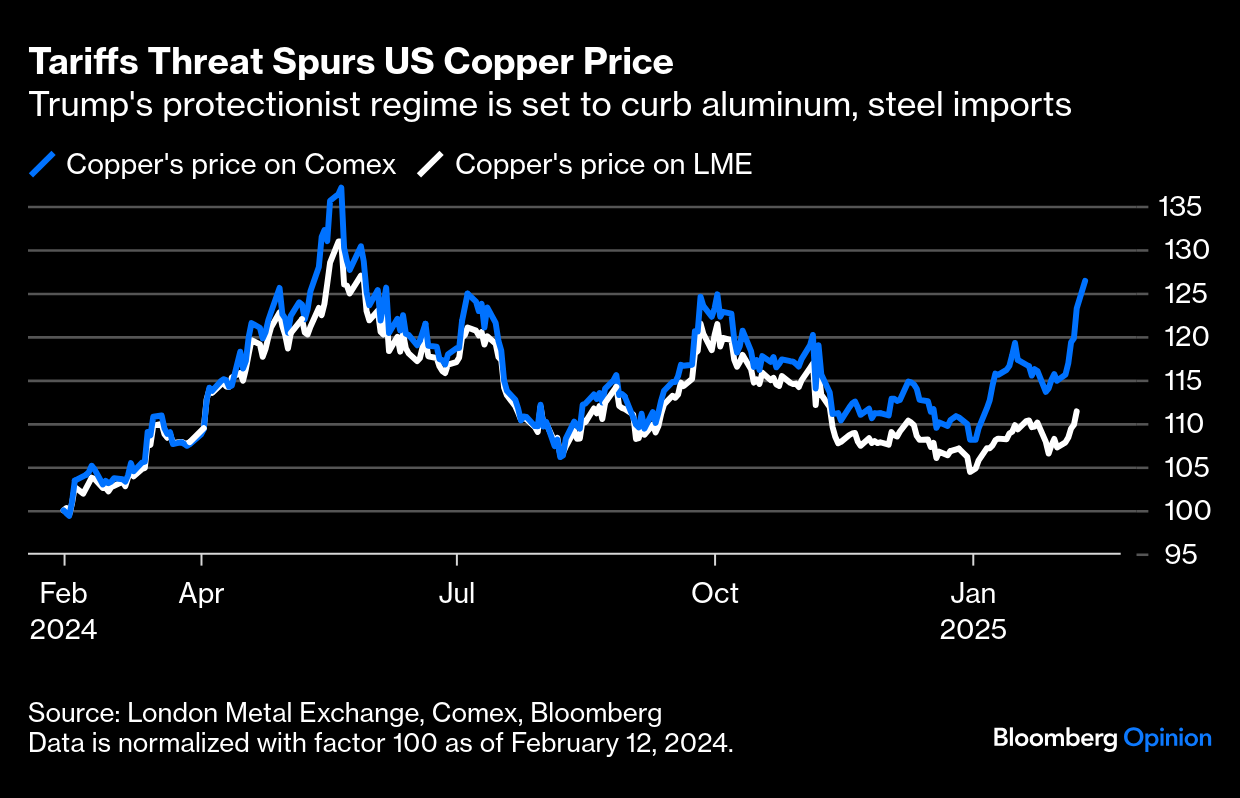
(…) It looks like markets are taking this threat more seriously. Even before the announcement, commodity prices were shifting in the US as traders rushed to stockpile before tariffs take effect. This trans-Atlantic price disparity between copper on New York’s Comex and the London Metal Exchange is unmissable:
(…) As shown by Apollo Global Management in this chart, Chinese exports to the US these days are dominated by electronics and computer products: (…)


Goldman Sachs:
- This policy impacts the cost of importing aluminum into the US, but has no direct impact on the LME price in London.

- We believe that the 25% increase in the price of the marginal imported tonne will need to flow through to domestic prices in order to (1) increase domestic utilisation rates (to the extent that they can) and (2) keep the required imports flowing. This implies that we see upside to 2025H2 US HRC futures. Even after Monday’s (10 February) rally, the December US contract ($862/st at time of writing) is priced 18% above the last week’s CRU spot index ($728/st), with further to run.
- We expect most of the tariff to transfer to the US domestic steel price, as was the case after June 2018 when imports from the EU, Mexico and Canada came under the S232 duty (following an initial exemption). In the short run, high inventories at US service centres (>2.2Mt) following a restocking in December and low shipments could slow the rally in spot prices. However, ultimately, we do not believe that US steel imports can be fully replaced by domestic production, despite the relatively low import dependence. First, while there is spare US steelmaking capacity, there are limitations in bringing all idled US capacity back online. Second, there are mismatches between domestic spare/new capacity and demand in terms of types of steel products. Even when US domestic steel prices soared to almost triple today’s prices in 2021, the US capacity utilisation rate did not exceed 85%.
- We see no direct impact on supply, and limited substitution risk. Duties have not been an effective way to lift primary aluminium production. US primary aluminium production is now lower than when tariffs were initially imposed and not much above the lows seen in 2016, when the LME price averaged $1,610/t. At present, there are two idle aluminium smelters in the US with a combined capacity of 0.3 million tonnes pa, neither of which we think will restart (for reference, global primary aluminium production is 73 million tonnes). The main barriers to restart is difficultly securing long-term competitive power contracts, as well as trade policy uncertainty.
- While we do not think that the tariffs would result in imports being fully replaced by domestic production (due to aforementioned reasons), we do expect some increase in US steel production as new capacity comes online. This would likely lead to a fall in imports (to an extent), as occurred when the S232 tariffs were imposed in 2018 (although domestic production also declined over the same period). Much of this new capacity is the result of investments following the 2021 steel price rally, including more than 4Mt from US steel (Big River 2), Nucor and CMC. It is also likely that the capacity utilisation of existing capacity gradually increases (as it did in 2018). This increase is most likely to come from capacity recently idled (over the past year) in response to low demand and prices. For example, in Q4 2024 Cleveland Cliffs idled 1.5Mt capacity No. 6 blast furnace at its Cleveland Works, Ohio (already announced to be coming back online). While this should help US imports to decline to an extent over the coming years (if the new tariffs remain in place without exemptions), this would require higher domestic prices (vs. today).
- (…) not including copper today increases the chance that copper will go through a S232 type investigation, possibly delaying tariffs by 9-12 months. We believe the US copper price is overestimating the probability of tariffs in the short-term.
Trump’s Early Tariff Wins Mask Future Risks The president’s trade policies may have unintended hazards, ranging from stagflation to the erosion of US influence on the global stage.
(…) Given recent developments, the Trump administration’s tariff plan can be thought of as evolving to focus on three major components: tariffs on a range of countries where the main goal would be revenue generation and better trade reciprocity; a much narrower overlay of additional duties aimed at protecting certain segments (such as steel and aluminum); and the periodic threat of much higher levies on individual countries to meet political objectives.
This multi-pronged approach promises to deliver immediate gains. Indeed, as evidenced by the spat with Colombia just over a week ago, America’s many structural advantages and its bigger and cyclically stronger economy give it the upper hand in most negotiations. The prospect of more quick victories means we can expect tariff threats to continue in the period ahead. This will not be a linear or predictable process. Indeed, as Annmarie Hordern noted on Bloomberg Television on Monday, “uncertainty is a feature rather than a bug” of the current approach.
The short-term gains for the US will come with risks. Depending on the response from US households, targeted countries and companies on both sides, tariffs can be stagflationary, contributing to cost increases while slowing growth. This impulse could be stronger now than during Trump’s first term, given the fragility of low-income consumers and the extent to which companies were hurt by the unanticipated surge in inflation that followed the pandemic. (…)
If used repeatedly, both the threat and the reality of tariffs can inflict collateral damage and have unintended consequences. Making America a less reliable partner could result in fewer bilateral interactions and the gradual erosion of the US’s role at the core of the international system.
Viewed through the lens of game theory, trade is an intrinsically cooperative game. Playing it uncooperatively can benefit the more powerful party in the short term. This is where the US is today, able to use a multi-pronged tariff policy to pursue multiple economic, financial and political objectives with immediate success. But the longer that international trade is played as an uncooperative game, the bigger the welfare losses to everyone participating, including the US.
NY Fed Survey Sees Inflation Expectations Edge Up Before Tariffs
Expected inflation five years ahead rose to 3% last month, the highest since May 2024, according to results of the New York Fed’s Survey of Consumer Expectations published Monday. Expected inflation rates over the next year and three years ahead were both unchanged from December at 3%. (…)
Preliminary results of a monthly University of Michigan consumer survey published Friday also showed expectations ticking up. In that poll, expected inflation over the next year jumped to 4.3%, while anticipated inflation five to 10 years ahead rose to 3.3%.
The New York Fed survey showed a rise in inflation expectations for various items over the next year, including gas, food, medical care, college tuition and rent. It also revealed a growing divergence among respondents over estimated inflation in the year ahead, with the gap between the 25th- and 75th-percentile respondents widening to the largest since mid-2023. (…)
Expectations for growth in household spending fell in January to a four-year low and respondents reported more pessimism about their financial situations. Even so, the perceived probability that the unemployment rate would be higher a year from now also fell, to the lowest level since July 2021.
Results of a separate survey published Monday by the Cleveland Fed indicated chief executives and other business leaders polled in January said they expect the consumer price index to rise 3.2% over the next 12 months, down from 3.8% in October.
Donald Trump to halt enforcement of law banning bribery of foreign officials President says move will ‘mean a lot more business for America’
Donald Trump has ordered the Department of Justice to halt the enforcement of a US anti-corruption law that bars Americans from bribing foreign government officials to win business.
“It’s going to mean a lot more business for America,” the president said in the Oval Office after signing an executive order on Monday directing Pam Bondi, the US attorney-general, to pause enforcement of the 1977 Foreign Corrupt Practices Act. (…)


 (…) the unemployment rate fell to an eight-month low of 4.0% in January from 4.1% in December. Absent the population control effects, the BLS reports the unemployment rate would have fallen a little more (-0.2 percentage points) than the actual data reported. After a foreboding march higher through the first half of last year that was a major factor in the FOMC cutting rates, the unemployment rate is now back near the bottom end of the range most Committee members think is needed to achieve its inflation target over the long run.


 So what has changed over the past two months to drive such an increase? The survey period ran from January 21st through February 3rd, with the end of this period coinciding with the day that tariff policy took center stage amid the current administration’s implementation of 25% tariffs on Canadian and Mexican goods imports, as well as a tariff of 10% on Chinese goods. Given the 30-day stay-of-execution granted on Monday for Mexico and Canada, perhaps this preliminary read will get revised down as more surveys come back later in the month. (…)


