Hiring Bounced Back With 227,000 Jobs Added Last Month October’s report had come in much lower, hurt by hurricanes and the Boeing strike
The U.S. added a seasonally adjusted 227,000 jobs in November, the Labor Department reported Friday, solid growth that was roughly in line with expectations.
The report provided something of a relief, confirming that October’s softening was the result of storm and strike-related distortions, rather than a more fundamental weakening. The general picture is that the labor market has slowed, but is still doing well. (…)
The largely as-expected report reinforced expectations that Federal Reserve policymakers will cut rates when they meet later this month. They could also signal plans to slow down the pace of cuts and even suspend them altogether if inflation pressures persist.
Payroll growth was strong enough to quiet fears of a sharper slowdown in hiring, but the increase in the unemployment rate should likewise allay anxieties that new pressures on wages and prices are resurfacing.
Looking through the strike and weather distortions, the underlying trend of job growth is healthy—not so strong that overheating is a worry, but not too weak, either, said Joe Brusuelas, chief economist at RSM. (…)
The October payrolls number was revised up to a gain of 36,000 jobs. The first estimate a month ago calculated that the U.S. added just 12,000 jobs that month.
For November, the unemployment rate rose to 4.2% from 4.1%.
Average hourly earnings rose 4% from a year earlier. Economists had expected a gain of 3.9%. (…)
Payroll growth was revised up by 24k to 36k in October and by 32k to 255k in September.
Smoothing out the storms/strikes effects on October, the 3-month job gain average is 173k (dash) vs the 6 month average of 143k, a rather significant jump from the April-August average of 133k.

Goldman Sachs’ estimate of the “underlying pace of job growth based on the payroll and household surveys now stands at 195k after adjusting for the undercounting of immigration in the official statistics and a small overstatement from the birth-death model.”
This is slightly (13%) below the 226k average for the 12 months ended in June 2024.
The unemployment rate increased to 4.2% after moving sideways at 4.1% in the prior two months.
 Remember the angst when the u-rate reached 4.3% last July (released Aug. 2)? During the following 2 sessions, the S&P 500 dropped 4.8%, the 2Y yield lost 27 bps to 3.9% (now 4.1%) and the 10Y 19 bps to 3.8% (now 4.2%). Well, the November unrounded jobless rate came in at 4.246%. July’s was 4.253%.
Then the FOMC’s focus moved away from inflation to the labor market.
Average hourly earnings increased by 0.37% MoM in November, above expectations. The YoY rate was unchanged, at +4.0%. Goldman estimates that “the underlying pace of average hourly earnings growth stands at +4.1%”.
Is it me or is there an ominous trend in monthly wage growth? Monthly growth averaged 0.23% (+2.9% a.r.) in Feb-Apr, 0.31% (+3.7%) in May-Jul and 0.38% (+4.6%) in Aug-Nov. Wages for the more sought-after service-providing employees rose at a 4.9% annualized rate in the last 4 months, +5.4% in the last 2 months.

Rising productivity and low oil prices so far have helped bring inflation down but the last mile to 2% could prove harder to achieve:

On the other hand, the 4.3% unemployment rate and the rising number of permanent job losers will likely incite the FOMC to keep worrying about the labor market.


Source: U.S. Department of Labor and Wells Fargo Economics
But everybody will be watching this week’s key inflation metrics:
- Tuesday: Final number for nonfarm productivity for Q3 (consensus +2.2%) and unit labor costs (consensus +1.2%)
- Wednesday: Core CPI for November (consensus +0.3%, 3.3% YoY)
- Thursday: PPI
- Friday: Import price index
Looking at consumer demand, the November employment data show continued strong growth in aggregate weekly payrolls (employment x hours x wages), +5.12% YoY, steady all year long (+5.17% on average).
Americans keep spending their nominal dollar earnings while inflation has eased from 3.8% in 2023 to October’s 2.3%.

Real consumption expenditures were up 2.2% YoY in Q1’24, 2.7% in Q2, 2.9% in Q3 and 3.0% in October.
Interest rates were first cut in September.
Total credit outstanding rose $19.2 billion after a revised $3.2 billion September increase, according to Federal Reserve data released Friday. The median estimate in a Bloomberg survey of economists called for a $10 billion gain. The figures aren’t adjusted for inflation.
Revolving debt outstanding, which includes credit cards, surged $15.7 billion. October included Amazon.com Inc.’s Prime Day, as well as similar promotions at Walmart Inc. and Target Corp.
Non-revolving credit, such as loans for vehicle purchases and school tuition, increased $3.5 billion, the Fed’s report showed. The pace of auto sales during the month was the strongest in more than three years, according to Ward’s Automotive Group data. (…)
Remember my 2 “what ifs”:
- What if this buoyant consumer, nearly 70% of GDP, coupled with recent and coming policies, triggers a U.S. manufacturing revival boosting its contribution above its current 10-11% of GDP? What if vehicle demand and production start to contribute to growth? (Nov. 18, 2024)
- What if housing also begins to contribute to GDP growth? (Nov. 25, 2024)
US Consumer Sentiment Rises Along With Inflation Expectations
(…) In anticipation of higher prices, consumers viewed current buying conditions for durable goods as the most favorable since April 2021, according to the report.
One quarter of respondents spontaneously reported that buying big-ticket merchandise now would avoid higher prices in the future. That helped drive a gain in the university’s measure of current conditions. (…)
A gauge of sentiment among Republicans now stands at a four-year high following President-elect Donald Trump’s win, while confidence among Democrats has dropped to a more than two-year low. Among political independents, sentiment rose to an eight-month high.
“Throughout this month’s interviews, Democrats voiced concerns that anticipated policy changes, particularly tariff hikes, would lead to a resurgence in inflation,” Joanne Hsu, director of the survey, said in a statement. “Republicans disagreed; they expect the next president will usher in an immense slowdown in inflation.”

It has happened before as this Goldman Sachs chart shows:

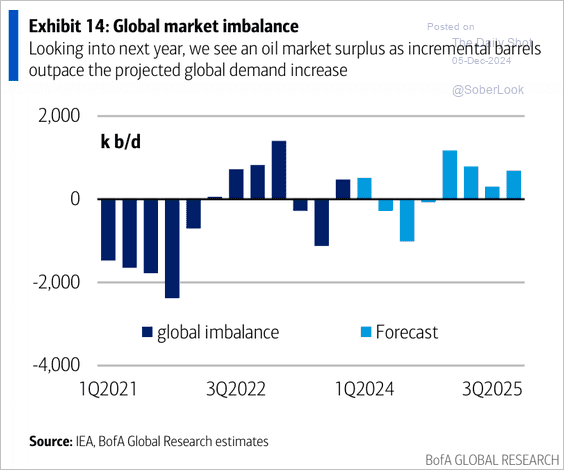
Saudi Arabia Cuts Oil Prices After OPEC+ Delays Reviving Output Aramco lowers Arab Light premium to Asia by 80 cents a barrel
Saudi Arabia is cutting oil prices for buyers in Asia by more than expected after OPEC+ further delayed an output revival, underscoring how the outlook for the market remains weak.
State oil producer Saudi Aramco will sell its main Arab Light crude grade at a premium of 90 cents a barrel to the regional benchmark in January, according to a price list seen by Bloomberg. That compares with $1.70 for this month. The company was expected to lower the premium by slightly less, to $1, according to a survey of traders and refiners.
Aramco also cut prices for north-west Europe and the Mediterranean. It made no change for North America. (…)
The prospect of an impending oversupply leaves the group with the uncomfortable dilemma of whether to prolong production curbs well into 2025 or risk a price slump.
- The Developing World Is Buying $180,000 E-buses on the Cheap India used financial alchemy to fund big-city transport at 30 cents a ride.
Talk about mission impossible. Your assignment: Electrify India’s fleet of public buses, which transport 128 million people a day. The economics are harrowing. An e-bus costs about 15 million Indian rupees ($177,000), 2.5 times the price of a diesel model. India’s riders tend to be poor. In Delhi, they pay a maximum of 25 rupees, or 30¢, for a ride. Women pay nothing.
The prospect made Mahua Acharya’s stomach ache. It seemed to require the resources of a multinational corporation. But Acharya ran Convergence Energy Services Ltd., or CESL, a small government-owned company committed to replacing fossil fuels. “I wanted access to scale,” she says. “It was really bugging me.”
In 2021, Acharya found a way to achieve that heft. She banded together five major cities for two giant acquisitions of buses. CESL called it the Grand Challenge, an act of financial alchemy that would ultimately put 12,000 on the road for little upfront cost. Instead of buying buses, New Delhi, Kolkata and the other cities would bid out to private companies the opportunity to run the entire bus service over 12 years.
Each city would specify the size of the fleet it was seeking. And each manufacturer—including Tata Motors Ltd., India’s largest bus maker—assembled a consortium of operators to provide the drivers, e-buses, battery replacements, charging stations and maintenance. The groups would compete for a contract that specified a per-kilometer price. Each contract was so big (48.7 million rupees per bus over the dozen years) that it was worth a look, even for Tata.
The municipalities ended up paying just shy of 49 rupees per kilometer, 27% less than the cost of operating with compressed natural gas without the need for subsidies. Acharya’s pay-as-you-go model helped spur cities to commission 29,000 e-buses, up from fewer than 500 four years ago. (…)
Acharya’s approach could be a model for climate and transportation around the developing world. Nine countries, including Brazil, Kenya and Mexico, as well as the European Union are looking to replicate her approach, among others, Acharya says.
Manufacturers sold about 50,000 e-buses in 2023, representing only 3% of the segment’s sales, according to the International Energy Agency (IEA), a Paris-based intergovernmental group. China accounted for 60%. But wealthier countries, particularly in Europe, are pushing to catch up. In New York, the Metropolitan Transportation Authority plans to electrify its entire fleet of 5,800 by 2040; London expects to do the same by 2034. (…)
Once up and running, Intent plans to help companies deliver a minimum of 1,000 buses and the same number of trucks a year in India, as well as 25,000 rickshaws and 500 megawatts of distributed solar energy to power it all. Currently, India has 150,000 public buses, and some 1.5 million are owned by private companies, mostly covering intercity routes, Acharya says. “There’s an interest in moving over to electric, except the same cost barriers come into play,” she says.
Intent will design a standardized contract and identify companies that can execute all its specifications, including operations and maintenance. It’s a much bigger challenge than the citywide purchases, Acharya says, because the average operator has only 10 to 15 buses. “It’s never been done before,” she says.
Then she’ll look to the rest of the developing world. “There’s no point reinventing the wheel,” she says. “You have crowded cities, so does India. And often there’s the issue of affordability, too. So if you are a country that’s willing to work at scale then, hey, all hands on deck are welcome.”
Trump’s Energy Secretary Pick Preaches the Benefits of Climate Change Fracking CEO Chris Wright points to positive changes produced by global warming, in contrast with what some oil giants say
Chris Wright, President-elect Donald Trump’s nominee for energy secretary, says that climate change poses only a modest threat to humanity. The biggest U.S. oil companies disagree.
A fracking executive, Wright acknowledges that burning fossil fuels is contributing to rising temperatures. But he also says climate change makes the planet greener by increasing plant growth, boosts agricultural productivity and likely reduces the number of temperature-related deaths annually.
“It’s probably almost as many positive changes as there are negative changes,” he told conservative media nonprofit PragerU last year, referring to climate change. “Is it a crisis, is it the world’s greatest challenge, or a big threat to the next generation? No.”
Trump has repeatedly called climate change a hoax but hasn’t articulated his views in detail. The selection of Wright is one of the clearest indicators yet that the next administration is likely to push back on widely accepted scientific findings about climate change.
Many oil-and-gas executives have lauded Wright’s nomination as they expect he will give their industry a boost. Still, Wright’s climate pronouncements highlight the chasm between the Trump administration and the country’s biggest oil companies on a crucial issue.
Occidental Petroleum Chief Executive Vicki Hollub this year called climate change “the greatest crisis our world has ever faced.” Exxon Mobil CEO Darren Woods said in a Wall Street Journal interview last month that Trump shouldn’t pull the U.S. from the Paris climate pact.
Wright has said “there is no climate crisis,” and that the Paris agreement empowers “political actors with antifossil-fuel agendas.”
A Trump-Vance transition official said Wright “intends to deliver on President Trump’s pledge to unleash affordable and reliable American energy to power homes, businesses, cars and factories, and secure energy independence.” (…)
Wright, if confirmed by the Senate, will be tasked with safeguarding the country’s nuclear arsenal and directing federal research on energy technologies. The Energy Department also approves exports of liquefied natural gas, and Wright is almost certain to speed up permits for new terminals. (…)
Wright has been critical of subsidies to wind and solar energy, favoring instead the development of geothermal and nuclear energy.
His brand of climate skepticism will likely find strong support in the Trump administration.
Pete Hegseth, Trump’s pick for defense secretary, has called climate science a “religion.” Vivek Ramaswamy, who alongside Elon Musk will seek to cut the federal budget, has pushed back against environmental, social and corporate-governance efforts and said, “The climate change agenda is a hoax.”
Climate deniers and skeptics also surrounded Trump in his first term. Since then, the world has seen a number of extreme weather events, which many scientists say are fueled in part by rising temperatures. Wealthy countries including the U.S. recently agreed to triple the financing they provide for climate-change projects in the developing world to at least $300 billion a year by 2035. (…)
Wright has said fighting climate change is less important than allowing the world’s poorest to improve their lives by burning oil and gas. The benefits of cheap and reliable energy, he argues, more than outweigh the costs of climate change.
“A little bit warmer isn’t a threat. If we were 5, 7, 8, 10 degrees [Celsius] warmer, that would be meaningful changes to the planet,” he said in the PragerU interview.
Scientists see a 1.5 degrees Celsius temperature increase over several decades as creating potentially irreversible changes for the planet, with profound implications for health, food security and water management. Earth’s average temperature is expected to pass the mark this calendar year.
Wright, a self-described nerd who studied at the Massachusetts Institute of Technology, has engaged with climate-change data in a way that few energy CEOs have. He has taken to Fox News to promote his views on fossil fuels and become a regular on the conservative speaking circuit. (…)
Wright has engaged with and promoted controversial climate thinkers. They include Steven Koonin, a physicist who served at DOE under President Obama, and who says that the impact of mankind on climate change is too uncertain to warrant radical climate action; and Alex Epstein, a philosopher pushing for using more fossil fuels. (…)
Wright cites the fact that the Earth is getting greener as more carbon dioxide lingers in the atmosphere, boosting plants’ photosynthesis. Climate scientists say lusher vegetation has helped mitigate climate change by cooling the land, but that the cooling effect is limited compared with the rate of global warming.
More available carbon dioxide has led to more productive crops, according to Wright. Scientists argue the long-term impact of global warming on agriculture will be mixed, with some farmers benefiting from longer, warmer growing seasons. But new weather patterns could upend today’s key food-producing regions.
Wright also argues that global warming probably reduces modestly the number of annual deaths related to extreme temperatures. Recent estimates from health researchers suggest otherwise. They say that in coming decades, the rise in extreme heat-related deaths will outweigh the decline in extreme cold-related deaths.
Climate change, Wright said at an oil-and-gas conference earlier this year, “should be treated honestly and evaluated as trade-offs, not as a religion or a cult, which unfortunately it’s become.”
China Adopts Crisis-Era Language as Leaders Signal More Forceful Stimulus Top decision-making body pledges to boost domestic demand and stabilize the housing and property markets
The 24-man Politburo, China’s top decision-making body, pledged Monday to implement more proactive fiscal policy and to adopt a “moderately loose” monetary policy next year—the first introduction of such language since 2008.
The Politburo also vowed to be more active in responding to economic downturns, to boost domestic demand and to stabilize the housing market, according to a readout published by the state-run Xinhua News Agency.
The shift in Chinese policymakers’ monetary approach marks a change from the “prudent” stance it has hewed to since 2011, hinting that more monetary easing will come in 2025.
Meanwhile, the mention of more proactive fiscal policy suggests Beijing might approve a larger-than-usual government deficit when lawmakers gather for the country’s annual legislative session in March, economists say. Xinhua said in a commentary last week that the country had room to increase borrowing and expand its fiscal deficit next year.
Morgan Stanley economists hailed the Politburo statement as being “even more positive” than one in September that helped ignite one of China’s most powerful stock-market rallies in years.
The language on fiscal policy was the strongest since the early days of the Covid-19 pandemic, they wrote, while the pledge to strengthen “unconventional” countercyclical adjustments—a term referring to stimulus measures designed to mitigate downward economic pressure—was unprecedented.
Others were more circumspect. Julian Evans-Pritchard, head of China economics at Capital Economics, said rate cuts and other central-bank actions are losing traction in an economy where appetite for borrowing is limited. He wrote in a note to clients that the key question remains just how much Beijing is prepared to borrow and spend to stimulate the economy, adding that “those hoping for big-bang stimulus are still likely to end up disappointed.” (…)
Officials at Monday’s Politburo gathering also said that China’s main economic and social development targets for the year will be met, suggesting that top leaders are confident that the country is on track to achieve Beijing’s full-year goal of around 5% gross domestic product growth.
The Politburo’s December meeting comes just days before the Central Economic Work Conference, where Chinese leaders are expected to outline their policy priorities and discuss annual growth targets for next year. (…)
Earlier on Monday, China’s statistics bureau released inflation data that pointed to persistently weak domestic demand in November, despite Beijing’s push to revive spending as the yearslong property downturn drags on.
In a separate meeting with another set of officials on Friday, Chinese leader Xi Jinping acknowledged the many uncertainties and challenges facing the economy, according to a Xinhua readout published Monday. (…)
Bloomberg adds that “The Politburo promised to “forcefully lift consumption” and drive domestic demand “in all aspects,” without directly mentioning the problem of deflation.”
Meanwhile:
China’s Consumer Inflation Weakens Ahead of Key Economic Meeting Sluggish demand remains a key factor holding back price growth
China’s consumer inflation unexpectedly decelerated in November while factory deflation eased, painting a mixed picture of the effects of recent stimulus efforts on the economy ahead of key policy meetings this week.
The consumer price index rose a less-than-forecast 0.2% from a year earlier, the lowest since June, while core inflation picked up slightly. Factory deflation extended into a 26th straight month, though the producer price index recorded a slower drop of 2.5% compared to October.
Taken together, the official data released Monday showed Beijing’s measures stabilized sentiment but have yet to reverse a deflationary trend.

Core CPI rose 0.3% YoY in November (after +0.2% in October). Core goods inflation was +0.1% YoY in November (after -0.4% yoy October). Services inflation was unchanged at +0.4% YoY in November.
Beijing’s challenge is to translate its nicely worded intentions into real actions by a population scarred and scared by the real estate mess and more inclined to boost its savings than to splurge.
Takeaways from Trump’s “Meet the Press” interview
President-elect Trump told Kristen Welker on NBC’s “Meet the Press” that he plans to give “first day” consideration of whether to pardon people convicted of crimes related to the Jan. 6 attack on the Capitol.
In Trump’s first network interview since the election, he made lots of news, making it clear he plans aggressive action from the moment he’s inaugurated 43 days from now.
When Welker asked Trump whether he planned action on Jan. 6 pardons within his first 100 days, he replied: “First day.”
- “We’re going to look at individual cases,” Trump said in the interview, taped at Trump Tower in Manhattan on Friday before he left for Paris. “But I’m going to be acting very quickly.”
Trump said his inaugural address will be “a message of unity,” and that he believes unity is born from success.
- On deporting families with mixed immigration status (such as the parents being in the U.S. illegally, while their kids are citizens): “I don’t want to be breaking up families, so the only way you don’t break up the family is you keep them together and you have to send them all back.”
- On whether he still plans to end birthright citizenship on Day 1: “Yeah. Absolutely.”
- Wants Dreamers to be able to stay: “We have to do something about the Dreamers because these are people that have been brought here at a very young age. … I will work with the Democrats on a plan.”
- On removing the Fed Reserve chair: Trump said he doesn’t expect to ask Fed Chair Jay Powell to step down. “No, I don’t think so. I don’t see it,” Trump said.
Pressed on whether he’ll appoint a special prosecutor to go after Joe Biden: “‘I’m really looking to make our country successful. I’m not looking to go back into the past. … [N]o, I’m not doing that unless I find something that I think is reasonable, but that’s not going to be my decision.
- On whether American families might pay more under his tariffs: “I can’t guarantee anything. I can’t guarantee tomorrow.”
Trump, 78, acknowledged he’ll be the oldest commander-in-chief, and said he has “no problem” with releasing his full medical report: “My reports are very good, very strong.”
AI CORNER
Adding to my September 23 Power Play post:
Over the past year, Georgia Power has more than doubled its forecast for potential power use by big developments like data centers or factories that are expected by the mid-2030s. “The company has never seen such a significant number of new large customer projects materialize in such a short period of time,” an earlier planning document read. Southern is now considering operating a coal plant longer than expected and has proposed building new gas generation, moves that could complicate its carbon-emission goals. (Bloomberg)
Syria Surprise — Markets Need to Rethink Putin’s ‘Genius’ No financial shock is imminent, but Russia’s chess master is starting to look like he’s playing checkers. Expect broader impacts to come
(…) But while it’s true that big geopolitical events seldom have big effects in the short term, they can change the world profoundly in the longer run, and be symptomatic of greater shifts afoot. I would argue that that is true of the Korean political mess, as well as the ructions in France, Germany and Japan, where the need to chart a future in which US support can no longer be guaranteed has greatly increased tensions. Assad’s fall might reveal something about the strength of Iran and, particularly, Russia. (…)
Assad was reliant on Russian support, and the fact that a ragtag militia could topple his regime so easily suggests that that support was no longer enough. After almost three years of its war of attrition in Ukraine, Russia is unable to help all of its client states. The demonstrations in the former Soviet state of Georgia where people, like Ukrainians before them, seem determined to build closer links with the EU are another sign of Putin’s weakness.
Then there’s the Russian economy. Much of the western defeatism toward Russia stems from its initial success in staving off serious impacts from the sanctions imposed after the Ukraine invasion. But inflation has picked up again, with the official data putting it at above 8%, and the central bank has responded with a policy rate of 21%, higher than it ever reached even in the first months of 2022:
With the government in hugely expansive mode to finance the war, the pressure to contain inflation would inevitaby be high. But last month’s decision by the US to put sanctions on 50 Russian banks led by Gazprombank sparked a run on the ruble close to its worst levels compared to the euro in three years. It has recovered somewhat after the central bank announced that it would stop buying foreign currency, while Putin relaxed requirements that all purchases of gas must be made through Gazprombank, but EU leaders remain anxious for the US to be more lenient. While the ruble is this weak, the upward pressure on Russian rates will continue. (…)
Meanwhile Iran, another country that preoccupies the west, has also sustained a blow to its reputation in Syria. It had already allowed Israeli strikes deep in Iranian territory this year, and watched its client Hezbollah go down to severe defeat in Lebanon while Hamas suffers in Gaza. Losing Syria as well leaves Iranian strategy in tatters. It now loses its link to the Mediterranean. Marko Papic of BCA Research says that a “far more cornered… and panicked Tehran” may emerge:
We may see a more aggressive Iran and a more contemplative and cautious Russia. Moscow did this to itself, prioritizing irrelevant territories in Donetsk that mean literally nothing. Meanwhile, Finland (a stone throw away from Murmansk and St. Petersburg) is in NATO, Georgia is reeling with a color revolution, and Syria has fallen. Slow clap for Putin.
There are many ways this could play out, some of them positive. But the key lesson from the last week is to check assumptions. As Papic puts it, Putin is no chess grand master, and begins to look as though he’s instead playing checkers. It’s time to question what we think we know about him. (…)
Ed Yardeni:
Bashar al-Assad has been overthrown in Syria, signaling that both Russia and Iran have lost their power to influence events in the Middle East.
Could it be that we are in for a period of good times? Might the Roaring 2020s be followed by the Roaring 2030s? Sure, why not?
The Economist:
But look back at other, similar moments of political high drama, and the sudden removal of repression often triggers violent disorder. The more repressive a place has been, the less able it is to cope with whatever comes next. There may be too few social or political structures to help politics to function. After Qaddafi fell, Libya suffered years of brutal civil war. Repression also held Yugoslavia together until it didn’t, and bloody conflict followed. Iraq, after Saddam Hussein’s long and nasty rule, fell into a bloody mire (despite the presence of American forces). The collapse of the Soviet-backed regime in Afghanistan at the start of the 1990s was the spark for decades of war.


 Source:

 Source: