The enemy of knowledge is not ignorance, it’s the illusion of knowledge (Stephen Hawking)

It ain’t what you don’t know that gets you into trouble. It’s what you know for sure that just ain’t so (Mark Twain)

Invest with smart knowledge and objective odds

THE DAILY EDGE: 26 August 2024: Lucky Fed!

Fed Chair Powell Declares ‘Time Has Come’ for Rate Cuts Jerome Powell gave his strongest signal yet that interest-rate cuts are coming soon, saying the Federal Reserve intends to act to stave off a further weakening of the U.S. labor market.

“It seems unlikely that the labor market will be a source of elevated inflationary pressures anytime soon. We do not seek or welcome further cooling in labor market conditions,” Powell said in a speech at the central bank’s annual gathering in the Grand Teton National Park on Friday. “The time has come for policy to adjust.” (…)

“The cooling in labor market conditions is unmistakable,” Powell said.

“We will do everything we can to support a strong labor market as we make further progress toward price stability,” he added. (…)

“The direction of travel is clear, and the timing and pace of rate cuts will depend on incoming data, the evolving outlook, and the balance of risks,” Powell said Friday. (…)

“With an appropriate dialing back of policy restraint, there is good reason to think that the economy will get back to 2% inflation while maintaining a strong labor market,” he said.

Mr. Powell presented his assessment of the post-pandemic period, more specifically “why inflation rose, and why it has fallen so significantly even as unemployment has remained low.” The full transcript is here but here’s a point form summary:

  • After a historically deep but brief recession, in mid-2020 the economy began to grow again. As the risks of a severe, extended downturn receded, and as the economy reopened, we faced the risk of replaying the painfully slow recovery that followed the Global Financial Crisis.
  • But pent-up demand, stimulative policies, pandemic changes in work and leisure practices, and the additional savings associated with constrained services spending all contributed to a historic surge in consumer spending on goods.
  • The pandemic also wreaked havoc on supply conditions. Supply chains were snarled by a combination of lost workers, disrupted international trade linkages, and tectonic shifts in the composition and level of demand. Clearly, this was nothing like the slow recovery after the Global Financial Crisis.
  • The initial burst of inflation was concentrated rather than broad based, with extremely large price increases for goods in short supply, such as motor vehicles. My colleagues and I judged at the outset that these pandemic-related factors would not be persistent and, thus, that the sudden rise in inflation was likely to pass through fairly quickly without the need for a monetary policy response—in short, that the inflation would be transitory.
  • Beginning in October, the data turned hard against the transitory hypothesis. Inflation rose and broadened out from goods into services. It became clear that the high inflation was not transitory, and that it would require a strong policy response if inflation expectations were to remain well anchored. We recognized that and pivoted beginning in November. Financial conditions began to tighten. After phasing out our asset purchases, we lifted off in March 2022.
  • New supply shocks appeared. Russia’s invasion of Ukraine led to a sharp increase in energy and commodity prices. The global nature of inflation was unlike any period since the 1970s. Back then, high inflation became entrenched—an outcome we were utterly committed to avoiding.
  • Labor supply remained constrained, and, in the summer of 2022, labor force participation remained well below pre-pandemic levels. There were nearly twice as many job openings as unemployed persons from March 2022 through the end of the year, signaling a severe labor shortage.
  • The summer of 2022 proved to be the peak of inflation. The 4-1/2 percentage point decline in inflation from its peak two years ago has occurred in a context of low unemployment—a welcome and historically unusual result.
  • How did inflation fall without a sharp rise in unemployment above its estimated natural rate?
  • Pandemic-related distortions to supply and demand, as well as severe shocks to energy and commodity markets, were important drivers of high inflation, and their reversal has been a key part of the story of its decline. The unwinding of these factors took much longer than expected but ultimately played a large role in the subsequent disinflation.
  • Our restrictive monetary policy contributed to a moderation in aggregate demand, which combined with improvements in aggregate supply to reduce inflationary pressures while allowing growth to continue at a healthy pace. As labor demand also moderated, the historically high level of vacancies relative to unemployment has normalized primarily through a decline in vacancies, without sizable and disruptive layoffs, bringing the labor market to a state where it is no longer a source of inflationary pressures.
  • An important takeaway from recent experience is that anchored inflation expectations, reinforced by vigorous central bank actions, can facilitate disinflation without the need for slack.

Mr. Powell concluded his Mission Accomplished speech with “That is my assessment of events. Your mileage may vary.”

Indeed.

I disputed the Fed’s “transitory” label as well as its early view that higher mortgage rates would “reset” the “overheated” pandemic housing market and that rentflation was then about to slow because of the “lags embedded in the BLS measure”.

I now offer a few observations denying the idea that this FOMC has a magic wand:

  • From its peak 2 years ago, CPI-Durable Goods declined 5.8%, contributing 1.3% to the 4.5% decline in inflation Mr. Powell refers to. July’s –4.1% YoY print is the largest since 1957 but for the last few months of 2003. That came about not because the Fed succeeded to tame demand (real spending on durables is up 6.4% in the last 2 years, +2.9% YoY in July), but because China flooded the world with surplus goods shunned by its own consumers.

This chart from Matt Klein shows that “China’s industrial output has grown by about 23% since December 2019—substantially less than would have been expected based on the pre-pandemic trend—but its real export volumes are up by about 34% even as its real imports [a proxy for domestic demand] have only increased by 6% over the past five years.”

Having failed to boost domestic demand post lockdown, China exported goods deflation to the USA. Lucky Fed!

  • CPI-Energy peaked in June 2022. Its 15.9% drop since contributed 1.1% to the decline in headline inflation over the last 2 years. While not part of core inflation measures, energy prices do impact a large swat of the economy since goods need to be transported and energy costs are a significant cost item for most businesses, particularly service providers. In spite of the war in Ukraine and the boiling Middle East, WTI prices are down 28% since their mid-2022 peak (-6.1% YoY in August).

China’s oil imports rose for 19 straight years from 2001. But in the first seven months of 2024, imports declined 2.9% (-11% YoY in June). Reuters explains:

Perhaps the biggest factor that may weigh on crude oil imports in 2024 and the coming years is China’s transition to what it calls new energy vehicles (NEVs), which include fully electric cars and trucks and hybrids. Sales of passenger car NEVs exceeded those with internal combustion engines (ICE) in July for the first time, according to data from the China Association of Automobile Manufacturers. Sales of passenger NEVs in July were 853,000, representing 53.5% of total auto sales of 1.595 million. (…)

China’s diesel demand is also softening. The U.S. Energy Information Administration reported that it dropped by 11% in June from the same month in 2023 to 3.9 million bpd. This is due to two factors: the slowdown in construction and the switch to LNG in trucks. (…) Last year 8% of road diesel demand, or about 220,000 bpd, was displaced by LNG, according to a report by consultants Wood Mackenzie. (…)

China’s domestic oil production rose by 2.1% over the January to July period to 4.28 million bpd. While this is a modest gain, it shows that some imports are being displaced. (…)

Also, China increased its oil imports from Russia by 5% this year, reducing demand for OPEC oil. Lucky Fed!

Meanwhile, U.S. petroleum demand is seen rising 1.0% in 2024 by the EIA after +0.2% in 2023.

Note also how inflation expectations are in sync with oil prices. The first chart plots inferred bond market inflation expectations with WTI prices:

image

The second chart from Ed Yardeni relates consumer expected inflation with pump prices:

image

  • On wage inflation and the “normalization of the labor market”, the comprehensive Employment Cost Index shows that growth in total compensation slowed from 5.1% in Q4’22 to 4.1% in Q2’24 with the last quarter rising at a 3.7% annualized rate. There is a very tight relationship between the ECI and PCE-Services inflation which also slowed from 5.9% in Q1’23 to 4.0% in Q2’24:

image

But a San Francisco Fed economist looked at how the recent spike in immigration helped ease the labor market in 2024. Miss Duzhak wrote:

(…) The inflow of people in the undocumented category surged in recent years, fueling the overall growth in NIM [net international migration]. Before 2019, the inflow of undocumented migrants averaged well below 1 million people. In 2022, however, the inflow exceeded 2 million people, followed by over 3 million migrants in 2023. (…) Annualizing the numbers as of January produces an estimate of 3.8 million for fiscal year 2024. (…)

I find that this strong migration inflow eased labor market tightness, as measured by a reduction in the job vacancy-to-unemployment (V–U) ratio. This occurs through two channels. Some new migrants entered the labor force and likely filled job openings, which reduces vacancies (V). Conversely, some of the migrants, being new to the labor market, are likely to be unemployed (U), which increases the U in the V–U ratio. Offsetting these channels, migrants add to consumer spending, which expands the U.S. economy and thus vacancies.

Overall, my estimates suggest that around one-fifth of the easing of labor market tightness in 2023 can be attributed to the spike in immigration. Given the delays in migrants transitioning to the labor force, further declines in the V–U ratio are likely this year.

Lucky Fed!

  • Labor productivity (output per hour) rose quite spectacularly since the pandemic, +7.5% in 4 years, including a 2.8% annualized jump in the last 5 quarters. But rather than helping bring prices and inflation down, it contributed to a 30% increase in corporate profit margins, from 12.0% in Q4’19 to 15.7% in Q1’24 and likely higher in Q2. This helped fuel a strong equity market, in turn boosting wealth … and demand.

image

This because the “restrictive monetary policy” did not produce any discernible “moderation in aggregate demand” as Mr. Powell asserts.

image

In all, there is no such thing as an immaculate disinflation. China’s inability to boost its domestic economy deflated imported goods and oil prices which kept inflation expectations anchored. Part of the normalization of the labor market came from surging immigration.

What now?

FOMC members can claim “mission accomplished” given inflation is flirting with their 2% objective but Americans still have to manage with prices (PCE) 18% above their pandemic levels, a 5-year rise that took 10 years after 2008. The fundamentals of supply/demand normally arising from a “very restrictive monetary policy” have not really materialized just yet.

And monetary policy is about to get less restrictive…

Is it the last 1960’s again? Hopefully not.

  • Watch China trying to mend its housing mess and boost domestic demand
  • Watch oil prices
  • Watch the USD
  • Watch immigration (elections)

All factors the Fed has no sway upon.

But also watch the unemployment rate. At 4.5%, even if from rising supply, it could begin to scare people and create a negative feedback loop. But the Fed has our back, right? “We do not seek or welcome further cooling in labor market conditions”.

Lucky Fed?

China’s Top Consumer Earnings Show Stocks Recovery Is a Ways Off Key gauge set for worst revenue miss in at least two years

One by one, China’s biggest consumer companies are reporting revenue misses, upsetting expectations for a market recovery to take hold.

Instead of a rebound, the MSCI China consumer staples gauge is set for the biggest sales underperformance in at least two years. Major tech firms from Alibaba Group Holding Ltd. to Kuaishou Technology led the disappointment, while retailers including Li Ning Co. have toned down guidance for future revenue growth. (…)

Tencent Holdings Ltd. shed 1.4% after it delivered strong profit growth but warned flagging consumption was hitting its giant fintech and cloud division. Baidu Inc. slumped as much as 7% in Hong Kong after reporting weaker-than-expected revenue despite earnings expansion. (…)

SENTIMENT WATCH

We are keeping our subjective odds of a 1990s Meltup scenario at 20%, but we are considering raising those odds as a result of Powell’s speech. He is playing with fire for sure. There’s a record $6.2 trillion in money market mutual funds with $2.5 trillion in retail MMMF. It wouldn’t take much to fuel a meltup in the stock market if some of that liquidity is invested in stocks because the yields on MMMF take a dive. Indeed, money is clearly moving into the Russell 2000 small caps because they are most likely to benefit from falling interest rates. (Ed Yardeni)

image

The double trouble of AI and Ozempic Anti-obesity drugs and artificial intelligence share the potential to jolt a plodding economy

In the fall of 2022, a remarkable innovation burst onto the scene with the power to reshape the world and kick-start the next Great Productivity Boom.

That would be ChatGPT, obviously. In November that year, the artificial intelligence chatbot made its debut, attracting a billion visits within a matter of weeks and launching at least as many debates about the future of work, life and humanity itself under AI.

Less obvious was the other technological breakthrough that grabbed the world’s attention at the same time and started literally reshaping its users: Ozempic, a drug developed by Denmark’s Novo Nordisk A/S and approved several years earlier to treat Type 2 diabetes. Ozempic also has the convenient side effect of inducing rapid weight loss in people. Hollywood celebrities twigged to its slimming powers, and the TikTok crowd soon followed. (…)

More than 40 per cent of Americans are obese, while roughly 30 per cent of Canadians fall into that weight category, and roughly one in three people in both countries are overweight (one level down from obesity). The costs are staggering. In the United States, people diagnosed with diabetes account for one in four health care dollars spent, according to the National Institutes of Health. Studies show obesity is linked to higher unemployment, greater absenteeism from work and, particularly for women, wage discrimination.

When taken, currently as a once-a-week injection, drugs such as Ozempic, as well as Wegovy, Mounjaro and Zepbound, essentially hack the brain, tricking the body into feeling full earlier in meals, and leading users to consume less food and slim down. The average weight loss for people taking such medications is 15 per cent to 20 per cent.

Add it all up and experts are beginning to see the potential for dramatic economic gains from anti-obesity medications, coming on top of an expected productivity boost from AI. (…)

“We’re at the start of an era where AI and weight-loss medicines have enormous potential to boost long-term productivity growth.” (…)

Anyone who has conversed with ChatGPT knows how other-worldly the experience can be. The app’s approachable interface, powers of reasoning, flexibility and speed have made it a popular tool to do things such as draft and edit reports, write code and conduct research.

You could, for instance, ask ChatGPT to estimate how much weight Americans have collectively shed thanks to Ozempic-like medications, and after factoring in estimates for the number of users and average weight loss rates, it suggests a range of between 15,000 tons and 90,000 tons. (…)

“Literally every sector of the economy and society are going to be totally transformed by AI and nothing will remain unchanged,” said Rob Toews, a San Francisco-based partner with Radical Ventures, a Toronto venture capital firm that focuses on the sector. “Every board of every Fortune 500 company is now getting very serious about their AI strategy.”

He rhymes off industries and sectors that AI is set to upend, such as software engineering, customer support work and banking. Even more upheaval is on the horizon with innovations around autonomous agents: programs capable of tackling highlevel tasks without being prompted and prodded like ChatGPT must be.

“Pretty soon we’re going to see AI products that are not like tools to help humans increase their productivity, but AI agents that do everything a human would do for a given job,” he said.

Interestingly, health care is one field in which Mr. Toews sees some of the biggest opportunities, since AI excels at sifting through massive troves of data and spotting patterns humans simply can’t. For instance, in 2020, Google DeepMind, the tech giant’s AI lab, unleashed its AlphaFold AI model on a problem that had confounded researchers for decades: how to predict and model the three-dimensional shape of individual proteins. The answer was achieved in hours and AlphaFold has pushed molecular science even further since.

For that reason, Mr. Toews bristles at the notion that AI and Ozempic can be compared. The drug is a marvel, he said, but AI will discover the next Ozempic. “Biology will be completely transformed by AI and the ability to make super precise drugs that are personalized for each individual based on their entire genome,” he said.

Yet those developments may still take years to become reality. On the other hand, the science behind Ozempic, and its impact on businesses and on people’s lives, is far more straightforward and immediate. (…)

The drugs aren’t a silver bullet to shedding weight, and work best when combined with healthy eating and activity. But while roughly 15 per cent of people don’t respond to the current generation of GLP-1s, the success rate is drastically higher than through dieting alone, which for most people does not work for losing weight and keeping it off.

At the moment, however, the drugs’ reach is relatively small. In the U.S., an estimated nine million people have prescriptions to a GLP-1 drug, or a little over 2 per cent of the population. With a cost between US$900 and US$1,300 a month south of the border, the drugs are currently out of reach for most Americans without private health insurance.

The penetration rate is higher in Canada, where the cost of Ozempic without insurance is around $250 a month. Last year in Canada, more than 6.3 million prescriptions for Ozempic were filled out, up 80 per cent from the year before, making it the fourth-most-commonly prescribed drug in Canada, according to IQVIA Canada, a health care data and analytics company. The prescription count includes refills, so it is not a measure of the number of users of the drug. (…)

Even though the share of North Americans on GLP-1 drugs is small, the effects are already being felt. J.P. Morgan Research has estimated that GLP-1 users are already purchasing 8 per cent less food in the form of snacks, soft drinks and high-carb products to consume at home than the average consumer.

This has started to move the needle for food, retail and other companies. Last fall, Walmart Inc. noted a “slight pullback in the overall basket” of food and snack purchases, which it attributed to weight-loss drugs. Nestle SA and Danone SA have responded to the Ozempic revolution by rolling out meals packed with higher protein, since one effect of rapid weight loss is loss of muscle mass.

Other industries are also bracing for the upsides and downsides of a thinned-down population. Airlines are eyeing fuel cost savings – an analysis of United Airlines operations by Jefferies Financial Group Inc. found that if passengers each were 10 pounds lighter, the airline could save US$80-million per year on fuel costs. And gyms may benefit as GLP-1 users find they need to maintain muscle.

The biggest winners, however, are the millions of people with diabetes and obesity who are able to live healthier and longer with more confidence, said Mr. Cole. That in itself will be disruptive. “The effects on marriage are going to be significant,” he said. (…)

The question then becomes: How much will the current innovation boom power growth? To answer that, at least on the AI front, we need an answer to another critical question, said economist David Rosenberg, president of Rosenberg Research: “Over the next five to 10 years, what is the total addressable market as it pertains to AI? That is the $64,000 question.” (…)

image

The impact of Ozempic on GDP is slightly simpler to estimate because the negative effects of obesity and poor health have long been known, measured and fretted over by health researchers.

Earlier this year, the economics team at Goldman Sachs quantified the drag on growth by drawing on academic studies that have shown people with obesity are less likely to have jobs and are less productive when they do. According to Joseph Briggs, Goldman Sachs’ senior global economist, obesity alone reduces per capita economic output by 3 per cent.

At the same time Mr. Christensen, the Danish economist, points to recent research in Europe that has found that workers with obesity take an average 3.8 more sick days per year than their thinner counterparts.

But it is in combatting wage discrimination that Mr. Christensen sees some of the most immediate potential economic benefits from Ozempic. Women with obesity earn roughly 10 per cent less than women of normal weight who are the same age, and have the same education and experience. If obesity in females could be cut in half, it could help close that gap, said Mr. Christensen.

“That alone would increase U.S. GDP by two percentage points, and that’s very substantial,” he said.

In its report, Goldman Sachs estimated that if 30 million Americans used GLP-1 drugs and 70 per cent of them experienced benefits, U.S. GDP could get a 0.4-per-cent boost. If the number of users doubled to 60 million and 90 per cent saw weight loss, GDP would get a 1-per-cent lift. (…)

image

Earlier this year, U.S. health regulators approved Wegovy to reduce the risk of heart attack and stroke in overweight patients with cardiovascular disease. Semaglutide has been shown to lower the risk of kidney and liver disease. In trials, GLP-1 drugs have slowed the decline of cognitive function in people with Alzheimer’s and lowered the rate of dementia in Type 2 diabetics. The drugs have also been associated with reduced alcohol consumption and curbed other addictions.

All these spinoffs are being put through tests and clinical trials. Even so, with a large pipeline of other GLP-1 drugs set to hit the market, human health on a massive scale could be at a turning point. (…)

AI applications are exploding, the majority still being rather rudimentary using AI to generate art and animation based on user requests:

WhatsApp Image 2024-08-24 at 00.13.33_cbdc8567

Very few have reached anything close to large scale adoption at this point but Apple and Google are about to launch many user-friendly apps with their new high performance chips.

WhatsApp Image 2024-08-24 at 00.19.46_1dc102ad

We are at the early stage but a lot of money is being spent.

For example, EMBARK Beyond, a luxury travel advisory, thinks Generative AI technology will be game-changing in proactive selling:

We see the following possibilities for the travel industry:
• Generating personalized travel recommendations based on preferences, previous travel, and other factors along with predictive models of customer behavior and preferences.
• Automating the creation of basic marketing content, including the creation of personalized marketing materials and ads for different segments of customer base, including relevant text, images, and other content for social media channels.
• Improving effectiveness of marketing campaigns.
• Developing alternative tourism destinations and activities based on client drivers.
• Offering pricing predictions.

Interestingly, Embark Beyond is already seeing Ozempic-like drugs impacting travel:

After years of social media saturation to find the “best croissant” in Paris and the “best cheeseburger” in NYC, will anyone care if no one is hungry? It is starting to feel gluttonous.
We are seeing a significant reduction in food-driven business and gastronomic restaurant requests – mostly being replaced with coveted lifestyle restaurants that are more about seeing than eating.

We are also seeing a huge (61%) spike in private shopping and insider shopping requests as people with fabulous new bodies want to splurge on a new wardrobe to flaunt it.

Also interesting is Embark Beyond’s assessment of recent travel industry trends. Embark Beyond caters to UHNW people (Ultra High Net Worth), generally careless about inflation:

Embark’s Word of the year: VALUE

While the UHNW has never been wealthier, the segment has had enough of inflated pricing. It is now to the point that “it just doesn’t feel right” and to some it is even “insulting.” Rich people are the most paranoid of being used. Clients, even of the
highest caliber, are starting to make purchase decisions based on value.

Consumers will spend but they are concerned about perceived value, and they don’t want to spend frivolously anymore.

We’ve just entered the third quarter of 2024, which historically is our most lucrative for luxury travel. The year is still strong, but we are all seeing signs of a softening future. Clients are pushing back more and more on exorbitant pricing, overtourism, and intense heat. While our UHNW clients can certainly afford to travel, they are also focused on value for money, their time, and their experience. And with inflation up 20-30%, it’s crunching the aspirational HNW customer bookings that opening category base. (…)

We are seeing a strong pace and growth at Embark Beyond; however, growth is at a much slower pace. We think 2025 will be a year of “normalization” as opposed to a year of decline. (…)

Domestic travel within the USA continues to decline, with Embark seeing a loss of 3% over 2023 which was already a weak year. And while international arrivals have picked up, they are still not enough to replace the bonanza of domestic demand of 2021 and 2022.

Rates are still not aligned with demand. Customer feedback is very clear and consistent: for the rates still being charged domestically clients can visit a new destination or another culture, including European hotspots.
Domestic destinations need to reevaluate their value proposition compared to the rest of the world as they no longer have a desperate and captive audience.

THE DAILY EDGE: 23 August 2024

U.S. Flash PMI

Solid output growth belies widening sector health divergences, selling prices rise at slower rate

The headline S&P Global Flash US PMI Composite Output Index edged down from 54.3 in July to a four-month low of 54.1 in August. Output has now risen continually over the past 19 months. Although the pace of expansion slowed slightly in August, it remained among the highest seen over the past two years.

image

However, growth has become increasingly uneven. While service sector activity grew at a solid and increased rate in August, the rate of growth falling just shy of June’s 26-month high, manufacturing output fell for the first time since January. The factory output decline was the steepest recorded since June 2023.

Sector variances also widened in terms of order books. Inflows of new work rose at a slightly increased rate in August, driven by stronger demand for services. Inflows of new business in the service sector showed the second-largest rise recorded over the past 14 months. In contrast, inflows of new orders into factories fell for a second successive month, dropping at the sharpest rate since December.

Both sectors nevertheless recorded falling volumes of new export orders. Although the drop in services exports was only very modest, the decline in manufacturing was the largest for 12 months.

Optimism about output in the year ahead lifted from July’s three-month low, but remained below the survey’s long-run average. An improvement in service sector confidence was offset by a gloomier mood in manufacturing. Where sentiment was buoyed, companies cited brighter prospects on the back of investments in new products and marketing, as well as improved business forecasts aligned with hopes for lower interest rates and lower inflation. However, optimism was checked by uncertainty regarding the Presidential Election and concerns about future demand, especially in the manufacturing sector.

Employment fell in August, dropping for the first time in three months. Net job losses have now been reported in three of the past five months, marking the softest spell of payroll growth since the first half of 2020. A renewed fall in service sector jobs after two months of job gains was accompanied by a near-stalling of employment growth in the manufacturing sector, which posted the smallest payroll gain since January. While falling employment in the service sector largely reflected difficulties hiring staff and replacing leavers, the cooling job market in manufacturing was driven by growing concerns about the business outlook.

Average prices charged for goods and services rose at the slowest rate since June 2020 barring only the recent dip seen in January. The rate of inflation is now only marginally above the average recorded in the decade prior to the pandemic.

image

Although selling price inflation ticked higher in manufacturing, July’s reading had been the lowest for a year and the latest reading was only modestly above the pre-pandemic average. Selling price inflation meanwhile cooled in the service sector to the second-lowest since May 2020 to a level only marginally above the pre-pandemic average.

The slower rise in charges occurred despite sustained upward pressure on input prices. Average costs across manufacturing and services rose at an unchanged rate in August, matching July’s four-month high.

Input price inflation consequently remained elevated by historical standards, most notably in the service sector. Although the latter cooled slightly from July’s four-month high, the rate of input cost inflation accelerated in manufacturing to the highest since May.
Firms cited higher staff costs as a key cause of raised prices alongside higher raw material prices and increased shipping rates.

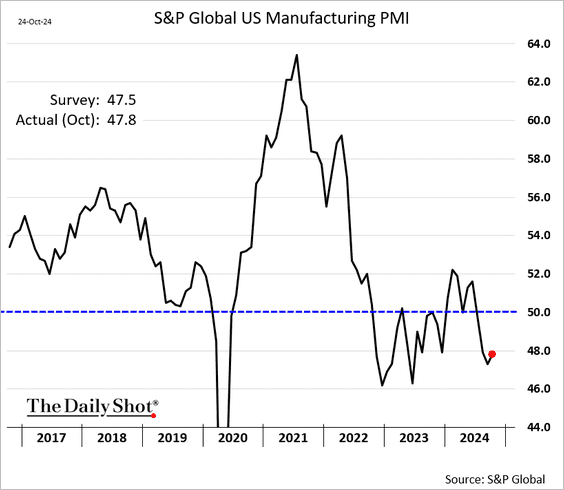
The S&P Global Flash US Manufacturing PMI fell from 49.6 in July to 48.0 in August, signaling a deterioration in business conditions within the goods-producing sector for a second successive month and the steepest rate of deterioration since December.

All five components of the PMI weakened in August. Increased rates of decline for new orders and inventories were accompanied by the first fall in factory production for seven months. Employment growth meanwhile slowed to near-stagnation. Suppliers’ delivery times also shortened to the greatest extent since February, in a sign of suppliers being less busy amid weaker demand for raw materials: input buying by factories fell at the sharpest rate for eight months. However, inventories of finished goods rose markedly for the third time in the past four months, the recent accumulation on unfinished inventory having been amongst the largest recorded in the history of the survey, often reflecting weaker than expected sales.

Commenting on the data, Chris Williamson, Chief Business Economist at S&P Global Market Intelligence said:

“The solid growth picture in August points to robust GDP growth in excess of 2% annualized in the third quarter, which should help allay near-term recession fears. Similarly, the fall in selling price inflation to a level close to the pre-pandemic average signals a ‘normalization’ of inflation and adds to the case for lower interest rates.

“This ‘soft-landing’ scenario looks less convincing, however, when you scratch beneath the surface of the headline numbers. Growth has become increasingly dependent on the service sector as manufacturing, which often leads the economic cycle, has fallen into decline. The manufacturing sector’s forward-looking orders-to-inventory ratio has fallen to one of the lowest levels since the global financial crisis.

“At the same time, service sector growth is constrained by hiring difficulties, which continue to push up pay rates and means overall input cost inflation remains elevated by historical standards.

“The policy picture is therefore complicated, and hence it’s easy to see why policymakers are taking a cautious approach to cutting interest rates. However, on balance the key takeaways from the survey are that inflation is continuing to slowly return to normal levels and that the economy is at risk of slowing amid imbalances.”

image

image

In brief:

  • The U.S. manufacturing sector is in a funk (new orders fell again and at a steep rate). The same for the Eurozone (largest reduction in new orders since the end of 2023) and for Japan (subdued demand conditions). This is exacerbated by a large inventory overhang which augurs badly for production and demand for commodities in the next 3-6 months.
  • Net job losses have now been reported in three of the past five months, marking the softest spell of payroll growth since the first half of 2020
  • Demand for services remains solid but employment declined because of “difficulties hiring staff and replacing leavers”. No supply!
  • Inflation looks back to pre-pandemic levels.

Strong U.S. retail sales (demand for goods) are only benefitting Asian exporters. Services are keeping the economy humming but slower payroll growth (jobs, hours, wages) will eventually hit overall spending

image

The other risk is that unemployment keeps rising to a point where consumers and business people begin to protect themselves against a potential recession: spending less, even on services, cost cutting, etc.

image

Rising productivity is good for profit margins but inflation back in the 2% range will also slow revenue growth.

image

This looks like a good time to start easing with positive forward guidance.

Three key charts from Goldman Sachs:

image

 image image

China Vows to Quicken Buying Unsold Homes for Public Housing

China’s housing regulator pledged to swiftly implement a program to purchase unsold apartments and turn them into affordable housing, its latest effort to cushion a record property slump.

The government will also push forward renting and selling public housing units as soon as possible when conditions are right, Vice Minister of Housing and Urban-Rural Development Dong Jianguo said in a briefing in Beijing on Friday. The ministry didn’t unveil a volume target.

Chinese authorities are trying to introduce a new housing model and put a floor under the prolonged property crisis. The real estate slowdown, now into its fourth year, has dragged down everything from the job market to consumption and household wealth. (…)

The country has formed a top-down plan to win the “uphill battle” of ensuring home delivery, the vice minister said. Since mid-May, the housing authority teamed up with the banking regulator and the National Administration of Financial Regulation to conduct comprehensive reviews on 3.96 million residences scheduled to be delivered this year, he added.

People “have paid money, so they should get their homes,” Dong said. (…)

Bloomberg Intelligence estimates that at least 48 million homes in China have been sold before construction is completed, bigger than Germany’s total housing stock in 2021.