(…) The labour differential – jobs plentiful less jobs hard to get looks especially worrying. This suggests people are now noticing a clear cooling in the jobs market and this measure has a tendency to lead changes in the unemployment rate. We are currently at levels historically consistent with the unemployment rate rising above 5% in the next few months. If that happens the market is right to expect another 50bp cut at either the November or December FOMC meetings – remember last week the Federal Reserve said it was only expecting the unemployment rate to rise to 4.4% by year-end.
This data is also consistent with the fall in the quit rate – the proportion of workers quitting their jobs to move to a new employers. That has been indicating that either the jobs on offer were not particularly attractive or that workers were starting to value tenure in case they were to be laid off. This really puts the onus on next week’s US jobs report. Anything around the 50,000 mark on non-farm payrolls or if the unemployment rate resumes its upward grind would lift talk of the Fed needing to loosen monetary policy more swiftly.
Consumers are feeling a cooler jobs market, which points to further rises in the unemployment rate
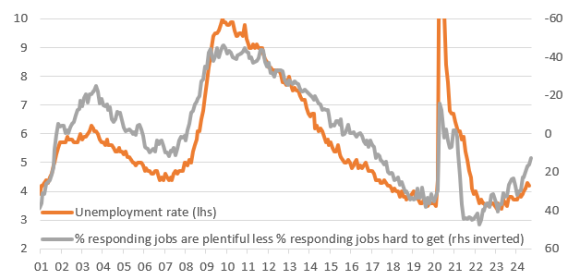
Source: Macrobond, ING
On the other hand, this chart from Ed Yardeni shows that more jobs are available, equivalent to rising labor demand (next JOLTS report on Oct. 1).

BTW, Goldman just boosted its Q3 GDP forecast to +3.0%.

The WSJ Editorial Board piggybacked on my Monday post which included these two charts showing world manufacturing wages and the well above average growth in U.S. manufacturing wages before, after the pandemic and even recently in spite of flat production and employment. I wondered whether MAGA can happen given the high and still rising U.S. manufacturing costs.


The WSJ Editorial Board opted to politicized the manufacturing stagnation:
(…) The problem for U.S. companies is that Mr. Biden’s anti-business policies offset the impact of subsidies. Inflation caused by all that government spending has raised business costs, and soaring electricity prices have been especially damaging. (…)
EPA’s regulations “stand to paralyze an industry” and “impose billions of dollars in mandates” on U.S. manufacturers, (…) The Biden EPA has also imposed stringent emissions limits on paper, cement, glass, steel, iron, and chemicals manufacturers in the name of reducing smog in downstream states despite little connection between the two. (…)
Being Canadian, I am not a party to the American political debate.
Being an investor, I can observe the following facts:
- Contrary to the WSJ article headline, manufacturing output has been flat as a pancake since 2007, that’s 17 years.
- So has employment, suggesting little, if any, productivity gains in manufacturing.
- Manufacturing unit labor costs rose 50% since 2007 vs 30% for the whole U.S. nonfarm business sector. (Boeing just offered a 30% wage increase over 4 years + performance bonus, ratification bonus, and improved retirement benefits. Is BA in a solid growth phase currently?)
- Environmental regs and other “anti-business policies” did not prevent a more than doubling in manufacturing construction since mid-2021.

- However, this huge additional capacity has yet to move the needle on actual production and employment. Manufacturers’ new orders are flat since early 2022 in spite of the surging capacity. Manufacturing capacity utilization dropped from 80% in early 2022 to 77% in August. American manufacturers have spent $155 billion in the last 3 years with nothing yet to show for it.
- Either production will soon explode, although new orders and employment have yet to move, or disastrous returns on capital will eventually bite many rear ends.
Could it be that American manufacturers are finally heavily investing in robotics to boost productivity and competitiveness?
Nah! The grey bars below seem frozen in time.

According to World Robotics, in 2023, the average robot density in the manufacturing industry was 162 robots per 10,000 employees.
- Asia’s average robot density grew by 13% CAGR from 2018 to 2023 and was 182 units per 10,000 employees in 2023. That’s 12% above average.
- During the same period, the European robot density grew by 7% CAGR to 142 units. That’s 12% below average.
- In the Americas, it was 127 robots per 10,000 employees (+6% CAGR since 2018). That’s 22% below average, growing at less than half the Asian growth rate.
In case you are wondering,
China’s operational stock of industrial robots, which had been growing impressively by 22% on average each year since 2018, exceeded the one-million-unit mark in 2021 and the 1.5-million-unit mark in 2022. In 2023, it grew by 17% to 1.76 million units.
This represented 41% of the global stock. Every other robot installed worldwide in 2023 ended up in China.
Could the tariffs war be part of the problem?
- An August 2018 analysis from economists at the Federal Reserve Bank of New York warned the Trump administration’s intent to use tariffs to narrow the trade deficit would reduce imports and US exports, resulting in little to no change in the trade deficit.
- A March 2019 National Bureau of Economic Research study conducted by Pablo D. Fajgelbaum and others found that the trade war tariffs did not lower the before-duties import prices of Chinese goods, resulting in US importers taking on the entire burden of import duties in the form of higher after-duty prices.
- In December 2019, Federal Reserve economists Aaron Flaaen and Justin Pierce found a net decrease in manufacturing employment due to the tariffs, suggesting that the benefit of increased production in protected industries was outweighed by the consequences of rising input costs and retaliatory tariffs.
- A May 2023 United States International Trade Commission report from Peter Herman and others found evidence for near complete pass-through of the steel, aluminum, and Chinese tariffs to US prices. It also found an estimated $2.8 billion production increase in industries protected by the steel and aluminum tariffs was met with a $3.4 billion production decrease in downstream industries affected by higher input prices.
- A January 2024 International Monetary Fund paper found “mostly adverse consequences of protectionism, in aggregate and across sectors and regions. Tariff shocks are more important than trade policy uncertainty shocks. Tariff shocks depress trade, investment, and output persistently. Undoing the 2018/19 measures would raise output by 4% over three years.”
- Another January paper by MIT/Harvard/NBER and the World Bank concludes that “So far, the trade-war has not provided economic help to the US heartland: import tariffs on foreign goods neither raised nor lowered US employment in newly-protected sectors; retaliatory tariffs had clear negative employment impact (…). Nevertheless, the tariff war appears to have been a political success for the governing Republican party. Residents of regions more exposed to import tariffs became less likely to identify as Democrats, more likely to vote to reelect Donald Trump in 2020, and more likely to elect Republicans to Congress. Foreign retaliatory tariffs only modestly weakened that support.”
- “Tariffs are the greatest thing ever invented,” the former president declared at a town hall in Michigan last week.
I certainly do not have all the answers. But the questions must be asked: if it takes 1.5 years on average to build a plant, why is U.S. manufacturing production still flat after 3 years of booming investments? Why are new orders not rising at all? Where are the robots?
Good thing the U.S. is really a service economy.
AI CORNER
(…) It won’t happen all at once, but we’ll soon be able to work with AI that helps us accomplish much more than we ever could without AI; eventually we can each have a personal AI team, full of virtual experts in different areas, working together to create almost anything we can imagine. Our children will have virtual tutors who can provide personalized instruction in any subject, in any language, and at whatever pace they need. We can imagine similar ideas for better healthcare, the ability to create any kind of software someone can imagine, and much more.
With these new abilities, we can have shared prosperity to a degree that seems unimaginable today; in the future, everyone’s lives can be better than anyone’s life is now. Prosperity alone doesn’t necessarily make people happy – there are plenty of miserable rich people – but it would meaningfully improve the lives of people around the world.
Here is one narrow way to look at human history: after thousands of years of compounding scientific discovery and technological progress, we have figured out how to melt sand, add some impurities, arrange it with astonishing precision at extraordinarily tiny scale into computer chips, run energy through it, and end up with systems capable of creating increasingly capable artificial intelligence.
This may turn out to be the most consequential fact about all of history so far. It is possible that we will have superintelligence in a few thousand days (!); it may take longer, but I’m confident we’ll get there.
How did we get to the doorstep of the next leap in prosperity?
In three words: deep learning worked.
In 15 words: deep learning worked, got predictably better with scale, and we dedicated increasing resources to it.
That’s really it; humanity discovered an algorithm that could really, truly learn any distribution of data (or really, the underlying “rules” that produce any distribution of data). To a shocking degree of precision, the more compute and data available, the better it gets at helping people solve hard problems. I find that no matter how much time I spend thinking about this, I can never really internalize how consequential it is.
There are a lot of details we still have to figure out, but it’s a mistake to get distracted by any particular challenge. Deep learning works, and we will solve the remaining problems. We can say a lot of things about what may happen next, but the main one is that AI is going to get better with scale, and that will lead to meaningful improvements to the lives of people around the world.
AI models will soon serve as autonomous personal assistants who carry out specific tasks on our behalf like coordinating medical care on your behalf. At some point further down the road, AI systems are going to get so good that they help us make better next-generation systems and make scientific progress across the board.
Technology brought us from the Stone Age to the Agricultural Age and then to the Industrial Age. From here, the path to the Intelligence Age is paved with compute, energy, and human will.
If we want to put AI into the hands of as many people as possible, we need to drive down the cost of compute and make it abundant (which requires lots of energy and chips). If we don’t build enough infrastructure, AI will be a very limited resource that wars get fought over and that becomes mostly a tool for rich people.
We need to act wisely but with conviction. The dawn of the Intelligence Age is a momentous development with very complex and extremely high-stakes challenges. It will not be an entirely positive story, but the upside is so tremendous that we owe it to ourselves, and the future, to figure out how to navigate the risks in front of us.
I believe the future is going to be so bright that no one can do it justice by trying to write about it now; a defining characteristic of the Intelligence Age will be massive prosperity.
Although it will happen incrementally, astounding triumphs – fixing the climate, establishing a space colony, and the discovery of all of physics – will eventually become commonplace. With nearly-limitless intelligence and abundant energy – the ability to generate great ideas, and the ability to make them happen – we can do quite a lot.
As we have seen with other technologies, there will also be downsides, and we need to start working now to maximize AI’s benefits while minimizing its harms. As one example, we expect that this technology can cause a significant change in labor markets (good and bad) in the coming years, but most jobs will change more slowly than most people think, and I have no fear that we’ll run out of things to do (even if they don’t look like “real jobs” to us today). People have an innate desire to create and to be useful to each other, and AI will allow us to amplify our own abilities like never before. As a society, we will be back in an expanding world, and we can again focus on playing positive-sum games.
Many of the jobs we do today would have looked like trifling wastes of time to people a few hundred years ago, but nobody is looking back at the past, wishing they were a lamplighter. If a lamplighter could see the world today, he would think the prosperity all around him was unimaginable. And if we could fast-forward a hundred years from today, the prosperity all around us would feel just as unimaginable.
Hopefully, the IA (Intelligence Age) will arrive before the RIA (Really Imbecile Age) which would be as long as a nuclear flash…
Altman may be pleading for more energy and energy infrastructure. The energy wall is racing towards us at increasing speed. See Monday’s post: Power Play
FYI: China Says It Test-Fired Intercontinental Ballistic Missile
(…) Drew Thompson, a senior research fellow at the Lee Kuan Yew School of Public Policy in Singapore, wrote on social-media platform X that the timing of China’s launch appeared to be motivated at least in part by geopolitical frictions with Japan, the Philippines and Taiwan.
“Timing is everything,” wrote Thompson, a former Pentagon official, who said separately that he believed it was Beijing’s first public acknowledgment of an ICBM test launch since 1982. “This launch is a powerful signal intended to intimidate everyone.”
Separately on Wednesday, Taiwan’s Defense Ministry said it detected 23 Chinese military aircraft around the island, all but one of which crossed into the island’s air-defense identification zone. The region has been on edge this week as a Russian military reconnaissance plane entered Japan’s airspace on Monday, prompting Japanese jet fighters to fire warning flares in response. On the same day, Russia and China each sent four warships through a strait dividing the Russian island of Sakhalin from the Japanese island of Hokkaido, according to Japan’s Defense Ministry.


