The enemy of knowledge is not ignorance, it’s the illusion of knowledge (Stephen Hawking)

It ain’t what you don’t know that gets you into trouble. It’s what you know for sure that just ain’t so (Mark Twain)

Invest with smart knowledge and objective odds

THE DAILY EDGE: 30 July 2024

Airplane Note: I am travelling (Pacific time zone) until August 10. Posting will be irregular and possibly limited by time and equipment constraints.

US Job Openings Come in Above Forecast After Upward Revision

Available positions decreased to 8.18 million from a upwardly revised 8.23 million reading in the prior month, the Bureau of Labor Statistics Job Openings and Labor Turnover Survey, known as JOLTS, showed Tuesday.

The median estimate in a Bloomberg survey of economists called for 8 million openings.

The report still shows there’s solid demand for workers even though employers have pulled back on hiring and wage growth has slowed.

Indeed Job Postings show the labor market has recently stabilized.

image

Small cars are hot again

Americans are snapping up small cars again, not because they want to, but because it’s what they can afford.

Small car sales are outpacing the rest of the market this year, according to Cox Automotive data.

  • While overall vehicle sales were up about 2% nationwide in the first half of 2024, subcompact crossover utilities grew more than 20%.
  • Compact cars and SUVs also increased 18% and 12% respectively, per Cox.
  • Full-size pickup truck sales, meanwhile, were down 4% for the first half of the year.
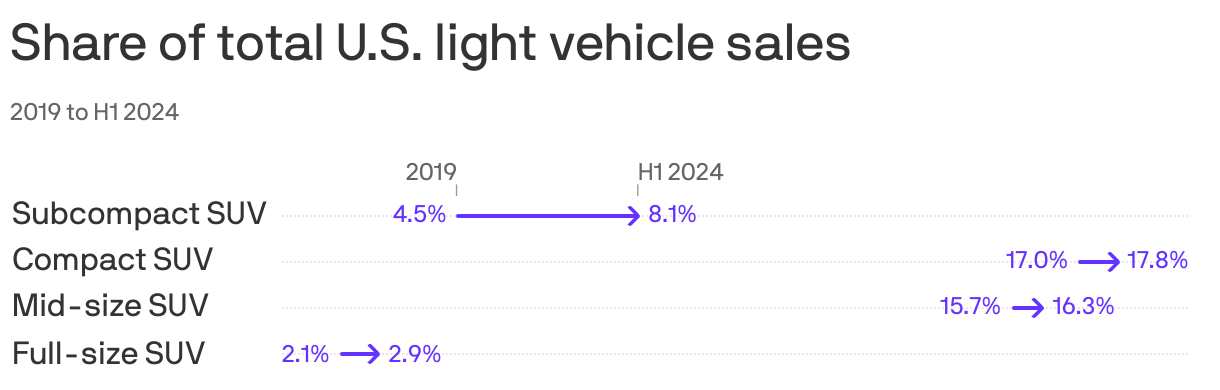
Arrow chart showing the share of U.S. light vehicle sales for select SUV types increased the most for subcompact SUVs from 4.5% of light vehicle sales in H1 2019 to 8.1% in H1 2024. The change for compact, mid-size and full-size SUVs was less than one percentage point in the same period.

(…) Consumers on average are paying $11,000 more for a new car than they were five years ago,” she tells Axios.

The Chevrolet Trax, with a starting price of $21,495, is perhaps the best example of the trend.

  • General Motors redesigned the small SUV for the 2024 model year, making it larger and less expensive but with more technology than the previous version.
  • Even the base model comes with standard safety features like automatic emergency braking and lane-keeping assist, while higher-trim versions include Apple CarPlay, a Wi-Fi hotspot and adaptive cruise control — all for well below $30,000.
  • Consumers love the Trax, with sales up 230% compared to the first six months of 2023.
  • Other subcompact SUVs, like Mazda’s CX-50 (starting at $30,300) and Honda’s HRV (starting at $25,100), are also selling fast.

Compact cars are also booming, led by strong sales of the Nissan Sentra (+55%), Honda Civic (+38%) and Toyota Corolla (+26%).

  • U.S. automakers pretty much gave up on small sedans in recent years, although the popularity of small SUVs like the Trax is keeping them in the entry-level game.

The threat of inexpensive electric cars from China will also drive automakers to shift to smaller, more affordable vehicles.

  • That’s the best way for automakers to compete with cheap Chinese EVs, Ford CEO Jim Farley said recently.
  • “We have to start to get back in love with smaller vehicles. It’s super important for our society and for EV adoption,” Farley told The Guardian. “We are just in love with these monster vehicles, and I love them, too, but it’s a major issue with weight.”
  • “These huge, enormous EVs are never going to make money: The battery is $50,000, even with low-nickel, LFP chemistry. They will never be affordable.”

Nerd smile Not necessarily good news for American car manufacturers…

China Pledges Steps to Shore Up Flagging Economy Chinese leaders said they would take more aggressive steps to boost consumer spending and head off a worsening set of economic challenges.

The Communist Party’s top policymaking body, the 24-member Politburo, pledged more measures to boost household income and reduce funding costs for companies, though the report from the state-run Xinhua News Agency offered few specifics on what it is planning. (…)

The Politburo’s assessment of China’s economy is “grimmer” in tone when compared with that of senior officials two weeks ago when they released second-quarter economic growth figures, said Bruce Pang, a China economist at Jones Lang LaSalle. The Politburo’s downbeat tone indicates that more policy support and stimulus could be in the offing.

At Tuesday’s Politburo meeting, Communist Party leaders stressed the importance of expanding domestic demand with a focus on boosting consumption, Xinhua said. Leaders also pledged to support consumption in industries including culture and tourism, elderly care and housekeeping, without offering further details.

They also signaled more regulatory efforts to address inefficient production and excessive competition in industries as China grapples with overcapacity issues that have sparked trade tensions abroad. (…)

Chinese EVs Nab Record 11% Share in Europe Ahead of Tariffs

Chinese brands captured 11% of the European electric-car market in June, notching record registrations as manufacturers raced to beat stiff European Union tariffs that took effect early this month.

SAIC Motor Corp. led the charge, shipping its MG4 hatchback to dealers in volume, according to analysts at researcher Dataforce, which compiled the figures. Cars registered before July 5 could be sold on to customers without the added duties on imported EVs.

Chinese brands registered more than 23,000 battery-electric vehicles across the region during the month, the most ever, Dataforce figures show. Their 72% sequential jump from May was twice the gain in overall European EV registrations for June. Chinese-made imports from Western manufacturers including Volvo Car AB, BMW AG and Tesla Inc. are also subject to the new levies. (…)

Image

The EU’s provisional charges subject SAIC to an additional 38% fee, while BYD will pay an extra 17% on the existing 10% customs duty. (…)

Conversely, there were signs of durable progress for BYD Co., the world’s largest plug-in vehicle maker. A marketing push centered on the Euro 2024 football tournament held in Germany gained real traction with consumers, said Julian Litzinger, a Dataforce analyst.

image

Another driver of the European EV market in June was the introduction of incentives in Italy, which helped to spur a doubling of battery-electric sales in the country from a year ago. About €200 million in new-EV subsidies ran out in less than nine hours, the government said in a statement. About 60% was tapped by families and the rest by companies.

The rise vaulted Italy, which has been lagging in EV sales, into the top six of a regional market that includes EU states, countries like Norway and Switzerland that participate in its single market, and the UK.

image

European policymakers are trying to strike a balance between easing access to less-expensive Chinese-made EVs that would aid progress toward sustainability goals, and protecting the legacy automaking industry in a tough economy. (…)

Overall, June was the third-highest month ever for EV volumes with 208,872 registrations across the region, according to the European Automobile Manufacturers’ Association, behind December 2022 and March 2023, and just ahead of June 2023.

The U.S. Wanted to Knock Down Huawei. It’s Only Getting Stronger. The Chinese telecom giant struggled at first under U.S. sanctions—then Beijing stepped in

Bolstered by billions of dollars in state support, Huawei has expanded into new businesses, boosted its profitability and found fresh ways to curb its dependence on U.S. suppliers. It has held on to its leading position in the global telecom-equipment market, despite American efforts to squeeze Huawei out of its allies’ networks. And it’s making a big comeback in high-end smartphones, using sophisticated new chips developed in-house to take buyers from Apple.

Along the way, a company that portrayed itself as independent from Beijing has morphed into something more like a national champion, helping China wean itself off foreign suppliers—part of a broader campaign to eliminate U.S. technology in China, dubbed “Delete A,” for Delete America. Its resurgence shows why it’s so hard for America to contain China’s technological ambitions.

State money was critical. While China’s government has backed Huawei since its earliest days, government support ramped up in recent years. Huawei’s profit more than doubled last year, the largest jump in at least two decades. Roughly two-thirds of its revenue comes from domestic clients.

Government contracts and company registration records, as well as interviews with former and current employees, reveal that billions of dollars flowed from the Chinese government to Huawei through preferential buying contracts and subsidies. State-owned enterprises, government agencies and Communist Party bodies sought Huawei chips, smartphones, cloud services and software, with some procurement contracts calling for Huawei gear by name.

Local governments have bought Huawei businesses, providing cash injections. Once reliant on Google’s Android for its consumer devices, Huawei built its own operating system. It has even made a foray into electric vehicles, a task that Apple gave up on, and developed its own version of Bluetooth.

Huawei still faces challenges. Its most advanced semiconductors remain a step behind industry leaders such as Nvidia, and some sector experts believe it will be hard for Huawei to keep innovating without access to more advanced Western technologies.

“We’ve been through a lot over the past few years. But through one challenge after another, we’ve managed to grow,” Huawei said in a written statement, adding that the company owed its survival and development to the trust and support of global customers, partners and “all sectors of society.” Sustaining R&D investment will be crucial going forward, the company said. (…)

“The goal wasn’t to drive Huawei out of business,” said Matt Pottinger, who was deputy national security adviser in the Trump administration and now chairs the China program at the Foundation for Defense of Democracies think tank. “It was to protect our alliances and protect our data, and if it made life harder for Huawei, all the better.”

Washington is watching Huawei’s progress warily. One current U.S. official said Washington is closely tracking Huawei’s efforts to make its own semiconductors, in case more actions are needed to block China from manufacturing artificial-intelligence-focused chips that can give Beijing a military edge. (…)

Huawei denied that its products would ever be used to spy on Western nations, and played down any ties with the Chinese state. In the company’s early years, according to state media, Ren turned down help from China’s then-premier in getting a loan so that Huawei could maintain distance from authorities.

After the U.S. imposed restrictions, Huawei and China’s government grew closer. Soon, Huawei leaders declared that every product they made going forward should be able to rely entirely on components developed by Chinese companies.

In a public speech last year, Ren recalled that a Huawei executive told him: “America doesn’t understand that with this blow, they are turning the biggest supporter of the U.S. into its largest detractor.” (…)

Huawei received over $1 billion in government grants in 2023, more than quadruple the amount it received in 2019, according to Huawei’s financial reports. In all, Huawei received nearly $3 billion in the past five years, accounting for 3% of its total R&D expenses. (…)

The Wall Street Journal found more than 300 government procurement contracts worth around $5 billion specifically calling for the purchase of servers and other tech infrastructure powered by Huawei’s Kunpeng central processing units, or CPUs, in 2023. Other contracts listed Huawei CPUs among a handful of preferred local vendors.

All of this was a sharp contrast to five years ago, when government agencies specifically requested products from U.S. chip makers Intel or AMD.

China’s buy-local policy is even more pronounced in the telecom-equipment space, Huawei’s largest revenue source. State-owned Chinese wireless carriers have largely stopped buying equipment from Huawei’s foreign rivals, Sweden’s Ericsson and Finland’s Nokia, even when one of them priced their contracts more cheaply than Chinese companies. The shift came while Sweden and other European countries indicated that they would cut Huawei and another Chinese equipment maker, ZTE, from their networks.

Ericsson and Nokia held about 15% of China’s cellular equipment market before 5G began rolling out in 2019. Now, in the 5G cellular-equipment market, they hold about 4% to 5%, according to research firm Dell’Oro. (…)

Huawei boosted R&D spending to almost 165 billion yuan, or $23 billion, last year, up from 102 billion yuan in 2018. More than half of Huawei’s 207,000 employees are in R&D.

Huawei is now at the vanguard of China’s push to develop cutting-edge chips to wean reliance on Nvidia and Intel, as the Biden administration seeks to curb China’s ability to develop advanced chips and technology that could aid its warfare and surveillance. U.S. chip juggernaut Nvidia singled out Huawei as a top competitor in February.

Huawei is leading a government-funded project to develop memory units for advanced AI chips, people familiar with the matter said, with at least 11 national AI data centers now using Huawei chips. (…)

Through various state-backed funds, the Chinese government has invested in more than two dozen chip-related startups alongside Huawei over the past five years, according to corporate database Tianyancha.

Last August, Huawei launched its Mate 60 Pro, a smartphone with 5G-like capability powered by a chip developed in-house. Many Chinese consumers have cited national pride as a reason for buying Huawei smartphones, whose success led to a sharp drop in Apple iPhone sales so far this year. (…)

Apple Intelligence: Here’s When the New AI Features Come to the iPhone and iPad The new Siri and other tools won’t be available until iOS 18.1 is released later this fall. This is the timeline.

The first wave of Apple Intelligence tools won’t be in the initial iOS 18 release this fall. Instead, they’ll be a part of iOS 18.1, which is expected a few weeks later. In the past, Apple has released the new iOS in mid-September, followed by the first big update in October. Microsoft, Google, Samsung and Meta have already released generative-AI tools to users.

On Monday the company released a developer-only beta version of iOS and iPadOS 18.1 and MacOS Sequoia 15.1, which include some of those Apple Intelligence tools. Keyword: some. Text-summarization tools and some Siri enhancements are there but the promised visual tools and ChatGPT integration aren’t coming until later in the year. (…)

Only those with an iPhone 15 Pro, 15 Pro Max, and iPads and Macs with M chips will be able to get Apple’s AI. Apple says the features require the latest and fastest chips.

If you’ve got one of those devices and iOS/iPadOS 18.1, you’ll get access to the following:

  • New Siri: With the redesigned assistant, you can move between talking and texting. It will also have a more natural voice, and it can better understand you if you flub or change your ask midsentence. (Example: “Set an alarm for 3 a.m., oh wait, I mean 3:10 a.m.”) Siri can also answer questions about your Apple products and their settings.
  • Writing tools: Available wherever you’re able to copy and paste text, these can proofread and rewrite your words. The AI can also take a big chunk of text and summarize it, and even distill it into a list or a table.
  • Photos: The Photos app supports natural language search and can create a video based on a written prompt. (Example: “A movie about my trip to the New Jersey Shore.”)

This specific release will also include transcriptions and summaries of phone calls and recordings in Notes. And there are AI-generated summaries of Messages, emails and notifications.

Before the New Year’s Eve ball drops, Siri will get ChatGPT integration and the ability to tap in to your personal context. (Example: “When should I leave to get mom from the airport?”) Siri’s ability to perform actions within third-party apps is coming next year. 

What Apple won’t commit to is when the rest of the following promised features will arrive. The company will only say they’ll arrive in software updates this year and over the course of next year:

  • Image creation/editing: Missing from iOS 18.1 are a number of the photo tools Apple previewed. These include Photos Clean Up (removes objects in a photo, similar to Android’s Magic Eraser), Image Playground (generates images in different styles) and Genmoji (generates new emojis).
  • More Siri: Plus, there’s also Apple’s promise that Siri will have an understanding of what appears on your screen. (Example: “Add this address to his contact card.”)
  • Additional languages + countries: Initially, Apple Intelligence will only support American English.

Like I said, these things could come this year or next. Maybe we can ask the new Siri about this, too. Oh, wait…

THE DAILY EDGE: 29 July 2024

Airplane Note: I am travelling (Pacific time zone) until August 10. Posting will be irregular and possibly limited by time and equipment constraints.

America’s Post-Covid Factory Boom Is Running Out of Steam Companies are laying off employees and cutting production to counter falling orders and rising inventories

More U.S. manufacturers are rethinking their plans as they brace for an extended slump in demand.

Higher interest rates, rising operating costs, a strengthening U.S. dollar and lower selling prices for commodities are dampening activity at factories across the country. Executives for the makers of long-lasting items such as cars, crop-harvesting combines and washing machines are projecting challenging business conditions for the remainder of the year.

Deere & Co., the world’s largest manufacturer of farm equipment by sales, has shed about 2,100 production workers since November, or 15% of its hourly workforce. Rival equipment maker Agco said in June it would cut 6% of its salaried workforce worldwide, or about 800 people, by the end of the year.

Recreational vehicle maker Polaris this week said it would adjust production to cut back on shipments to dealers. The disclosure came as it reported a 49% drop in quarterly income and noted that sales of its motorcycles, boats and off-road vehicles all dropped as consumers pulled back on discretionary purchases. (…)

Whirlpool said a soft housing market is holding down demand for its refrigerators, dish washers and other household appliances. MSC Industrial Direct, a distributor of tools and industrial supplies to manufacturers, said its average daily sales during its recently completed quarter decreased by 7% compared with a year earlier. (…)

Sluggish economies elsewhere in the world, including China, also are weighing on U.S. companies. Elevator and escalator maker Otis Worldwide slightly raised its profit outlook for the year but pared its sales forecast because of falling demand in China.

The rising value of the U.S. dollar relative to other countries’ currencies makes foreign-made goods cheaper to import, putting U.S. companies at a disadvantage against foreign competitors.

Sohel Sareshwala, president of Accu-Swiss, a California-based manufacturer of small precision parts for the semiconductor, biomedical and food industries, said U.S. tariffs drive inflation and keep domestic prices for stainless steel and other materials he uses higher than his foreign competitors’ material costs.

“The strong dollar, it does make a difference. Their cost for raw material also is significantly lower,” he said.

Is it the economy or specific industry or company problems? Many of these companies boosted prices during the pandemic. Plus tariffs. Sticker shocks coupled with high interest rates do impact demand. As shown below, overall consumer demand remains fairly solid, including discretionary goods.

image

On a YoY basis, initial claims for unemployment insurance are flat through July 20.

As to the recent rise in the unemployment rate, Goldman agrees with my own analysis:

The increase in the unemployment rate—now up 0.46pp from its cycle low on a three-month average basis—has revived concerns about downside risks to the US economy. After all, in US history even moderate increases in the unemployment rate have eventually grown into large increases accompanied by recessions.

But we are less worried this time [mainly because] the recent rise in the unemployment rate breaks with the historical pattern in one crucial respect—there has not been an increase in the layoff rate, which remains historically low. This is important because it means the economy is not experiencing the usual vicious circle in which job and income loss lead laid-off workers to reduce their spending, leading to further job loss.

The increase in the unemployment rate has instead come partly from a surge in labor supply driven by immigration, with which job growth has not quite kept up. But job growth is far from weak, and with final demand still growing at a robust pace, it appears set to remain fairly solid.

A Fed Rate Cut Is Finally Within View Central-bank officials meet in the coming week looking ahead to a September rate cut to maximize chances of a soft landing

While Federal Reserve officials aren’t likely to change interest rates in the coming week, their meeting will nonetheless be one of the most consequential in a while.

At each of their four meetings this year, interest-rate cuts have been a question for later. This time, though, inflation and labor-market developments should allow officials to signal a cut is very possible at their next meeting, in September. (…)

The Fed’s newfound readiness to cut rates reflects three factors: better news on inflation, signs that labor markets are cooling and a changing calculus of the dueling risks of allowing inflation to remain too high and of causing unnecessary economic weakness. (…)

With inflation resuming its progress and the labor market cooling, Fed officials face a shift in the trade-offs they often refer to as risk management, which boils down to which problem—somewhat elevated inflation or rising unemployment—they judge as harder to fix.

The Fed was late to raise interest rates two years ago in part because it had incorrectly judged inflation would subside rapidly. The Fed was able to correct that mistake, but to do so, had to rapidly raise rates from near zero in 2022 to around 5.3% in July 2023, the highest in more than two decades. One lesson: “When you’re too confident that your view is correct, you’re prone to mistakes,” said San Francisco Fed President Mary Daly.

The Fed doesn’t expect demand or hiring to weaken much in coming months, but if it is wrong, it probably won’t be able to cut rates quickly enough to forestall a recession. “If you’re behind on [cutting rates] when the labor market starts to falter, it’s really challenging to get that back on track. It is just not the same thing” as the belated start to rate increases two years ago, said Daly. (…)

McDonald’s Sales Fall in First Since 2020 as Traffic Drops

The chain’s comparable sales, a metric tracking restaurants open for over a year, fell 1% from the year prior. Each of McDonald’s geographic segments saw sales declines. In the US, the trend was driven by a decline in foot traffic that was partially offset by higher prices. (…)

image

CPI-Food-Away-From-Home is up 27% since the pandemic vs 19% for core-CPI. YoY in June: +4.1% vs +3.3% respectively. Margins or volume?

China Defends Manufacturing Push, Says World Needs More EVs Vice Finance Minister Liao says Chinese output helps world

China’s manufacturing capacity is helping the world fight climate change and contain inflation, said Vice Finance Minister Liao Min, pushing back against US Treasury Secretary Janet Yellen’s latest criticism of the nation’s industrial excess.

“For decades, China has been a force of disinflation for the world through its supply of manufactured products with good value for money,” Liao said in an exclusive interview in Rio de Janeiro, where he attended this week’s meeting of G-20 finance ministers and central bank governors.

“It is now also providing green goods for the world as countries try to achieve their carbon reduction goals by 2030,” he said. Global demand for new energy cars will be 45 million to 75 million units by then, far exceeding the world’s current supply capacity, he added, citing estimates by the International Energy Agency. (…)

While China pays attention to concerns of major economies about overcapacity, it too is concerned by trade threats like tariffs, Liao said.

“We should communicate in a candid manner with respect to rules of market economy and true facts,” he said, adding that China and the US will “continue to discuss the issue at the China-US Economic Working Group meetings.”

Liao was a key member of China’s team of trade-war negotiators facing off against US officials during Trump’s presidency. He traveled to the US as an aide to then Vice Premier Liu He and met Trump in the Oval Office. More recently, Liao greeted Yellen when she visited the country in April. (…)

Brazil’s Finance Minister Fernando Haddad said that while the response by some countries to China’s exports is an “understandable reaction,” it’s not sustainable in the long run.

Government subsidies are not the main reason that Chinese industries such as the renewable energy sector have gained competitive advantages over their peers, Liao said in the interview. More important factors are corporate investment in research and development spanning years, entrepreneurship and technological innovation, he said.

“China’s reform and opening-up experience over the past more than 40 years has told us not a single industry can become a globally competitive sector simply relying on government support,” he said.

He also argued that some countries were left behind in terms of developing EVs because they enjoy advantages in the conventional auto sector and therefore didn’t shift their focus onto the emerging industry. In contrast, China had to seek growth in new sectors like EVs due to a lack of advantages in the traditional car market.

Demand-supply disequilibrium is only natural for any market economy, partly because companies make their own investment decisions and they do so for the long run expecting to meet higher demand, Liao said. Market forces will show if they made the right and wrong decisions, he said.

Large flows of capital funds into new industries is also not rare, he said, citing previous investment frenzies into sectors like information technology, shale gas and biopharmaceuticals that resulted in “periodical” excess capacity in developed countries.

The current AI angst is a case in point. The race by cash-rich behemoths to create moats on Gen AI with better, faster and cheaper LLMs and killer apps will no doubt come with large casualties in 2-3 years when the chips are finally down (pun intended). At this point of the race, nobody knows who the winners will be. We should begin to see how AI will directly impact our lives when Apple (and likely others) releases its new iPhone this fall.

 WhatsApp Image 2024-07-20 at 15.19.32_494f764f

Meanwhile:

Earnings Derail Stock Rally Over Doubts on AI, Consumer Strength Concerns about AI rally, consumer health weigh on sentiment

The latest earnings reports are fanning two worries that were already gnawing away at the US stock market: That the euphoria about artificial intelligence had run too far and that — at some point — consumers spending will start to stall. (…)

The Nasdaq 100 Index slid 2.6% in its third straight weekly loss after Alphabet Inc.’s results stoked a broader concern about how long it will take for investments in artificial intelligence to pay off. At the same time, updates from Southwest Airlines Co., United Parcel Service Inc., Whirlpool Corp. stoked worries about a potential pullback by consumers.

That’s heightened the stakes as earnings continue to roll out next week, including those from the tech bellwethers Microsoft Corp., Meta Platforms Inc., Amazon.com Inc. and Apple Inc. (…)

To be sure, there have been plenty of bright spots in the earnings picture. About 69% of companies in the S&P 500 that have already posted their results reported higher per-share earnings than a year ago, data compiled by Bloomberg Intelligence as of Friday morning show. And banks surpassed the sell-side’s expectations, while a profit squeeze for industrial companies may be coming to an end.

Moreover, those that posted disappointing figures have generally not been severely punished, at least so far. Companies in the S&P 500 that have trailed projections on both earnings per share and sales have underperformed the broader S&P 500 Index by an average of 1.6% within a day of reporting, the least since 2017, according to data compiled by Bloomberg Intelligence. (…)

The Google parent reported sales and cloud revenue that beat expectations. At the same time, capital spending rose to $13.2 billion in the second quarter, exceeding Wall Street’s estimates.

“It really feels like we are moving from a ‘tell me’ story on AI to a ‘show me’ story,” said Ohsung Kwon, equity and quantitative strategist at Bank of America Corp. “We are basically at a point where we’re not seeing much evidence of AI monetization yet.”

With weeks still to go before major US retailers roll out their earnings, early reports have indicated consumers are continuing to feel the pinch of high interest rates and still elevated inflation, particularly in the low-income category. Second quarter EPS growth in both consumer staples and consumer discretionary sectors is sitting at the lowest level in two years. (…)

Maybe there is too much focus on low-income consumers. They are indeed pressured by high interest rates and food/rent inflation but employment remains solid (Indeed Job Postings rose 1.5% MoM in June), real wages are still rising and inflation on essentials is slowing (+3.9% YoY in June).

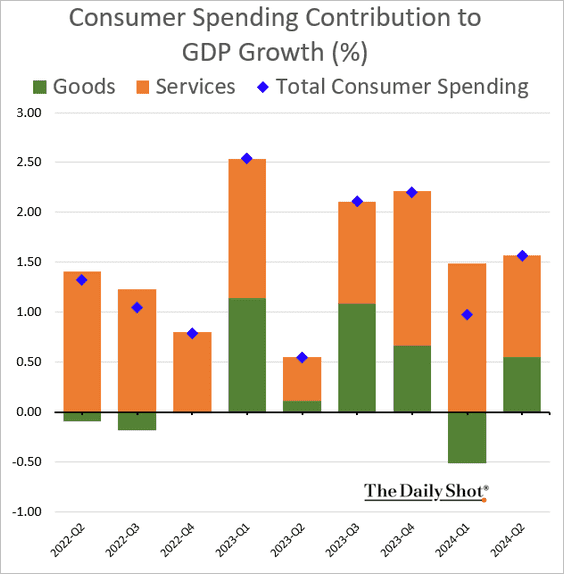
Consumer spending contributed 1.6% out of the 2.8% GDP growth in Q2. Spending on services has picked up while goods are not collapsing as widely expected.

Source: U.S. Department of Commerce and Wells Fargo Economics
Significantly, discretionary expenditures have accelerated lately.

Source: U.S. Department of Commerce and Wells Fargo Economics

June saw the lowest saving rate of the past 18 months. Statistically, the hand off in June means that even if spending were to flatline, real consumption expenditures would rise at a 1.1% annualized rate in Q3.

The Atlanta Fed GDPNow is at 2.8% for Q3 while the NY Fed’s staff estimate is at 2.7%.

EARNINGS WATCH

From LSEG IBES:

image206 companies in the S&P 500 Index have reported earnings for Q2 2024. Of these companies, 78.6% reported earnings above analyst expectations and 15.0% reported earnings below analyst expectations. In a typical quarter (since 1994), 67% of companies beat estimates and 20% miss estimates. Over the past four quarters, 79% of companies beat the estimates and 16% missed estimates.

In aggregate, companies are reporting earnings that are 4.4% above estimates, which compares to a long-term (since 1994) average surprise factor of 4.2% and the average surprise factor over the prior four quarters of 7.3%.

Of these companies, 58.3% reported revenue above analyst expectations and 41.7% reported revenue below analyst expectations. In a typical quarter (since 2002), 62% of companies beat estimates and 38% miss estimates. Over the past four quarters, 62% of
companies beat the estimates and 38% missed estimates.

In aggregate, companies are reporting revenues that are 1.0% above estimates, which compares to a long-term (since 2002) average surprise factor of 1.3% and the average surprise factor over the prior four quarters of 1.2%.

Factset calculates that S&P 500 companies with more than 50% of their revenues from foreign countries grew their earnings 21.8% in Q2 vs +4.0% for domestically focused companies. That in spite of fairly similar revenue growth rates and benign forex impact. Yet, the U.S. economy keeps meaningfully outperforming other economies.

 image image

IT and Communication Services companies are again the likely culprits as Factset shows:

image

More from LSEG IBES:

The estimated earnings growth rate for the S&P 500 for 24Q2 is 12.1%. If the energy sector is excluded, the growth rate improves to 13.1%.

The estimated revenue growth rate for the S&P 500 for 24Q2 is 4.8%. If the energy sector is excluded, the growth rate improves to 4.8%.

The estimated earnings growth rate for the S&P 500 for 24Q3 is 7.1%. If the energy sector is excluded, the growth rate improves to 8.3%.

image

image

Trailing EPS are now $231.10. Full year 2024e: $243.56. Forward EPS: $259.84. Full year 2025e: $279.65.

Expectations are very high. Revenues are seen accelerating sharply amid decelerating inflation while profit margins will go through the roof.

image

Ed Yardeni:

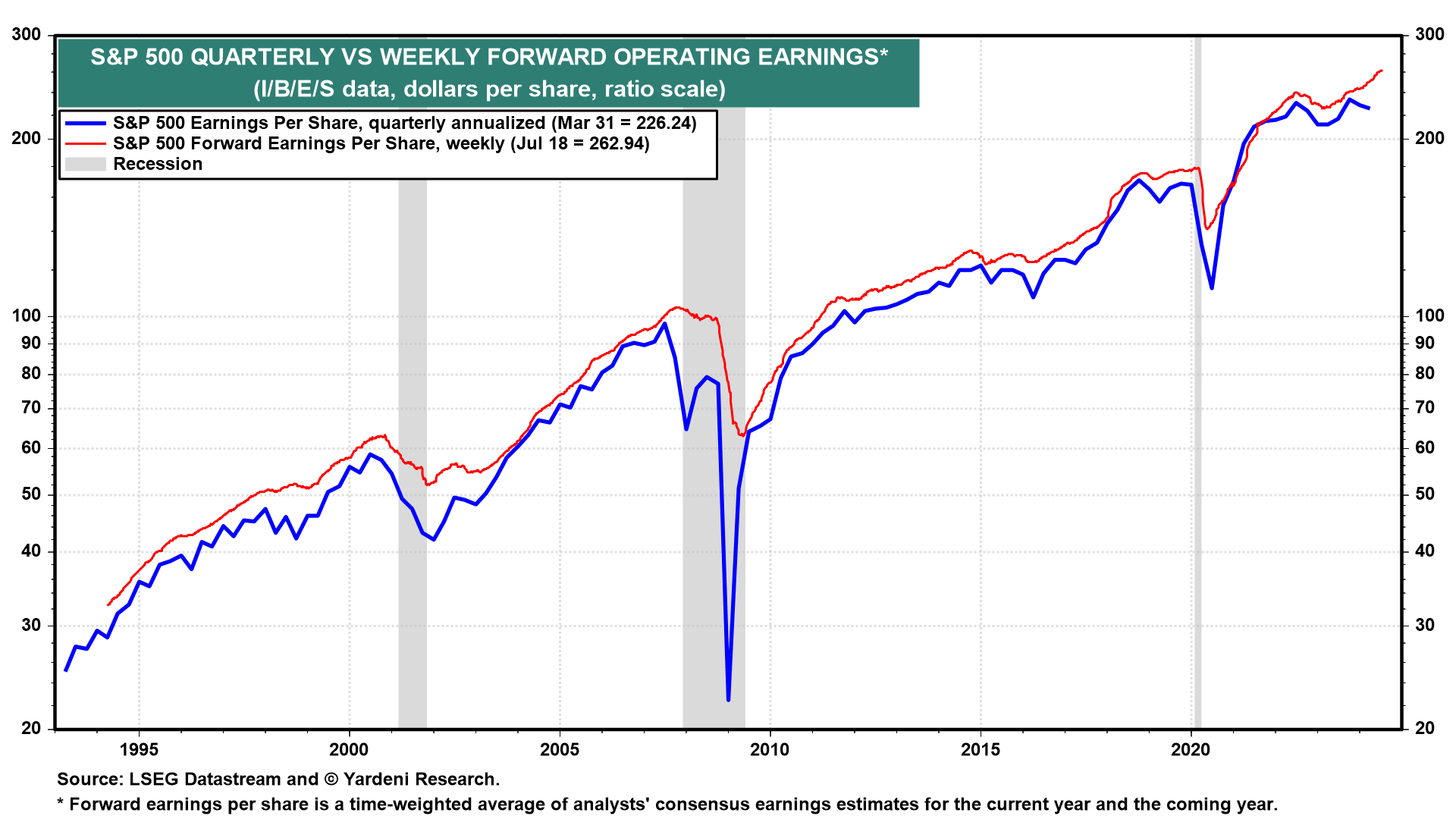
S&P 500 forward earnings (i.e., analysts’ consensus earnings expectations over the coming year) tends to do a good job of forecasting actual earnings when the economy is growing. S&P 500 forward earnings hit a new record high of $263 last week suggesting a solid gain in S&P 500 EPS during Q2, and boding well for Q3.

The weekly S&P 500 forward profit margin has climbed to its highest level since June 2022, nearing a new record high. We’re expecting realized margins to reach new record highs in the second half of the Roaring 2020s, beginning as early as 2025.

image

The S&P 500 forward P/E is relatively high at 20.6 currently. It is inflated by the 30.0 forward P/E of the MegaCap-8 (i.e., the Magnificent-7 plus Netflix) (chart). Excluding them, the S&P 492 are trading around 18.5. The S&P 400 MidCaps and S&P 600 SmallCaps are cheaper at 15.7 and 15.4. The problem with the S&P SMidCaps is that their earnings have been flat for the past couple of years. About 40% of the Russell 2000 universe currently are losing money.