China’s Economic Growth Comes in Worse Than Expected, Adding Pressure on Xi GDP expansion slowest in five quarters as demand struggles
Gross domestic product expanded 4.7% in the second quarter from the same period a year earlier, weaker than all except one of 28 estimates in a Bloomberg survey of economists. Retail sales rose at the slowest monthly pace since December 2022, showing a flurry of government efforts to juice confidence have done little to reinvigorate the Chinese consumer. (…)
China’s housing crisis remained a significant drag on the world’s second-largest economy, with new-home prices in major Chinese cities falling for the 13th straight month in June. Underscoring the weak confidence caused by that slump, China marked its fifth period of deflation in the second quarter, extending the longest slide of economy-wide prices since 1999.
A government program to subsidize the replacement of old vehicles and home appliances was having mixed effects. the data showed. (…)
Illustrating China’s struggle to stimulate household spending, retail sales of cars fell 6.2% in June despite new financial incentives, the steepest decline in more than a year. Home appliances and audio-video equipment decreased 7.6% last month, the worst since 2022.
Companies were more responsive to the government’s efforts. Growth in purchases of equipment and instruments exceeded 17% in the first half of the year, dwarfing a 6.6% increase in 2023, as factories sought to comply with new environment regulations accompanying the subsidies.
Goldman Sachs Group Inc. cut<?XML:NAMESPACE PREFIX = “[default] http://www.w3.org/2000/svg” NS = “http://www.w3.org/2000/svg” /> its China GDP growth forecast to 4.9% from 5% for this year, a downgrade that still puts the country on track to meet its annual goal of around 5%.
The National Bureau of Statistics said in a statement accompanying the data that the growth slowdown in the second quarter was due to short-term factors such as extreme weather and rain downpours and floods. It also reflected the economy is facing more difficulties and challenges, with the problems of insufficient domestic demand and clogged domestic circulation remaining, the NBS said. (…)
China didn’t disclose much about the first day of the closed-door meeting of its Central Committee on Monday, announcing only that it had started and Xi explained a plan on “deepening reform and advancing Chinese modernization.” (…)


China Home Prices Fall Sharply Despite Latest Rescue Plan
New-home prices in 70 cities, excluding state-subsidized housing, dropped 0.67% from May, when they slid 0.71%, the most since October 2014, National Bureau of Statistics figures showed Monday. Values of existing homes declined 0.85%, compared with a 1% decrease a month earlier. (…)
Price declines deepened from a year earlier. New-home prices slid 4.9% on average and used-home values tumbled 7.9%, the statistics bureau said. (…)
One bright sign was an improvement in residential property sales, which narrowed declines to 13% in June from a year earlier, according to Bloomberg calculations based on figures for the first six months. That compares with a 28% year-on-year drop in May. (…)
Funding for developers has stayed weak even after the government drew up a “white list” late last year of property firms that are eligible for loans. A broad gauge of financing for builders, including loans, bonds and proceeds from home sales, shrank 23% from a year earlier, separate data showed Monday.
While slightly more cities saw new-home prices rise from a month earlier, the first such improvement in three months, the recovery has been skewed to bigger cities and second-hand homes, BI’s Hung said on Bloomberg Television. (…)

Goldman Sachs’ take:
China’s Q2 GDP growth came in well below market expectations, while June activity data were mixed. This set of data highlighted the continued, significant cross-sector divergences in the economy — strong exports and manufacturing activity, relatively stable services consumption (in volume terms), and still-depressed property activity.
Industrial production growth remained solid in June, as the support from strong export growth has somewhat offset the distortions from the number of working days. Fixed asset investment growth rose slightly, mainly driven by the improvement in infrastructure investment, despite still-depressed property investment and adverse weather conditions in South China. By comparison, growth in retail sales fell notably and missed expectations in June, in line with sluggish tourism revenue growth during the Dragon Boat Festival and the soft 618 Online Shopping Festival.
Despite the recent round of housing easing, property-related activity remained depressed in June. Incorporating Q2 GDP outturns and NBS revisions to historical sequential GDP growth estimates mechanically lowers our 2024 full-year GDP growth forecast to 4.9% from 5.0% previously, but lifts our 2025 growth forecast to 4.3% from 4.2%.

Canada’s Freeland Hints at Broader Trade Action Against China
Canada’s finance minister said she’ll hold talks next week with business and labor groups about erecting trade barriers against Chinese-made vehicles — and suggested the government may even go beyond autos. (…)
“Geopolitics and geoeconomics is back. That means that Western countries— and very much the US — is putting a premium on secure supply chains and is taking a different attitude towards Chinese overcapacity,” she said. “And that means that Canada plays an even more important role for the United States.” (…)
US Producer Prices Move Higher as Service Provider Margins Climb PPI increased 0.2% in June from a month earlier; 0.1% expected
Compared with a year ago, the PPI rose 2.6%. (…)
The PPI report showed services costs increased 0.6%, with nearly all of the advance tied to a 1.9% jump in margins at wholesalers and retailers. Goods prices fell 0.5%.
Stripping out food, energy and trade, a less-volatile measure favored by many economists, prices were unchanged. Compared with a year ago, the gauge moderated to a 3.1% rate. (…)
“The PPI components that feed into the Fed’s preferred PCE deflator inflation measure were significantly lower than expected for June and it looks like May’s PCE gain could be revised down too, albeit only slightly,” Paul Ashworth, chief North America economist at Capital Economics, said in a note.
Costs of processed goods for intermediate demand, which reflect prices earlier in the production pipeline, fell 0.2% — the third decline in the last four months.

Big Banks and Customers Continue to Feel Pressure From Higher Rates JPMorgan and Wells Fargo report a drop in profit, while Citigroup’s profit rises thanks to cost-cutting measures
JPMorgan Chase, the biggest U.S. bank, and Wells Fargo both reported a drop in second-quarter profit Friday. Citigroup posted a rise in profit, driven in part by the bank’s cost-cutting measures, but set aside more provisions for potential losses in its credit-card business.
Banks of all sizes have struggled to adapt to the Federal Reserve’s faster-than-expected interest-rate increases. At first, rising rates boosted profits at America’s biggest banks, which were earning more on their loans while facing little pressure to pay customers more interest on their deposits. Yet competition for customers’ cash has heated up, crimping banks’ net interest income—the difference between what banks pay out on deposits and charge on loans. The rate increases also have squeezed some of the banks’ borrowers, causing them to fall behind on their loan payments. (…)
JPMorgan’s second-quarter profit declined 9% year-over-year to $13.1 billion. That figure excludes one-time items, including a $7.9 billion gain on an exchange of the bank’s shares of Visa.
JPMorgan’s reported net interest income rose to $22.7 billion, up 4% versus a year earlier. It was down from the previous quarter for the second period in a row, however, a sign that banks are having to pay up more for deposits.
Wells Fargo, whose business mix leans more heavily toward consumers than its peers, reported a second-quarter profit of $4.91 billion, down 1% from a year earlier. The San Francisco-based bank predicted net interest income would fall between 8% and 9%. (…)
Investment banking, trading, asset management and wealth management all benefited from improving confidence by corporate executives and investors.
JPMorgan reported a 46% increase in investment-banking revenue and Citigroup posted a 60% jump, though it slipped from the first quarter of this year. Wells Fargo’s fees were up 38% from a year ago but, like Citi, slipped from the previous quarter.
Credit-card loans rose faster than spending at all three banks, a sign that more borrowers carried over balances month to month.
“When you really dig into what’s happening across different consumers, the folks on the lower end of the wealth or income spectrum are struggling more,” Wells Fargo Chief Financial Officer Mike Santomassimo said on a call with reporters.
JPMorgan’s credit-card arm—the biggest in the country—said charge-offs on loans rose by nearly two-thirds from a year earlier. The rise in part reflected a normalization from years of historically low levels, Chief Financial Officer Jeremy Barnum told reporters.
But lower-income consumers have started to shift spending to nondiscretionary from discretionary purchases, which is historically a sign of weakness, he said.
Meanwhile, Citi finance chief Mark Mason said consumers with lower credit scores were spending less and delinquencies were up, though he saw possible signs of improvement. By June, more were catching up on their payments. (…)
Citigroup Inc. is shuttering unused credit card accounts as a growing number of customers fall behind on their payments.
The bank has also increased its capacity for collecting bad debts as part of its efforts to manage losses, Chief Financial Officer Mark Mason said on a conference call with journalists. That work has also included decreasing customers’ credit-card limits if they aren’t using them and tightening underwriting to ensure new accounts go to customers with higher credit scores.
“We’re watching the intent to pay very closely,” Mason said. “We’re constantly monitoring and managing this.”
(…) With moves like proactive credit line decreases or shuttering unusued accounts, banks are trying to avoid becoming a customers’ lender of last resort right as they’re facing trouble. (…)
Citigroup’s total provisions for credit losses were $2.5 billion in the second quarter, up from $1.8 billion in the same period a year earlier. That included $1.93 billion in net credit losses tied to its US personal banking division. (…)
The bank is not alone: Wells Fargo & Co. and JPMorgan Chase & Co. each saw net charge-offs from their credit card businesses soar more than 60% in the second quarter compared to a year ago. (…)
The bank now expects its full year net charge-off rate for the branded cards business — which is home to its popular proprietary cards like the Double Cash card — to be between 3.5% and 4%. That business finished the quarter with a net credit loss rate of 3.82%.
In retail services, that rate is expected to be between 5.75% and 6.25%, though the company warned it’s likely to be in the higher end of that range. (…)

EARNINGS WATCH
From LSEG IBES:
27 companies in the S&P 500 Index have reported earnings for Q2 2024. Of these companies, 81.5% reported earnings above analyst expectations and 11.1% reported earnings below analyst expectations. In a typical quarter (since 1994), 67% of companies beat estimates and 20% miss estimates. Over the past four quarters, 79% of companies beat the estimates and 16% missed estimates.
In aggregate, companies are reporting earnings that are 3.6% above estimates, which compares to a long-term (since 1994) average surprise factor of 4.2% and the average surprise factor over the prior four quarters of 7.3%.
Of these companies, 51.9% reported revenue above analyst expectations and 48.1% reported revenue below analyst expectations. In a typical quarter (since 2002), 62% of companies beat estimates and 38% miss estimates. Over the past four quarters, 62% of companies beat the estimates and 38% missed estimates.
In aggregate, companies are reporting revenues that are 0.7% above estimates, which compares to a long-term (since 2002) average surprise factor of 1.3% and the average surprise factor over the prior four quarters of 1.2%.
The estimated earnings growth rate for the S&P 500 for 24Q2 is 9.6%. If the energy sector is excluded, the growth rate improves to 10.0%.
The estimated revenue growth rate for the S&P 500 for 24Q2 is 4.5%. If the energy sector is excluded, the growth rate declines to 4.3%.
The estimated earnings growth rate for the S&P 500 for 24Q3 is 8.3%. If the energy sector is excluded, the growth rate improves to 9.4%.


The S&P 500’s Q2-2024 EPS estimate of $59.22 didn’t change from the start to the end of the quarter. Typically, there’s a decline as the quarter progresses (a 2.4% drop for Q1-2024, a 5.9% drop for Q4-2023, and an average decline of 4.0% in the 120 quarters since consensus quarterly forecasts were first compiled in 1994). The quarter’s 0% change is great news and implies yet another strong earnings surprise.
The MegaCap-7 group of stocks (i.e., Alphabet, Amazon, Apple, Meta, Microsoft, Nvidia, and Tesla) is expected to record y/y earnings growth of 28.3% in Q2-2024—down from levels in the 50%-56% ballpark for the three prior quarters but close to the year-earlier 28.0%. Looking ahead to Q3-2024, analysts expect y/y earnings growth to decelerate even further to 15.7% as four of the MegaCap-7 companies slow to single-digit growth and Nvidia’s forecasted growth drops to 71.9% from 132.5% in Q2-2024.
Looking at the data without the MegaCap-7 group is telling as well. S&P 500 earnings excluding the MegaCap-7 are expected to rise 5.7% in Q2 after Q1 growth of 0.1% ended a six-quarter string of declines. We think the typical earnings surprise hook again in Q2-2024 will easily result in high-single-digit percentage y/y growth for the S&P 500 excluding the MegaCap-7.
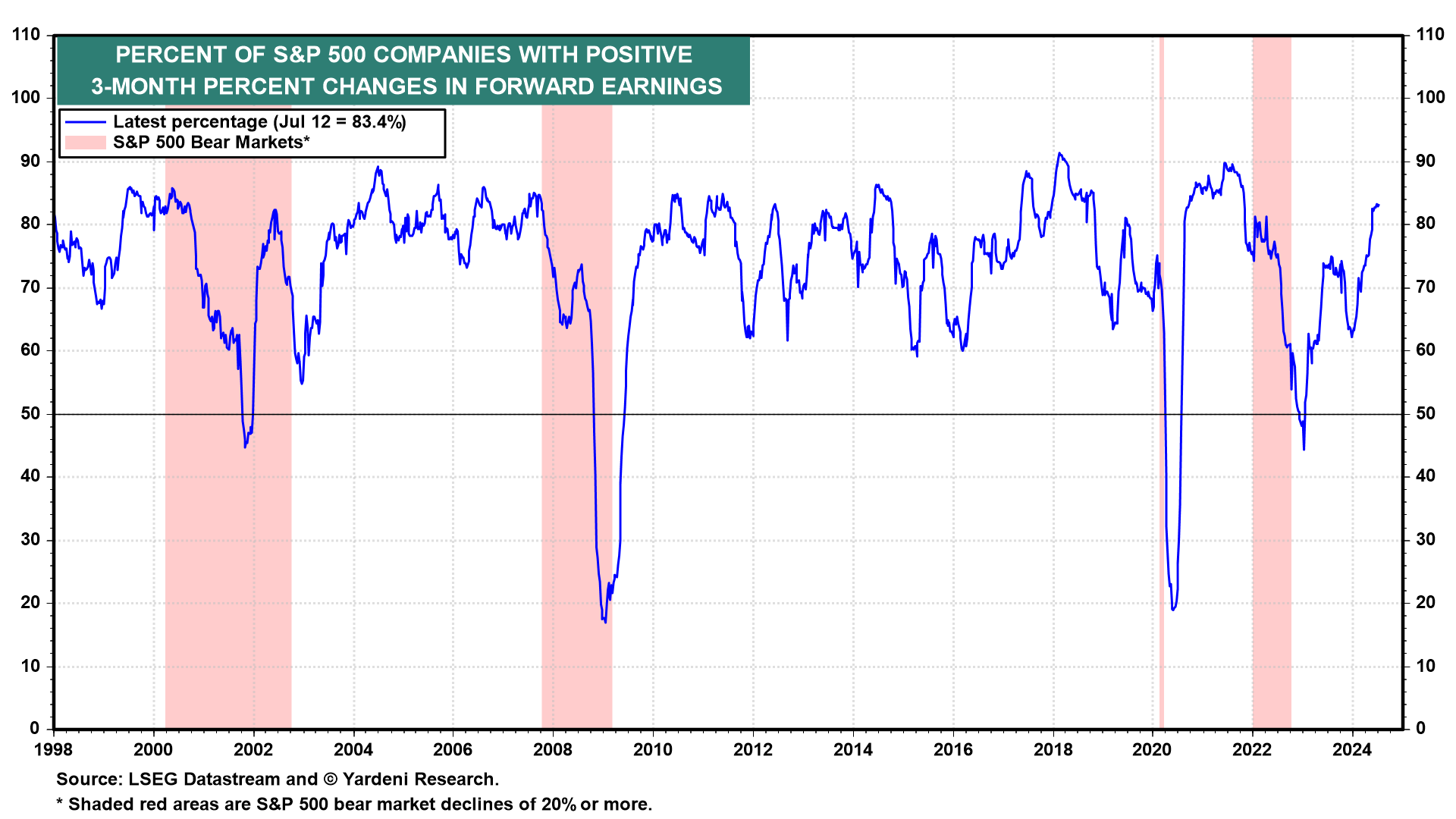
The breadth of positive three-month forward earnings growth rates among the S&P 500 continues to widen. (…) We also expect lots of positive earnings guidance, especially about how AI might already be contributing to cut costs and to boost productivity.

AI’s missing revenues (Axios)
(…) Newly published reports from Goldman Sachs, Barclays and Sequoia Capital have crunched the numbers on how much has been and will be spent on AI-related infrastructure, and how much extra revenue companies will need to make all that spending worth it.
“Overbuilding things the world doesn’t have use for, or is not ready for, typically ends badly,” Goldman Sachs head of global equity research Jim Covello warns.
- Sequoia’s David Cahn cautions against “the delusion that we’re all going to get rich quick, because [artificial general intelligence] is coming tomorrow.”
Goldman Sachs projects that companies and utilities will spend about $1 trillion on AI capex in the coming years.
The lack of revenue is at the core of the skepticism.
- Cahn notes that OpenAI is still generating the bulk of AI-related revenue right now, and its annualized revenue has been pegged at a mere $3.4 billion.
- Even his generous predictions of $5-$10 billion in annual revenue from Big Tech (from Google and Meta to Tencent and Tesla) still leave a giant hole of $500 billion in revenue just to make up for 2024’s infrastructure investment.
Barclays estimates that AI capex by 2026 will be sufficient to support 12,000 AI products of the scale of ChatGPT.
- “We do expect lots of new services that will bring some of this bull case to light, but probably not 12,000 of them,” Barclays analysts write.
- Meanwhile, Goldman’s Covello points out that even Salesforce, which has been aggressively spending on AI, showed little revenue boost in its Q2 financials.
Other unknowns include whether AI tech will become cheap enough to generate significant cost savings, whether it’ll solve the kind of highly complex problems that would make it worth the price, and whether we’ll be able to supply the energy needed to keep up with AI’s growth.
Tech leaders don’t see “overbuilding” as a dirty word.
- They remember how the dot-com bubble overbuilt telecom capacity before the bust of 2000-2002 wiped out legions of investors. But within a handful of years, all that capacity — and plenty more — was put to good use.
Generative AI’s topline benefits are not arriving anytime soon, realists argue.
Stephen Roach Warns of Disaster From Our ‘Sinophobic’ China Policy The former chairman of Morgan Stanley Asia warns of an accidental conflict.
One of the rare areas of bipartisan consensus in the US right now is taking a tough line on China. We saw President Trump put tariffs on Chinese goods, and the Biden administration has only added to them. A second Trump administration may add to them even further. Meanwhile, we’re increasingly placing export restrictions on various technologies, such as semiconductors. Stephen Roach, the former chairman of Morgan Stanley Asia and now a fellow at Yale Law School, foresees disaster from this. He sees an explosion of Sinophobia, with policymakers misreading China and ushering us into a new Cold War, where the risk of some kind of accidental conflict will inevitably rise. In this episode of the podcast, we talk about the current tensions, how they compare to the US-Japan trade tensions in the 1980s, and how things could go bad.
American Idle
Via ADG:
From Bloomberg:
Boeing Co. has notified some 737 Max customers in recent weeks that aircraft due for delivery in 2025 and 2026 face additional delays, another reminder that production of its cash-cow jetliner faces a long road to recovery.
The plane maker has cautioned that delivery timelines continue to slip by three to six months on top of already-late handovers, according to people familiar with the matter. In some instances, deliveries scheduled for next year have spilled into 2026, said the people, who asked not to be identified as the discussions are confidential.
On the bright side, what’s safer than an undelivered plane?




 Data: Oxfam; Chart: Rahul Mukherjee/Axios

 The big shift in China export strategy continues:
