Jay Powell yesterday:
-
“it’s challenging to know what to do”
-
“there are no risk-free paths now.”
Greg Ip:
The Fed Rolls Back Recession Risk The central bank’s rate cut eliminates the economy’s worst-case scenarios
(…) Economic growth through the first half of this year had been sluggish. Then on Aug. 1 came news that job growth had slowed to a crawl as hiring dried up, the sort of thing that often comes at the start of a recession. Fresh jobs data on Sept. 5 painted an even more dismal picture, with the unemployment rate drifting up to 4.3%.
Yet since that first bad jobs report, the S&P 500 has risen 6%. That’s partly over enthusiasm about artificial intelligence. But AI can’t explain why the Russell 2000 index of small stocks has risen even more, by 11%. Those companies are more sensitive to the ups and downs of the economic cycle, suggesting that investors expect a pickup in consumer and business spending.
This isn’t because weak job growth is good for spending, but because investors correctly figured the Fed would shift priorities from inflation to jobs. (…)
If demand takes off in coming months, as investors anticipate, that may make it easier for businesses to pass tariffs along to customers. Rebounding job growth would lead to higher wages. In dealing with one risk, recession, the Fed may have aggravated another: that inflation stays stuck above its 2% target.
The WSJ Editorial Board:
It’s Trump’s Federal Reserve Now The President gets his interest-rate cut—and all that comes with it.
(…) In their Summary of Economic Projections (SEP) released after this week’s meeting, Fed officials anticipate two more 25-point rate cuts this year and another in 2026. Yet the same SEP projections concede that inflation is proving more persistent than anticipated.
They now expect personal-consumption-expenditure inflation to hit 2.6% next year, up from the 2.4% they predicted in June. They don’t expect to hit the Fed’s target inflation rate of 2% until 2028. So they’re cutting rates even as inflation is expected to rise. Yet failure to get back to that target is the single biggest risk hanging over the Fed as an institution.
Instead, Chairman Jerome Powell and colleagues are shifting their main policy focus to the slowing labor market. Mr. Powell in his press conference described this week’s decision as a “risk-management cut” and emphasized evidence of softness in job creation.
But he struggled to articulate how monetary policy might make a difference. Neither of the negatives he mentioned—tariffs and Mr. Trump’s immigration crackdown—can be offset by lower interest rates. Otherwise, “it’s not a bad economy,” he allowed. Booming stock valuations and investor enthusiasm for low-quality debt, among other symptoms, suggest financial conditions aren’t especially tight as it is. (…)
The “dot plot” of policy makers’ interest-rate predictions revealed a greater diversity of opinions than usual. But it’s a dovish diversity, with the question being how far to cut rates in coming years and not whether to do so. (…)
Coupled with those inflation projections, the message is that the Fed will tolerate higher inflation for longer to take pre-emptive action to shore up an economy that may or may not need the help. (…)
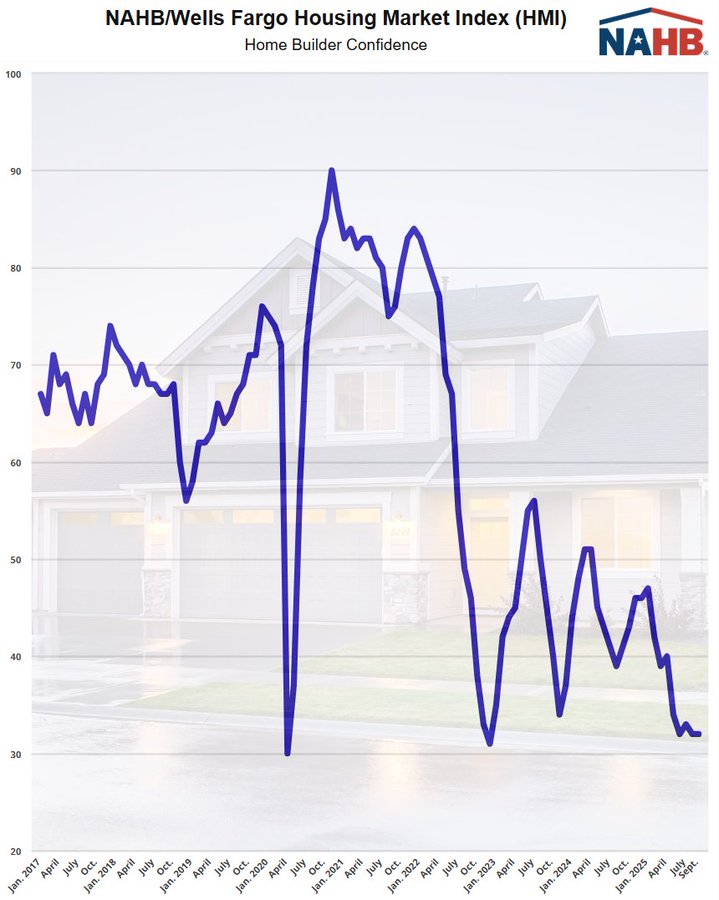
So good luck. It may be that everything works out fine: inflation drifts downward after a brief price bump from tariffs, the economy booms despite tariffs and a looming labor shortage, the housing market enters a new golden age, and financial markets gallop happily off into the artificial-intelligence sunset.
But if Mr. Trump is wrong, voters will notice sustained inflation and the lack of gains in real wages. Having staked so much on his political assault on the Fed, Mr. Trump owns the outcome now for good or ill.
John Authers’ interesting observation:
(…) although the Fed is more nervous that unemployment could take off, the average governor now thinks joblessness will be slightly lower than they did in June.
In the chart below, taken from the FOMC’s press release, the dotted line shows how many participants expected different rates of unemployment in June, while the solid bars show their expectations now. For both 2026 and 2027, they’re lower:
They’re nervous about the labor market, but on balance don’t expect it to deteriorate significantly.
The GDPNow model estimate for real GDP growth (seasonally adjusted annual rate) in the third quarter of 2025 is 3.3 percent on September 17:

Tough times for everybody but, thankfully, for the most affluent.
The wealthiest 10% of consumers by income distribution accounted for 49.2% of total spending during the second quarter, per Moody’s Analytics, up from 48.5% during the first three months of the year to mark the highest reading on record dating to 1989.
“As long as [the well-to-do] keep spending, the economy should avoid recession,” Moody’s chief economist Mark Zandi commented yesterday on X. “But if they turn more cautious, for whatever reason, the economy has a big problem.”
The second quarter ended in June. We learned this week that retail sales rose by 0.6% MoM in August (consensus was +0.2%!). But June sales were revised from +0.6% to +1.0% ( ) and July from +0.5% to +0.6%.
Last 3 months +2.2% sequentially or +9.1% annualized, suggesting a much broader participation than from only the wealthiest 10%.
While employment growth gets revised sharply lower, retail sales are revised sharply higher, actually booming.
Retailers’ and wholesalers’ inventories must be depleting fast, meaning rising new orders, production (and imports), leading to higher employment. This when labor supply is shrinking and tariffs are increasingly biting.
And the Fed, in “risk management” mode, is stimulating while equities and bonds appreciate further.
Sounds like a recipe for higher prices and wages…
Elsewhere in Bloomberg:
Tariffs are a difficult challenge for markets to gauge as they can either weaken company profit margins, or be passed on and stoke inflation, Kaveh said.
“If you have a situation where tariffs are going to push prices up, and the weaker dollar potentially can increase inflation, that would cause the Fed much more of a challenge to cut rates,” he said.
The Trump administration’s broad support for a lower greenback is “the Achilles heel to the current approach” because it would amplify the inflation caused by tariffs, he added.

Analysts See More Easing Ahead After Bank of Canada Cuts to 2.5%
The Bank of Canada cut its policy interest rate for the first time since March, matching the expectations of markets and many economists. With weak economic growth on the horizon and a tough outlook for job-seekers, several analysts believe the central bank isn’t done.
Governor Tiff Macklem said there was a clear consensus among the governing council for Wednesday’s cut, “suggesting that inflation fears have subsided on a fairly widespread basis,” said Karl Schamotta, chief market strategist with Corpay. (…)
Huawei Unveils AI Chip Roadmap to Challenge Nvidia’s Lead
Huawei Technologies Co. unveiled new technology from memory chips to AI accelerators Thursday, outlining publicly for the first time its multiyear plan to challenge Nvidia Corp.’s dominance in a growing market.
The highlight of the company’s presentation on Thursday were new SuperPod cluster designs that will allow Huawei to link as many as 15,488 of its Ascend neural processing units for artificial intelligence and operate them as a coherent system, rotating chairman Eric Xu said at the event. Those SuperPod products will be built with new generations of Ascend chips from next year. (…)
“This is a significant milestone in China’s long march of the AI chipset industry,” said Charlie Dai, vice president at Forrester Research. “This achievement reflects breakthroughs in system design, interconnect technologies, and local fabrication capabilities. It signals a stronger push toward self-reliance and resilience in the face of export restrictions.”
Shenzhen-based Huawei is China’s most advanced chip designer and strongest contender to build alternatives to Nvidia’s industry-leading AI hardware. (…)
Like its US competitor, Huawei is developing systems that combine several of its AI chips into more capable clusters. The newly announced Atlas 950 SuperPod will deliver 6.7 times more computing power than Nvidia’s upcoming NVL144 systems, Xu said. Huawei is also planning a super cluster with about 1 million graphic cards, based on the new SuperPod technology.
Earlier this year, company founder Ren Zhengfei told state newspaper People’s Daily that Huawei still lags behind the US in terms of output from a single chip, but “can still get the results we want by compensating with cluster-based computing.”
The aggressive approach helps China’s AI chip leader draw more performance from its semiconductors, which face a manufacturing constraint as the company cannot readily advance to more sophisticated fabrication due to trade restrictions on leading-edge machinery. While short of a big breakthrough in chip technology, Huawei’s solution marks the latest development by Chinese firms trying to develop homegrown alternatives and lessen the impact of US sanctions. (…)
Inside the Room Where CEOs Say What They Really Think of Trump’s Policies America’s top executives worry about moves that many see as state capitalism and pressure on the Federal Reserve
At a meeting of CEOs and other executives on Wednesday convened by the Yale School of Management, dozens of America’s business leaders sounded off on their concerns about tariffs, immigration, foreign policy matters and what many described as an increasingly chaotic, hard-to-navigate business environment.
“They’re being extorted and bullied individually, but in private discourse, they’re really upset,” said Jeffrey Sonnenfeld, a Yale management professor who organized the event, referring to recent deals that give the U.S. government a cut of certain Nvidia chip sales and a “golden share” in U.S. Steel. (…)
Many who shared their concerns Wednesday in the confines of a private conference room didn’t want to speak publicly for fear that their companies could be targeted by the administration or that they could attract criticism from Trump.
In a series of poll questions, the executives in the room made their frustrations known. Asked if tariffs had been helpful or hurtful to their businesses, 71% of respondents described the levies as harmful. Another question centered on the legality of tariffs. About three quarters of respondents said courts were correct in saying the tariffs are illegal as executed. The Supreme Court will take up the matter this fall.
Executives also said U.S. consumers and domestic importing companies were the ones bearing the brunt of the costs on tariffs, not international exporting companies or countries. (…)
When asked whether they planned to invest more in U.S. manufacturing and infrastructure, 62% of respondents said they didn’t plan to do so.
The reason, Yale’s Sonnenfeld said, is because tariffs, immigration policies and concerns about the economy are all weighing on leaders and preventing them from feeling confident enough today to make new investments. “They’re holding back doing anything,” he said. (…)
Several who went to the event said they appreciated efforts among Trump officials to correct trade imbalances and reinforce the country’s borders, but said they took issue with the way some policies were being carried out.
“There’s a fair amount of confusion,” said Kathwari of Ethan Allen, which produces many of its products in the U.S. “The focus on making trade fair between America and the rest of the world is important, but now it’s got to be managed so it does not create chaos.” (…)
Asked whether American capitalism could compete with China’s socialist economy in the global race to develop artificial-intelligence tools, executives didn’t waver: Nearly three-quarters said they had faith in the U.S.
Event organizers didn’t ask the executives in attendance to disclose their political affiliations, though Sonnenfeld said he estimated, based on past surveys of the group, that the vast majority of those in the room identified as Republicans. (…)
CEOs were nearly unanimous in expressing displeasure about Trump’s efforts to pressure Federal Reserve Chair Jerome Powell to lower interest rates: 80% of respondents said Trump wasn’t acting in the best long-term interests of America by doing so. In another question, 71% of respondents said the Fed’s independence had been eroded by Trump’s actions. (…)
A good portion of the discussion on Wednesday, those in attendance said, focused on so-called state capitalism. (…) Some executives saw the recent moves as concerning, a sign of the government encroaching on the free-market ethos that long defined the U.S., or potentially favoring some companies over others. (…)
Also in today’s WSJ:
Trump’s Tariffs on Aluminum Kill U.S. Factory Jobs
(…) The U.S. doesn’t produce much new aluminum anymore. Our share of world production has fallen over the past 50 years from almost half to less than 3% today. But America is a vital source of recycled aluminum—50% of the world supply comes from one U.S. company, Novelis. It’s a pervasively reusable material: Novelis’s website says that more than 70% of aluminum ever produced is still in use today.
The tariffs have endangered the many manufacturing jobs provided by American companies that use aluminum inputs, including recyclers. Novelis alone is one of the world’s largest producers of aluminum for cans of beer and soft drinks, parts for airplanes, housing construction components and car production. The company is building a massive plant in Bay Minette, Ala. At $4.1 billion, it’s one of the largest manufacturing investments in Alabama’s history and will hire thousands of workers across construction and up to 1,000 once the plant opens.
But now Novelis is in danger of ceasing construction if there is no relief from the more than $40 million in monthly tariff-related costs it suffers.
The damage to existing U.S. manufacturing reaches up the supply chain. The aluminum tariff is hurting, among others, automakers, John Deere, Molson Coors, and Caterpillar.
The U.S. manufacturers hit by Mr. Trump’s tariffs are frustrated. They provide good jobs to Americans yet are getting hammered. Many also compete directly with China—which will be the big winner of the aluminum tariffs. Mr. Trump promised that “there are no tariffs if you manufacture or build your product in the United States.” That has proved utterly untrue. (…)
Canada, Mexico to sign strategic partnership during Carney visit
Prime Minister Mark Carney will sign a strategic partnership on trade and security with Mexico when he visits Thursday, part of what officials are describing as a reset of their relationship as both countries prepare for a renegotiation of their trilateral trade deal with an increasingly protectionist United States. (…)
Canada and Mexico are both looking for new export markets as the United States under President Donald Trump tries to raise the cost of selling to American customers. (…)
Speaking about the Carney-Sheinbaum relationship, a senior official said the Prime Minister’s visit marks a moment when there is a lot of alignment between these two leaders. (…)
Mexican officials have said they are eager to attract Canadian investment as the country modernizes six of its ports and assembles a new shipping route with its Interoceanic corridor that runs a railway line between the Pacific port of Salina Cruz and the Atlantic port of Coatzacoalcos on the Gulf of Mexico.
These Mexican ports could provide a shipping route for Canada-Mexico trade that bypasses the United States to deliver goods straight to each other’s markets. (…)
FYI:
‘They’ Didn’t Kill Charlie Kirk It insults his memory to blame political opponents for one man’s heinous act.
By Karl Rove (Mr. Rove was senior adviser and deputy chief of staff for President George W. Bush)
It has been a sad, sickening week for America.
Our country witnessed a terrible event. A young man was gunned down doing what he loved—debating all comers on a college campus on behalf of his passionately held beliefs. (…)
Utah Gov. Spencer Cox was one of the first voices to capture our attention. In anguish, he said, “We just need every single person in this country to think about where we are and where we want to be, to ask ourselves, ‘Is this it? Is this what 250 years has wrought on us?’ ” His answer was a challenge. “All of us,” he said, must “try to find a way to stop hating our fellow Americans.”
Despite this earnest plea, there has been a disturbing and growing undercurrent in our national conversation and on the internet, a pronounced emphasis on “they” and “them.” Charlie would be alive but for “them.” “They” killed him. “They” are responsible for his death. “They” must be made to pay.
No. Charlie Kirk wasn’t killed by “them.” “They” didn’t pull the trigger. One person did, apparently a young man driven by impulse and a terrible hate. If there were a “they” involved, law enforcement would find “them” and the justice system would hold “them” accountable. But “he” and “him” are the correct pronouns for this horrendous act.
Our culture is built on the principle that individuals are responsible for what they say and do. People can be influenced by words they hear and groups they’re part of. But we aren’t helpless automatons whose actions are dictated by others.
Using Charlie’s murder to justify retaliation against political rivals is wrong and dangerous. It will further divide and embitter our country. No good thing will come of it.
It is also an insult to his memory. Anyone who saw Charlie in action could see he had supreme confidence that logic, facts and appeals to history were the way to win arguments. Not thuggery, threats or silencing. He was in the business of persuasion. No one can have faith in the power of persuasion like he had without an inherent respect for people who might disagree. Earlier this year, Charlie appeared on California Gov. Gavin Newsom’s podcast. Though they disagreed on much, they spoke for more than an hour, free of vitriol and full of mutual regard. That’s the model to emulate.
Charlie will be honored at a memorial service Saturday at State Farm Stadium in Glendale, Ariz. The president, vice president and secretary of state will be among the speakers. What they say there will reverberate. Our political system could become even more dominated by deep, dark obsessions. Or Saturday could be a moment when Americans see people of prominence remind us that our republic’s continuance depends on debating important ideas with both passion and mutual respect.
Above all, it needs to be repeated: Violence has no role in our country’s politics. Now or ever. Reasoned discourse is essential to our democracy. Charlie Kirk understood that. Let’s hope it’s a message his eulogists honor.
The FT:
- In Charlie Kirk’s name: Trump officials signal move to limit free speech White House shifts from defending dissent to vowing crackdown on ‘hateful’ rhetoric in wake of killing
Among President Donald Trump’s first executive orders of his second term was one headlined “Restoring freedom of speech and ending federal censorship”. (…)
But after the killing of Charlie Kirk, some people — on both sides of the political divide — fear an assault on free speech may be under way. (…)
Other top officials have made clear that, after last week’s shooting of Kirk, 31, they believe there are limits to free speech.
The president set the tone, vowing in a speech just hours after Kirk’s death to pursue the “radical left” people he said were responsible for the attack. (…)
Secretary of state Marco Rubio said the US could revoke the visas of foreigners seen to be supporting Kirk’s killing. Vance urged people to report on those cheering the murder. (…)
Trump late on Wednesday posted on Truth Social: “Great News for America: The ratings challenged Jimmy Kimmel Show is CANCELLED.”
Bondi has also said the federal government would investigate some speech. “There’s free speech and then there’s hate speech,” Bondi said. There was “no place, especially now” for the latter, she added, and the government would “go after” people for it.
“The old term is cancel culture,” said Eugene Volokh, an emeritus professor of law at the University of California, Los Angeles. He said he was using the term in the context of people losing their jobs over comments they had made.
While arguments for firing people were often complicated, he said, “there are real dangers with cancel culture from the left, real dangers with cancel culture from the right”.
It “ends up spiralling in [a] way that is bad for American democracy”, he said.
The comments from Trump officials come as Stephen Miller, the president’s top policy adviser, has threatened a sweeping crackdown in Kirk’s name against the administration’s ideological opponents.
“It is a vast domestic terror movement,” Miller said this week on Kirk’s podcast.
“With God as my witness, we are going to use every resource we have at the Department of Justice, Homeland Security and throughout this government to identify, disrupt, dismantle and destroy these networks and make America safe again for the American people,” he added.
“It will happen, and we will do it in Charlie’s name.” (…)
The president on Wednesday said in a different Truth Social post that he would designate “Antifa” as a terrorist group. Trump described Antifa — a decentralised activist movement which takes its name from a shorthand of “Anti Fascist” — as “A SICK, DANGEROUS, RADICAL LEFT DISASTER”.
“I will also be strongly recommending that those funding ANTIFA be thoroughly investigated in accordance with the highest legal standards and practices,” he added.
Officials’ threats to speech have been levelled mainly at Trump’s opponents on the left.
But the tonal shift from a government so intent months ago on protecting free expression — however unsavoury — has drawn a backlash on the right.
It has also begged a question: how far will an administration that has repeatedly challenged established legal precedent and judicial authority go when it comes to the constitution’s free speech protections in the First Amendment?
Floyd Abrams, senior counsel at Cahill Gordon & Reindel, said: “It’s one thing to denounce hate speech . . . but it’s quite something else to ban it or to jail people for engaging in it.”
“Certain sorts of speech deserve to be criticised but that doesn’t mean there’s a role for the government in limiting or punishing the speech.”
The EU and UK have rules against hate speech, though these have proven controversial at times. In the UK, the head of the police inspectorate Sir Andy Cooke this month said officers risked becoming “thought police” unless there was more clarity about what constitutes criminal content.
Reform UK leader Nigel Farage has likened the UK to North Korea and criticised the recent arrest of Irish comedy writer Graham Linehan in London over his social media posts about transgender people.
Vance also took aim at European countries during a speech in Munich earlier this year, in which he said EU officials were too quick to threaten to shut down social media at moments of unrest.
“In Britain, and across Europe, free speech, I fear, is in retreat,” he said.
By contrast, US laws do far less to define or restrict speech that expresses or incites hatred.
Brendan Carr, the Trump-appointed chair of the Federal Communications Commission, said at a Politico conference this week: “I think you can draw a pretty clear line, and the Supreme Court has done this for decades, that our First Amendment, our free speech tradition, protects almost all speech.”
But Carr also later threatened Disney about Kimmel’s Kirk remarks, suggesting the FCC could act against the channel.
Conservative commentators from the Wall Street Journal’s opinion pages to the National Review have noted there is no US law distinguishing hate speech from free speech.
Some also pointed to comments Kirk made last year, saying hate speech, “ugly speech”, “gross speech”, and “evil speech” were all protected by the First Amendment.
But Bondi posted on X that while the First Amendment “protects ideas, debate, even dissent”, it does not protect “hate speech that crosses the line into threats of violence”.
As Trump left the White House for a state visit to the UK this week, a reporter asked him about Bondi’s comments on hate speech. “We will probably go after people like you because you treat me so unfairly,” he replied.
Risk management?
God bless America.
In God We Trust?