The enemy of knowledge is not ignorance, it’s the illusion of knowledge (Stephen Hawking)

It ain’t what you don’t know that gets you into trouble. It’s what you know for sure that just ain’t so (Mark Twain)

Invest with smart knowledge and objective odds

THE DAILY EDGE: 5 March 2024

CONSUMER WATCH

From The Transcript:

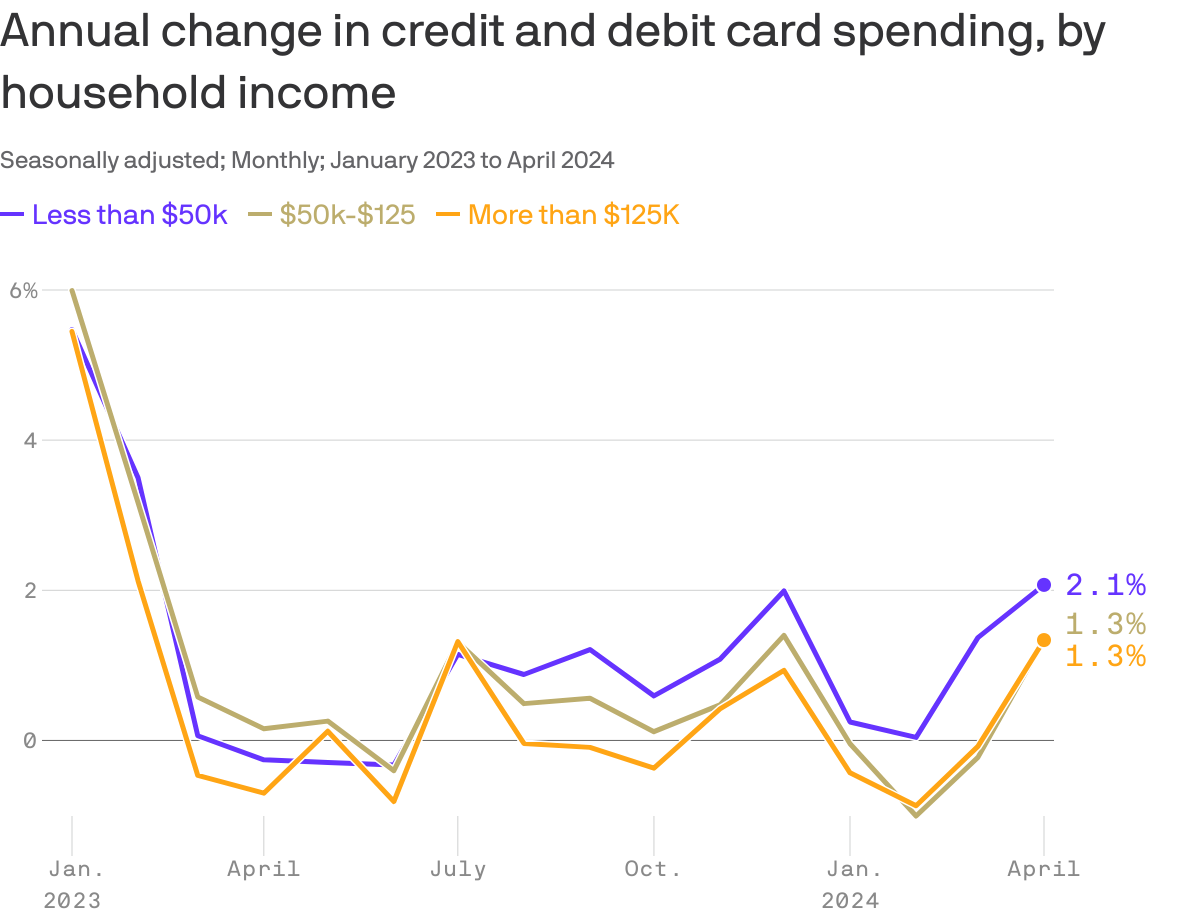
  • “The consumer remains resilient and consumer spending remains robust. As we look at both macro factors as well as Mastercard’s own data, we see that spending is quite healthy…Here in the US, we look at wage growth relative to CPI or inflation. And generally, as long as wage growth is higher than CPI, we believe consumers have purchasing power. And so far, that theory has been proven. (…) We see that charge-offs and delinquencies are now back to pre-pandemic levels but are leveling off. We certainly see a strong consumer sentiment.” – Mastercard (MA ) President Linda Kirkpatrick
  • “I feel that we say the same thing over and over the last number of quarters, but the consumer continues to be very resilient through a time where I think we all would have thought there would have been more weakness at this point…We were saying before the conference, you go out and you go out to dinner, restaurants are packed. You travel. The plane I was coming on down here last night, was packed, not a seat on the plane. And so you see the signs that are out there that it’s still very, very active and I think that’s what you see in the underlying spend data.” – Wells Fargo (WFC ) CFO Mike Santomassimo
  • “Consumers are doing what they do best, which is to consume…And importantly, all the credit numbers, the balance sheet side of the consumers is very strong” – American Express (AXP ) CFO Christophe Y. Le Caillec
  • “And we’re seeing most of these on sales still selling front to back, meaning most expensive tickets to least. So we’re seeing strong demand at all price points….If we really have the best per-cap on-site spending right now at our theaters and clubs, just given it’s Q1, those numbers continue to be strong and show year-on-year growth. So all fronts are showing strong consumer demand globally” – Live Nation (LYV ) CFO Joe Berchtold
Eurozone economy moves closer to stabilisation in February as service sector ekes out growth

The seasonally adjusted HCOB Eurozone Composite PMI Output Index remained in sub-50.0 contraction territory in February. That said, having risen from 47.9 in January to an eight-month high of 49.2, the index signalled a near-stabilisation of the euro area economy. A rejuvenation in the service sector was evident, where activity levels rose for the first time since July last year. The downturn in the manufacturing sector, albeit cooling, continued to offset this, however.

image

There were noteworthy differences in economic performance across the countries included in the eurozone PMI. Solid expansions were seen in Ireland and Spain. (…) Italy also contributed positively, although the expansion here was mild. That said, these upturns were counteracted by the euro area’s two largest economies, France and Germany, which remained mired in contraction. Although France’s downturn eased, Germany saw its rate of decline quicken to the sharpest since last October.

The near-stabilisation of eurozone economic activity was in part due to a less marked reduction in new business intakes. Although private sector order books shrank, they did so to the softest degree since the slump in demand started in June last year. Better trends were apparent at the sector level, with both manufacturers and service providers seeing slower declines than at the beginning of the year. The greatest drag continued to come from export markets, however, with new business from non-domestic customers falling at a faster pace than seen for order books overall.

A slower rate of deterioration in demand caused the pace of backlog depletion to slow during February. Outstanding business volumes fell solidly, but to the weakest extent in eight months. Companies in the manufacturing sector continued to drive the reduction, sector data showed. Nevertheless, job creation picked up midway through the first quarter, despite the absence of capacity pressures. The rate of employment growth, albeit modest, was at a seven-month high and fractionally quicker than seen across the survey history on average. (…)

As for price trends, February survey data signalled an intensification of pressures across the eurozone. Input costs continued to rise, with the rate of inflation accelerating to a ten-month high. Steep increases in service sector costs were to blame, sector data showed, although manufacturing costs declined at a weaker rate than at the turn of the year. In turn, prices charged for eurozone goods and services increased at the fastest pace since last May.

The HCOB Eurozone Services PMI Business Activity Index for February provided a positive signal for the services sector as it moved into growth territory for the first time since last July. At 50.2, the index was up solidly from 48.4 in January and indicated a fractional improvement in output levels compared with the previous month.

The pick-up in activity coincided with a broad stabilisation of demand, with the respective index posting below but close to the neutral 50.0 threshold. Steadier sales performances were accompanied by a stronger uplift in service sector employment across the euro area. The rate of job creation quickened to an eight-month high in February. (…)

As has been the case over the past three years, inflationary pressures in the service sector were elevated during February. While not as severe as seen between 2021 and 2023, the rate of increase in costs did edge up to a nine-month high and was well above its long-term average. Similarly, prices charged rose at a sharp and accelerated pace.

China: Business activity increases modestly during February

The seasonally adjusted headline Caixin China General Services Business Activity Index edged down from 52.7 at the start of 2024 to 52.5 in February, to signal an increase in services activity for the fourteenth month in a row. That said, the rate of expansion was the softest seen since last November and modest overall. The upturn was also below the long-run series average. image

The slower rise in business activity coincided with a further mild upturn in overall new work placed with Chinese service providers during February. New order growth was little-changed from January and remained slower than the average seen over 2023 as a whole. In contrast, services companies registered a solid and accelerated increase in new work from overseas. Notably, the improvement in foreign demand was the most pronounced since June 2023 amid reports of firmer customer demand across external markets.

After rising marginally in the prior two months, payroll numbers across China’s service sector fell in February. Though modest, the rate of job shedding was the quickest seen in over a year, with a number of monitored companies lowering their headcounts due to relatively subdued demand conditions. (…)

Average input price inflation meanwhile quickened from the start of the year, with firms often linking the latest rise in expenses to higher raw material and fuel costs. That said, the rate of increase was modest overall and remained slow by historical standards.

After a slight reduction in January, prices charged by Chinese services companies increased in February as firms looked to pass on additional expenses to customers. Though mild, the rate of charge inflation was the quickest seen since May 2023. (…)image

The Composite Output Index was unchanged from January’s reading at 52.5 in February, to signal an expansion of overall Chinese business activity for the fourth straight month. Underlying data indicated that a slightly softer rise in service sector activity was offset by a quicker increase in manufacturing output, though rates of expansion were identical across both sectors and modest overall.  (…)

image

China Sets Ambitious Growth Target for 2024 The 5% target signals Beijing’s confidence in the economy—or its willingness to roll out stimulus.

(…) For this year, achieving expansion of about 5% would require quarter-over-quarter annualized growth to average 5.3%, up from 4.2% in 2023 that excluded the first quarter’s reopening surge, analysts from Capital Economics wrote in a note last week, cautioning that Beijing might be underestimating the challenge of maintaining the same target as last year. (…)

In a sign of more direct support from Beijing, Li announced a plan to issue 1 trillion yuan of ultralong special central government bonds in 2024, which won’t be included in the fiscal deficit, marking the fourth such sale in the past quarter-century.

Beijing last issued these bonds in 2020, raising 1 trillion yuan worth of funds to support an economy then still reeling from the initial pandemic outbreak. Li said Tuesday that Beijing plans to issue more such bonds in the next few years to fund strategic priorities.

According to a separate report published Tuesday, the government said it would boost fiscal spending by 4% this year, less than last year’s target of 5.6%, while fiscal revenue was expected to grow by 3.3% this year, less than last year’s target of 6.7%. Officials are aiming for a fiscal deficit of 3% relative to GDP this year, lower than the revised 3.8% in 2023 but in line with initial plans for 3% from last year. (…)

Fiscal transfers from Beijing to local governments are set to rise to 10.2 trillion yuan, equivalent to about $1.4 trillion this year, up 4.1% from last year. Beijing will allow localities to issue a combined 3.9 trillion yuan worth of local government special-purpose bonds, which are mainly used to fund infrastructure projects, up slightly from last year’s 3.8 trillion yuan. (…)

Separately, China plans to increase military spending by 7.2% to 1.67 trillion yuan, equivalent to about $232 billion, mirroring the previous year’s increase, according to a draft budget report released Tuesday. Li said in his work report that the military would “devote great energy to training under combat conditions” as the country seeks to defend its interests and sovereignty.

On China’s most sensitive territorial question—the status of self-ruled Taiwan, which Beijing claims as part of China—Li reiterated the leadership’s pledges to “resolutely oppose separatist activities aimed at ‘Taiwan independence’ and external interference.”

Notably, Li’s report dropped references to “peaceful unification” with Taiwan contained in previous reports.

China to Mobilize Nation as It Fights US for Tech Supremacy The central government will raise R&D spending by about 10%

Beijing hammered home a longstanding goal to break an American stranglehold on key spheres, according to government work reports submitted to the nation’s legislature on Tuesday. The central government will increase spending on scientific and technology research by 10% to 370.8 billion yuan ($51.5 billion) in 2024, promote national champions and grant enterprises a central role in spearheading advances, according to the documents, which are closely scrutinized for clues to President Xi Jinping’s thinking.

Under Xi’s watch, China has expanded state control of strategically critical areas from semiconductor manufacturing to quantum computing. His deputies have initiated a so-called “whole nation” approach to driving tech advances, essentially coordinating a nationwide effort to funnel resources into breaking US strangleholds on key technology. The country as a whole spent 3.3 trillion yuan on basic research last year — about 2.6% of gross domestic product, according to the report. (…)

“We will pool our country’s strategic scientific and technological strength and non-governmental innovation resources to make breakthroughs in core technologies in key fields and step up research on disruptive and frontier technologies.” (…)

Against that backdrop, Beijing has endorsed the efforts of local champions such as Huawei Technologies Co., which stunned the US last year by designing and making a chip more advanced than Washington had thought possible. The government continues to support the emergence of homegrown tech leaders such as SMIC through subsidies and policy. (…)

BTW:

A wave of patriotic buying from Chinese consumers is helping local brands outdo foreign counterparts like Apple, whose market share fell below 16% in the first six weeks of the year, down from 19% a year ago, according to figures from Counterpoint Research. China’s homegrown champion Huawei is getting a larger slice — more than 16% now versus 9.4% a year ago. While competition and geopolitics are one side of the coin, a broader market malaise is also undermining Apple’s iPhone sales in China, which sank 24% over the first six weeks of this year. Apple’s shares have lost about 9% in 2024, missing out on the Big Tech rally. (Bloomberg)

Chinese patents surpass U.S.

For the first time, the number of international patents filed from inventors in China has surpassed applications from the U.S., according to a new report.

Patent data is a key indicator of science and technology prowess — and the economic and national security strength that comes with it.

  • “[We’ve] never seen a country grow its patenting both at the rate and the volume” as China has, says Robert Atkinson, president of the Information Technology and Innovation Foundation (ITIF).
  • It is a “pretty serious indicator” and “should be a wake-up call.”

Inventors in China applied for roughly 68,600 patents in 2022 through the Patent Cooperation Treaty, which allows inventors to file across many countries at once, according to a report published today from the National Science Foundation’s National Center for Science and Engineering Statistics (NCSES).

  • There were about 58,200 U.S.-based applications the same year — the most recent year for which the data has been compiled.
  • In 2015, the U.S. had twice as many applications as China, and in 2020 China pulled even with the U.S.

The growth patterns reflect the different growth rates of economies and science and engineering institutions, says report author Carol Robbins, a senior analyst at NCSES. Those rates sped up for some, like China, while others slowed down.

  • There’s been “resilience in middle-income countries and in the developing world over the past several years,” Robbins says.

AI-related patents saw tremendous growth. In 2012, AI inventors in China were granted 650 worldwide utility patents — those given for non-obvious inventions. By 2022, that number climbed to more than 40,000.

  • U.S.-associated AI patents also grew from about 920 to 9,400 during the same time.
  • They encompassed different AI techniques (for example, machine learning), applications (i.e. computer vision or robotics) and fields where they might be used (life sciences, banking and others). This was all before ChatGPT stormed the scene at the end of 2022.
  • According to the congressionally mandated report, China had the highest number of patents in the top three categories of patents issued — machine learning, computer vision, and personal devices and computing.

Utility patents are counted from the patents issued in a particular country, and the standard may differ.

  • China “systematically over patents and the patents are not necessarily good,” Atkinson says.
  • One factor is financial incentives in the country to file for patent protection.

For the first time, the biennial report looked at patenting in critical and emerging technologies identified in the CHIPS and Science Act.

  • These include AI, advanced materials, semiconductors, quantum information science and tech, and biotech.
  • About 190,000 USPTO utility patents were granted in these technologies — about 45% overall were granted to U.S. inventors.
  • For many of the technology fields, the share granted to U.S. inventors was roughly 50%, but for some, it was less: 31% for energy-related technologies and 35% for advanced materials.

“Patents are an output, not an outcome,” Atkinson says. An abundance of patents doesn’t necessarily translate to a successful product or technology.

The report looks at invention and innovation around the world through several metrics.

  • Patents are treated as a reflection of invention at the earliest stages of technology development.
  • Trademarking is a measure of the other end of the development pipeline — inventions that have developed into innovations with real-world applications. China’s trademark activity in the U.S. grew massively between 2011, when there were about 2,500 trademarks assigned to China, and 2022, when there were more than 120,000.

Instead of focusing on how to address the rest of the world’s advances, the emphasis should be on “a renewed commitment to make sure the United States leads” in workforce, patenting, investment, education and innovation, says Dario Gil, director of IBM Research and a member of the National Science Board.

“The competitive environment for tech innovation is way tougher than it was” a decade ago, Atkinson says.

Data: Invention, Knowledge Transfer, and Innovation report from the National Science Foundation; Chart: Axios Visuals

SENTIMENT WATCH

JPMorgan Sees ‘Froth’ in US Stocks, While Goldman Says Rally Justified

The sharp rally in US stocks this year has left strategists at JPMorgan Chase & Co. and Goldman Sachs Group Inc. divided about whether a market bubble is forming.

To JPMorgan’s chief market strategist Marko Kolanovic, the dramatic rally in US equities and Bitcoin’s quick surge above the $60,000 mark signal yes. He sees those advances as indicative of accumulating froth in the market — conditions that typically precede a bubble when asset prices rise at an unsustainable pace. (…)

Meanwhile, David Kostin at Goldman Sachs is among those who thinks the risk-on mood is warranted, arguing Big Tech’s lofty valuations are supported by fundamentals. (…)

“Equities have moved up this year, even as bond yields rose and rate cut expectations unwound,” he said. “Investors may be assuming that the increase in yields is reflective of economic acceleration, but earnings projections for 2024 are coming down and the market appears too complacent on the cycle.” (…)

In contrast, Goldman’s Kostin said this time is different from other periods in history when stock prices have moved abruptly, typically beyond their value. Unlike prior such instances, the breadth of “extreme valuations” is far more contained this time, with the number of stocks trading at those multiples down sharply from the peak in 2021.

Moreover, in contrast to the “growth at any cost” mentality in 2021, “investors are mostly paying high valuations for the largest growth stocks in the index,” he wrote in a note Friday. “We believe the valuation of the Magnificent 7 is currently supported by their fundamentals.” (…)

So far, financial results are justifying the moves. Earnings per share for the cohort rose a combined 59% in the fourth quarter from a year earlier, compared with expectations of 47%, data compiled by Bloomberg Intelligence show.

But to Kolanovic, the environment is a head-scratcher, reflecting investor complacency and an underappreciation of risk.

The continued climb in stocks “may keep monetary policy higher for longer, as premature rate cutting risks further inflating asset prices or causing another leg up in inflation,” he said.

The 13-34w EMA trend: extended but unwavering…

image

John Authers:

Looking at net inflows to the dollar from abroad since the turn of the century, we get an inkling as to why the US has outperformed the rest of the world so convincingly since the GFC. Previous outflows turned into huge net inflows to the dollar. The growing problems with the Chinese economic model, in particular, seem to have spurred this:

Howell sums up as follows:

The S&P 500 looks extended in absolute terms when measured by US domestic liquidity flows, but it looks far more comfortably placed when Global Liquidity is the benchmark. Plainly, US equities have got much further to run if we can reassure ourselves that Wall Street has become the ‘World market’ for stocks. Indeed, this might be plausible given the dominance of US firms in tech and AI-applications?

The corollary is that anything that halts the flows into the US (such as change of course by the Bank of Japan or some intensification of the trade war) could imperil the bubble. That hasn’t happened, yet. His conclusion: Stay invested.

The bigger picture points to the kind of calm that can propagate bubbles. If stability begets instability (as proposed by the economist Hyman Minsky), then conditions look set fair for the market to go further. The Fathom Risk-Off Gauge (or FROG) in the chart below, calculated by London’s Fathom Consulting, incorporates changes in the macro cycle, market liquidity, and the correlation between bond and equity markets to derive a probability that markets are in a “risk-off” regime (in which bonds are favored over stocks). At this point, all looks set fair:

A move to make money cheaper has lit the touch paper for several explosions of past speculation. Several rate cuts are still, of course, expected before the end of this year. But much depends on whether they prove to be merited. As this chart from James Reilly of Capital Economics demonstrates, cuts that are not quickly followed by a recession tend almost invariably to push the stock market higher over the next year. When they’re followed by a recession, then in general they cannot save the stock market from a loss:

There’s no particular evidence that lowering rates into a slowing economy would do much to boost share prices. Cuts when the economy is OK are different; the cuts in late 1998 after the Russian default and the meltdown of Long-Term Capital Management were followed by a 38% gain.

This time, Fed rate cuts aren’t “a necessary condition for the stock market bubble to inflate further,” says Reilly. “After all, most measures of equity risk premia have scope to fall as hype around AI grows.” And, he points out, this stock market rally has gained strength even as bond yields have rebounded higher.

That might well be because the Fed’s pivot late last year has already done the job. Ed Cole of Man Group in London suggests that what has changed to allow stock prices to rise so fast is that the Fed “signaled a change in its reaction function,” so that is symmetrical again, rather than strongly focused on bringing inflation down.

That has been interpreted as a sign that the Fed “has our back again” and will even tolerate a bubble. And, he points out, financial conditions have already responded dramatically by getting much easier. Following Bloomberg’s financial conditions index, the backdrop has grown more lenient even as rate expectations have grown more hawkish: (…)

The IPO market gives a great clue as to whether exuberance has become irrational. Generally, newly floated companies don’t perform well for their first year or two, but investors still clamor to get a stake. Nicholas Colas of DataTrek International suggests this makes the level of excess on IPO days a great measure of whether sentiment is truly bubbly.

Thus, in 1999, the 476 IPOs (a record) saw an average first-day gain of 71% (a record by a massive margin, as this number had never before reached 25%). As Colas put it: “Scarcity value doesn’t explain the first day moves. Irrational exuberance does.”

In the post-pandemic bubble of 2020 and 2021, the average first day gains were 42% and 32%. There were 311 IPOs in 2021, the most since the top of the previous bubble in 2000. Last year, by comparison, saw only 54 IPOs with an average first-day gain of 12%. This market rally is about paying, perhaps overpaying, for quality.

Finally, a necessary word of caution. Valuation is more or less irrelevant when trying to predict the next year, but it’s everything you need to know to predict the next decade. That’s only a slight exaggeration. Subramanian’s note raising her target for 2023 also included this chart looking at price/earnings ratios compared to subsequent 10-year returns. The correlation is above 80%:

Following this to its conclusion, there is powerful reason to believe that the next 10 years won’t be very good. As there’s also pretty good reason, as we’ve seen, to expect share prices to rise healthily for a while longer. The implication is that after this rally, or bubble, reaches a peak, the market is set to go down for a while. The logic that might lead you to jump in to a potentially forming bubble will also require you to keep looking over your shoulder to decide when to sell.

THE DAILY EDGE: 4 March 2024: Perfect Storm Forming?

Surges in Inflation & Personal Income Both Apt to Be Short-Lived

Consumer spending rose 0.2% in nominal terms in January, but after adjusting for the largest monthly increase in prices since September, real spending actually fell 0.1%. The increase in real spending for December got a bump up to 0.6% in the revisions (…).

Critically, the composition of spending in January represents a pivot back toward non-discretionary categories (particularly services categories) at the expense of outlays in recreational categories.

Source: U.S. Department of Commerce and Wells Fargo Economics

The real eye-catcher in this morning’s data was the 1.0% jump in personal income, or the largest gain since the start of 2021 when pandemic-related stimulus was still funneling into the household sector. Wage growth remained strong last month, rising 0.4%, but notable gains in rental income (+1.6%) and receipts on assets (+2.1%) were major drivers of the overall gain. (…)

The cost-of-living adjustment (COLA) drove Social Security income up 3.5% in January. Despite Social Security representing only about 6% of total income, it accounted for 20% of the gain in overall income last month. The COLA will boost spending power for seniors who rely on this source of income, but it’s a one-off adjustment, or level set higher, meaning the growth won’t be sustained. Excluding social security, personal income still rose a strong 0.8% last month.

Tax payments also dented the real income situation last month. Ultimately the true household experience differs from BEA accounting when it comes to taxes. That is, the BEA accounts for tax collections evenly over the course of the year rather than specifically when households file their taxes (typically Feb-Apr). In recent years, this accounting methodology has come with revisions to taxes and has resulted in a large adjustment to taxes at the start of each year, which was the case again in this morning’s data.

Current personal taxes rose $166 billion and were a sizable drag on real disposable personal income, which declined a modest 0.02% last month. But remember there was no change to tax policy at the start of the year, so real income was likely not nearly as weak as the January data suggest.

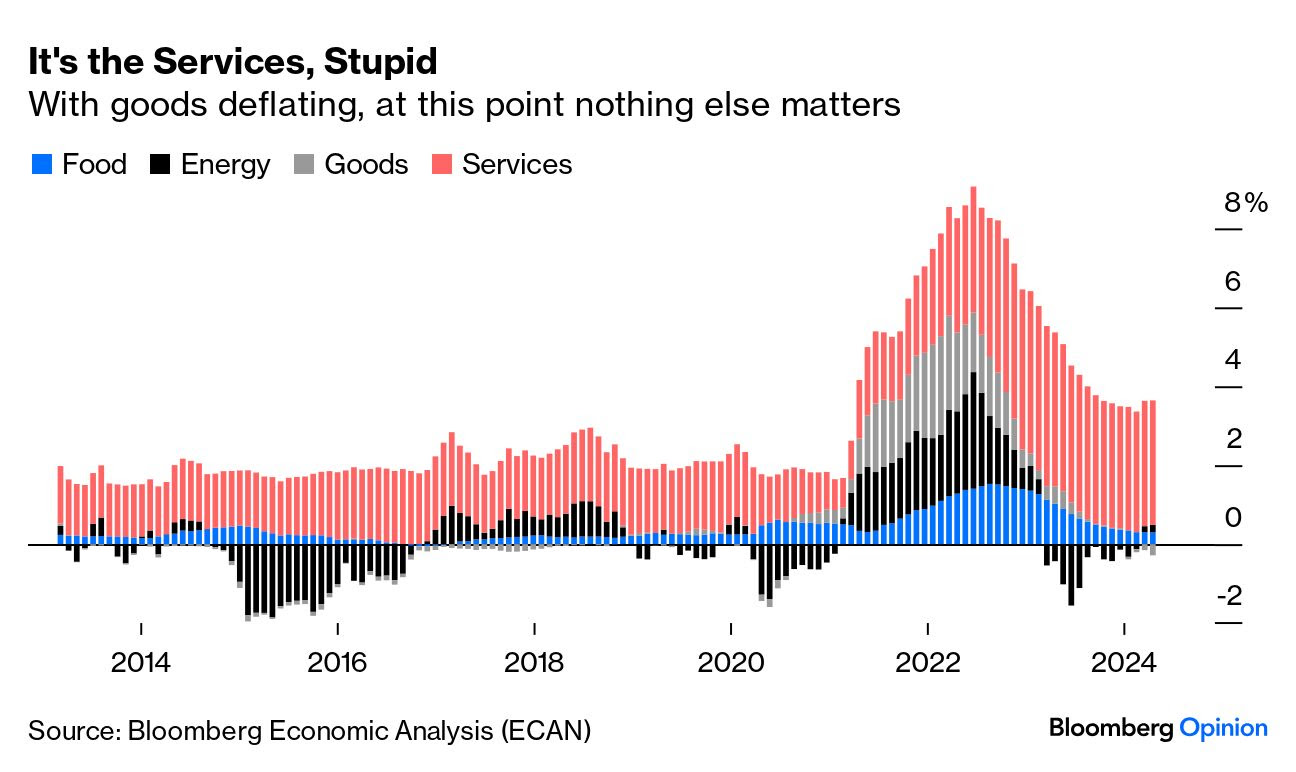
Yet the inflation problem is not yet completely eradicated and continues to dent purchasing power. The core PCE deflator rose 0.4% last month, marking the fastest pickup in a year, but the annual pace of core inflation still ticked down a tenth to 2.8%. (…)

Most pundits focused on the inflation reading from the income and spending report. I think the income and expenditures data are more significant:

  • A 1.0% monthly jump in Personal Income, whatever the cause, is a big deal. It has happened less than 6% of the time since 1982. Excluding social security “one-off”, Personal Income nonetheless jumped 0.8%!
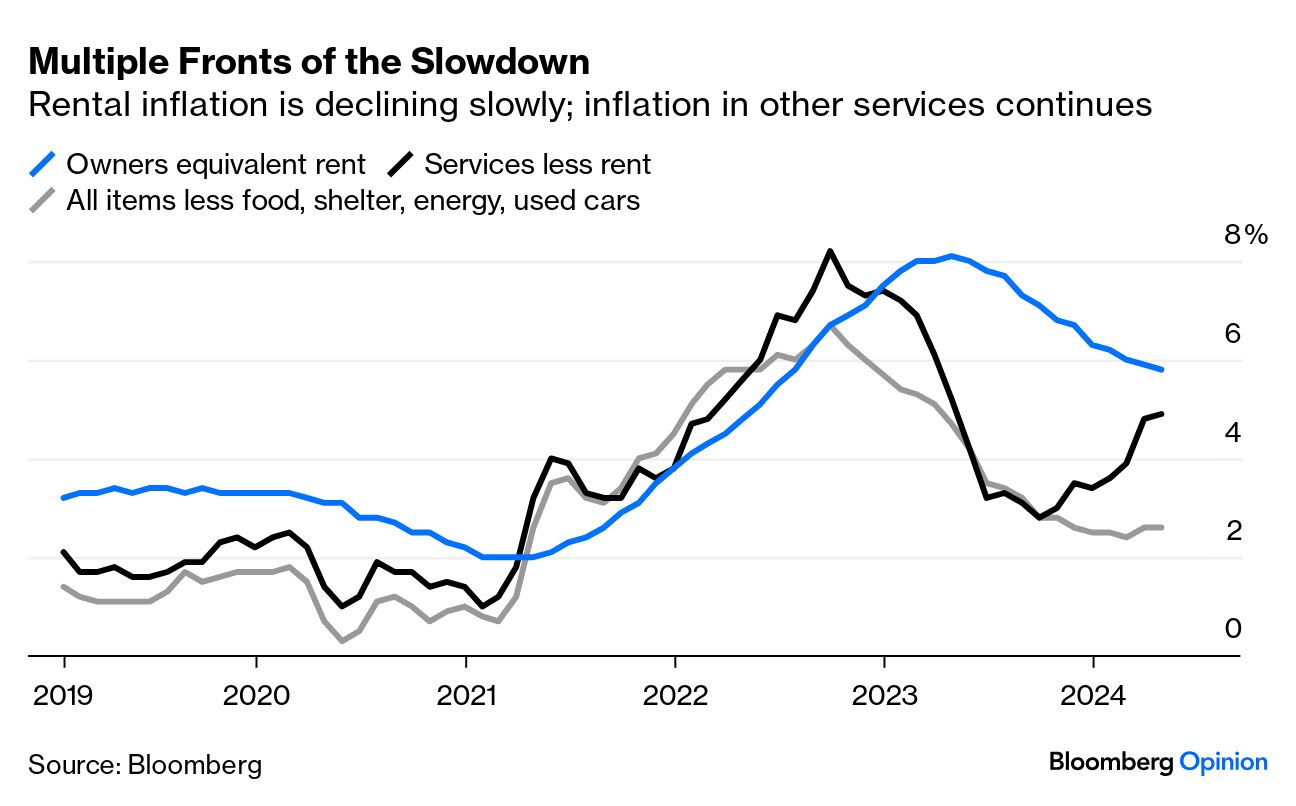
  • Rental income spiked 1.6% in January, also a big deal, but mainly from the viewpoint that rentflation is not slowing much, is it? Since July 2023, rental income rose at a 8.1% annualized rate. Somebody’s paying for that.
  • Wages and salaries rose 0.4%, +5.3% a.r. in the last 3 months, same as the previous 3 months. No slow down there.
  • Disposable income growth was dragged down by the accounting treatment of income taxes. In fact, the tight relationship between personal income and after tax disposable income has been restored to its pre-pandemic trends.

image

Nerd smile Core PCE inflation is now one full percentage point lower than core CPI, near its historical maximum gap. There imagewas no gap in late 2021 and a 0.5% gap in mid-2023. Why this Fed-friendly trend?

Trends in services prices were particularly favorable to the PCE measure since mid-2022. Shelter costs weigh twice as much in the CPI (33%) vs the PCE (15%) so the rapid increase in rents had a larger impact on the CPI as this Roosevelt Institute chart neatly illustrates.

Mike Konczal on X: "With Q4 in, we can see the technicals on what ...

The Fed’s preference for PCE inflation has driven everybody to focus on the recently better PCE measures. The CPI has its drawbacks but, really, how many Americans devote only 15% of their budget to shelter?

  • Core PCE rose 0.42% MoM in January after +0.14% and 0.09% the previous 2 months. Last 3 months annualized: +2.6% vs 2.3% the previous 3 months. The 6-m trends:

image

  • PCE services prices jumped 0.6% after +0.3% in each of the previous 2 months. Last 3 months annualized: +4.9% vs +3.2% the previous 3 months.

image

(Apollo)

  • Services excluding housing (“supercore”) also rose 0.6% after +0.1% in December. Disinflating supercore saved the Fed from the annoyingly sticky rentflation, but no more.

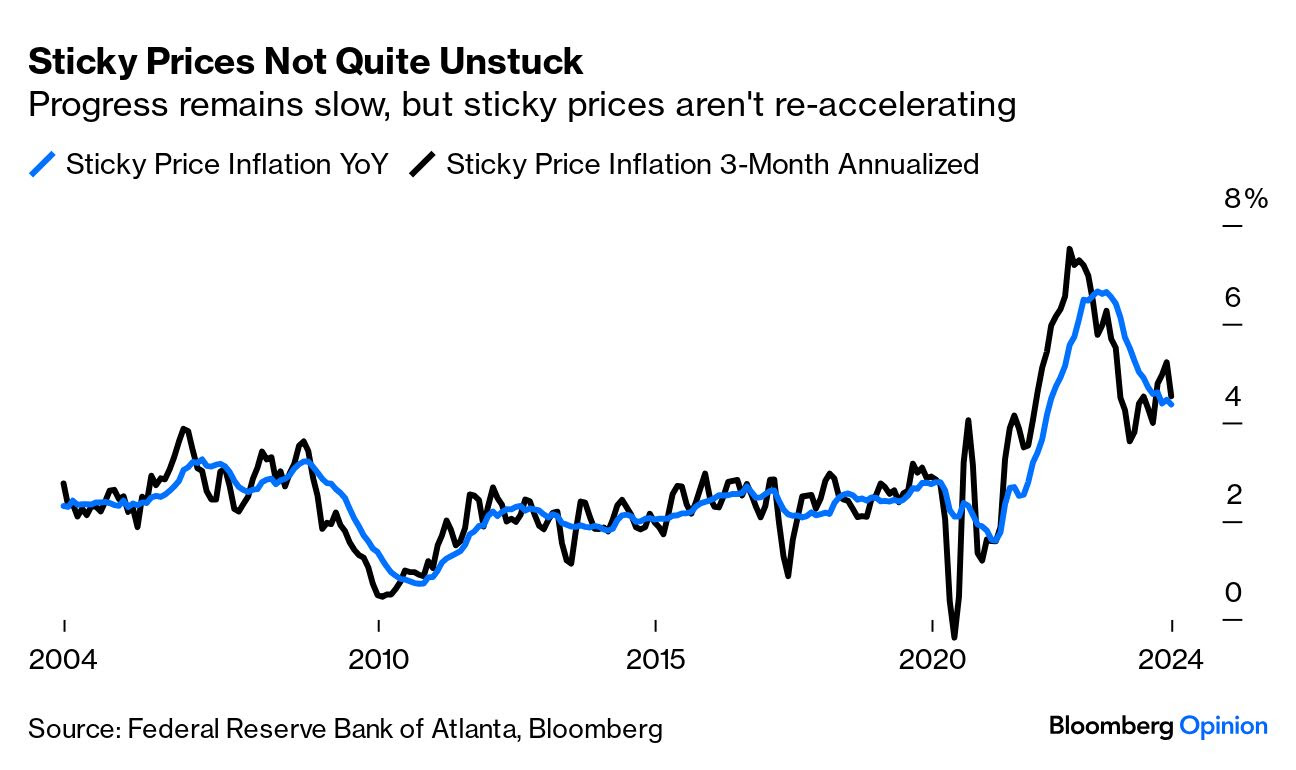
  • “Alternatively, the Fed’s statisticians set great store by the trimmed mean, which excludes the biggest outlying components in either direction, and takes the average of the rest. That ensures that the measure can’t be skewed by a few extreme price moves in isolated segments. Again, unfortunately, the news here is not good. The chart shows both month-on-month inflation (annualized to show how much inflation would be if it carried on at this rate for a year), and year on year. The year-on-year measure is still declining, but a bit too high for comfort; while month on month, January saw a sharp acceleration:” (John Authers)

image

(Apollo)

These 2 charts show that consumer demand has yet to be impacted by monetary tightening:

image

Real spending on services is almost back on trend after logging consecutive 0.4% monthly growth rates in each of the last 3 months, +4.9% a.r.. This is twice the “normal growth rate”.

The good news from that is that, as a result, services employment has accelerated from +182k on average between June and November (+1.6% a.r.) to +312k in December-January (+2.7% a.r.).

Pointing up The potentially not-so-good news is that the only labor slack left in the U.S. economy is in services (unemployment of 5.2% in January compared to 2.9% in durable goods). If this slack gets quickly used up, growth in wages of service providers, responsible for the slowdown in total wage growth since the fall of 2022 (from 5.4% YoY to 4.4%), could accelerate towards goods-producing wages which have kept inflating 5.5-6.0%.

image

Goods-producing industries (left) have benefitted from significant productivity gains after the pandemic, much less so for service providing sectors (admittedly not perfect proxies but a good approximation).

 image image

Amid perhaps the bluest of economic blue skies:

  • income growth remains solid, sustaining demand even against 5.5% funds rates;
  • demand for services is now accelerating back to trend without much softening in demand for goods;
  • inflation on goods is muted but services prices are accelerating along with demand and costs (wages);
  • employment in services has sharply increased in recent months which, if sustained, will reduce or eliminate the labor slack in that key segment of the economy;
  • that might re-accelerate wage inflation in services while labor tightness in goods is already keeping wage growth above 5.5%;
  • this while goods manufacturers are just exiting their production purgatory due to an 18-month inventory correction at their merchant clients (see below);
  • if worldwide, goods inflation may not remain as subdued. S&P Global informed us last week that

The increase in global manufacturing production was supported by growth in new business intakes (…). Total new orders rose for the first time in 20 months (…). The cyclically sensitive ratio of new orders-to-stocks of finished goods edged up to its highest level since May 2022. (…) Average input prices and output charges both increased during February and at similar, or identical, rates to the prior survey month.

image

Is there a perfect storm forming out there, invisible on any radar? Fingers crossed

Last week:

  • “at some point, I think it will be appropriate to pull back on restrictive monetary policy, likely later this year.” (NY Fed’s John Williams)
  • “if inflation expectations. . . continue to move down then I think we’re in a good spot where we could consider an easing of the restrictive level that we’re in.” (Cleveland Fed’s Loretta Mester)
  • “the question is, how long to remain this restrictive?” (Chicago Fed’s Austan Goolsbee)

This restrictive? Interest rates going from 0% to 5.5% in 18 months have not bothered consumer spending nor the whole economy much, have they?

image
MANUFACTURING PMIs

USA: Manufacturing conditions improve at fastest pace since July 2022

The seasonally adjusted S&P Global US Manufacturing Purchasing Managers’ Index™ (PMI) posted 52.2 in February, up from 50.7 in January and higher than the earlier released ‘flash’ estimate of 51.5. The latest upturn indicated a modest improvement in operating conditions that was the strongest since July 2022.

image

Contributing to the upturn was a renewed rise in output during February. Production levels increased at the fastest pace since May 2022, as previous supply chain delays which hampered activity in January eased and demand conditions strengthened again. The rate of growth was solid and quicker than the trend pace.

Panellists highlighted more favourable demand conditions in February, as total new orders grew at a strong pace that was the fastest for 21 months. Alongside greater interest from customers, manufacturers noted that some clients had worked through safety stocks and were looking to replenish inventories.

Meanwhile, new export orders expanded for the first time in three months. Foreign client demand improved, especially in Europe and Canada, with external sales rising at the sharpest rate since May 2022, albeit only marginally.

At the same time, selling prices increased at the quickest pace in ten months midway through the first quarter. The rate of charge inflation accelerated for the third successive month as firms sought to pass through higher costs to customers.

That said, the rate of input price inflation eased on the month in February. Although higher cost burdens were linked to greater freight, transportation and raw material prices, the pace of increase eased to the slowest since last November.

Some inputs reportedly fell in price as supply chains improved and the availability of raw materials increased. Goods producers signalled a renewed improvement in vendor performance, with lead times shortening to the greatest extent since last July.

In line with stronger demand conditions, firms recorded the first rise in input buying since July 2022 in February. Companies reportedly sought to rebuild stocks, as both pre- and post-production inventories returned to growth.

Increased new order inflows also spurred a sharper uptick in workforce numbers. Manufacturers registered the quickest rate of job creation since last September, with many noting the hiring of full-time and permanent staff. Moreover, goods producers remained upbeat regarding the outlook for output over the coming 12 months despite the degree of confidence slipping slightly from January’s 21-month high.

Wells Fargo reports on the ISM and goes to great lengths to explain why it may not be reflecting the reality. Once more…

The ISM manufacturing index slipped 1.3 points to 47.8 in February. (…) New orders, production and employment were all down, and while the measure of prices paid declined, it is still consistent with an expansion in prices last month.

The largest decline was in new orders where the 3.3 point drop pushed the component back below 50 for the 17th time in the past 18 months. The February decline in new orders also marks the largest one-month pullback in new orders since September 2022. This outturn makes January’s pop look like a potentially seasonal-related fluke, despite the series being adjusted for seasonal factors.

The select industry comments strike a notably more optimistic tone than the ISM components suggest. Purchasing managers cited increasing sales, strong expectations for 2024, demand picking up, steady orders and a stable business outlook. In fact, the only glimmer of pessimism in the selected comments came from the computer & electronic products respondent who said, “customer softness continues in China, Japan and Europe.” (…)

Source: Institute for Supply Management and Wells Fargo Economics

Canada: Manufacturing sector close to stabilizing in February

The seasonally adjusted S&P Global Canada Manufacturing Purchasing Managers’ IndexTM (PMI®) remained below the crucial 50.0 no-change mark in February. It was the tenth successive month that a deterioration in operating conditions has been recorded. However, by rising to 49.7, from 48.3 in January, the index signalled only a marginal decline that was the slowest in the current sequence.

The relative improvement in the PMI reflected slower falls in both output and new orders. Production was only down slightly, and the decline in orders modest. That said, there remained many reports that client demand was subdued, characterised by hesitant decision-making and a reluctance to commit to new contracts. This was especially the case for international demand, where sales declined for a sixth month running. (…)

image

Eurozone: Factory orders decline at slowest pace in nearly a year

The HCOB Eurozone Manufacturing PMI registered a fractional month-on-month fall in February. Nevertheless, at 46.5, the headline index was broadly unchanged from January’s 10-month high of 46.6 and signalled the second-slowest deterioration in manufacturing sector conditions since March 2023.

image

The drop in the HCOB Eurozone Manufacturing PMI was entirely driven by the largest economy of the single currency union, Germany, which registered its sharpest deterioration in four months. The strongest performances were seen in the periphery of the eurozone, with Greece and Ireland recording their best expansions for 24 and 20 months, respectively. Spain returned to growth for the first time in nearly a year, while softer contractions were seen in the Netherlands, Italy and France.

The downturn in demand for euro area goods cooled for a fourth consecutive month during February, with factory orders declining at the slowest pace since March last year. There were also positive signals to be taken from other forward-looking survey indicators, such as quantities of purchases, which also fell to the softest extent in close to a year. Improvements in these indices coincided with resilience in growth expectations, which were on a par with the nine-month high seen in January.

Total factory output across the eurozone continued to shrink, February survey data showed, although the rate of contraction was unchanged from January (and therefore the joint-weakest for ten months). Nevertheless, eurozone manufacturers were able to clear orders pending completion. The rate of depletion was sharp and slightly faster than at the beginning of the year. The reduction in backlogs was achieved despite employment levels falling for a ninth month in succession.

Eurozone manufacturers continued to reduce their inventories midway through the first quarter of 2024. Stocks of inputs fell to the slowest degree in six months amid speedier supplier delivery times. The improvement in vendor performance followed on from January’s lengthening – the first in a year – and points to a positive readjustment in the region’s supply chains amid disruption in the Red Sea. Finished goods held in warehouses also declined in February, but at a slightly weaker pace than previously.

Operating expenses faced by factories in the euro area continued to fall during the latest survey period, marking a year of sustained input price deflation. Although the rate of decrease was solid, it was the weakest since March 2023. Prices charged for eurozone goods were discounted further.

China: Business conditions continue to improve slightly in February

The headline seasonally adjusted Purchasing Managers’ Index™ (PMI) edged up from 50.8 in January to 50.9 in February, to signal another marginal improvement in the health of the sector. Business conditions have now strengthened in each of the past four months, with the latest PMI reading the best recorded since August 2023.

image

Helping to nudge the headline index higher was a slightly quicker rise in manufacturing production across China during February. Though modest, the rate of output growth was the fastest seen since May 2023, with companies generally attributing this to a sustained improvement in market conditions and greater new order volumes.

The total amount of new work placed with Chinese goods producers also rose at a quicker pace in February, albeit one that remained marginal overall. The upturn was partly driven by a second successive monthly increase in new export business, albeit only slight, with firms citing an improvement in underlying global demand conditions.

In February, gauges for manufacturers’ output, total new orders, and new export orders picked up between 0.1 and 0.3 of a point, with the last indicator reaching a 12-month high.

image

The sustained rise in production led firms to expand their purchasing activity again in February. Though modest, the rate of growth was the most pronounced since March 2023. As a result, inventories of purchased items also increased in February, and at the fastest pace since late-2020. In contrast, stocks of finished items fell for the first time since last June, which was often linked to the fulfilment of orders.

After a slight improvement at the start of 2024, goods producers recorded a fractional deterioration in average vendor performance in February. According to panellists, transportation delays had constrained lead times.

With output expanding at a faster rate than new work, firms registered another decline in unfinished business during February. This was despite a further reduction in headcounts across the manufacturing sector, as company restructuring efforts and cost considerations weighed on hiring decisions. That said, the rate of job shedding remained marginal overall.

The rate of cost inflation continued to slow across China’s manufacturing sector during February. Notably, input prices rose at a fractional pace that was the weakest in seven months. Companies meanwhile cut their selling prices slightly for the second month in a row as part of efforts to stimulate new business.

Chinese manufacturers expressed the strongest degree of optimism towards the one-year outlook for output since April 2023. Expectations were often buoyed by forecasts of firmer global economic conditions, new product lines and investment in new equipment.

Japan: Manufacturing conditions deteriorate at stronger rate in February

The headline au Jibun Bank Japan Manufacturing Purchasing Managers’ Index™ (PMI®) fell from 48.0 in January to 47.2 in February, indicative of a moderate deterioration in the health of the Japanese manufacturing sector. The contraction was the ninth in as many months and the strongest recorded since August 2020.

image

Output and new orders saw steeper contractions during February. Both have now fallen in each of the last nine months, with the latest declines the strongest reported for a year. Panellists often commented that sales demand was weak at home and overseas, while machinery shutdowns also hindered production.

As such, the latest decrease in export sales extended the current sequence to two years and was the sharpest in 11 months. Mainland China was notably reported to be a key source of reduced international sales, although there was also weakness reported from the US and Europe.

Given the challenging market environment, manufacturers chose to reduce their employment levels for the second month in a row. While only modest, the rate of job shedding was the steepest seen since January 2021, as firms demonstrated a general reluctance to replace voluntary leavers. Weaker pressure on capacity also allowed firms to keep on top of their workloads, as evidenced by a further sharp fall in backlogs of work.

Japanese manufacturers also reacted to weaker operating conditions by reducing purchasing activity sharply, extending the current sequence of depletion to 19 months. At the same time, firms opted to utilise existing holdings of inputs and finished items to complete and fulfil incoming orders as part of efforts to optimise current inventory levels.

This came amid a sustained deterioration in vendor performance in February. Delivery times lengthened to the greatest extent for a year as a number of firms mentioned shipping delays as a result of disruption in the Red Sea and the impacts of the Noto earthquake.

Businesses continued to signal elevated price pressures during February, as manufacturers cited higher raw material, energy, labour, oil and transport costs. That said, the rate of input cost inflation eased to a seven-month low. Moreover, the rate of factory gate inflation eased on the month to reach the lowest since June 2021 as some firms mentioned that prices were limited in an attempt to stimulate sales.

China’s Coming ‘Two Sessions’ Put Plans to Jumpstart Economy in the Spotlight Key announcements include the outlook for China’s economy in 2024

The annual gathering of the National People’s Congress deputies and top policymakers comes as China’s economic woes pile up. Consumers have tightened their purse strings, the country’s property giants are struggling for survival and stock markets have suffered a punishing selloff. (…)

A target of 5% or more could signal strong determination to revive the economy, suggesting more aggressive stimulus ahead, analysts say. One below 5% would likely be seen as more bearish, suggesting policy restraint. (…)

Investors have become increasingly concerned about the strength of China’s consumer demand, a key engine of economic growth. China’s consumer inflation in January fell at the fastest pace in over 14 years, underlining continued weakness in demand.

“Investors should look for measures to stimulate consumption including through trade-in programs, incentives to upgrade large-scale equipment as well as moves to attract foreign investment and reform the financial sector and capital markets,” DB Research said in a note. (…)

Moody’s Analytics sees scope for “a lifeline for real estate,” with announcements of widening support and clear market interventions. Authorities could help supply with more property-sector funding to expedite construction of unfinished properties, says Moody’s. Delays in delivering projects has sapped confidence and weakened demand. (…)

Pointing up China: Cash For Clunkers program

In the latest Central Financial and Economic Affairs Commission (CFEAC) meeting chaired by President Xi Jinping on February 23rd and the March 1st State Council meeting chaired by Premier Li Qiang, policymakers vowed to step up fiscal and financial support to a “large-scale equipment upgrading and consumption goods trade-in” program aimed to support domestic demand and the economy.

(…) recent events suggest policymakers are getting close to formally introducing the program. (…)

Our analysis suggests a potential impact of 0.6pp of GDP, although our estimates are sensitive to embedded assumptions, and there would be crowding out effects on other sectors as well as a significant payback effect down the road. (GS)

Beijing seeks to jumpstart consumption and manufacturing. They will deal with the eventual consequences in due time.

Xinhua last month: China pledges measures to boost domestic consumption in 2024

China will introduce a raft of measures, such as stimulating purchases of vehicles and household appliances, to boost consumption this year, a commerce ministry official said Tuesday.

“Automobiles, household appliances and home furnishing are the focus of traditional consumption and are closely related to people’s lives,” Vice Minister of Commerce Sheng Qiuping told a press conference. (…)

Last year, China’s new car sales exceeded 30 million units for the first time, up 12 percent year on year.

The country’s second-hand car trading volume reached 18.41 million units in 2023, an increase of nearly 15 percent.

Car ownership has reached 340 million in China, ranking first in the world, according to the vice minister.

Eurozone Inflation Cools, Keeping Rate Cuts on Agenda

Consumer prices in the eurozone were 2.6% higher in February than a year earlier, a slowdown in the annual rate of inflation from 2.8% in January and increasing the likelihood the ECB will cut its key interest rate later this year.

The European Union’s statistics agency Friday said consumer prices across the 20 economies that share the euro were 2.6% higher than a year earlier, a slowdown in the annual rate of inflation from 2.8% in January. (…)

Falling energy prices have helped pull the inflation rate lower over recent months, but food prices made a big contribution in February. Food, alcohol and tobacco prices were 4.0% higher on year in February, compared with 5.6% higher in January.

Prices of services continue to rise rapidly, even as energy, food and goods prices cool. Eurostat said the core rate of inflation, which excludes volatile items such as energy and food, remained well above its target at 3.1%, albeit cooling from 3.3% in January. (…)

Unemployment data also released on Friday showed the jobless rate equalled a record low at 6.4% in January. The most recent figures for wage growth pointed to only a slight slowdown in the final three months of 2023.

“Wage growth continues to be strong and is expected to become an increasingly important driver of inflation dynamics in the coming quarters, reflecting tight labor markets,” ECB President Christine Lagarde told European lawmakers Monday. (…) (WSJ)

Euro-zone inflation eased less than anticipated in February — supporting European Central Bank officials who don’t want to rush into lowering interest rates.

Consumer prices rose 2.6% from a year ago in February, Eurostat said Friday. That’s above the 2.5% median estimate in a Bloomberg survey of economists. Core inflation, excluding volatile components such as food and energy, also moderated less than envisaged, to 3.1%. (…)

The market’s outlook for the pace and scale of rate cuts this year was little changed. The first reduction is expected by June, though odds of a move by then have fallen to about 80% from a near certainty as recently as this week. (…)

Canada GDP Rebounds in 4Q With 1% Growth The growth was stronger than the 0.8% advance economists were expecting and marked a recovery from a 0.5% contraction in the third quarter.

While modest, the growth was stronger than the 0.8% advance economists were expecting and marked a recovery from a 0.5% contraction in the third quarter. Revisions meant the contraction was softer than previously shown, while growth in the second quarter of the year was slightly softer.

Industry-level activity was essentially unchanged in December and an advance estimate of GDP in January points to growth of 0.4% on the prior month. January’s advance, if realized, hints at a tailwind that could buoy GDP in the current quarter, though the strength owes much to the end of public-sector strikes in Quebec that weighed on the economy toward the end of 2023.

(…) the growth looks less rosy in per-capita terms, falling roughly 2% annualized for the latest quarter to continue the trend for more than a year as Canada’s population has grown rapidly. (…)

A recovery in exports after a slight decline in the third quarter fueled growth at the end of last year, boosted by shipments of crude with sustained oil production in Alberta. Overall, exports rose 1.4% for the quarter and imports slipped 0.4% on the back of lower intake of metal products, vehicle parts, and passenger cars and light trucks.

Consumer spending ticked up for the quarter, led by outlays on new trucks, vans and utility vehicles as back orders were filled and supply chain troubles continued to ease, but housing investment fell for a sixth quarter in the last seven, with the resale market weakening despite a rise in new construction and renovations.

Business investment also declined for a sixth time in the last seven quarters, and while businesses continued to build inventories in the fourth quarter the pace slowed with lower accumulations by retailers and wholesalers.

Final domestic demand, a gauge of spending by all sectors of the economy, weakened 0.2% at a nonannualized rate in the three months compared with a modest 0.2% rise the previous quarter. (…)

Goldman Sachs:

On a per-capita annualized basis, real consumption expenditure declined by approximately 2.5% in Q4.

Compensation of employee grew at a +3.2% annualized pace in Q4 (vs. +5.4% in Q3 and +9.1% in Q2), the slowest growth rate since 2020 Q2. The release highlighted that wages increased at a slower pace in services-producing industries and declined in goods-producing industries.

Today’s report confirms our view that activity is gradually picking up after stagnating in the middle quarters of 2023, although growth remains well-below potential and spending on a per-capita basis continues to decline.

The slowdown in growth of compensation suggests that the advanced labor market rebalancing achieved in 2023 is finally moderating wage growth. This should contribute to further disinflation over the course of 2024 even as activity recovers. We maintain our view that the BoC will deliver its first rate cut at the June meeting and continue to expect a total of 100bp of cuts by the end of 2024.

EARNINGS WATCH

From LSEG/IBES

487 companies in the S&P 500 Index have reported earnings for Q4 2023. Of these companies, 76.2% reported earnings above analyst expectations and 18.9% reported earnings below analyst expectations. In a typical quarter (since 1994), 67% of companies beat estimates and 20% miss estimates. Over the past four quarters, 76% of companies beat the estimates and 19% missed estimates.

In aggregate, companies are reporting earnings that are 6.2% above estimates, which compares to a long-term (since 1994) average surprise factor of 4.2% and the average surprise factor over the prior four quarters of 5.7%.

Of these companies, 63.3% reported revenue above analyst expectations and 36.7% reported revenue below analyst expectations. In a typical quarter (since 2002), 62% of companies beat estimates and 38% miss estimates. Over the past four quarters, 66% of companies beat the estimates and 34% missed estimates.

In aggregate, companies are reporting revenues that are 1.3% above estimates, which compares to a long-term (since 2002) average surprise factor of 1.3% and the average surprise factor over the prior four quarters of 1.6%.

The estimated earnings growth rate for the S&P 500 for 23Q4 is 9.8%. If the energy sector is excluded, the growth rate improves to 13.4%.

The estimated revenue growth rate for the S&P 500 for 23Q4 is 3.7%. If the energy sector is excluded, the growth rate improves to 5.1%.

The estimated earnings growth rate for the S&P 500 for 24Q1 is 5.2%. If the energy sector is excluded, the growth rate improves to 8.3%.

Trailing earnings are now $222.88. Full year 2024: $243.33. Full year 2025: $276.00

image

Corporate guidance was better last week: 5 of the 13 pre-announcements were positive, improving the negative/positive ratio from 3.7 last week to 3.2. It was 2.1 one quarter ago.

image

image

image

China Stocks See Largest Weekly Outflow Since October, Says BofA

About $1.6 billion was pulled from Chinese funds in the week through Feb. 28, a team led by Michael Hartnett wrote in a note, citing EPFR Global data. Emerging market funds overall had their first redemptions since November at $1 billion. (…)

Pimco Sees Swelling Deficit Dragging Bonds ‘Back to the Future’

(…) “What if we are heading back to the future, to a market resembling prior decades when higher term premiums prevailed?” they asked in a paper published Thursday. Term premium is generally described as the extra yield investors seek to own longer-term debt instead of rolling over into shorter-term securities as they mature. It’s viewed as protection for bond holders against unforeseen risks such as inflation and supply-demand shocks, beyond other drivers of Treasury yields including economic growth and Federal Reserve policy.

Since the global financial crisis, a New York Federal Reserve model of term premia on the 10-year has averaged less than 0.5% and spent considerable time below zero. Last September, this measure briefly turned positive as the 10-year yield shot higher and peaked above 5% the following month amid concerns about US deficits, and the prospect of higher-for-longer Fed policy rates.

While term premium remains slightly negative, bond investors are wary of another climb that in turn could push 10-year yields back toward 5% and spark broader financial market tumult.

“If the term premium returned even to levels common in the late 1990s to early 2000s – around 200 bps – that would likely become the defining feature of financial markets during this era,” the California-based money manager cautioned, adding such an outcome “would not only affect bond prices, but also prices of equities, real estate, and any other asset that is valued based on discounted future cash flows.”

Fitch’s downgrade of the US credit rating last year focused investor attention on rising spending in Washington. “More deficits are in the cards,” Pimco warned, and “the important point is that markets are a disciplining mechanism for governments, keeping them from straying too far down this spending path.”

Among the main investment implications of a rising term premium, is a steeper yield curve the asset manager argued.

Currently, the 10-year sits around 4.25%, below those of shorter maturities and the Fed’s target rate of 5.25% to 5.5%. This curve inversion usually corrects once the central bank eases policy, but Pimco doesn’t rule out “the possibility of a much bigger shift ahead: that the curve will also correct as the term premium comes back.”

“There is a very real possibility that the curve could kink following the first Fed rate cut, with shorter-term yields declining, intermediate rates not moving much, and longer-term yields rising as the term premium stages a comeback,” the firm concluded.

SENTIMENT WATCH

SPACs are back!

Wednesday brought news that Cayman Islands-based online trading venue Webull plans to list its shares on the Nasdaq via a merger with special purpose acquisition company SK Growth Opportunities, targeting a $7.3 billion valuation in the deal. Overall, 33 pending blank check IPOs have taken shape over the first two months of 2024 according to SPAC Research, surpassing the 31 seen throughout last year.

Animal spirits likewise enjoy free rein in the digital asset realm, as the price of bitcoin hovered near $63,000 this morning, up some 22% from Sunday morning (good old 24/7/365 trading) and nearly 50% in the year-to-date.  BlackRock’s iShares Bitcoin exchange traded fund reached the $10 billion assets under management threshold yesterday after gathering a net $604 million Thursday, marking the vehicle’s 34th consecutive session of inflows.

CoinDesk, meanwhile, relays that open interest in Dogecoin futures reached a record $1 billion yesterday, “indicative of strong interest in the tokens” and up 54% from one day earlier. The so-called meme coin, which was conceived as a joke at its launch just over a decade ago, is up nearly 60% this week to push its fully diluted valuation above $19 billion per Coinmarketcap.com. (Almost Daily Grant)