US Inflation Picks Up, Signaling Bumpy Path for Fed Consumer price index advanced 3.4%, most in three months
(…) It also rose by more than forecast on a monthly basis as housing costs continued to climb, Americans paid more to drive and energy prices advanced for the first time since September. (…)
Much of the surprise in so-called core goods, which excludes energy and food, came from pickups in prices for used cars and apparel, despite year-end promotional activity. Services prices also held firm, notably within costs for housing and car insurance, which rose the most on an annual basis since 1976. (…)
Shelter prices, which make up about a third of the overall CPI index and contributed to more than half of its advance, rose 0.5% in December. The gain included a rise in hotel prices that were lower in the prior month. (…)
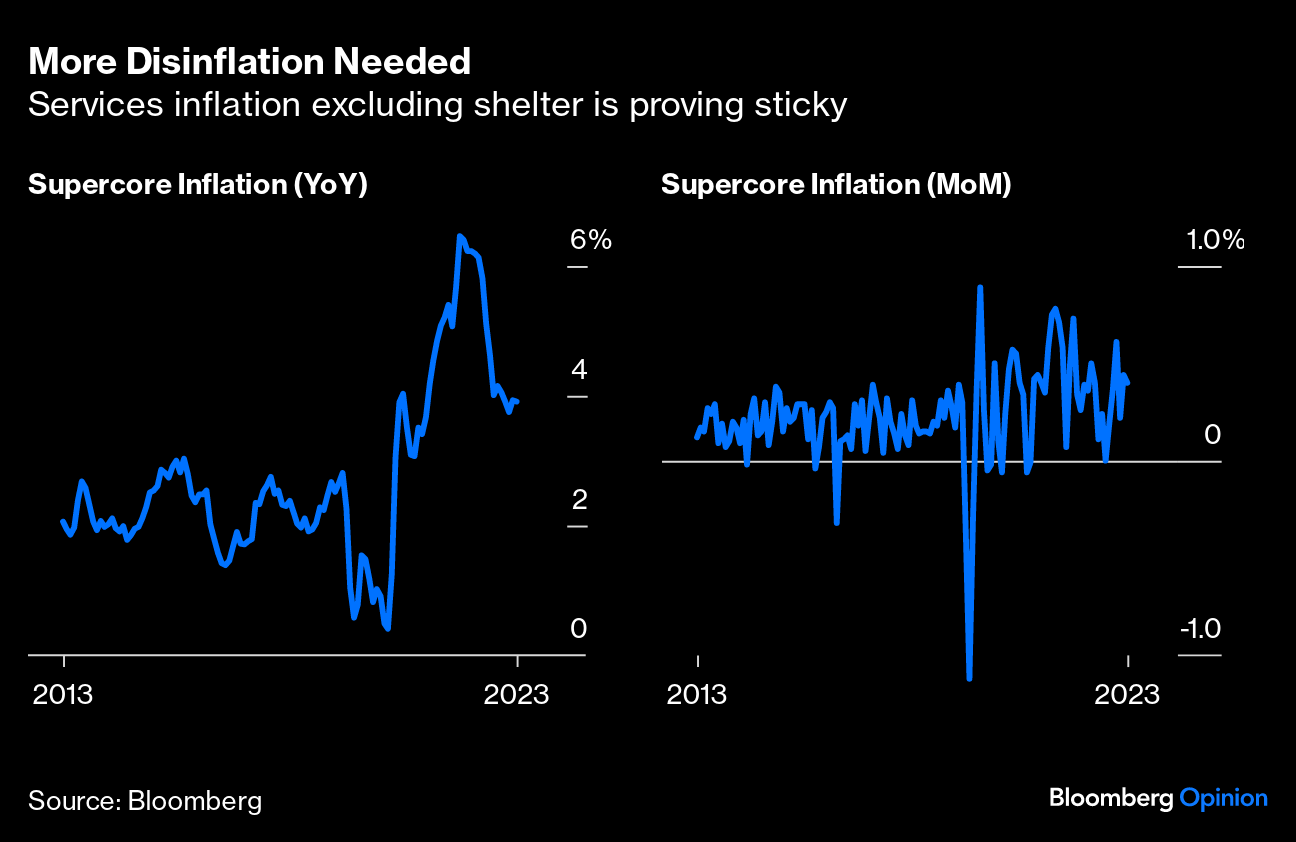
Excluding housing and energy, services prices climbed 0.4% from November, easing slightly from the prior month, according to Bloomberg calculations. (…)
A separate report Thursday showed real earnings advanced 0.8% in December from a year earlier, extending a months-long streak in which wage growth has modestly outpaced inflation. (…)
More CPI data:
- Core goods: 0.0% MoM after 2 consecutive declines averaging -0.2%.
- Core Services: +0.44%; previous 5 months: +0.42% on average and well above the 0.25% run rate averaged in 2019.
- CPI-Rent: +0.43% after +0.51% in last 5 months on average.

- CPI-Services less rent: +0.6% after +0.3% in October and +0.6% in November.
- 6-m changes annualized from Goldman Sachs:

 We should all be pleased! “Changes to Used Cars and Trucks Methodology”
With the release of January 2024 data, the CPI program plans to update the mileage adjustment applied to each sampled used vehicle in the used cars and trucks index. Historically, a single, stable mileage amount estimated for a given make and model was applied to each sampled vehicle and was unchanged throughout the year. The assigned mileage amount will now be replaced with a monthly average mileage amount based on the age of the sampled used vehicle, and not the make and model. Each estimated price for a sampled used vehicle will still be adjusted for depreciation. (BLS)
John Authers: Slower for Longer — Inflation Has Stopped Falling The stall gives the Fed little reason to start early rate cuts, even though the market still expects them.
(…) In the context of expectations of a faster fall, and the dominant narrative that inflation has now been licked, this was a disappointing report. Not disastrous, but certainly not strengthening the case for imminent rate cuts. Rather, it appeared to confirm fears that the “last mile” of disinflation to get back to the Fed’s 2% inflation target was going to be difficult, with the easiest gains now in the past. Tiffany Wilding, economist at Pimco, summed it up as follows:
The deflationary impulse from normalizing supply chains is a tailwind that will eventually fade. Shelter inflation continues to slowly cool, and services ex-shelter inflation remains sticky — supported by still-elevated wage growth. We think this backdrop is likely to mean that disinflation, which was incredibly fast by historical standards in 2023, could be slower and more complicated in 2024.
(…) It’s hard to see how the Fed can start cuts as early as March, with disinflation stalled and inflation still above target. Yet federal funds futures barely moved. They still discount five cuts this year, while the chance of a 25 basis-point cut in March is still put as high as 63%. (…)
If the central bank is really happy to start cutting with inflation still above 2% to avoid overshooting, and if it’s truly in the tank for Joe Biden in an attempt to boost the economy before November’s election, then December’s report needn’t stop them from cutting in March.
This line of argument isn’t dumb, and may well be correct. If so, it suggests a nasty resumed inflation problem for whoever wins the presidency. But it’s startling to see how much confidence has been invested in that narrative.
Tesla Boosts Pay for US Factory Workers That the UAW Wants to Unionize Plant flyer says all US production workers getting increase
All US production associates, material handlers and quality inspectors are getting a “market adjustment pay increase” to kick off the new year, according to a flyer posted at Tesla’s facility in Fremont, California. (…)
Tesla is joining the likes of Toyota Motor Corp., Volkswagen AG and Hyundai Motor Co. in hiking pay at US plants after the UAW secured historic labor contracts last year for workers at Ford Motor Co., General Motors Co. and Stellantis NV. The union is now parlaying success at the bargaining table into a simultaneous organizing drive targeting Tesla and a dozen other manufacturers, looking to double the number of auto workers in its ranks. (…)
Tesla’s factory in Fremont alone employs more than 20,000 workers. Employees at the plant have formed a UAW organizing committee, and the union has committed to providing whatever resources are necessary for the campaign there, a person familiar with the endeavor said last year. (…)
Deflation Worries Deepen in China With domestic demand weak, fears are growing that China will try to export its way out of trouble, raising trade tensions.
China’s consumer prices fell for a third straight month in December, underscoring the challenges Beijing faces in reviving its economy as deflationary pressures persist.
An index of prices charged by Chinese manufacturers, meanwhile, contracted for a 15th straight month. That is a source of growing concern for U.S. and European officials, as some Chinese business owners look to unload more low-cost goods on the rest of the world, competing with Western brands.
Chinese leaders have been struggling to reignite domestic demand for months, after a hoped-for rebound in economic activity following the lifting of Covid controls fizzled. Instead, Chinese consumers, spooked by a weak property market and high youth unemployment, are skimping on spending. Factory owners are racing to cut prices as they face weaker sales at home. (…)
The consumer-price index dropped 0.3% last month from a year earlier, narrowing from a 0.5% drop in November, the country’s national statistics bureau said on Friday. The reading, mainly dragged down by oil and food prices, compares to a 0.4% fall expected by economists polled by The Wall Street Journal.
Stripping out volatile energy and food prices, core inflation was 0.6% last month. (…)
For the full calendar year, consumer inflation reached 0.2% in 2023, far below the around 3% target set by Beijing, and confounding predictions by some from a year ago that inflation would surge in China after senior leaders abandoned Covid-19 restrictions in late 2022.
Producer prices, a gauge of wholesale prices charged at factory gates, dropped 2.7% on-year in December, compared with a 3% decline in November. The index has stayed in negative territory for 15 months in a row since October 2022.
Lower oil prices and insufficient demand for some industrial products weighed on producer prices, according to China’s statistics bureau. (…)
China’s Exports Drop for First Time Since 2016 as Demand Cools
The country sold $3.38 trillion worth of goods to the rest of the world last year, a 4.6% drop from the record a year earlier. Shipments had soared during the pandemic as people stepped up purchases as they worked from home, but demand from Europe, the US and elsewhere faded as interest rates rose.
Full-year imports fell 5.5%, leaving a surplus of $823 billion for the year. (…)
The sustained deflation is dragging down the value of Chinese exports and making them cheaper for foreign consumers. The index of export prices in October hit the lowest in data going back to 2006.
For the month of December, China’s exports in dollar terms rose 2.3% from a year earlier while imports expanded 0.2%, leaving a surplus of $75 billion. The rosier December data was likely helped by more favorable comparisons with a year ago, when shipments tumbled due to the effect of Covid-19 running rampant across the country.
There are some early signs of a rebound in global trade, with South Korean exports rising 5.1% in December and global sales of semiconductors returning to growth in November after falling for more than a year.
- Exports to the US decreased 6.9% in December from a year ago, while shipments to the EU fell 1.9%.
- Sales to regional partners including Japan, South Korea and Southeast Asia also declined.
- Shipments to Russia remained strong in December, jumping more than 20% year-on-year.
- Imports from Australia surged almost 25% in December from a year ago as diplomatic ties improved; purchases from Canada slumped 40%.
Chinese Cities Buy Housing With PBOC-Tied Loans, Report Says
Some Chinese cities have started to take advantage of low-cost funds from the central bank to purchase unsold homes and convert them to rental housing, a local media report showed, several months after the policy was introduced to help address the nation’s property crisis.
Major cities including Qingdao and Fuzhou have purchased apartment buildings for the purpose of subsidized rental housing, the Economic Observer reported Thursday, citing unidentified sources. The transactions were done via so-called rental housing loans, the local news outlet said.
The People’s Bank of China set up a specialized monetary tool for this purpose in early 2023, encouraging seven financial institutions to extend loans in eight trial cities, one of a number of initiatives it’s launched. The facility was aimed at bulk purchases of existing homes, which would both reduce the overhang of unsold properties and expand the supply of affordable rental housing.
The PBOC had promised to provide as much as 100 billion yuan ($14 billion) for banks participating in the initiative. No funds was extended under the program as of end-September, the central bank’s latest quarterly data showed, implying it took lenders and cities months before they’re able to utilize the tool. (…)
“Once the experiments are done successfully, the roll-out of the program will gain momentum,” he added.
Some of the cities bought properties from local government financing vehicles — government-backed entities, the Economic Observer said. This method eases local debt risks and reduces excess housing stock at the same time. (…)
The loans extended to cities carry an interest rate as low as 3%, with the underlying funding from the PBOC to the financial institutions set at a rate of 1.75%. They also have long maturities and so can be rolled over in an extended period of time as long as cities are able to pay the interest with the rental income generated, the newspaper said, citing unnamed local officials. (…)
 As Dallas Cowboys quarterback Dak Prescott says just before the snap: “Here we go!”. Finally a concrete measure to begin to really address China’s real estate problem. A Chinese version of the Fed’s Quantitative Easing program: the central bank provides low cost funds to cities to purchase vacant apartment buildings from troubled developers or, even better, from troubled LGFVs, thereby transferring bad debt up to the PBOC.
The PBOC should provide an update on the use of its tools later this month, potentially confirming that banks have tapped the funds for the rental program. Look for the $14B program to repeatedly be extended.
Global minimum tax will put the squeeze on investors’ returns
The FT reports that “new international tax rules will restrict the scope to profit from arbitrage and curb a race to the bottom in corporate tax rates” and that “once fully bedded in, the new 15 per cent minimum tax is expected to force multinationals to pay between 6.5 per cent and 8.1 per cent more tax, according to the OECD.”

 Record number of guns were discovered at airport checkpoints in 2023
A record 6,737 guns were discovered at airport security checkpoints in 2023. About 93% (!) of the weapons were loaded, Axios’ Ivana Saric reports from a TSA announcement. 2023 was the third consecutive year a record was set.


