The enemy of knowledge is not ignorance, it’s the illusion of knowledge (Stephen Hawking)

It ain’t what you don’t know that gets you into trouble. It’s what you know for sure that just ain’t so (Mark Twain)

Invest with smart knowledge and objective odds

YOUR DAILY EDGE: 9 September 2025

CONSUMER WATCH

Via The Transcript:

  • “I think every quarter for the last 12 quarters, I’ve been asked what’s going to happen in the U.S. when the consumer goes away, you guys are too far over, right? And so for the same 12 quarters, we’ve said things are going fine.” – Live Nation Entertainment ($LYV ) President Joe Berchtold
  • “So we just have not really seen any weakening in the consumer right now. We feel good about the macro environment and the consumer, and despite the headwinds of tariffs and sort of the headlines that are out there.” – Urban Outfitters ($URBN ) COO Francis Conforti
  • “From our view, the consumer is healthy and resilient, remarkably resilient. You think about the challenges the consumer has been through over the last 5, 6 years, and they’ve just been remarkably resilient through it. They’ve evolved, iterated, and adjusted based on the conditions, but GDP continues to be strong. Consumer spending continues to be strong. And that’s what we see in our business.” – Tractor Supply ($TSCO ) CEO Harry Lawton
  • “Our consumer is an upper-middle-income consumer. So roughly 2/3 of what we sell is at a household level income of over $100,000. And so we continue to see that consumer healthy…The other side we’ve seen is certainly that you see a consumer that is strained, that is getting more constrained, particularly if tariff costs are passing through to the consumer.” – La-Z-Boy ($LZB ) CEO Melinda Whittington
  • “And the state of our consumer is very strong. I think that — but it goes back to that compelling creating want and creating an emotional connection and making her feel something. So the intimates market has been soft for some period of time.” – Victoria’s Secret ($VSCO ) CEO Hillary Super
  • “But I think of the broader lens, they’ve been surprisingly Uber resilient, right? And I think about in our lens, Sabrina alluded to getting rid of double stacking. And so you would think despite pulling back on some of that, you look at our second quarter results on sales versus first quarter on a 2-year stack, we actually had 100 basis point sequential improvement. And so that, to me, big picture allude to the consumers remain resilient as we’ve tightened.” – Petco Health and Wellness ($WOOF ) CEO Joel Anderson
  • The underlying, I think, fundamentals are still quite good. We’re still seeing employment growth. Wage growth, in particular, continues to be strong.” – Automatic Data Processing ($ADP ) CFO Peter Hadley

Short-Term Inflation Expectations Tick Up, Job Finding Expectations Reach Series Low

The Federal Reserve Bank of New York:

Inflation

  • Median inflation expectations ticked up by 0.1 percentage point to 3.2% at the one-year-ahead horizon in August. They were unchanged at the three-year- (3.0%) and five-year-ahead (2.9%) horizons. (…)
  • Median inflation uncertainty—or the uncertainty expressed regarding future inflation outcomes—increased at the one- and three-year-ahead horizons and declined at the five-year-ahead horizon.
  • Median home price growth expectations remained unchanged for the third consecutive month at 3.0%. This series has been moving in a narrow range between 3.0% and 3.3% since August 2023.
  • Median year-ahead commodity price change expectations declined by 0.9 percentage point for the cost of college education to 7.8%, by 1.0 percentage point for rent to 6.0%, and by 0.4 percentage point for the cost of medical care to 8.8%. Median year-ahead price change expectations remained unchanged for gas (3.9%) and food (5.5%) for the third consecutive month.

Labor Market

  • Median one-year-ahead earnings growth expectations fell by 0.1 percentage point to 2.5% in August, remaining below its 12-month trailing average of 2.8%. The series has been moving within the range between 2.5% and 3.0% since May 2021.
  • Mean unemployment expectations—or the mean probability that the U.S. unemployment rate will be higher one year from now—increased by 1.7 percentage points to 39.1%. The series remains above its 12-month trailing average of 38.1%.
  • The mean perceived probability of losing one’s job in the next 12 months ticked up by 0.1 percentage point to 14.5%. The reading is above the series’ 12-month trailing average of 14.0%. The mean probability of leaving one’s job voluntarily in the next 12 months decreased by 0.1 percentage point to 18.9%, remaining slightly below its 12-month trailing average of 19.0%.
  • Pointing up The mean perceived probability of finding a job if one’s current job was lost fell markedly by 5.8 percentage points to 44.9%, the lowest reading since the start of the series in June 2013. The decline was broad-based across age, education, and income groups, but it was most pronounced for those with at most a high school education.

Household Finance

  • The median expected growth in household income remained unchanged for the second consecutive month at 2.9% in August, equaling its 12-month trailing average.
  • Median household spending growth expectations increased by 0.1 percentage point to 5.0%. The series has been moving in a range between 4.8% and 5.2% since February 2025.
  • Perceptions of credit access compared to a year ago improved with a smaller share of households reporting it is harder to get credit. Expectations for future credit availability deteriorated somewhat, with a smaller share of respondents expecting it will be easier to obtain credit in the year ahead. (…)
  • The mean perceived probability that U.S. stock prices will be higher 12 months from now increased by 0.6 percentage point to 38.9%.
Trump’s Auto Tariffs Starts to Bite Border taxes in July hit 80% of cars and parts from Mexico and Canada.

(…) Anderson Economic Group reports that tariffs on Canadian and Mexican cars and parts totalled $1.4 billion in July alone, about two and a half times the monthly average through June. Tariff costs jumped even as imports of some product categories fell. The share of Mexican cars exempt from tariffs fell to 20% in July from about 90% before Mr. Trump’s border taxes took effect. (…)

Meantime, a Federal Reserve business survey last week noted that “automobile dealers experienced an increase in demand for parts and service as consumers chose to keep their vehicles longer,” but “new car sales were flat to down.” (…)

BYD predicts car brand clearout in China as Beijing cracks down on discounting About 100 automakers need to be ‘pushed out’, says world’s largest electric-vehicle producer

BYD has predicted a bloodbath in the Chinese car industry in the wake of Beijing’s crackdown on aggressive discounts, warning that roughly 100 carmakers needed to be “pushed out” of the hyper-competitive market. (…)

Without the ability to offer discounts to attract customers, “some of the original equipment makers will be pushed out”, said Stella Li, BYD’s executive vice-president, on the sidelines of the Munich motor show. “Even 20 OEMs is too much.”

Until now, about 130 manufacturers have jostled to capture share in the world’s largest car market for pure battery electric vehicles and plug-in hybrids. (…)

Of the 129 brands selling EVs and hybrids in 2024, consulting firm AlixPartners estimates that 15 will remain financially viable by 2030. BYD rival Xpeng has previously predicted the world’s car industry will shrink to only 10 companies over the coming decade. (…)

BYD and other Chinese brands have been rapidly expanding their sales in the UK and other European markets by offering affordable EVs and plug-in hybrids with advanced software and other technologies. State-owned Changan has also recently launched in the UK as part of its overseas push. (…)

Leapmotor is considering producing its B10 electric sport utility vehicle at a Stellantis plant in Spain but Xin said the company was able to sell vehicles made in China at competitive prices as it was able to use Stellantis supplier and dealer networks.

Producing cars in Europe was “super complicated”, Xin said. “The [labour] cost is so high and the energy is so high.”

(…) Of course, the industry is in a challenging situation. It’s a race and that will get tougher and tougher, especially for the Europeans. (…)

The industry will be electric — there’s no turning back. It may take a bit longer in some regions, but the direction is clear. In (about) 10 years, cars will all be electric and they will be lower cost.

There will be new dominant players, exactly as Ford, GM, Toyota and Volkswagen were in the old world. In the new world, there will be two or three very strong Chinese brands. That makes the room for the old ones tougher. So this will trigger a (wave of) restructuring. Some companies will adapt to new circumstances and survive. Others will not.

  • Tesla’s U.S. market share dropped below 40% — the lowest since 2017. Its aging lineup of electric vehicles is facing new competition from General Motors, Ford, Hyundai and others. Go deeper.

A line chart that tracks Tesla

Data: Cox Automotive. Chart: Axios Visuals

EARNINGS WATCH

From Ed Yardeni:

(…) The weekly S&P 500 forward earnings per share series is an excellent year-ahead leading indicator of actual quarterly earnings per share, which rose to a record high during Q2. It should continue doing so according to the forward earnings series.

Forward earnings is equal to forward revenues times the forward profit margin. Weekly forward revenues continues to rise in record high territory, as does quarterly revenues. The former tracks the latter very closely indeed. (Neither forward revenues nor forward earnings do a good job of anticipating recessions, which is our job.)

Remarkably, the weekly forward profit margin of the S&P 500 rose to a record high of 13.9% during the week of August 28. It too is an excellent weekly coincident indicator of the quarterly series. There is no sign that rising tariff costs and labor shortages are squeezing profit margins. We have to conclude that productivity growth must be strong.

The S&P 500’s aggregate forward earnings in dollars has been growing at a faster pace in recent weeks. The Magnificent-7 have certainly contributed to this performance. But so have the Impressive-493.

Finally, we note that the forward P/E of the S&P 500 has been range-bound since August 2020, which is when the pandemic losses in the index were fully recovered. It is currently near the top end of this range at 22.5. Forward earnings is up 96% since August 2020, accounting for all of the increase in the S&P 500 since then! It has been an earnings-led bull market, and it should continue to be so.

Twelfth-Grade Math and Reading Scores in U.S. Hit New Low Declines began even before the pandemic

American high-school seniors’ scores on major math and reading tests fell to their lowest levels on record, according to results released Tuesday by the U.S. Education Department.

Twelfth-graders’ average math score was the worst since the current test began in 2005, and reading was below any point since that assessment started in 1992. The share of 12th-graders who were proficient slid by 2 percentage points between 2019 and 2024—to 35% in reading and 22% in math.

There also were drops in the proportion of students who were able to reach at least a basic level of performance, a tier below proficiency. (…)

The learning loss has been broad and substantial, showing up on international exams and tests of children just entering school. Few if any student groups or regions of the country have been entirely spared. (…)

Scores also fell on newly released 8th-grade science tests. (…)

On other exams in earlier grades, scores have partially bounced back in math. Reading scores have generally remained low or fallen further. (…)

(…) Large language models (LLMs) such as ChatGPT, Google Gemini and Anthropic’s Claude excel at locating, synthesizing and connecting knowledge. They don’t add to the stock of knowledge.

By contrast, when humans answer questions, such as whether Einstein should be energy secretary, they often pursue novel avenues of inquiry, creating new knowledge and insight as they go. They do this for a variety of reasons: salary, wealth, fame, tenure, “likes,” clicks, curiosity.

If LLMs come to dominate the business of answering questions, those incentives shrivel. There is little reward to creating knowledge that then gets puréed in a large language blender.

Consider the fate of Stack Overflow, a website where software developers ask and answer questions, becoming both a wellspring and repository for knowledge.

But then developers started putting their questions to ChatGPT. Six months after its introduction in November 2022, the number of questions on Stack Overflow had fallen 25% relative to similar Chinese and Russian language sites where ChatGPT wasn’t an alternative, according to a study by Johannes Wachs of Corvinus University of Budapest and two co-authors.

The drop was the same regardless of quality, based on peer feedback, refuting predictions that AI would displace only low-value research.

As of this month, the number of questions is down more than 90%. Why should anyone other than Stack Overflow’s owners care? Because, as tech writer Nick Hodges explained in InfoWorld, “Stack Overflow provides much of the knowledge that is embedded in AI coding tools, but the more developers rely on AI coding tools the less likely they will participate in Stack Overflow, the site that produces that knowledge.”

Stack Overflow may be an extreme case. A different study found no similar decline on Reddit.

But there are signs of similar effects elsewhere. Many LLMs are trained on Wikipedia, a repository of knowledge compiled and curated by humans. Columbia University business professor Hannah Li and five co-authors found that between the year before and the year after ChatGPT’s launch, views fell for Wikipedia pages most similar to what ChatGPT could produce. Edits also dropped, a potential sign of less incentive to contribute, although the data were inconclusive.

Meanwhile, as Google has enabled users to answer queries through AI without clicking on links, web publishers large and small have seen referral traffic from search plummet. (…)

If LLM output comes to dominate the web, the web will become, well, dumber. Columbia’s Li said in an interview: “What happens when we train LLMs on other LLM outputs? The overall outcomes get worse. The models get worse. This is what they call model collapse.”

There is a parallel in what index funds and other passive strategies have done to the stock market. They don’t do research and price discovery (the process of negotiation that reveals an asset’s value). Instead, they free ride on the research and price discovery of active investors. In other words, they exploit market efficiency without contributing to it. In the process, they are squeezing out active investing, leaving a market increasingly dominated by algorithms trading against each other. 

These are, I’ll admit, dystopian scenarios. I could tell a different story of how AI will help scholars discover connections between otherwise disparate bits of knowledge across the web. Joshua Gans, a University of Toronto economist who has written extensively on AI, thinks that so long as new knowledge has value, it will find a way to be created. He says when AI insights are incremental, humans will pivot to more truly novel research.

Maybe. But instead of pivoting, what if humans lose interest in learning altogether? Reliance on AI can cause critical thinking to atrophy, just as reliance on GPS weakens spatial memory. A study by Nataliya Kosmyna at Massachusetts Institute of Technology and seven co-authors asked three groups of subjects to write essays, one using an LLM, one using internet search, and one just their brains. Scans later showed the LLM group had the least engagement across brain regions such as for memory recall and executive functioning; the brain-only group had the most. (…)

YOUR DAILY EDGE: 8 September 2025

Dismal Jobs Report Fuels Expectations of Faster Rate Cuts

(…) Rather than cutting at every other meeting as previously anticipated, officials are likely to debate whether to continue with consecutive cuts of a quarter percentage point through their remaining meetings this year. Officials meet again in October and December.

Markets raised their bets on rate cuts Friday. Yields on the 2-year Treasury note, which closely track expected Fed moves, settled at 3.506%, its lowest level in three years. Traders now see a roughly 75% chance that the Fed will make the equivalent of a quarter-point rate cut at each of its three remaining policy meetings this year, according to CME Group. (…)

A few analysts see a case for a larger half-point cut this month so rates can better catch up to job-market conditions that are weaker than they appeared at the Fed’s past two meetings. The Fed made a half-point cut at the same meeting one year ago. But the bar for aggressive action is higher now because of two key differences.

First, interest rates sit a full percentage point lower than last year, closer to the neutral rate that neither stimulates nor restrains growth. A half-point cut would require officials to believe either that current rates are very restrictive or that the economy needs active stimulus. Neither view appears widely shared.

Second, inflation progress has stalled. Price pressures were easing when the Fed started cutting rates a year ago. With inflation potentially rising above 3%—well above the Fed’s 2% target—more officials are likely to favor a cautious cutting approach. (…)

August employment figures showed the U.S. has added fewer than 600,000 jobs so far this year. Except for 2020, when the pandemic upended economic activity, that is the fewest for the first eight months of the year since 2009, when the economy was exiting a deep downturn. The manufacturing and construction sectors posted sharp employment declines in August.

Hiring softness has been particularly pronounced since May, the month after President Trump announced his broad tariffs. Businesses of all sizes have said they might freeze investment plans until they have a better idea where the economy was heading. (…)

  • The Trump Summer Jobs Stall Most businesses have stopped new hiring as tariffs add costs and uncertainty, the latest jobs report confirms.

(…) Employers added a mere 22,000 jobs last month while the numbers were revised down for the previous two by a combined 21,000. This means only 107,000 new jobs were created in the last four months—an average of 27,000. Monthly job gains averaged 167,000 last year.

Nearly all of the new jobs last month were in social assistance and healthcare (46,800), which rely on government spending. Industries with high tariff exposure shed workers, including manufacturing (-12,000) and wholesale trade (-11,700). Transportation equipment manufacturing lost 14,500, and manufacturing jobs overall this year have declined by 38,000. That tariff golden age is still over the horizon. (…)

Nearly all industries on the Institute for Supply Management survey last month reported a slowdown from tariff uncertainty. (…)

Of the 511,000 net new private jobs since January, 453,000 have been in social assistance and healthcare. (…)

Repeat after us: Tariffs are taxes, and taxes hurt economic growth. (…)

image

The weakness has been particularly pronounced since May, right after Trump’s “Liberation Day” tariffs.

KKR estimates “that unemployment would be closer to 5.0% if supply had not been curtailed in recent months.” The unemployed have a hard time finding a new job:

image

Another way to express the reality is that only 59.6% of the US population was employed in August, down from 60.3% in March 2024 and 61.1% just before the pandemic. The unemployment rate is low but so is the employment rate due to declining participation.

image

Federal government employment declined by 15,000 jobs. However, those losses don’t reflect the magnitude of the massive job cuts the Trump administration has announced. Many federal workers have been on paid leave or are still getting severance pay, and therefore still counted as employed. JPMorgan Chase economists said that about 150,000 employees who took deferred resignations, and are still counted as having jobs, are set to roll off of government payrolls starting in October.

Monthly change in non-farm payrolls (000s)

Source: Macrobond, ING

Source: Macrobond, ING

Right now 62% of Americans think unemployment will rise over the next 12 months while only 13% think it will fall. This gives a net reading of 49% who expect unemployment to rise. We’ve only seen worse readings on four occasions in the past 50 or so years, as seen in the chart below. People see and feel changes in the jobs market before they show up in the official data – they know if their company has a hiring freeze or the odd person here or there is being laid off. This suggests the real threat of outright falls in employment later this year. (ING)

Households fear jobs will be lost

Source: Macrobond, ING

Source: Macrobond, ING

So, the labor market is weak amid a rather decent economy. Recent PMI surveys all suggest growth in the 2.5% range.

S&P Global: “Fuller order books, reflecting a summer upturn in customer demand, has meanwhile encouraged service providers to take on additional staff in increasing numbers, accompanied by a return to hiring in the manufacturing sector.”

But:

  • S&P also notes that some of the recent manufacturing demand is due to tariff-related inventory accumulation.
  • Consumer demand may start to slow as labor income is now only supported by wage growth. In the past 4 months, there was zero contribution from employment and hours worked.

image

  • Aggregate weekly payrolls were up 4.4% YoY in August, down from 4.8% and 4.9% respectively in Q1 and Q2. Meanwhile, PCE inflation is creeping up, +2.6% in July vs +2.2% in April with indications that tariffs are gradually finding their way to retail prices in both goods and services. Thursday’s August CPI is seen up 0.36% (GS) which would bring the YoY rate to 2.9% (+3.1% for core CPI).

image

  • Average hourly earnings were up 3.7% YoY in August but 3.3% annualized in the past 3 months.

Pretty uncomfortable for the FOMC, preventing a 50pts cut.

Tomorrow:

Once a year, BLS benchmarks the March payrolls level to a more accurate but less timely data source called the Quarterly Census of Employment and Wages, which is based on state unemployment insurance tax records and covers nearly all US jobs.

Economists at Wells Fargo & Co., Comerica Bank and Pantheon Macroeconomics expect the Bureau of Labor Statistics’ preliminary benchmark revision on Tuesday to show the March payrolls count was almost 800,000 less than currently estimated — or about 67,000 a month on average. Nomura Securities, Bank of America Corp. and Royal Bank of Canada say the downgrade could even be closer to a million.

While a dated snapshot of job growth, a substantial downward revision would illustrate a labor market with far less steam last year and reinforce expectations for a series of Federal Reserve interest-rate cuts. (Bloomberg)

Lastly, from Ed Yardeni:

President Donald Trump on Saturday amplified his promises to send National Guard troops and immigration agents to Chicago by posting a parody image from “Apocalypse Now” featuring a ball of flames as helicopters zoom over the nation’s second-largest city. “I love the smell of deportations in the morning,” Trump wrote on his social media site. “Chicago about to find out why it’s called the Department of WAR.” On Thursday, 475 mostly South Korean nationals were arrested at a Hyundai facility in Georgia. They will be returned to South Korea on a chartered flight.

That kind of news certainly will convince other would-be undocumented immigrants to stay in their home countries or to go back there if they are working illegally here. Also, US employers will be less likely to hire them. No wonder that the number of foreign-born workers in the labor force fell by 1.5 million from March through August down to 32.2 million.

Trump’s DOGE, tariff, immigration, and deportation policies are discombobulating the US labor market. They are certainly reducing the supply of foreign-born workers and causing employers to refrain from hiring them. The supply of workers may be a greater concern for the US economy than a weakening demand for labor.

Canada Unemployment Rate Rose to 7.1% in August Employers shed 65,500 jobs last month, the highest since the start of 2022, official data shows. This is likely to lift rate-cut expectations.

Employers in the country cut a net 65,500 jobs last month, the steepest decline since the start of 2022 when another Covid-19 variant forced widespread lockdowns, Statistics Canada said Friday. That builds on the 40,800 jobs shed in July to leave the unemployment rate 0.2 percentage point higher, at 7.1%.

The bulk of the jobs lost in August were in part-time roles—unlike in the month before, when losses were concentrated among full-time positions—though much of the decline was among adults even as returning students continued to struggle to find work. August also saw a another slump in employment in services jobs not reliant on trade or in the firing line of higher tariffs. (…)

When calculated using U.S. Labor Department methodology, Canada’s unemployment rate was 0.2 point higher at 6%.

Canada’s jobless rate has now risen half a percentage point since January, when there was a jump in employment, and it now sits at its highest level since May 2016, outside of the peak during the pandemic lockdowns in 2020 and 2021. (…)

The data also showed the struggle to find work after being laid off is intensifying, with roughly 15% of those who were jobless in July finding work the next month, compared with just over 23% in the same period of 2017 to 2019 before the onset of the pandemic. (…)

The job picture for manufacturers, who have been hit hardest by the Trump administration’s trade policies and tariffs, continues to decline. There were 19,200 fewer manufacturing jobs last month, down 1.0% from the month before, and losses since January now sit at roughly 58,000, or 3.1%. (…)

NBF:

The labour market has deteriorated much more than economists had expected in August, with employment falling significantly due to an obvious weakness in trade sensitive industries (manufacturing and transportation). The unemployment rate rose more than anticipated to 7.1%. The increase could have been even greater had it not been for the decline in the participation rate, which limited the damage for the time being.

As a result, the unemployment rate has now reached its highest level since August 2021. The rise in unemployment was fairly widespread, with six provinces seeing increases, Alberta and Quebec posting the largest deteriorations this month. Ontario, was spared in August, but that does not mean that the situation is rosy, as employment was down and the impact was offset by a decline in the participation rate. (…)

August data further reinforces our view for the need for the Bank of Canada to lower interest rates later this month. Hiring and investment intentions were sluggish in the BoC’s latest survey published in June, and the situation does not appear to have changed as tariff uncertainty continues to paralyze businesses in the third quarter.

The job market has deteriorated markedly since last February (the unemployment rate has risen from 6.6% to 7.1%) and is now showing material slack, which is consistent with rapidly declining wage pressures in the private sector. These developments should reassure the BoC that inflation risks are now minimal, especially since the government has drastically reduced retaliatory tariffs.

image

Raid at Georgia battery plant points to conflicts in Trump’s growth plans

The arrest of hundreds of South Korean workers building a battery plant at a Hyundai manufacturing campus in Georgia underscores the inherent tension in President Trump’s policy goals.

The Trump administration’s fundamental economic policy is that companies should build factories in America. It’s particularly keen on automakers — foreign or domestic — expanding their U.S. production.

  • But his simultaneous crackdown on immigration means there can be a shortage of highly skilled engineers with the know-how America lacks — in this case, advanced battery production.
  • You can’t build a factory if all the workers get arrested.

475 people — including workers at Hyundai’s joint battery plant with LG Energy Solution, its construction company Hyundai Engineering and other subcontractors — were arrested Thursday morning by the U.S. Department of Homeland Security.

  • The raid appears to be part of a lengthy investigation by U.S. officials to crack down on foreigners working in the U.S. without the proper work permits.
  • Hyundai and the joint venture, HL-GA Battery Company, both issued statements saying they were cooperating with law enforcement.
  • The carmaker later said it has “zero tolerance” for those who don’t follow the law and said it would launch its own investigation to ensure all suppliers and subcontractors comply with immigration requirements.
  • Construction on the battery plant has been paused, a spokeswoman said. (…)

Many of those arrested were South Koreans on temporary assignment in the U.S. to set up the battery plant next to a Hyundai vehicle assembly plant near Savannah.

  • The sprawling manufacturing site is part of a massive $26 billion investment in the U.S. by the South Korean carmaker and its suppliers.
  • The U.S. government is pressuring companies to hire local workers, but South Korean companies counter that it’s impossible to recruit skilled workers in the U.S., where battery technology is still underdeveloped.
  • Many of the South Koreans arrested are working in the U.S. under short-term business visas or the Electronic System for Travel Authorization (ESTA), rather than H-1B visas, which are expensive and intended for for highly skilled, non-immigrant workers in specialty occupations.
  • “Most Korean companies have been sending engineers on short-term missions under the ESTA system until their U.S. factories are up and running,” one employee told the South Korean publication, Hankyung.
  • “Experienced Korean employees would need to directly set up the [manufacturing] process, but given the U.S. government’s reluctance to issue H-1B visas, realistically, there are no other options than ESTA and B-1 visas.”

“The United States is proud to be a home for major investments and looks forward to continuing to build on these historic investments and partnerships that President Trump has secured,” White House spokesperson Abigail Jackson tells Axios.

  • “Any foreign workers brought in for specific projects must enter the United States legally and with proper work authorizations. President Trump will continue delivering on his promise to make the United States the best place in the world to do business, while also enforcing federal immigration laws.”

“The rights of our citizens must not be unfairly infringed upon,” South Korea’s Ministry of Foreign Affairs said. “We have conveyed our concerns and regrets (to the U.S. side). We have urgently dispatched the Consul General from the U.S. Embassy to the U.S. to the scene.”

What they’re saying: “Let’s be clear: this is part of the Trump administration’s larger assault against workers and immigrants,” said Becky Belcore, co-director of the National Korean American Service and Education Consortium (NAKASEC), who accused the government of targeting international workers and companies.

(…) Data from the household survey indeed showed that young people are bearing the brunt of the labour market slowdown, with the unemployment rate for 20-24 year olds rising much more sharply than that of the prime age population in the past few months.

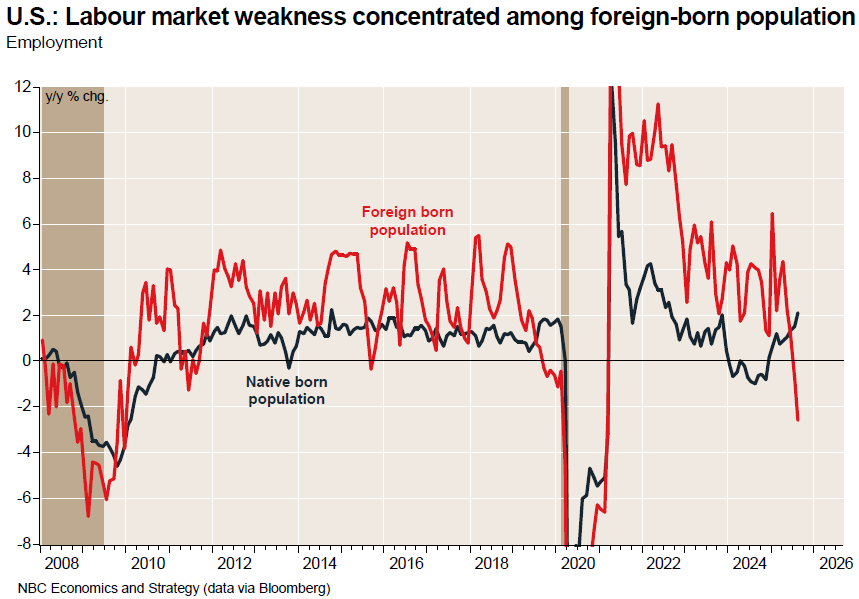
As today’s Hot Chart shows, the significant divergence between the employment prospects of native- and foreign-born populations was also striking, with employment increasing by 2.1% in the former group over the last twelve months and falling by 2.6% in the latter. This decline does not appear to be the result of mass layoffs but rather of a much more restrictive immigration policy.

Indeed, the foreign-born population has declined by 0.6% in the last year according to data released this morning by the BLS. Another factor to consider is the acceleration of deportations, which seems to be discouraging many foreign-born individuals from seeking work. The participation rate of foreign-born Americans aged 16 and over has indeed fallen three times faster than that of the overall population over the past 12 months. It remains to be seen how the decline in the supply of foreign-born workers will impact wages and inflation in a context where the latter tend to be paid less on average than native workers.

image

China pharma deals threaten U.S. biotech

A surge of recent licensing deals for Chinese drugs is sending new signals that the U.S. could be toppled as the world’s biotech leader.

A decade-long national strategy to develop its biopharmaceutical industry has left China in a position to deliver medical products faster and cheaper.

  • It’s part of a global power shift that’s seen China emerge as a powerhouse in AI, chemistry and other areas, Andrei Iancu, undersecretary of commerce for intellectual property in the first Trump administration, told Axios.
  • “Any way you cut it, any way you measure, they’re basically pointing in the same direction: China taking the lead, already leading, or knocking on the door in these various areas,” Iancu said.

China-sourced antibodies, heart treatments and other drug candidates will make up almost 40% of all licensing deals this year, up from less than 3% five years ago, according to Evaluate Pharma.

  • Chinese biotech shares surged earlier this year amid an increase in licensing deals for cancer treatments, Financial Times reported in July.
  • An analysis last week in Nature found 11 big pharma companies — including AstraZeneca, Bristol Myers Squibb, Eli Lilly and GSK — collectively committed more than $150 billion to license novel assets from Chinese sources in the last five years.
  • GSK has the highest estimated share, with roughly 10% of its pipeline composed of assets from Asia.

China’s biotech boom comes as the U.S. is paring federal funding for biomedical research and freezing grants to universities and medical research institutes.

  • Steep Food and Drug Administration staff cuts, the Trump administration’s proposed 40% budget reduction for National Institutes of Health and its termination of $500 million for mRNA vaccine development could chill investor enthusiasm and fuel an exodus of research talent.
  • “This current retrograde step by the U.S. will allow others to catch up and likely pull ahead in the context of vaccines,” Robin Shattock, professor of mucosal infection and immunity at Imperial College London, told Inside Higher Ed.
  • “It will only take another pandemic for them to rapidly see their mistake.”
  • An independent commission in April recommended Congress and the White House dedicate a minimum of $15 billion over the next five years to unleash more private capital into the U.S. biotechnology sector.

The way China’s biotech boom coincides with a U.S. retreat could have far-reaching ramifications as drug manufacturers face a spate of patent expirations in the next five years. The question is whether pharma keeps turning east for less expensive new products.

From Callum Thomas:

In case you missed it, both Tech Stocks & Bitcoin topped earlier in August (this is technically true, prices reached a high and have not surpassed that level since). Whether this is *the* top is an open question, but facts are both of these lines have stopped going up for now.

Source:  MarketCharts

Taking a step back, the reason we look at these two together is because ever since 2020 they’ve been traveling a similar path and riding the same waves of liquidity and speculation. The problems start when either liquidity-speculation-loops spiral to excess (and reverse) and/or when you get cracks appearing in the confidence structure (as there does seem to be recently).

Source:  Topdown Charts

All in!

Source:  @MikeZaccardi

  • State Street data shows institutional investor allocations to equities near 20-year highs

Source:  @dailychartbook

Support for Capitalism Drops to New Low in US, Gallup Says

Americans’ positive image of capitalism has eroded over the past decade, as a new Gallup poll finds widening polarization over the US economic system.

Just 54% of US adults view capitalism positively, down from 60% in 2021 and the lowest since Gallup began asking the question in 2010. And while overall support for socialism remains mostly stable at 39%, the partisan divide has grown — especially among Democrats.

Two-thirds of Democrats now view socialism favorably — up from half in 2010.

Gallup analyst Jeff Jones said Donald Trump’s first election in 2016 was an inflection point. “I think it’s Trump, but I also credit Bernie Sanders and maybe populism more generally,” he said. “Certainly in the Democratic Party, some of the socialist ideas are becoming almost mainstream.”

image

Generational change is a key driver. Those who came of age after the Cold War never absorbed the same negative messaging about socialism as older Americans, Jones said. Among Republicans, younger voters remain skeptical but “they’re not nearly as negative toward it as older Republicans are.” (…)

Even as views of capitalism slip, Americans still strongly support many of its component parts. Small business earns a 95% positive rating, and 81% support free enterprise. Big business, however, has seen sharp declines — only 37% rate it favorably, down from a majority in 2019.