Central U.S. Manufacturing Maintains Expansion, But Prices Keep Rising Too
The Federal Reserve Bank of Kansas City said Thursday that its Tenth District manufacturing survey’s composite index was steady at 1.0 this month, maintaining the same level as July, when for the first time in three years the index pointed to expansion rather than contraction in the area’s manufacturing. (…)
Demand continued to recover, with production moving out of contraction territory, the index showed. (…)
With activity continuing to increases, price pressures also heated up. The index showed rises in both the prices manufacturers pay for raw materials, and the prices they receive for finished goods. (…)
The WSJ paints it rosier than it actually is. From the KC Fed data:
- Volume of new orders have been falling all year, faster in the last 2 months.
- Same for backlogs.
- Employment and the work week weakened measurably in the last 2 months.
Ed Yardeni:
The regional business surveys conducted by five of the 12 Federal Reserve district banks showed that inflationary pressures are building. The average of the prices-paid indexes jumped in August to 56.0, the highest reading since October 2022. The average of the prices-received indexes is lower at 24.5, suggesting that many companies are absorbing the increasing costs of tariffs and/or offsetting them with productivity gains. More companies may start to pass their costs on to consumers in the coming months.

Ed is also wondering “Is The Fed About To Stimulate A Hot Economy?”
Perhaps.
My August 22 post was titled Growthflation! following S&P Global’s flash US PMI:
S&P Global’s flash PMI rose to an eight-month high from 55.1 in July to 55.4 in August. The latest two months seeing the strongest back-to-back expansions since the spring of 2022. The last two months saw the the strongest back-to-back expansions in services since the spring of 2022. Employment rose for a sixth successive month, with the pace of job creation hitting the highest since January (and one of the strongest rates seen for over three years). Service providers took on staff at the fastest pace for seven months while factory job gains reached the highest since March 2022.”
Most large past divergences between S&P Global and the Employment ISM surveys ended up in favor of S&P Global. If this one is no exception:
- The ISM releases on September 2 (manufacturing) and 4 (services) could be surprising to many. If S&P Global is right, the US economy is actually quite strong and employment growth has strengthened in August.
- The FOMC would be wise to stay put a while longer, particularly since both surveys agree on accelerating inflation, fueled not only by tariffs but by strong underlying demand and limited supply.
This is supported by very strong real world data from corporate America in Q2: S&P 500 earnings are up 12.9% (14.8% ex-Energy), largely beating the July 1 forecast of +5.8%. Revenues are up 6.3% (7.4% ex-E) vs +3.7% expected. Corporate guidance remains solid.
Walmart’s US comps rose 4.6% in the quarter ended August 1, +3.6% in volume. The company raised its full-year sales guidance from +3-4% to +3.75-4.75%, a sign that back-to-school sales are solid.
- The Citigroup Economic Surprise Index jumped today to 26.8.

Higher Prices Are Coming for Household Staples Companies from Hormel to Ace Hardware forecast prices rising as the costs of Trump’s tariffs are passed on to consumers
Companies including Hormel Foods, J.M. Smucker and Ace Hardware said this week they would raise prices for reasons ranging from higher meat costs to tariffs. Large retailers like Walmart, Target and Best Buy said some tariff-related price increases are already in place. More are on the way.
“Some vendors are clearly communicating cost increases. Some are adjusting promotions. Some are planning to potentially increase prices with new product introductions, which always happens,” Best Buy Chief Executive Corie Barry said on an analyst call Thursday. She said price increases are much lower than the overall tariff rate. (…)
So far, tariff-related price increases have been muted, Walmart CEO Doug McMillon said last week. “But as we replenish inventory at post-tariff price levels, we’ve continued to see our costs increase each week, which we expect will continue into the third and fourth quarters.”
McMillon said price increases have led middle- and lower-income shoppers to pull back on some purchases. (…)
With tariffs driving up its purchasing costs, Ace said it plans to pass the increases through to its stores, which in turn will pass them along to consumers.
Food giant J.M. Smucker, which makes Folgers and Jif peanut butter, said prices will continue to go up for its coffee products as a result of the Trump administration’s 50% tariff on certain imports from Brazil, one of the world’s largest coffee producers. Smucker raised prices for its coffee in May and said it would raise them again this month.
Up to this point, many U.S. companies have either sold through existing inventory purchased when tariff rates were lower, absorbed the tariffs or negotiated with suppliers to share the burden. Other tariff-related costs haven’t arrived until now. (…)
Hormel Foods said Thursday that rising costs for beef, pork and nuts eroded its profit for the most recent quarter. As a result, the maker of Spam, Jennie-O turkey and Planters nuts began raising prices during the summer and plans to continue increases on some products. (…)
Tyson Foods, the largest American meat supplier by sales, said its average selling price for beef, chicken, pork and precooked products was up about 4% in the three months ended June 28 from a year earlier. Restaurant chains including Texas Roadhouse and Portillo’s have said they are hiking menu prices because of pricier beef. (…)
Retailers including Dick’s Sporting Goods, Victoria’s Secret, Dollar General and Williams-Sonoma reported higher quarterly sales in recent weeks, saying that while they and their suppliers have implemented some tariff-related price increases, that hasn’t slowed consumers’ purchases.
Dick’s Sporting Goods said shoppers are gravitating to new products and premium brands. “We have not seen a consumer having any issue with the price increases, the small level of price increases that have gone in,” said CEO Lauren Hobart.
At home-goods retailer Williams-Sonoma, which owns brands including West Elm and Pottery Barn, executives said higher prices and fewer discounts helped boost its profit in the most recent quarter. Apparel retailer Victoria’s Secret also said it continued to pull back on discounts, in part to offset the cost of tariffs. (…)
Dollar General CEO Todd Vasos said climbing consumer prices elsewhere could benefit his chain. While the company’s core clientele of low-income shoppers has increased spending at the chain, higher-income shoppers are trading down to Dollar General as they look for deals.
All are “seeking value at this point,” he said Thursday.
Trump Leans on National Security to Justify Next Wave of Tariffs Expanded steel and aluminum tariffs are just the start; new levies seen as likely for semiconductors, heavy trucks, commercial aircraft and more
(…) s on steel and aluminum were expanded this month, covering more than 400 new product lines with 50% levies and increasing compliance costs for companies. Those charges will likely be broadened further, along with expansions of existing tariffs on copper and automotive parts.
New levies on sectors like semiconductors, heavy trucks, pharmaceuticals and ingredients, processed critical minerals, and commercial aircraft and parts, among others, are also likely to be unveiled in coming months. (…)
Trump still holds near-unilateral authority over how national security tariffs are set or altered. That gives the administration an insurance policy if its reciprocal tariffs are struck down in court, people with knowledge of the administration’s plans say. (…)
At the same time, Trump’s team is considering ways to provide relief from some of those tariffs for a handful of large companies like U.S. automakers and tech firms, the people familiar with the plans say.
U.S. automakers have argued that despite 15% tariffs on Japan and Korea, it is still profitable to produce cars in those countries and ship them to the U.S.—in part because of higher input prices in the U.S. due to Trump’s steel, aluminum and parts tariffs.
Options the administration is considering for relief include expanding existing tariff rebates for automotive assemblers like Ford, Stellantis and General Motors, or applying quotas that allow a certain number of parts to enter the U.S. duty-free, according to people with knowledge of policy discussions. Trump has also floated exemptions from certain tariffs to large tech firms with U.S. operations, or giving some companies with U.S. operations more time before tariffs kick in. (…)
The additional items, announced Aug. 15, represent a major expansion of the national security tariffs on the steel and aluminum in finished goods that Trump imposed in March. Construction and farm equipment, factory robots, metal-cutting machinery, auto parts and other complex components are among the 400 items now subject to 50% tariffs on the metal contained in them.
The latest tranche of products brings the total value of imported finished products subject to U.S. metal tariffs to more $300 billion, according to Jason Miller, professor of supply chain management at Michigan State University.
“They’re just so sweeping in terms of their coverage,” Miller said. “We just keep picking up more and more. You’re now penalized for importing parts with a high percentage of steel and aluminum.” (…)
The administration plans to allow companies to petition for additional products to be covered by tariffs three times a year, with the next round opening in September, and another in January of next year. Additionally, the Commerce Department is considering inclusions for auto parts tariffs that could be unveiled in mid-September—one of four inclusion rounds planned each year—and the agency is also expected to open an inclusion process for copper tariffs by late October. (…)
Already, Trump has announced plans to expand the lumber tariffs to imported furniture products, which would significantly expand the scope of the levies to a number of everyday consumer products.
Trump rolled out the duties on metal derivative products after steel and aluminum producers complained that companies were buying finished products with foreign metal to avoid buying American-made products with domestic metal. (…)
Ken Fedor, a vice president for sales in the U.S. for transformer manufacturer SGB-SMIT Group in the Netherlands, said the U.S. doesn’t produce enough electrical steel or transformers to accommodate the surging transformer demand from data-center operators and utility companies. Expanding production of large transformers in the U.S. will take years, he said.
“You just can’t ramp it up. It’s a highly skilled process. Everything is customized,” he said.
He expects the tariff to increase the cost of the large imported transformers that SGB-SMIT builds by as much as 30%. The company makes them in the Netherlands and sells them mostly to U.S. electric utility companies for use at power generating plants and electrical substations.
The new tariffs on the metal in robotics gear will make it more expensive for U.S. companies to automate factory processes by deploying robots. The robot market in the U.S. is now largely supplied with hardware from robotics companies in Japan, South Korea, China and Germany. Automation to reduce labor costs has been an incentive for companies thinking about bringing manufacturing to the U.S. from overseas.
“If the costs go up, it’s going to make it harder for companies to justify bringing more manufacturing back,” said Jeff Burnstein, president of the Michigan-based Association for Advancing Automation, a trade group for robotics. “Right now, the tariffs look like this is a negative for the robotics industry and manufacturing in general for the U.S.” (…)
Texas-based construction and mining equipment maker Caterpillar said Thursday its tariff expenses this year could reach $1.8 billion, up from the $1.5 billion forecast earlier this month. The company said it raised its expense outlook in response to the expansion of tariffs. (…)
The Trump administration currently lets the automakers receive a rebate on the tariffs they pay for auto parts. But companies have asked the Commerce Department to expand the program to allow them to be refunded for other tariff costs as well, according to people with knowledge of the discussions. (…)
Centralized economy run by civil servants. Good luck. History rhymes as Mark Twain said.
BTW:
Agco for years has been trying to boost its business in the U.S., where it has held the No. 3 spot in essentially a three-company farm-equipment market. But a wave of new tariffs means it will be harder to boost its standing there.
The Duluth, Ga., company doesn’t have enough U.S. sales to justify moving more production out of Europe, where it has most of its production and sales, Chief Financial Officer Damon Audia said. And the likely need to raise prices to offset tariff costs could further depress sluggish demand for farm equipment in the U.S., where the company is continuing to invest.
Meanwhile, in Europe, where much of its supply chain and sales are aligned, the company could see a boost by avoiding many tariff costs that its peers Deere & Co. and CNH Industrial face. (…)
“All of us are looking at these costs trying to figure out how to keep it low for the farmers,” he said. “But ultimately, these are things that we’re going to have to try to pass through in some capacity over time.”
The company might spread out price increases across its brands, for example charging more for planters and sprayers made in the U.S. so it wouldn’t have to raise prices as much on tractors from Germany, Audia said, adding no decision has been made. (…)
“If what we really want as a country is more U.S. manufacturing, then making it harder for people to do that seems counterproductive,” Volkmann said. (WSJ)
US Tariff Impact Tracker
Goldman Sachs plots high-frequency data: China exports less to the US but more overall.


The Richmond Fed polled businesses in August:
According to our August surveys, almost 30 percent of firms were not at all certain about their input costs for the remainder of the year. The uncertainty went beyond just those firms affected by tariffs: Sixteen percent of firms that reported not importing products subject to tariffs were not at all certain about their input costs for the remainder of the year.
Thirty percent of firms were only slightly certain about input costs. That means that well over half of firms are relatively uncertain about what they will be paying for inputs in 2025. This was especially prevalent among manufacturing firms, where 44 percent reported that they were not at all certain about input prices for the remainder of the year.
A vehicle parts manufacturing firm reported, “Over the past 20+ years, we have developed good relationships and a reliable, stable supply chain. The tariffs and the threat of tariffs have completely upended that … we will have to increase prices to our customers or make less margin or, most likely, both.”
On the other hand, there was much more certainty among respondent firms about how they will price their own products and services. Although most firms were uncertain about their costs, over 60 percent of responding businesses were very or somewhat certain of the prices they will charge their customers, with service sector firms (66 percent) more likely to report certainty than manufacturers (52 percent).
Nonetheless, there were service sector firms that reported ripple effects of trade policy changes. For example, one professional services respondent reported, “My firm supports businesses that import materials from other countries, so we are impacted by their ability to invest in professional services based on increased costs and supply issues related to tariffs.”
Some firms remain in “wait and see” mode as uncertainty around tariff policy and input prices persists. However, most impacted respondents have begun passing along tariff costs to their customers by raising prices.
Of the roughly half of firms that reported direct tariff impacts, nearly 60 percent of them have already increased their prices due to tariffs, and most of these firms plan to raise prices again.
In contrast, about 25 percent of firms reported that they have been impacted by tariffs and plan to raise prices but have not yet. For example, a South Carolina transportation manufacturer plans to pass on tariff costs but has not yet due to concerns about demand for their product. As they explained, “Tariff cost transfer to customers is creating the largest earnings uncertainty in our 2026 business plan.” Fourteen percent of respondents who reported being affected by tariffs were unsure about whether to adjust prices.
Regardless of whether they have increased prices already due to tariffs, most impacted firms intend to raise prices. However, amid trade policy changes, over half of firms that plan to increase prices are mostly or entirely uncertain about their prices through the end of the year, casting uncertainty on whether and when these price increases will manifest.
Almost one-quarter of respondents that are impacted by tariffs have not increased prices but plan to. Roughly 50 percent of these firms expect to increase prices before the end of the year. Another 29 percent expect to start passing through in 2026, and 21 percent are not sure when they will start passing through costs.
Another 45 percent of tariff-affected respondents have already increased prices and expect to increase prices further. Nearly 70 percent of these firms expect to raise prices by October, and few anticipate waiting until 2026. In other words, firms that have increased prices already expect to increase prices again sooner than those firms that have yet to increase prices.
Still, many firms continue to be unsure about the timing of their next price increases. A North Carolina transportation company reported that they have begun passing through tariff costs, but they are waiting until next year to increase prices further, noting that “We have found demand softening, which has led … to much more price competition. …”

Canada’s annual job growth barely above zero in June, payroll survey shows
(…) The number of factory jobs fell 8,400 on a month-over-month basis, as manufacturers scaled back operations in the face of U.S. President Donald Trump’s tariffs on imports from Canada. Based on the payroll data, manufacturing employment has fallen every month since December, wiping out 26,600 jobs since then.
Meanwhile, employment at retailers suffered the next largest decline, dropping by 8,100 positions between May and June. (…)

NBF adds:
In its July Monetary Policy Report, the Bank of Canada stated that several labour market indicators point to growing slack but added that this weakness was limited to sectors sensitive to trade. (…)
According to the survey, total employment fell by 33,000 in June, bringing the total decline since the beginning of the year to 47,000.
Limiting our analysis to the private sector reveals an even more pronounced decline so far in 2025, with 69,000 jobs lost, resulting in the lowest employment level in 28 months. Unsurprisingly given current trade situation, the manufacturing sector has declined by 25,000 jobs, and the two major provinces that depend most on this sector have shown significant declines (Ontario: -39,000; Quebec: -24,000).
However, the weakness is much more widespread at the sectoral level than the Central Bank seems to believe. As today’s Hot chart shows, only 36% of private sector industries have grown over the past six months (i.e. since the beginning of the year), which is unheard of outside of a recession.
While the Federal Reserve has begun to show unease with a weakening U.S. labour market—evident in its increasingly narrow breadth of job gains—the outright collapse in Canada should be an even greater cause for concern at the Bank of Canada.

Notice how low is the US diffusion index. Still declining.
Alibaba Creates AI Chip to Help China Fill Nvidia Void Chinese tech companies spark market exuberance by signaling they are catching up to U.S.
Chinese chip companies and artificial-intelligence developers are building up their arsenal of homegrown technology, backed by a government determined to win the AI race with the U.S.
The latest example: China’s biggest cloud-computing company, Alibaba has developed a new chip that is more versatile than its older chips.
Alibaba was long one of the biggest customers of American AI-chip leader Nvidia. Now it and other chip designers are filling the void left after Nvidia ran into regulatory barriers to selling its products in China.
Industry insiders say China remains far from being able to make chips that can rival the most advanced American products, which Washington bars China from importing. Chinese factories are hobbled by U.S. restrictions on access to cutting-edge chip-making technology.
Still, companies are coming up with substitutes for Nvidia’s H20 chip, the most powerful AI processor it is allowed to sell in China. (…)
In July, Shanghai-based MetaX rolled out a new chip that it said could serve as a replacement for the H20. The chip has bigger memory than the H20, boosting its power for some AI tasks, although it consumes more electricity. MetaX said Wednesday it was preparing for mass production of the chip.
Another would-be Nvidia rival, Beijing-based AI-chip designer Cambricon Technologies, had a breakout April-June quarter, posting revenue of $247 million on robust orders of its AI-chip Siyuan 590. (…)
Alibaba, founded by internet pioneer Jack Ma, is sometimes compared with Amazon.com because its biggest business is e-commerce, but it makes much of its money from the lower-profile business of cloud-computing services—running applications and storing data for customers on remote computers. Alibaba competes with Amazon Web Services, Microsoft and Google for cloud business, particularly in Asia.
Corporate customers are increasingly demanding AI services, and Alibaba Chief Executive Eddie Wu has said “AI plus cloud” is one of Alibaba’s two engines of growth alongside e-commerce. In February, Alibaba said it would invest at least $53 billion over the next three years in the area. It also has one of the world’s highest-rated AI models, called Qwen. (…)
Previous cloud-computing chips developed by Alibaba have mostly been designed for specific applications. The new chip, now in testing, is meant to serve a broader range of AI inference tasks, said people familiar with it.
The chip is manufactured by a Chinese company, they said, in contrast to an earlier Alibaba AI processor that was fabricated by Taiwan Semiconductor Manufacturing. Washington has blocked TSMC from manufacturing AI chips for China that use leading-edge technology.
One challenge for Alibaba and other local players relying on Chinese chip factories is getting enough supply. These factories, which use older foreign machines and less powerful homegrown equipment, have struggled to increase capacity.
MetaX, the Shanghai startup, is getting around the bottlenecks by using an earlier-generation technology to make its new chip, people familiar with the product said. MetaX combines two smaller chips to make up for the loss of performance. (…)
The flag-bearer for Beijing’s push is Huawei Technologies and its Ascend AI chips. Earlier this year, Huawei showed off a computing system that integrates 384 Ascend chips. Some analysts said the machine, although a power hog, was more powerful on some metrics than Nvidia’s top-of-the-line system containing 72 Blackwell chips.
By combining chips, “we can achieve comparable computing results to the most advanced standards,” and “there’s no need to worry about the chip problem,” Huawei founder Ren Zhengfei told the Communist Party’s main newspaper in June.
Even within China, Huawei’s privileged status is raising some hackles. Many engineers are accustomed to the software and tools that accompany Nvidia’s chips. Huawei, subject to U.S. sanctions, didn’t design its chips to work with the Nvidia platform, whereas Alibaba’s new chip will be compatible with it, meaning engineers can repurpose programs they wrote for Nvidia chips.
Private-sector cloud companies including Alibaba have refrained from bulk orders of Huawei’s chips, resisting official suggestions that they should help the national champion, because they consider Huawei a direct rival in cloud services, people close to the firms said.
China’s biggest weakness is training AI models, for which U.S. companies rely on the most powerful Nvidia products. Alibaba’s new chip is designed for inference, not training, people familiar with it said.
Chinese engineers have complained that homegrown chips including Huawei’s run into problems when training AI, such as overheating and breaking down in the middle of training runs. Huawei declined to comment.
DeepSeek, a Chinese startup with models challenging OpenAI’s, recently prompted a stock rally in China by suggesting in a cryptic comment on social media that its software innovations could combine with improved Chinese-made chips to train some AI models.
Kevin Xu, founder of AI-focused fund manager Interconnected Capital, wrote on a blog that such adaptations may allow Chinese AI developers to narrow the gap with the U.S. “sooner than most people think, credibly challenging Nvidia and the American AI stack both at home and abroad.”
Not just to “narrow the gap” …
Europe Car Sales Gain Most in 15 Months as Consumers Warm to EVs
Registrations climbed 5.9% last month from a year earlier — the steepest gain since April 2024 — to 1.09 million units, the European Automobile Manufacturers’ Association said Thursday.
Plug-in hybrids made the biggest jump in July of 52%, as buyers increasingly opt for models that combine electric driving with a backup combustion engine. Sales of fully electric vehicles rose by more than a third, the best result since January.
The data is a boost for the region’s beleaguered industry following a sharp drop in June. European automakers continue to face headwinds as US President Donald Trump’s tariffs disrupt supply chains and Chinese brands led by BYD Co. gain ground with affordable EVs. (…)
Tesla Inc. continued to suffer. Sales of the Elon Musk-led brand slumped 40% last month, giving it a market share of just 0.8%. Volkswagen, Ford Motor Co. and BMW had double-digit gains, while BYD’s deliveries more than tripled.
Renewables investors are pulling back from the U.S.
Trump 2.0’s reversal of federal support is starting to show up in hard financing data.
The first half of 2025 saw the “reallocation” of investment dollars away from the U.S. begin, the research firm BloombergNEF found. U.S. spending fell by $20.5 billion, or 36%, from the second half of 2024 in what the firm calls a response to the U.S. presidential election.
It was the steepest drop of any country.“There was a rush to construct toward the end of last year as developers sought to lock in access to tax credits, and then a sharp drop in the first half of this year due to worsening policy conditions, particularly for wind, and growing tariff uncertainty,” the report states.
The European Union saw a big jump, which “supports the idea that developers and investors may be reallocating capital out of the U.S. and into Europe.”
The U.S., in the first half of 2025, wasn’t among the world’s top-five wind markets for the first time since 2016.
Worldwide investment was $386 billion in the first half of 2025, a tally that’s largely wind and solar, but also includes biofuels, geothermal and more. (…)
How recent events sway U.S. investment trends.
- The Interior Department has unveiled fresh constraints on wind and solar projects, while the Commerce Department could impose new tariffs on wind blades and components.
- And just last week, Interior demanded that Ørsted halt construction on a big, nearly complete wind project off Rhode Island.
 FYI:
FYI:
Around 90% of renewables cheaper than fossil fuels worldwide, IRENA says
The majority of newly commissioned renewable energy is more cost-effective for electricity generation than most fossil fuels worldwide, a report by the International Renewable Energy Agency (IRENA) showed on Tuesday. (…)
Solar photovoltaic (PV) was 41% cheaper on average than the lowest-cost fossil fuel alternatives, such as gas, while onshore wind projects were 53% cheaper.
The cost of battery energy storage systems has declined by 93% since 2010, the report added.
MAGA?
WHY NOT?
Trump Ally Floats Norway Tariffs Over Caterpillar Divestment
A Republican senator closely allied with US President Donald Trump suggested imposing additional tariffs on Norway in retaliation for a decision by the country’s sovereign wealth fund to divest its holdings of heavy-equipment maker Caterpillar Inc.
Senator Lindsey Graham, a South Carolina Republican, in a social media post Thursday also floated halting US visas for leaders of the sovereign wealth fund and other “organizations that attempt to punish American companies for geopolitical differences.”
Norway’s $2 trillion sovereign wealth fund removed Texas-based Caterpillar from its fund this week based on Israel’s use of its bulldozers to destroy Palestinian property in Gaza and the West Bank. The fund held about $2.1 billion worth of shares in the company as of June 30. (…)
Norges Bank Investment Management operates under a mandate set by the Norwegian parliament with ethical guidelines on issues ranging from land mines to climate change. It is advised by an external ethics council, which assesses the portfolio on an ongoing basis and recommends companies for exclusion or observation.
More than half of the fund’s investments were in US equities and bonds as of June 30.
Trump Suggests ABC And NBC Should Lose Broadcast Licenses Over Negative Coverage Of Him
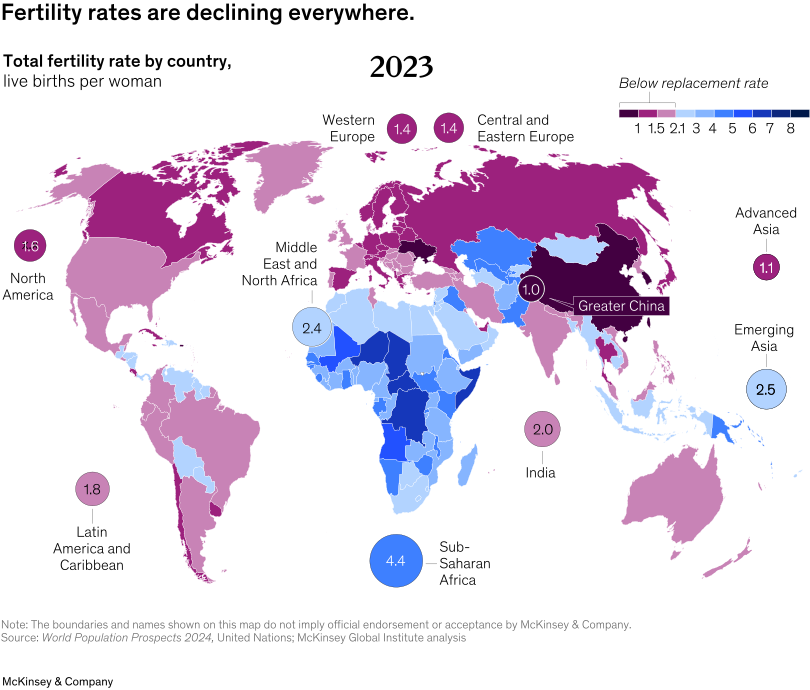
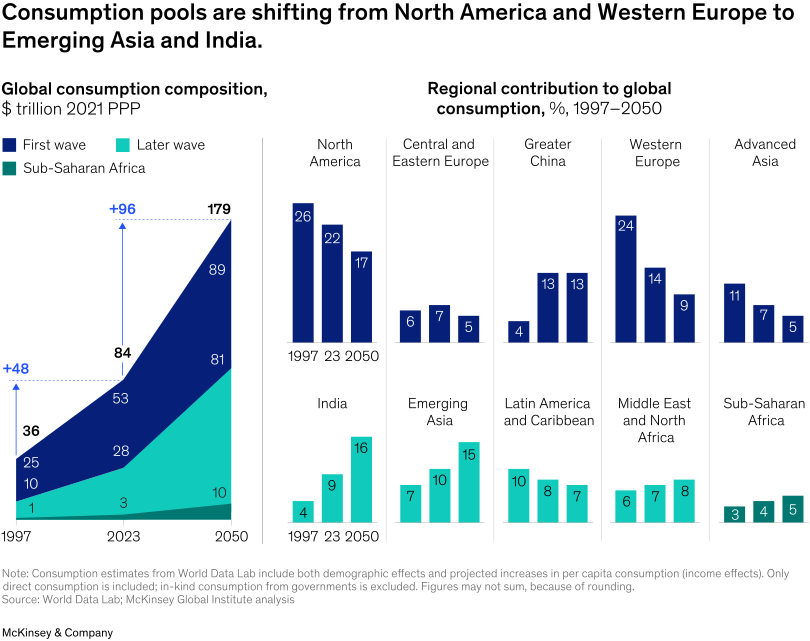
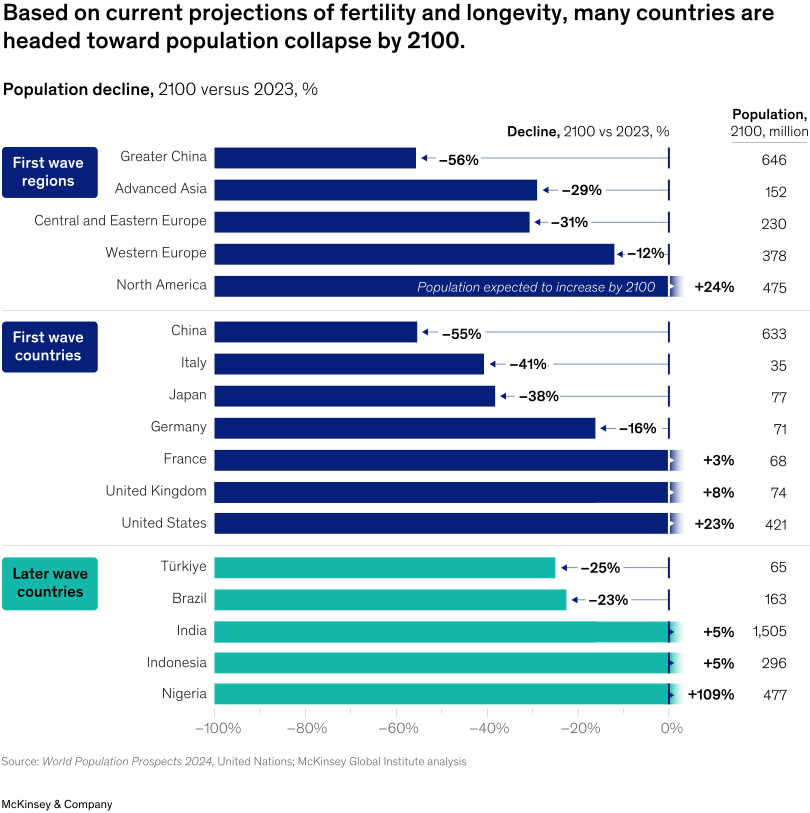
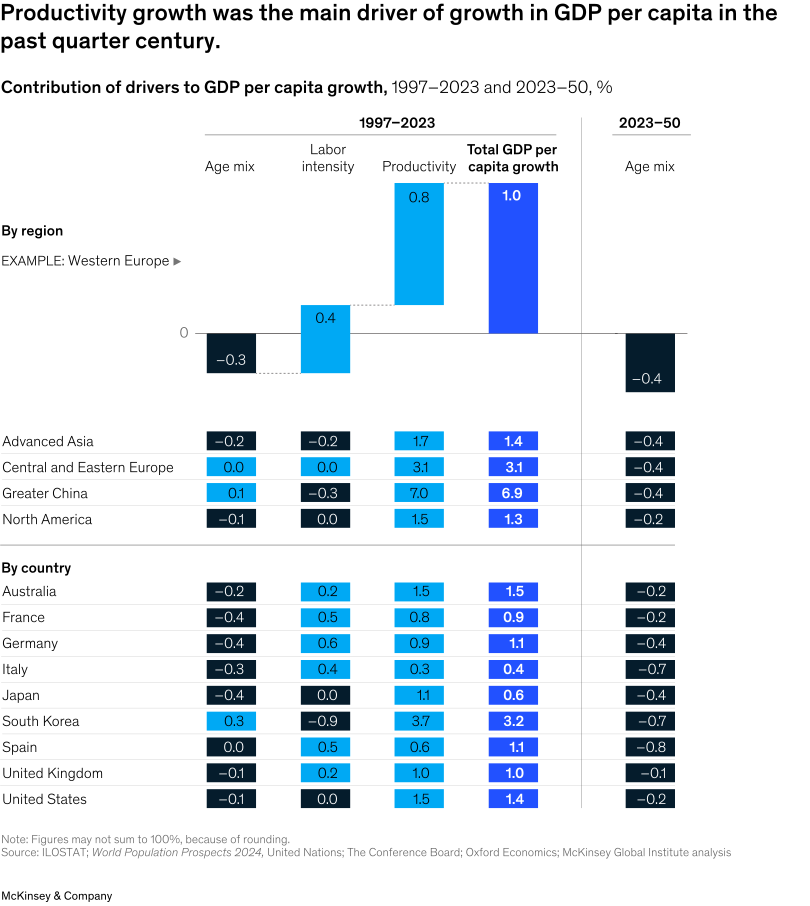
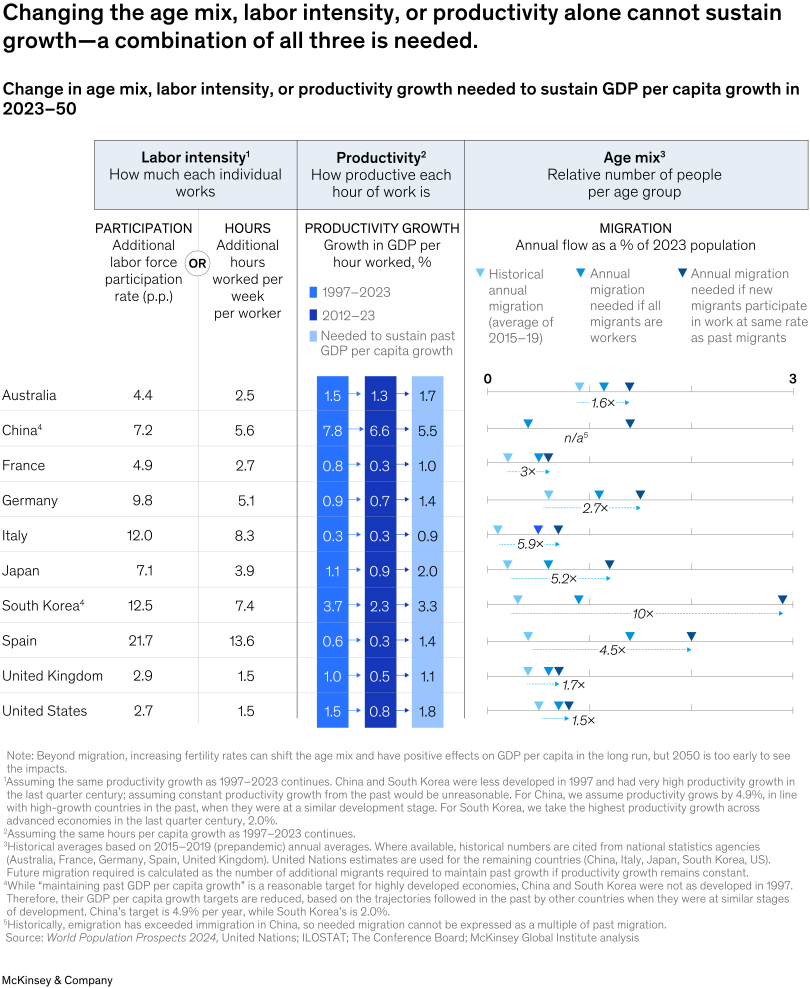
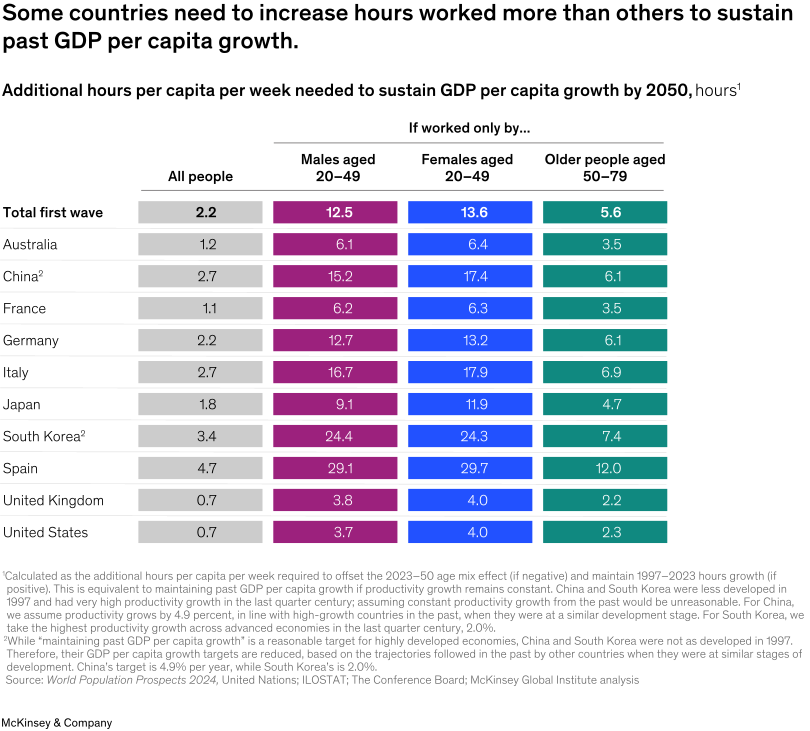
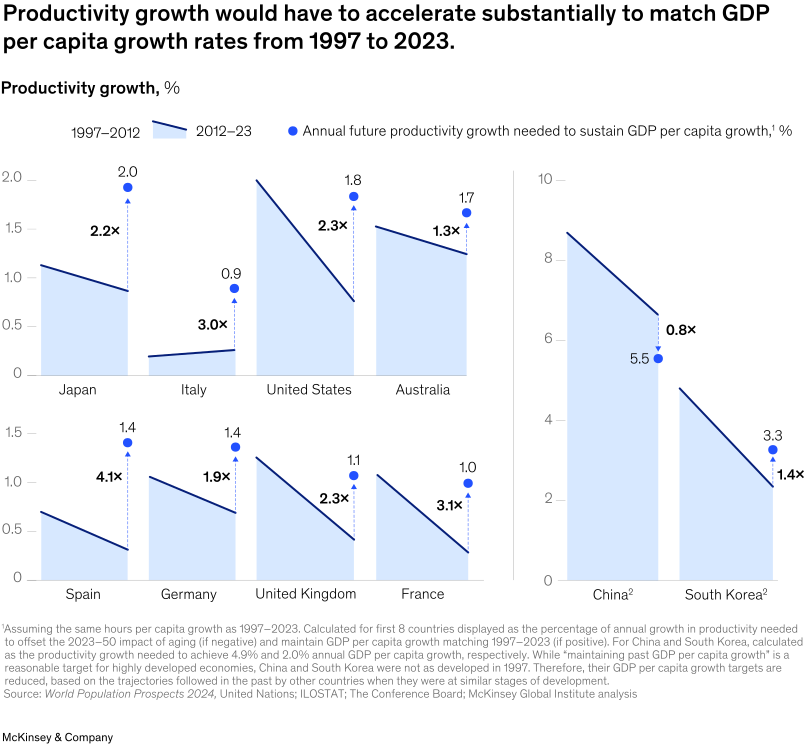
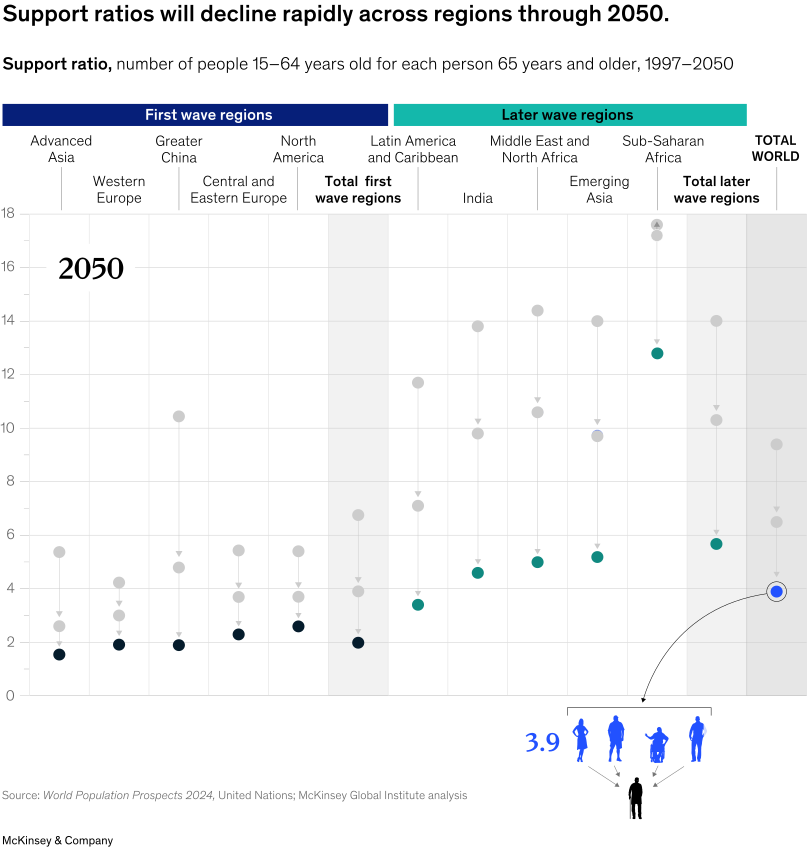 This trend is starker in first wave economies, where the support ratio is already 3.9 today, down from 6.8 in 1997. The ratio is expected to fall to two working-age individuals for every person over 65 years by 2050. Among regions in the first wave, Advanced Asia, Greater China, and Western Europe will have the lowest support ratios by 2050; the ratio will fall fastest in Greater China.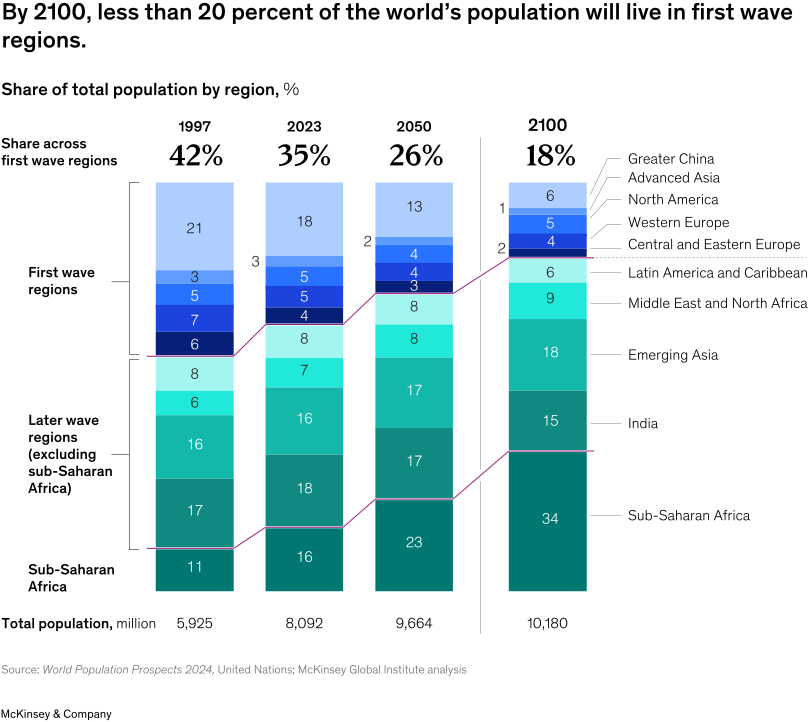
![image_thumb[1]](https://i0.wp.com/www.edgeandodds.com/wp-content/uploads/2025/08/image_thumb1.png?ssl=1 "image_thumb[1]")
![image_thumb[3]](https://i0.wp.com/www.edgeandodds.com/wp-content/uploads/2025/08/image_thumb3.png?ssl=1 "image_thumb[3]")
![image_thumb[5]](https://i0.wp.com/www.edgeandodds.com/wp-content/uploads/2025/08/image_thumb5.png?ssl=1 "image_thumb[5]")
![image_thumb[7]](https://i0.wp.com/www.edgeandodds.com/wp-content/uploads/2025/08/image_thumb7.png?ssl=1 "image_thumb[7]")