The enemy of knowledge is not ignorance, it’s the illusion of knowledge (Stephen Hawking)

It ain’t what you don’t know that gets you into trouble. It’s what you know for sure that just ain’t so (Mark Twain)

Invest with smart knowledge and objective odds

THE DAILY EDGE: 25 NOVEMBER 2022

BLACK FRIDAY SALE AT EDGE AND ODDS (Last call!)

I receive so many Black Friday discount offers from content providers, I feel bad not doing the same for my readers. So here it is:

  • All new or past donators will now have free access to Edge and Odds and be allowed to double their donation, free of charge, yearly!
  • Readers who subscribe to the Daily Edge will receive it daily in their mailbox, free of charge!
  • That’s nearly 250 deliveries per year! There surely is something useful once in a while.
  • And readers who recommend Edge and Odds to a friend will see their subscription extended indefinitely.
  • That could be 2500 Daily Edges, maybe even more…who knows? It’s been 14 years already.

I know, not that big a deal, but that’s all I can do Winking smile

What’s a big deal to me is readers supporting the blog with donations. Lately, I have been very bad at taking the time to thank them personally.

Please forgive me Richard T., John M., Constantin Z., Richard B., Robert K., Joseph T., Joshua F., Jasec, Donald M., David M., Massimo B., Lawrence M., Stephen C.. I hope I forgot nobody. You are truly helping this blog survive during this not so transitory inflation period.

Red rose P.S. I hereby officially thank recent donators: Bill C., Jack H. and long time reader and donator Richard T.. Your support is very much appreciated.

Back to regular programming!

Pointing upPointing up Pointing up
MAYBE YOU MISSED YESTERDAY’S IMPORTANT DAILY EDGE: “Very Weak U.S. Flash PMI”. You should read it…

Recession Watch: identifying recessions with uncertain data

Economists are not very good at forecasting recessions. In a blog post published almost four years ago, ‘The economist who cried wolf’, I analysed the IMF’s forecasting track record. I found that, of the 469 recessions that had taken place since 1988 across 194 countries, only 13 were correctly anticipated in the World Economic Outlook (WEO) published in the October of the preceding year.

Worse still, fewer than half were identified even by the October of the year in which the fall in GDP took place.

Moreover, economists were prone to cry wolf, just like the boy in Aesop’s fable, with the IMF predicting recessions in the following year where none subsequently occurred 24 times in the Spring WEO and 23 times in the Fall WEO. Research from the IMF, published in the same year as my blog post, finds that private-sector forecasts are no better. The authors summarise the problem in the following way: ‘Recessions are not rare: economies are in a state of recession 10-12 per cent of the time. What is rare is a recession that is forecast in advance.’

In its World Economic Outlook, October 2022: Countering the cost-of-living crisis, the IMF warned that global economic activity was experiencing ‘a broad-based and sharper-than-expected slowdown’. The global financial crisis and the COVID-19 pandemic aside, the IMF described its forecast for global growth as the weakest since 2001.

The consensus among private sector forecasters is now for a recession across much of Europe, with the euro area as a whole suffering two consecutive quarters of contraction, beginning this year, and the UK five consecutive quarters.

For the US, it is a close call, with the median projection in the latest Reuters Poll being for near-stagnation through the first half of next year, rather than outright contraction.

In our Global Outlook, Autumn 2022, finalised in early September, our central scenario saw a period of recession across all the major economies. The historical precedents for us were compelling. Falling real wages had pushed levels of consumer confidence in the US, the EA and the UK down to levels that in the past had always signalled recession.

If that were not enough, rates of inflation in the US and the UK had reached levels from which recession had been avoided only once – in 1952. Rates of inflation in the euro area, available over a shorter time period, had reached levels from which recession had never been avoided. As a net exporter of energy, the US terms of trade had improved over the past year. That put it in a fundamentally stronger position than the EA or the UK.

Put together with the fact that pandemic savings offered some protection against falling real wages, and with the Fed acting more decisively than either the ECB or the Bank of England to get inflation under control, we felt that the US stood the best chance of avoiding recession – though we gave it no more than a 1-in-3 chance.

The conventional wisdom has been that data revisions tend to be pro-cyclical: in a boom, initial estimates of growth tend to get revised up, and in a slump they tend to get revised down. There is a logic to this. Statistical agencies base early estimates of GDP at least in part on a survey of firms. They then need to scale up estimates of gross value added in their sample to match the number of firms in the country as a whole.

In a boom, the total number of firms will tend to be growing faster than the statistical agency’s working assumption, giving a downward bias to initial estimates of growth. In a slump, the number of firms nationwide will tend to be growing more slowly than the statistical agency’s working assumption, or perhaps falling outright, giving an upward bias to initial estimates of growth.

In our own analysis, we find evidence of pro-cyclical revisions to initial estimates of growth in the UK, but only up until the global financial crisis. Before 2010, there was a strong, positive correlation between the final estimate of the change in GDP growth from one quarter to the next, and the revision to the initial estimate of GDP growth. But since 2010 that correlation has gone away.

In the US and the EA, by contrast, we find that pro-cyclical revisions to initial estimates of GDP growth have persisted, at least until the eve of the pandemic.

More specifically, using all available data from 2010 up to 2019, we find that the economic cycle can explain 55% of the revisions to US GDP growth and 61% of the revisions to EA GDP growth. For what it’s worth, if we take our model of EA revisions at face value, then in a world where true EA GDP growth was actually zero in Q3, then given the pace of the implied slowdown, our best guess is that the initial estimate of GDP growth would have an upward bias of 0.2 percentage points. The initial estimate of EA GDP growth in Q3 was, of course, 0.2%.

In our Global Outlook, Autumn 2022, we argued that, while non-farm payrolls data were a lagging indicator of economic activity, their timeliness meant they might still provide a useful cross-check on whether the US had entered recession. As the chart shows, the monthly change in non-farm payrolls tends to flip from around +240,000 in the month when activity peaks, to around ‒210,000 in the first month of recession.

image

But our next chart, which shows a smoothed measure of revisions to the initial estimate, casts some doubt on the usefulness even of non-farm payrolls as an arbiter of recession, at least in the short term. In the period following the dotcom bust, and again during the global financial crisis, initial estimates of the change in non-farm payrolls were revised down significantly.

image

The yield curve is thought by many to provide a useful leading indicator of the macroeconomic outlook. As our final chart shows, the slope of the US yield curve tends to turn negative some six to nine months before the peak in economic activity. As the green line in our chart shows, the US yield curve has flattened dramatically since the summer, with the ten-year yield lying some 15 basis points below the three-month bill rate on average through November to date. That would be consistent with the USentering recession early next year.

image

Where does this leave us, in terms of the current outlook? For now, we persist in our judgment that a recession in the European single currency bloc is almost inevitable, despite the stronger-than-expected initial estimate of EA growth. Indeed, given the tendency for early estimates of EA growth to be revised pro-cyclically, it may well have entered recession in Q3. Nevertheless, signs that EA economies have managed to substitute away from Russian gas to a greater degree than we had imagined, means the recession may be less severe than we had at first imagined.

We had always assigned a greater weight to the notion that the US might escape recession, and we may raise the weight we attach to that scenario in our Global Outlook, Winter 2022, due to be finalised on 2 December. As for the UK, initial estimates suggest the economy contracted in Q3, and we expect it will do so again in Q4.

Global Growth to Be as Weak Next Year as 2009, IIF Forecasts

Global growth is expected to slow to 1.2% in 2023, economists including Robin Brooks and Jonathan Fortun wrote in a note Thursday. When adjusted for base effects, that’s as weak as it was in 2009.

The severity of the coming hit to global GDP depends principally on the trajectory of the war in Ukraine,” the analysts wrote. “Our base case is that fighting drags on into 2024, given that the conflict is ‘existential’ for Putin.”

The slowdown will be led by Europe, which is impacted most by the war, according to the IIF. The Eurozone economy will shrink by 2% following sharp declines in consumer and business confidence. In the US, the IIF expects gross domestic product to rise 1%, while Latin America is the “positive standout,” expanding 1.2%, as commodity exporters reap the benefits of high food and energy prices.

The single biggest driver for the global economy next year will be China, where loosening Covid restrictions are likely, according to the Washington-based IIF. (…)

Chinese Banks’ $178 Billion ‘Medicine’ for Developers Won’t Cure All Ills China’s state-owned banks are showering the country’s real-estate developers with loans and other promises of financial support, moves that will prevent the beleaguered industry from spiraling into a full-blown crisis.

The fresh commitments from state-owned banks, coupled with a recent expansion of a government-sponsored bond guarantee program, are designed to help developers remain in business and finish construction on their projects. The actions would help resolve real-estate companies’ near-term liquidity pressures, but the much bigger challenge is regaining the trust of ordinary Chinese citizens and home buyers. (…)

To achieve that, homes that were presold first need to be delivered to buyers. The heightened concerns about developers defaulting—which created a negative feedback loop—also have to be alleviated, he added. (…)

“The real bottleneck now is the current pandemic situation in China and the zero-Covid strategy,” said Ting Lu, chief China economist at Nomura in Hong Kong. “As long as that policy exists, the financing-side supporting measures are medicines that can alleviate symptoms, but cannot cure the disease,” Mr. Lu said. (…)

So far, more than 30 developers have defaulted on their dollar-denominated bonds. (…) The yield on an ICE BofA index of noninvestment grade dollar bonds issued by Chinese companies was recently at 29% versus around 32% before the property-easing measures were unveiled. (…)

Just before the downturn, Chinese developers were selling around 14 million apartments annually—but a chunk of those were a result of speculative buying, he said.

Mr. Xing said he expects sales to eventually settle at around 10 million units a year, which he said would reflect the natural pace of people joining together to make up households and urbanization in China. (…)

Image@Sino_Market

Signs are growing in China that local government debt burdens are becoming unsustainable.

China’s 31 provincial governments have a stockpile of outstanding bonds that’s close to the Ministry of Finance’s risk threshold of 120% of income. Breaching that line could mean regions will face more regulatory hurdles to borrow, hampering their ability to drive up economic growth.

In addition, local authorities will face a massive maturity wall over the next five years as bonds worth almost 15 trillion yuan ($2.1 trillion) — more than 40% of their outstanding debt — fall due.

While there’s little risk of provincial governments defaulting, they will run into increasing difficulty in repaying their debts. More and more bonds will need to be sold to roll over maturing ones rather than to finance new spending and as a result, investment growth may suffer.

A major cause of the financial squeeze is the property crisis. Revenue from land sales — which in the past made up about 30% of local governments’ income — has plummeted. On top of that, trillions of yuan in tax breaks were doled out to businesses to help them cope with the economy’s slowdown over the past few years.

The central government recently acknowledged for the first time concerns about special local bond repayment risks, urging Shenzhen, the technology hub that neighbors Hong Kong, to consider setting up a provision fund to prevent debt payment risks. Shenzhen’s finances are in better shape than many other cities or provinces, and it’s a sort of test area for fiscal reforms. (…)

China set the risk threshold for provincial debt at 120% of their “comprehensive financial resources” — widely regarded as the combined income from the general public budget and the government fund budget, as well as transfer payments from the central government. (…)

Provincial debt jumped to 118% of income by the end of September from 83% in 2019, according to Bloomberg calculations based on official data. (…)

Image

To bring overall borrowing below the threshold, high-risk regions will be required to curb the size of their investment projects, cut public spending, and dispose of assets, according to a report by the Ministry of Finance. Some provinces, such as Anhui in central China, have already moved to ban risky areas from adding new debt. (…)

If the central government issues more general bonds to fund infrastructure projects, it would have to let the official fiscal deficit balloon from its current levels of about 3% of gross domestic product. The official deficit has been kept low because the government is cautious about expanding general bond sales, preferring to allow provinces to issue more and more special notes.

Standard Chartered’s Ding estimates the broad fiscal deficit will reach 7.3% of GDP this year if special local bonds are included.

“Such a high ratio is unsustainable,” he said.

There were 31,987 new infections reported for Thursday, up from Wednesday’s record of 29,754. The southern city of Guangzhou reported more than 7,500, while cases in the metropolis of Chongqing topped 6,000. The capital, Beijing, saw daily infections exceed 1,800 with the record tally and lockdown-like restrictions sparking panic buying in parts of the capital. (…)

In Beijing supermarket delivery apps are being overwhelmed after residents across Chaoyang, its biggest district, were told not to leave their homes unless necessary. Grocery outlets in the district are also no longer taking orders. (…)

This controlled economy seems to be out of control…

THE DAILY EDGE: 24 NOVEMBER 2022: Very Weak U.S. Flash PMI

BLACK FRIDAY SALE AT EDGE AND ODDS

I receive so many Black Friday discount offers from content providers, I feel bad not doing the same for my readers. So here it is:

  • All new or past donators will now have free access to Edge and Odds and be allowed to double their donation, free of charge, yearly!
  • Readers who subscribe to the Daily Edge will receive it daily in their mailbox, free of charge!
  • That’s nearly 250 deliveries per year! There surely is something useful once in a while.
  • And readers who recommend Edge and Odds to a friend will see their subscription extended indefinitely.
  • That could be 2500 Daily Edges, maybe even more…who knows? It’s been 14 years already.

I know, not that big a deal, but that’s all I can do Winking smile

What’s a big deal to me is readers supporting the blog with donations. Lately, I have been very bad at taking the time to thank them personally.

Please forgive me Constantin Z., Richard B., Robert K., Joseph T., Joshua F., Jasec, Donald M., David M., Massimo B., Lawrence M., Stephen C.. I hope I forgot nobody. You are truly helping this blog survive during this not so transitory inflation period.

U.S. FLASH PMI

Demand weakness weighs further on private sector business activity in November

November saw a solid contraction in business activity across the US private sector, according to latest ‘flash’ PMI™ data from S&P Global. Lower output was seen across both manufacturing and service sectors amid increasingly steep downturns in demand. The overall fall in activity was the second-fastest since May 2020 as inflation, rising borrowing costs and economic uncertainty weighed on demand.

The headline Flash US PMI Composite Output Index registered 46.3 in November, down from 48.2 at the start of the fourth quarter. The rate of contraction signalled was the sharpest since August and among the quickest since 2009.

image

Demand conditions worsened as the fourth quarter progressed, with new orders across the private sector falling in November at the fastest pace since the initial pandemic wave in May 2020. With the exception of the early stages of the pandemic, the decrease in total new sales was the sharpest since 2009. Manufacturers and service providers alike recorded steeper declines in new business, with many firms stating that the impact of inflation and interest rates had led to greater hesitancy and postponements by customers in placing orders.

The pace of decline in new export orders also gathered momentum, with manufacturing weakness being met by a dwindling service sector performance in external markets.

On a more positive note, inflationary pressures eased further in November. Private sector input cost inflation softened for the sixth month running, increasing at the slowest rate since December 2020. Although still rising at a pace well above the series average, firms noted that decreases in the price of some key components including lumber, steel and plastic, as well as reduced freight costs, led to a softer overall uptick in expenses.

Reflecting the slower growth of input costs, firms raised their selling prices at the slowest rate for just over two years. The pace of charge inflation was notably softer than seen earlier in the year. Some firms stated that concessions and discounts were made to entice customers to place orders amid the weak demand environment.

Meanwhile, lower new order inflows led to a strong reduction in levels of outstanding business at US firms. The fall in backlogs of work was the sharpest in two-and-a-half years, with manufacturers reporting the steeper decline in work-in-hand. A more consistent supplier performance and weak demand allowed firms to work through their incomplete business, according to panellists.

In line with subdued demand, firms increased their workforce numbers only marginally in November. Hiring reportedly continued as firms tried to fill open vacancies for skilled workers, but the non-replacement of leavers (in an effort to cut costs) weighed on employment growth.

Despite challenging demand conditions, firms reported a pick-up in output expectations for the coming 12 months in November. Manufacturers and service providers both signalled greater confidence in the outlook. Improvements in supply chain stability and hopes of greater client demand following new product launches were key factors spurring greater optimism. Growth expectations nonetheless remained well below levels seen this time last year.

The S&P Global Flash US Services Business Activity Index posted 46.1 in November, down from 47.8 in October. Excluding the initial pandemic phase in the first half of 2020, the rate of decline was the second-fastest on record. Panellists often stated that the impact of inflation and interest rates on customer disposable income had dented demand conditions.

In line with weak demand, new business fell at a solid pace in November. The second successive monthly decrease in new orders was the sharpest seen since May 2020.

On the price front, input costs rose at a slower pace midway through the fourth quarter. The increase in cost burdens was the softest in almost two years, as firms noted lower prices for some key inputs.

At the same time, the rate of inflation for prices charged for services eased for the seventh successive month and was the softest since October 2020. Firms often noted that slower price hikes were linked to efforts to remain competitive and drive new sales.

A solid reduction in backlogs of work and capacity pressure at service providers led to only a marginal uptick in employment. Where hiring was successful, firms linked this to the filling of long-held vacancies.

Nonetheless, firms remained upbeat in their expectations for activity over the next year. Confidence picked up from October and was reportedly driven by hopes of further easing in price pressures and investment in service lines.

At 47.6, down from 50.4 in October, the S&P Global Flash US Manufacturing PMI signalled a renewed decline in operating conditions at manufacturers in November. The deterioration in the health of the sector was solid and the first since June 2020.

Contributing to the decrease in the headline figure was a renewed fall in output and a sharper decline in new orders. Demand conditions were stymied by inflation and economic uncertainty, according to panellists, with new sales falling at the quickest rate since May 2020. Alongside challenging domestic demand conditions, new export orders contracted at a sharper pace.

Nonetheless, there were positive developments in November, as firms signalled the first improvement in supplier performance since October 2019. Faster lead times were, however, often linked to reduced demand for inputs. Moreover, purchasing activity fell at the sharpest pace since May 2020 as firms reportedly worked through excess inventories.

In line with shorter delivery times for inputs, firms recorded a slower rise in cost burdens. Average input prices increased at the softest rate for two years amid reports of lower costs for key inputs including lumber and plastics.

Although historically elevated, factory output price inflation also eased in November. Firms sought to drive sales and entice customers, with selling prices rising at the slowest pace since January 2021.

Difficulties in finding skilled labor remained apparent in November, however, which – combined with concerns over weakening demand – caused the rate of employment growth to slow to only a marginal pace. Backlogs of work fell sharply in part due to firms receiving inputs in a more timely manner, but new orders also declined at an increased rate.

Finally, business confidence in the outlook for output over the coming year improved from October’s recent low. Although still below the historic series average, optimism stemmed from shorter lead times for inputs and hopes of stronger client demand.

Chris Williamson, Chief Business Economist at S&P Global Market Intelligence: “Business conditions across the US worsened in November, according to the preliminary PMI survey findings, with output and demand falling at increased rates, consistent with the economy contracting at an annualised rate of 1%. (…)”

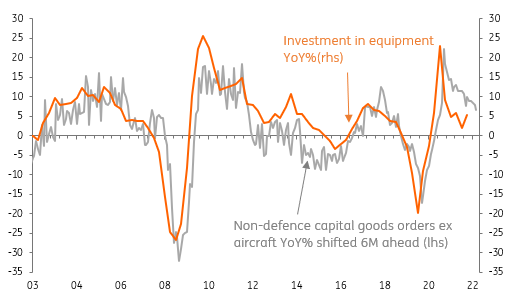
ING sees resilience in nominal capex orders:

The good news is that the durable goods report is solid and points to business capex holding up well in the fourth quarter. We always ignore the headline number, which rose 1% month-on-month versus the 0.4% consensus expectation as it gets buffeted around by Boeing aircraft orders, which were decent at 122 planes versus 96 in September.

The Fed tends to look more at the non-defense capital goods orders ex aircraft as a cleaner measure of what is happening in the corporate sector. It rose 0.7% MoM versus expectations of 0.0%. Admittedly the September number was revised a little lower to -0.8% from -0.4% and, as the chart below shows, it is trending towards slower growth, but it is not suggesting companies are looking to retrench imminently.

US core durable goods orders and business investmentSource: Macrobond, ING

The problem with ING’s chart is that it compares a series in constant dollars (GDP- equipment investment, orange) with one in nominal dollars (capex). When deflating capex with the implied deflator in the GDP-equipment investment series (red), we see that real capex growth was about flat in Q2 and likely turned negative in September and October.

fredgraph - 2022-11-23T142902.102

Add November’s flash PMI findings of

  • “increasingly steep downturns in demand”
  • “the decrease in total new sales was the sharpest since 2009”
  • “new export orders contracted at a sharper pace”

and the resiliency looks much more fragile, particularly when reading about only “marginal increases” in both manufacturing and service employment.

Speaking of employment, ING continued:

The not-so-good story was the rise in initial jobless claims to 240k from 223k (consensus 225k) while continuing claims rose from 1503k to 1551k, suggesting that there is evidence of a cooling in the US labour market. (…) The consensus for next Friday’s payrolls number is for a 200k jobs gain and we doubt expectations will shift much for that, but the rising lay-off story is something we will be closely following and could hint of early signs that the jobs numbers in early 2023 being softer.

This chart shows unemployment claims with the scale set to reflect levels between 2014 and 2019. The horizontal line is the average for that period. The low in claims was in March. Based on continuing claims, 245k workers having lost their job in May have yet to find another one.

fredgraph - 2022-11-23T145734.353

This “data-dependent” Fed next meets December 13-14. They will get a new CPI report on December 13. Will they then have enough data to conclude that demand is waning rapidly, that employment seems to be slowing fast and that inflation looks set to pause for a while?

The WSJ Nick Timiraos sums it up well (my emphasis):

Fed Minutes Show Most Officials Favored Slowing Rate Rises Soon Policy makers have signaled plans to dial back the pace of interest-rate increases, while warning rates could rise to somewhat higher-than-anticipated levels next year

Their discussion at the meeting, described in minutes of the gathering released Wednesday, suggests they could downshift to a rate rise of 0.5 percentage point, or 50 basis points, at their meeting next month.

“A substantial majority of participants judged that a slowing in the pace of increase would soon be appropriate,” the minutes said.

(…) the discussion revealed some were more anxious about the possibility of overdoing the increases, while others worried they might not be making enough progress to warrant a downshift.

Some from the first camp said the risks were rising that the Fed’s rate increases might ultimately “exceed what was required to bring inflation back” to their 2% goal. A few also warned that continuing to raise rates in 0.75-point increments “increased the risk of instability or dislocations in the financial system,” the minutes said.

A small minority believed it might be better to wait to slow increases until rates were “more clearly in restrictive territory and there were more concrete signs that inflation pressures were receding significantly,” the minutes said. (…)

The minutes said that officials thought that high inflation and the strong labor market would call for raising the benchmark federal-funds rate next year to a level “somewhat higher than they had previously expected.” (…)

The central bank’s staff saw a U.S. recession next year “as almost as likely” as their baseline projection of weak growth, the minutes showed. That represented a downgrade of the economic outlook due to the tightening of financial conditions that had occurred this fall. (…)

This summer and fall, several Fed officials suggested they would want to see evidence that inflation is declining toward their 2% goal before slowing or stopping rate increases. But at a press conference on Nov. 2, Mr. Powell suggested a sequence of slower inflation readings had never been “the appropriate test” for slowing or halting rate rises. (…)

Recall that at his last FOMC presser, Mr. Powell sounded more hawkish than the official communique, even saying that “I control the messaging, that’s my job”. I have not seen any commentator pick up on this rather bizarre statement.

From the minutes:

In discussing potential policy actions at upcoming meetings, participants reaffirmed their strong commitment to returning inflation to the Committee’s 2 percent objective, and they continued to anticipate that ongoing increases in the target range for the federal funds rate would be appropriate in order to attain a sufficiently restrictive stance of policy to bring inflation down over time.

Many participants commented that there was significant uncertainty about the ultimate level of the federal funds rate needed to achieve the Committee’s goals and that their assessment of that level would depend, in part, on incoming data.

Even so, various participants noted that, with inflation showing little sign thus far of abating, and with supply and demand imbalances in the economy persisting, their assessment of the ultimate level of the federal funds rate that would be necessary to achieve the Committee’s goals was somewhat higher than they had previously expected.

(…) A number of participants observed that, as monetary policy approached a stance that was sufficiently restrictive to achieve the Committee’s goals, it would become appropriate to slow the pace of increase in the target range for the federal funds rate. In addition, a substantial majority of participants judged that a slowing in the pace of increase would likely soon be appropriate. A slower pace in these circumstances would better allow the Committee to assess progress toward its goals of maximum employment and price stability. The uncertain lags and magnitudes associated with the effects of monetary policy actions on economic activity and inflation were among the reasons cited regarding why such an assessment was important.

A few participants commented that slowing the pace of increase could reduce the risk of instability in the financial system. A few other participants noted that, before slowing the pace of policy rate increases, it could be advantageous to wait until the stance of policy was more clearly in restrictive territory and there were more concrete signs that inflation pressures were receding significantly.

It seems safe to conclude that:

  • A pause is not contemplated just yet.
  • Mr. Powell’s insistence in his presser that rates would rise more than previously expected did not reflect the view of a majority of participants. “Various participants” (rarely used in minutes) see the need for terminal rates “somewhat higher than they had previously expected”.
  • Mr. Powell is clearly among these “various participants”. He made it clear in the presser that the policy needed to get clearly in restrictive territory, a view shared only by “a few participants”.
  • This FOMC is divided and Powell is the boss controlling the message.

This will likely get worse in December.

For their part, equity investors need to decide if a Fed pivot (slowing, not yet pausing) is more significant than potentially declining profits.

Personally, the odds currently favor the fixed income side.

Retailers’ Holiday Discounts Are Steeper This Year, CFOs Say Markdowns help clear excess stock and attract Black Friday shoppers, but they crimp profit margins

(…) Among retailers in the S&P 500 that reported financial results through Nov. 22, the average margin on earnings before interest and taxes declined to 10.7% in the third quarter from 13.2% in the year-earlier period, according to S&P Global Market Intelligence. (…)

U.S. Poised to Grant Chevron License to Pump Oil in Venezuela The move would come just as Western sanctions on Russia threaten to tighten global supplies.
China’s Record Covid Surge Hits Recovery Hopes The prospect that Beijing’s zero-tolerance approach to Covid-19 persists well into next year means the world can’t rely on China to be a locomotive of growth as the U.S. and European economies slow.

High five Wait, wait! Here’s the FT: Chinese lenders to pump $162bn of credit into property developers