Producer Price Gains Slowed in April but Remain Elevated Key reading of producer-level inflation showed 11% annual rate, the fifth straight month of double-digit increases
(…) On a one-month basis, producer prices rose a seasonally adjusted 0.5% in April from the prior month. That marks a deceleration from the upwardly revised 1.6% gain in March. April’s rate of increase was the lowest since September 2021, but was higher than the average monthly gain of 0.2% in the two years before the pandemic.
The so-called core price index—which excludes the often-volatile categories of food, energy and supplier margins—slipped slightly, climbing 0.6% in April from a month earlier, after jumping 0.9% in March. (…)
The index also measures margins for retailers and wholesalers, which fell 0.5% in April from March, but still up 15.4% from a year earlier. Declines were broad-based across industries, spanning machinery, apparel, food and alcohol, flooring, portfolio management and bookselling. (…)
Producer prices for goods, excluding food and energy, rose 10% in April from a year earlier—reaching the highest pace in records to 2010. Services producer prices decelerated to 8.1% last month, from 9.2% the prior month.
There are a few more important stats from the PPI release:
- PPI core goods is up 1.0% after 1.1% in March and 0.8% in each of January and February. Last 4 months: +3.7% = +11.5% annualized. Previous 4 months: +7.7% a.r.. No let down in the pipeline.
- PPI services are unchanged but mainly because merchants’ margins declined. PPI services had jumped at a 10.8% rate in Q1.
- PPI foods rose another 1.5% in April . Last 4 months: +24.9% a.r. following +4.1% in Q4’21.
Goldman Sachs notes that “most of the medical care PPI categories relevant for the PCE report decreased”, so, “based on details in the PPI and CPI reports, we estimate that the core PCE price index rose 0.20% in April, corresponding to a year-over-year rate of +4.74%. Additionally, we expect that the headline PCE price index increased 0.13% in April, or increased 6.12% from a year earlier.”
Such numbers would be welcomed by everybody. Core PCE inflation was +0.29% in each of February and March. Core CPI was +0.57 in April and averaged +0.41% in February/March.
- Powell Reiterates Half-Point Hikes Are Likely in June and July
- Jay Powell warns that taming US inflation will cause ‘some pain’
Samsung in Talks to Hike Chipmaking Prices by Up to 20%
Samsung Electronics Co. is talking with foundry clients about charging as much as 20% more for making semiconductors this year, joining an industry-wide push to hike prices to cover rising costs of materials and logistics.
Contract-based chip prices are likely to rise around 15% to 20%, depending upon the level of sophistication, according to people familiar with the matter, who asked not to be identified due to the sensitivity of the issue. Chips produced on legacy nodes would face bigger price hikes, they said. New pricing would be applied from the second half of this year, and Samsung has finished negotiating with some clients, while it is still in discussions with others, the people said.
Samsung’s decision is a shift from its relatively stable pricing policy last year, when the industry rushed to raise prices in the wake of a global chip shortage. (…)
Samsung and Taiwan Semiconductor Manufacturing Co. account for more than two-thirds of global capacity for outsourced chips.
Manufacturing costs for chipmakers are now rising at about 20 to 30% on average on all fronts, from chemicals, gas and wafers to equipment and construction materials. (…)
U.S. Housing Affordability Plunges in March
Affordable homes are in short supply. The National Association of Realtors’ Fixed Rate Mortgage Housing Affordability Index fell 7.9% in March and has fallen by roughly one-third since its recent peak in January 2021. The Housing Affordability Index equals 100 when median family income equals the amount required for an 80% mortgage on a median-priced existing single-family home.
In March, a 4.4% rise (15.2% y/y) in the median sales price of a home to $382,000 was accompanied by a rise in mortgage rates to 4.2%, up from 3.1% twelve months earlier. As a result, the monthly mortgage payment rose 9.7% m/m to a record $1,502 (32.0% y/y).
Median family income in March rose 1.1% (-6.6% y/y) to $89,381. Consequently, the standard mortgage payment as a percent of income rose to 20.2%, the highest level since August 2008. These figures are up from a recent low of 13.6% in January of 2021.


Chinese developers’ debt woes worsen as sales, yuan weaken
(…) An over 6% drop in the yuan has made offshore debt maturities worth around $20 billion for rest of the year more expensive for developers, some of whom have already defaulted on their repayment obligations this year. (…)
“The situation is definitely more severe this time,” said Zhongliang Chief Financial Officer Albert Yau, comparing current conditions to the yuan’s last major decline in 2018.
Unlike the 2018 tumble, developers are now unable to refinance offshore after a series of defaults by other issuers in the troubled sector made new debt raising impossible. That means repayments would need to be transferred from onshore yuan accounts. (…)
Nordea:
During the last three weeks the daily fixing of USD/CNY set by the People’s Bank of China has been moved higher almost every day. The daily fixing has only been lowered on two different trading days during this period. So, no serious attempt from the PBoC to stem the tide – quite the opposite.
The sharp weakening of the CNY can only be seen as a deliberate action by the PBoC. From the middle of 2020 and until the beginning of this year, the Chinese currency basket – the RMB index – increased by 17%. An appreciation that would have killed off exports in most countries. No wonder the PBoC wants a weaker currency when the growth outlook has deteriorated significantly due to the lockdowns in China and bleaker demand for Chinese goods from Europe and North America.
Will weak data out of China force the PBoC to move the daily fixing even higher in the weeks to come? The next test will be the Chinese data out next week. Retail sales and industrial production data are on the agenda.
PBoC allows sharp depreciation of CNY against USD
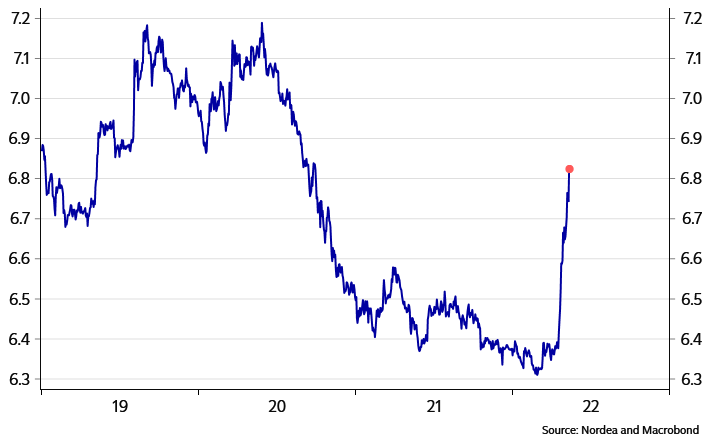
(…) The total devaluation so far is about 7%, which is roughly half of the 2015/16 and 2018-20 devaluations. So, there is probably more to go, especially given the relatively wide spread between the onshore (CNY) and offshore (CNH) Yuan. When this spread increases, it is historically indicative of money trying to leave the country.
The devaluations usually have a quick downward impact on prices. For instance, if we look at import prices from China, they track changes in the CNY closely. This suggests that import prices from China have peaked, providing a tailwind for the inflation “peaking” story. (…)

China’s top chipmaker SMIC says smartphone, PC demand has ‘dropped like a rock’
China’s top chipmaker Semiconductor Manufacturing International Corp (0981.HK) said on Friday it anticipates smartphone sales from its clients this year to fall by at least 200 million units due to the Russia-Ukraine war and China’s COVID lockdowns.
While SMIC previously had issues fulfilling orders due to high demand amid a global chip shortage, customers from the smartphone, personal computer and household appliance sectors were now cancelling orders due to these two events, CEO Zhao Haijun told analysts after the company’s quarterly results. (…)
This meant that the proportion of SMIC’s manufacturing capacity dedicated to smartphones and such products had fallen to 29%, he said, from around 50% previously. (…)
 Is U.S. manufacturing also falling like a rock? From Nordea:
The development adds to a large pile of evidence pointing to a contraction in the manufacturing industry, which is weighed down by poor consumer sentiment and shortages of input materials and labour. Recently, growth has deteriorated materially, impacted by financial conditions and renewed supply-chain disruptions as China struggles with its zero-covid strategy, which all add to a worrying outlook.
Philly Fed points to severe ISM contraction
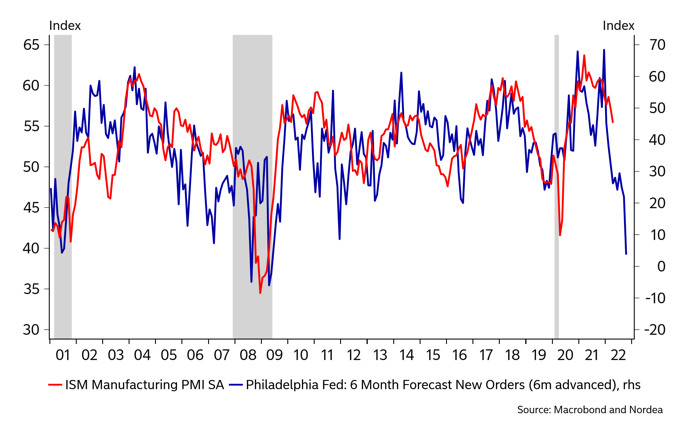
Recall that the latest S&P Global U.S. Manufacturing survey was nothing but upbeat:
New orders increased at a marked pace at the start of the second quarter, and at a rate broadly in line with that seen in March. Companies reported stronger demand conditions, with some noting that new sales expanded despite substantial rises in prices.
Meanwhile, new export orders grew at the fastest rate for almost a year. The expansion in new sales from abroad was attributed to greater demand in key export markets and the acquisition of new customers.
S&P Global’s survey is broader and cover more small and mid-size firms than the ISM. A sudden severe decline in manufacturing activity would be a big surprise and raise the probabilities of stagflation/recession. There have been several comments recently about buyers balking at rising prices.
Coincidently, this BofA indicator suggests demand has suddenly weakened.

Is it just a coincidence that prices of copper, lead, tin and zinc have suddenly turned down in the last 10 days? China + E.U. + USA!!!
BofA Strategists Say Investor Exodus Signals ‘True Capitulation’
Money is leaving every asset class and the exodus is deepening as investors rush out of names like Apple Inc., according to Bank of America Corp. strategists.
Equities, bonds, cash and gold all saw outflows in the week ended May 11, strategists led by Michael Hartnett wrote in a note, citing EPFR Global data. At $1.1 billion, technology stocks suffered their biggest withdrawals so far this year, second only to financials, which lost $2.6 billion.
“The definition of true capitulation is investors selling what they love,” Hartnett said, citing Apple, big tech, the dollar and private equity. The meltdown in cryptocurrencies and speculative tech now rivals the internet bubble crash and the global financial crisis, he said. (…)
“Fear and loathing suggest stocks are prone to an imminent bear market rally, but we do not think ultimate lows have been reached,” Hartnett wrote. (…)
John Authers on Bloomberg on that:
(…) Much time has been devoted to the notions of “catharsis” and “capitulation” — the notion that markets have to go through one final wave of selling to expunge any last appetite for speculation before a bottom is in. The expert treatise on this is “Anatomy of the Bear” by Russell Napier, which examined conditions at four points in the 20th century that turned out to be great buying opportunities, when bear markets had reached their trough. His book casts some doubt on the notion of catharsis; crashes tend only to happen when the market has been falling for a while, and bottoms tend only to be set after that, when people have stopped even asking if this could be the bottom.
Rather than waiting for peak fear or peak panic, the key is to look out for the death of hope. (…)
It’s very hard to see anything cathartic in markets at present. For a start, the U.S. indexes are still above their levels from immediately before the pandemic. The rest of developed markets, and emerging markets, are below their February 2020 levels, but they didn’t enjoy a big boom in the first place. Looking at action since the pandemic started, at a time when it seemed reasonable to expect that it would take several years for markets to make up the lost ground, nothing very cathartic has happened.
If we look at the most speculative parts of the market, however, we can see marked similarities with the most extreme overblown markets of the recent past. The following chart compares the crashes of Shanghai A shares in 2007, the Japanese Nikkei 225 in 1990, and the Nasdaq Composite from 2000 with the peak-to-present performance for the Nasdaq, FANGs and the Solactive Meme index.
The memes are crashing faster than any of those famous burst bubbles. As for the FANGs, even though the stocks in the index are unquestionably dominant and highly profitable companies, their fall so far is outpacing the Nasdaq in 2000 and the Nikkei in 1990. So this does look very much like a replay of one of the historic crashes. In all of them, there was further to fall:
(…) Valuation hasn’t ceased to matter, at least for any long-term investor. But for the near term, it’s only investor psychology that counts.

(…) With U.S. stocks in the midst of a 16-per-cent-plus correction, it would be prudent to look back in history to see how far the ERP would need to widen before investors can begin to feel confident that a bottom is nearing. Unfortunately for the bulls, there is considerable room to go still on this front, with the risk premium actually compressing, despite the sell-off.
The equity risk premium is currently just 300 basis points. Prior recessionary bear markets did not end until levels widened, on average, to 425 basis points.
Interestingly enough, after initially expanding following the market peak back on Jan. 3, the risk premium actually began to contract significantly as the surge in bond yields dwarfed the improvement in the S&P 500 earnings yield. (Note that our definition of the ERP is calculated by subtracting the 10-year Treasury yield from the S&P 500′s forward earnings yield, also known as the Fed Model.)
While this narrowing process has reversed somewhat in recent days, thanks to 10-year yields appearing to stabilize, all that has been achieved is bringing the ERP back to the level it was at the S&P 500 peak at the beginning of the year.
What is clear is not only how unusual this sell-off period has been, historically, but also how much work needs to be done for the ERP to get caught up.
No bear market has bottomed based on an ERP that did not widen at all, or as was the case a few days ago, still contracting.
Ultimately, it is evident that this corrective phase has followed a different pattern than similar periods in the past – no thanks to the current inflationary pressures and the upward influence on bond yields. (…)
Either bond yields significantly fall, thanks to aggressive central bankers getting the recession needed to reset supply/demand conditions (thus weighing on profits and flowing through to stock prices), or equity valuations will have to fall significantly faster than they have currently to outpace the rise in yield. (…)
In case you missed yesterday’s Daily Edge (Not A Good Day (Year)!):
First and foremost, this is a valuation correction, the pricking of the broad valuation bubble. Profits are still rising and apart from a few doomsayers, recessions calls are still not significant (though rising). Fed tightening has just begun. Since 1962, there have been 9 tightening episodes, 7 ending in recessions, starting on average 27 months after the first hike (range 12-41 months).
Since 1961, there have been 7 valuation correction episodes, when the Rule of 20 P/E exceeded 23 and subsequently declined to its median “fair value” of 20. Only 3 were followed by recessions (1968, 1971, 2000).
The valuations corrections lasted between 3 months (1987) and 28 months (2000-03) with an average of 13 months (median 9 months) and brought the S&P 500 index down 17.5% on average before the index reached “fair value”. (In 1992, valuations corrected but equities nonetheless rose 12.5% as profits exploded 40% during the period.) Excluding this episode, valuations corrections brought the S&P 500 down 18.3% on average and lasted 11 months on average.
During the current episode, the S&P 500 has declined 18% so far over 4.5 months but the Rule of 20 P/E, at 24.5, remains 18% above its 20 fair value.
There are 2 ways to reduce the R20 P/E: rising earnings and/or declining inflation. If the current consensus is right, trailing EPS will near $221 after the Q2 earnings season in early August. To get a R20 P/E of 20, we would thus need inflation at 2.4% at the current 3900 level.
Assuming inflation of 4%, an index level of 3550 would be fair value. Understand that undershooting is the norm.
Because after the valuations correction might come the recession correction which would take earnings down.

Warnings From the Crypto Crash As the Federal Reserve withdraws liquidity to fight inflation, stablecoins won’t be the last casualties.
From the WSJ Editorial Board:
Well, the party was fun while it lasted. But now the liquidity tidal wave is crashing as it always does when credit conditions tighten. This week’s crypto-currency crash is the first body exposed on the beach, and let’s hope the damage doesn’t spread too far into the financial system and broader economy.
Some $200 billion in crypto assets have blown up in 24 hours, led by the collapse of the so-called stablecoin TerraUSD. The crypto universe used to be small and dominated by Bitcoin enthusiasts, but it has swelled as investors sought higher returns amid negative real interest rates. (…)
One risk is that Terra’s rout causes investors to lose faith in other virtual currencies and creates a market contagion. Crypto currencies are often used as collateral for trading, and other popular tokens are getting pummeled this week. The stablecoin Tether, which is backed by opaque hard currency reserves, wavered from its dollar peg on Wednesday.
Shares of Coinbase, the crypto exchange that benefited from enormous market liquidity and lack of investor discipline, have also tumbled. Coinbase assures customers it is at “no risk of bankruptcy.” But on Tuesday it also disclosed that its customers would be unsecured creditors in the event of a bankruptcy, meaning their $256 billion in crypto and fiat currencies could be wiped out. Nice of Coinbase to tell us now.
Another danger is that the crypto turmoil bleeds into the banking system. Crypto enthusiasts claim that virtual currencies “disintermediate” financial institutions since you don’t need a bank or broker to make transactions. That’s true up to a point. But credit to buy crypto has to come from somewhere. Who’s standing behind it? Nobody knows.
The crypto market ballooned to $2.9 trillion last November from some $500 billion in November 2020. This runup wasn’t only driven by millennials gambling with stimulus checks. Central banks had made credit essentially free, which encouraged speculation.
The point is that there are always unexpected casualties when risk aversion returns with a vengeance. This is why junk bond prices are falling as concerns mount that some companies may struggle to roll over their debt, especially if the Federal Reserve’s tightening tips the country into a recession.
The European Central Bank recently warned banks to hold extra capital against leveraged loans, which are sensitive to interest rates, to cover potential losses. As rates rise, some could default. About $800 billion in leveraged loans in the U.S. were issued last year, 60% more than in 2019. Regulators won’t know who’s overextended until markets shake out.
Debt covenants and market discipline were already deteriorating before the pandemic. When the economy shut down, the Fed was right to backstop financial markets. But it continued to provide support long after it was needed. As inflation heated up, the oracles of the Eccles building assured investors it was only “transitory” and monetary policy would remain supportive. (…)
Crypto currencies have passionate supporters, and the best may find a permanent place in the financial marketplace. But more than a few will wash out in this liquidity purge. As we learned in 2008, problems on Wall Street can quickly spread to Main Street. The challenge for regulators is to protect the financial system from damage that won’t end with crypto. They’d better be preparing for the next casualties.
- Coinbase Customers Sue Over Stablecoin That Was ‘Anything But’
- Terraform Again Halts Blockchain Behind UST Stablecoin, Luna
The blockchain behind the collapsed TerraUSD stablecoin and the affiliated Luna token stopped processing new transactions for the second time in less than a day.
Terraform Labs said in a tweet from its verified Twitter account that validators, the entities responsible for verifying transactions on the blockchain, had taken the step to “come up with a plan to reconstitute” the Terra network.
TerraUSD was one of the largest and most closely-watched algorithmic stablecoins before its intended 1-1 peg to the dollar disintegrated this week. The unraveling sent shock waves through crypto, triggering deep losses before sentiment stabilized. (…)
“A quorum among validators is attempting to halt the network in order to avoid a DECIMAL crisis due to exponential depreciation of LUNA,” read one post on the Terra Validators Discord server, seen by Bloomberg prior to the transaction shutdown.
The total amount of Luna tokens in circulation is up from 1.46 billion yesterday to more than 6.5 trillion on Friday morning, according to data from CoinMarketCap. (…)
- Crypto Is the New Dot-Com Bust. Could It Also Be the New Crisis? Whatever the outcome of this meltdown, the need for adult supervision is clear.
(…) So after years of being told to “LOL, have fun staying poor,” it’s also natural to LOL now at headlines like the Onion’s “Man Who Lost Everything In Crypto Just Wishes Several Thousand More People Had Warned Him,” even when this describes untold numbers of real, suffering human beings. (…)
Sweden Edges Closer to NATO After Key Parliamentary Report
 Southwest “megadrought” is a scary omen
It’s only May, and the worsening, long-term drought in the Southwest is taxing water managers, firefighters and even homicide detectives in new ways, Andrew Freedman writes in Axios Generate.
California just recorded its driest first four months of the year, encompassing a crucial period during the state’s wet season.
The state’s largest reservoir, Lake Shasta, stands at just 40% of its average for this time of year, and the snow cover in the Sierra Nevada Mountains is anemic.
Data: NOAA; Chart: Erin Davis/Axios Visuals


 FYI: Are NFTs really art? Collectible and cartoonish, these digital multiples, traded in cryptocurrency, confer membership of an exclusive club – sometimes literally. But do they have any aesthetic value? A critic weighs in. (