The enemy of knowledge is not ignorance, it’s the illusion of knowledge (Stephen Hawking)

It ain’t what you don’t know that gets you into trouble. It’s what you know for sure that just ain’t so (Mark Twain)

Invest with smart knowledge and objective odds

THE DAILY EDGE: 9 MARCH 2022: Inflation Week

February CPI:

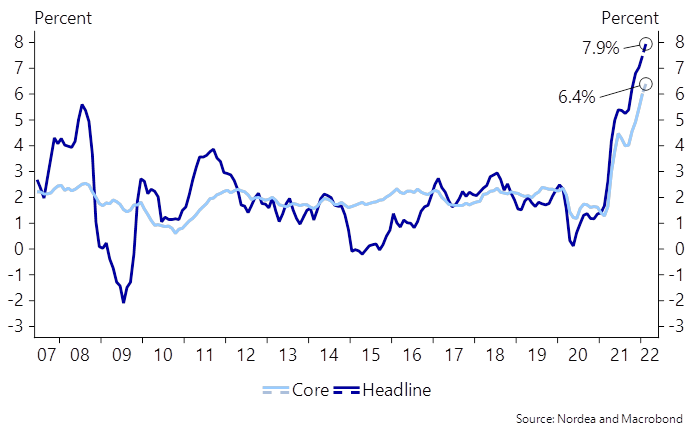
Our models suggest that inflation climbed further in February. Once again supply-chain disruptions from last year show in prices on used cars and trucks, likely adding about 1.14% to the all items y/y growth. The lagging contribution from increased shelter costs throughout last year put pressure on over-all living costs, hence OER contributed by 1% to headline inflation. We estimate that headline inflation will print above consensus at 7.9% with risk to the upside. We have estimated core inflation to print at 6.4%, in line with other forecasters.

The majority of pressure on oil and gas prices will first show in the March release. WTI crude oil has risen by 63% year-to-date and for March alone oil is up 28%. (Nordea)

Higher core and headline inflation in Februaryx

  • Ukraine bans wheat exports. (AP)

  • Dr. Pippa Malmgren:

Every core element of the food supply chain is affected by the war in Ukraine: Putin has dropped a bomb on the European agricultural sector. Russians have suspended fertilizer exports and Belarus declared a Force Majeure and cannot export their potash. Russia won’t allow it to be exported now either. Nor will the world buy anything from them as long as they are Russia’s lackeys.

To remove that much fertilizer from the world economy (Belarus provides 40% of the global supply of potash and Russia supplies 66% of ammonium nitrate), is to set the stage for massively reduced yields and possibly famine. On top of this, we now see the oil price up at $125 and heading a lot higher. This too will remove fertilizer from the reach of the common farmer.

In addition, Russia won’t sell their wheat and the world won’t buy it (or anything else due to sanctions). The good news is that alternative suppliers are coming online like, of all places, Michigan and Morroco They need to move much faster though.

Switzerland-based Kuehne + Nagel International AG and Germany’s DB Schenker both said in customer advisories they are halting deliveries to and from Russia by air, land and sea. Denmark-based DSV A/S and France’s Geodis said they were also suspending deliveries to Moscow ally Belarus. (…)

Digital cargo marketplace Freightos said the disruptions in services and in transportation connections to Russia, along with rising oil prices, threaten to further drive up shipping costs for companies world-wide.

Some airfreight carriers are already introducing war-risk surcharges to cover rising operating costs, Freightos said in a report Thursday. The diversion of ocean freight shipments to other ports “is already resulting in pileups at origin ports in Europe and elsewhere, possibly causing congestion and increasing rates on these lanes,” the company said.

DHL, a unit of Deutsche Post AG , had earlier halted handling of inbound shipments for Russia.

DHL, Kuehne + Nagel, DB Schenker and DSV are the world’s four largest freight forwarders by revenue, according to research group Armstrong & Associates, and Geodis is the No. 9 logistics provider.

Container shipping lines A.P. Moller-Maersk A/S, Mediterranean Shipping Co. and CMA CGM SA had earlier this week suspended their freight services to and from Russia, with exceptions for foodstuffs, medical shipments and humanitarian aid. (…)

  • Unfortunately, the rising price for essentials, like food and energy, combined with the decelerating growth in the money supply, presents world-wide recession risk. Energy bills jumped to 12.4% of global GDP this week, the highest on record, other than May through July 2008. Meanwhile, agricultural commodity prices are heading to record levels. These are growing risks. The changing terms of trade resulting from higher food and energy prices are absorbing a big piece of monetary growth, and may eventually force consumers to use their extra savings accumulated during the pandemic to make ends meet. We had oil spikes before, albeit larger than the current one, and all were followed by serious slowdowns in real economic activity. (Palos Management’s Hubert Marleau)
  • Chinese Nickel Giant Tsingshan Faces $8 Billion Trading Loss as Ukraine War Upends Market Nickel prices soared, part of a self-reinforcing dynamic known as a short squeeze, prompting the London Metal Exchange to suspend trading in the metal.

Tools Of Financial Destruction

From Gavekal’s Charles Gave (via John Mauldin)

Russia is one of the world’s biggest producers of oil, gas, industrial metals, wheat and other commodities. And inevitably, there are large volumes of derivative contracts outstanding against Russian commodities, bought and sold by consumers and producers looking to hedge the risk of price changes in the underlying raw materials.

Despite efforts since 2008 to contain systemic risk, it is likely that exposure to derivatives on Russian commodities creates interlinked chains of risk that stretch throughout the system.

(…) [it is probable that] the lion’s share of the problems caused by the inability of Russian institutions to fulfill their commodity derivatives contracts will rebound on banks in the eurozone. The impact will be all the more severe given the losses likely to be sustained in financing the trade in physical commodities—a business in which French banks are very much to the fore. The probable result will be a whole new collapse in the eurozone bank index. (…)

The 2008 financial crisis took place because of the discontinuity that hit the US financial system when the Treasury refused to guarantee bonds issued by Fanny Mae. Today, the world may be facing another financial crisis because of the discontinuity that has hit the commodity derivatives markets because of the West’s imposition of financial
sanctions on Russia.

Zoltan Pozsar, Credit Suisse AG’s head of short-term interest rates, is back to explain. As he puts it in a note published late on Monday, the problem is that — much like triple A-rated mortgage bonds were used as collateral to secure short-term funding before the Great Financial Crisis of 2008 — commodities have been used to secure financing that could now be stressed as Russia’s invasion of Ukraine sparks major price moves.

The issue isn’t necessarily commodities being suddenly valued at zero. (Although Urals crude and other Russian assets certainly could be.) But overall funding is being constrained as massive amounts of volatility cause market players to derisk.

“Crises happen either because collateral goes bad or funding is pulled away – that’s been the central lesson in every crisis since 1998. Now on to today… (…)

“Russia and Ukraine are the single -largest commodity exporters in the world. Russia, while only 5% of the world’s GDP, is financially deeply interlinked – it used to have $500 billion of FX reserves, and owes about as much in debt to the rest of the world, not to mention ‘off balance sheet’ debt that it owes to the world through derivatives when spot commodity prices rally, like they do now. It’s a bit more complex to de -SWIFT Russia than it was to de -SWIFT Iran… (…)

The books about 1997, 1998, and 2008 have FX pegs, default and leverage, and collateral and leverage as their central themes, respectively. The books about today’s market events will have commodities as collateral as the central theme. That’s where we need to dig…”

Mohamed A. El-Erian:

(…) Without an orderly end to the war, the disruptions to commodity markets and supply chains will intensify, as will “self-sanctioning” by the corporate world; Europe will be pushed into an inflationary recession; China and the U.S. economies will slow notably; some commodity-importing developing countries will risk foreign-exchange and debt crises; and the new stagflationary baseline for the global economy as a whole will be associated with a growing risk of an outright global recession.

Neither economic and financial policies nor markets are well positioned to deal with this combination, let alone overcome it.

Traditionally, stagflation has been one of the hardest challenges for policy making. It is compounded because the war in Ukraine came when the Fed had already fallen behind inflation realities and failed to build the much-needed flexibility for its policy responses. (…)

Markets have similarly been caught offsides. And it’s not just positioning. Already, market liquidity has proved patchy at times, including for U.S. Treasuries and, of course, individual stocks and commodities. In what fortunately remains a rarity for now, market malfunction has also reared its ugly head: Witness the London Metal Exchange’s suspension of chaotic nickel trading this week. (…)

New index shows U.S. inflation expectations shifting higher

A new daily index released on Tuesday by the London-based ICE Benchmark Administration (IBA) showed the expected pace of consumer price increases over the next year rising from 3.5% on Feb. 1 to 5.24% as of March 7. The index is based on trading in the roughly $300 billion monthly market for inflation-protected U.S. Treasury securities and in the $100 billion monthly market for inflation swaps contracts.

Inflation anticipated over longer 10- and six-year horizons has also turned abruptly higher since the onset of the Ukraine war, with rates as of Monday around 2.43% and 2.73%, respectively, significantly above the Fed’s 2% annual price increase target, the index shows.

image

Financial markets don’t see longer term inflation as problematic:

fredgraph - 2022-03-09T061010.495

Here’s the spread between the 5Y breakeven and the 5Y-5Y:

fredgraph - 2022-03-09T074112.904

image

China Growth Faces Dual Shocks from Oil Spike and Virus Spread

The economy will grow only 4.5% this year, economists at Goldman Sachs Group Inc. wrote in a note, a full percentage point below the gross domestic product target of about 5.5% set last week. Beijing will need to accelerate policy easing to keep growth from sliding further, they said, estimating the spike in oil prices alone could cut the GDP growth rate by half a percentage point.

The sudden rise in prices for oil, gas and other commodities will push up still-high producer price inflation, putting renewed pressure on manufacturers by squeezing profits and reducing funds for investment. On top of that, coronavirus cases in China — mostly the omicron variant — are climbing to levels unseen since the initial outbreak in Wuhan two years ago, a further threat to consumption.

The producer price index rose 8.8% from a year earlier, official data showed Wednesday, reflecting elevated cost-pressures on factories even before the most recent surge in crude costs was fully factored in. China will be hoping its ability to continue buying Russian energy and low consumer-price growth — which was unchanged at 0.9% — will help insulate its consumers and companies from geopolitical tensions. (…)

Core inflation, which doesn’t include volatile energy and food prices, slowed to 1.1% after remaining unchanged at 1.2% for three straight months. (…)

Some more numbers:

  • February CPI was up 2.0% MoM annualized.
  • Non-food CPI was up 2.5% annualized. It was up 2.1% YoY

Here’s How Surging Oil Prices Shift the Economic Outlook in Asia

Oil’s relentless surge above $125 a barrel threatens to stoke inflation across Asia, forcing central banks to decide whether to respond to higher prices with tighter policy, or hold off amid the blow to economic growth.

As a net importer of energy, Asia is vulnerable to the oil price spike triggered by Russia’s invasion of Ukraine. And with more than 40% of global exports stemming from the region, any sustained price increases will ripple throughout the world. (…)

Another New World!!!

9-11 changed the world. Now Putin, as Hubert Marleau aptly summarizes:

For all the scary unknowns Russia has brought the world, it has strengthened the will of NATO nations to defend itself, unshackling public finance to fund everything from enhanced military capabilities to alternative energy supplies. It will hasten the process of subdividing the global economy into competing blocs. It will harden economic policies toward global rivals. It will force them – especially – America, to introduce industrial policies to protect their edge or leadership in new technologies, including semiconductors, artificial intelligence, electrical vehicles and 5G wireless.

THE DAILY EDGE: 8 MARCH 2022

War Drives Up Inflation at U.S. Farms, Retailers The global supply chain is slow, but the economic fallout from the invasion of Ukraine is swiftly raising prices for producers and consumers world-wide

(…) Grain markets recently hit a 14-year high in anticipation of a diminished harvest in Ukraine, which would raise costs to feed the world’s cattle and poultry.

Aluminum prices rose in anticipation of sanctions on Russia, a major supplier of the metal used in soda cans, aircraft and construction, as well as on fears that Moscow could halt exports.

Crude oil prices rose 25% last week, to more than $118 a barrel, the highest level since 2013. Gas prices have gone up an average of 43.7 cents a gallon in the U.S., according to data from price tracker GasBuddy. On Sunday, the national average was $4.02 a gallon, according to GasBuddy. [$4.17 on Monday]

On Friday, Russia, one of the world’s largest suppliers of fertilizers such as potash and nitrogen, said it could suspend exports. Farmers and consumers will bear the cost of any prolonged shortage.

Ingka Group, which owns and operates furniture giant IKEA’s stores, said Thursday that prices would rise more than expected this year after it warned the war in Ukraine was causing serious supply chain disruptions. IKEA said its global prices would rise about 12%, up from earlier estimates of 9%. (…)

Ukrainian farmers are supposed to plant their spring crops soon. Yet even if the fighting were to stop, they may not have enough fertilizer and pesticides. Agriculture industry executives are warning of smaller yields in Ukraine, which normally has some of the world’s most productive fields. (…) “Yields could drop by 50%.” (…)

“We’ve seen grain come up,” he said. “That’s the number one cost of feeding cattle.” (…)

What would a U.S. ban on Russian oil mean for the world?

JP Morgan predicts oil could hit a record $185 a barrel by the end of 2022 if disruption to Russian exports lasts that long, although along with most analysts polled by Reuters the bank expects a yearly average price below $100. (…)

As a rule of thumb, every 10% rise in the oil price in euro terms increases euro zone inflation by 0.1 to 0.2 percentage point. Since Jan 1, Brent crude is up around 80% in euros. In the U.S., every $10 per barrel rise in oil prices increases inflation by 0.2 percentage point. (…)

Preliminary calculations by the European Central Bank (ECB) suggest that war could cut euro zone growth by 0.3 to 0.4 percentage points this year in a baseline scenario and 1 percentage point in case of a severe shock. (…)

In the U.S., the Fed estimates that every $10 per barrel rise in oil prices cuts growth by 0.1 percentage point, though private forecasters see a more muted impact.

In Russia, the damage is likely to be large and immediate. JPMorgan estimates that its economy will contract by 12.5% from peak to trough. (…)

(…) The White House is sending emergency missions to Saudi Arabia and Venezuela to find extra barrels. The US is pushing for a quick deal with Tehran on nuclear proliferation to bring back Iranian crude. All normal diplomatic reservations are being set aside. (…)

Frans Timmermans, head of the EU’s energy transition, says Europe currently has enough gas to muddle through this spring whatever happens.

We have an odd situation where both sides are threatening to play the energy card, but the threats are not in reality equivalent. A crude blockade will make it impossible for Putin to continue waging serious offensive war in Ukraine beyond a few weeks. Oil and gas make up 40pc of Russia’s state budget. It is what holds the patronage machine together. (…)

Bank of America says the industry’s rule of thumb is that each “unexpected” loss of 1m b/d lifts prices by $20. A total Russian cut-off of 5m b/d would therefore lift prices to around $200. (…)

This implies recession. It would be just as uncomfortable for China, with energy use per unit of GDP almost double that of France and Germany, and 2.5 times higher than the frugal UK. The worse it gets, the greater the strain on the Beijing-Moscow axis. (…)

Citigroup’s energy strategist Ed Morse said the Western Hemisphere could produce an extra 2.5m b/d this year, much of it from US shale, but also from Brazil and Guyana.

The US is sending diplomats to the Gulf to demand extra output from Saudi Arabia and the OPEC petro-states, which are currently withholding supply to force up the price. The charm offensive comes with a warning. These states no longer have the option of playing it both ways: relying on the US security umbrella against Iran while at the same teaming up with Russia in an oil cartel. They must choose.

Helima Croft from RBC Capital Markets said the Gulf states and Iraq have up to 2.5m b/d in spare capacity that could be mobilised within 30-60 days. (…)

All is forgiven in Caracas. The Chavista regime of Nicolas Maduro is back from the cold. Ms Croft said a relaxation of sanctions could unlock 600,000 b/d. That would deliver sulphurous ‘heavy’ oil to balance the mix in US refineries, replacing heavy Urals from Russia.

The Ayatollahs are being cut some slack too. A deal could open the way for the return of 1m b/d of Iranian crude, though it will be a staggered process of over many months. Add in China’s zero-covid strategy, which cuts jet fuel use, and it is possible to see our way through this crisis. The rest will have to come from de facto rationing.

Vladimir Putin cannot easily switch his surplus oil to China. “The infrastructure is in the wrong place: the Transneft oil pipelines go to the Baltic and the Black Sea, and then you have to find somebody willing to pick it up. The Chinese haven’t got the tankers,” said Prof Riley. (…)

Goldman Sachs:

The uncertainty on how this conflict and oil shortages will be resolved is unprecedented. To attempt to provide an estimate of where oil prices are heading, we build three scenarios, ranging from a resumption in exports in the coming months to a sustained two-thirds reduction of Russian seaborne exports. Even assuming SPR and OPEC supply relief, these point to oil prices ranging from $115/bbl to $175/bbl in 2022. Given a still intensifying military conflict, escalating Western sanctions and growing isolation of Russia, our subjective probability weighting of these potential outcomes currently leaves us base-casing a 1.6 mb/d disruption. As a result, we are raising our 2022 Brent spot price forecast to $135/bbl, with our 2023 forecast at $115/bbl, up from $98 and $105/bbl respectively.

Small Business Owners Reporting Inflation as Biggest Problem Reaches Highest Level Since Q3 1981

In February, the NFIB Optimism Index decreased by 1.4 points to 95.7, the second consecutive month below the 48-year average of 98. Twenty-six percent of owners reported that inflation was their single most important problem in operating their business, a four-point increase since December and the highest reading since the third quarter of 1981.

“Inflation continues to be a problem on Main Street, leading more owners to raise selling prices again in February,” said NFIB Chief Economist Bill Dunkelberg. “Supply chain disruptions and labor shortages also remain problems, leading to lower earnings and sales for many.” (…)

image

image

image

image

image

Traders Surrender to Recession Paranoia in Stock Market Rout

(…) Plotting the velocity of equity gauges over their trendlines against the ISM manufacturing report, Chadha found that the S&P 500 is pricing in a plunge in the factory gauge to 48 — below the level consistent with growth. Small-cap stocks reflect deeper troubles. The Russell 2000, which is already in a bear market, appeared to price in a manufacturing reading of 40, a level indicating a “severe recession,” he said. (…)

relates to Traders Surrender to Recession Paranoia in Stock Market RoutMarket veteran Ed Yardeni, citing rising recession risk, slashed his target for the S&P 500 for a second time in as many months. At 4,000, his new projection implies a 17% drop from the index’s peak in January. (…)

A 2014 study by Prakash Loungani of the International Monetary Fund found that not one of 49 recessions suffered around the world in 2009 had been predicted by the consensus of economists a year earlier. Loungani previously reported that only two of the 60 recessions of the 1990s had been anticipated a year in advance. (…)

Among all the 20% drops that have hit American stocks since the Great Depression, all but two preceded or coincided with U.S. recessions, according to data compiled by Bloomberg. (…)

Bear markets in stocks tended to foreshadow recessions

Just when the Fed starts tightening, inflation and financial markets are already pressing on the brakes:

Image

image_7

This Is No Century for Optimists. Can It Change? War in Ukraine and the return of inflation won’t help equity risk premiums rediscover their mojo, which has flattened out in most of the world since the millennium.

John Authers:

One of the greatest investment books ever written, which shows up on the desks and bookshelves of countless successful investors, is Triumph of the Optimists, published two decades ago by Elroy Dimson, Paul Marsh and Mike Staunton, a trio of British academics then working together at London Business School. A massive work of data analysis, it aimed to build a history of stocks, bonds and bills for the whole 20th century, across the globe, to measure the equity risk premium — the average extra annual return compared to bonds or bills that investors gained by taking the risk of buying stocks. (…)

Thankfully, Dimson, Marsh and Staunton annually update the “Triumph of the Optimists” database in the Global Investment Returns Yearbook, which for many years has been sponsored by Credit Suisse AG. (…) Its coverage of the previous 120 years provides some very good ideas on how long-term investors should navigate this terrifying juncture. You can find out much more about it on the Credit Suisse website here. (…)

  • When real yields are low, it’s a bad time to buy stocks

relates to This Is No Century for Optimists. Can It Change?

  • Inflation Is Bad For Your Investments

relates to This Is No Century for Optimists. Can It Change?

This might seem blindingly obvious, but it’s surprising how much sell-side research over the last few months has attempted to deny it. In the short term, equities are not a good inflation hedge. But they do perform better than bonds in all but the most intense periods of deflation, and they generally beat inflation in the long run. You just have to be prepared to hold them until well after inflation has abated. This is mighty relevant at present, as inflation is its highest in four decades across much of the developed world, and the Ukraine-driven surge in commodity prices will likely keep prices rising for a while.

  • Rate-hiking cycles are also really bad times to buy stocks

relates to This Is No Century for Optimists. Can It Change?

(…) So, some conclusions. A sweeping look at history confirms that this looks bad. A period of high inflation and rising rates, starting with negative real yields, is a time when we can expect returns for stocks to be about as bad as they ever are — while bonds should be even worse. Throw in war, and it’s worth avoiding combatant countries, and particularly those that seem likely to lose. Any buying opportunities in Ukrainian and Russian equities are probably yet to come. Diversifying geographically — and at this point that particularly means outside the U.S. — should help, but not as much as we might hope.

However, over the last 120 years, which have seen some moments in history considerably darker than even this one, long-term equity investment has generally paid off. Getting out of the stock market altogether is a bad idea, particularly for those with a long time horizon. As equities and bonds both look challenged, it makes sense to go searching for opportunities in real assets, led by commodities. (…) But unfortunately, there’s no great historical support for the notion of diving into the thick of it now with some big contrarian bets.

Yesterday, Lowry’s Research commented that “Despite very heavy volume, climactic selling was not observed”. So far, de-risking has hit story stocks very hard. Growth stories are always interesting, but profitable growth is what, eventually, matters.

 iwo iwn

arkk

The S&P 500’s 13/34–Week EMA Trend is not appealing, is it?

image
China Warns U.S. Over Forming Pacific NATO, Backing Taiwan

(…) The senior diplomat repeatedly alluded to the U.S. as the source of problems with countries around the globe and issued some of China’s most pointed warnings yet against calls to expand U.S. ties with Taiwan.

“This would not only push Taiwan into a precarious situation, but will also bring unbearable consequences for the U.S. side,” Wang said on the sidelines of the National People’s Congress in Beijing, later adding: “Taiwan will eventually return to the embrace of the motherland.” (…)

“Beijing talks a lot about the importance of upholding international order, stability, respecting sovereignty,” Blinken said. “But from its coercion of Vilnius to its failure thus far to condemn Moscow’s flagrant violation of the sovereignty and territorial integrity of Ukraine, today and in 2014, Beijing’s actions are speaking much louder than its words,” he added, referring to Moscow’s earlier seizure of Crimea. (…)

Wang passed up another opportunity to criticize Russia’s military action or call it an “invasion,” instead saying that ties between the two countries remained “rock solid.” (…)

“No matter how precarious and challenging the international situation may be, China and Russia will maintain a strategic focus and steadily advance our comprehensive strategic partnership and coordination,” he said. (…)

“China is prepared to continue playing a constructive role to facilitate dialogue for peace and work alongside the international community when needed to carry out necessary mediation,” Wang said, stopping short of clarifying whether Beijing would mediate between Kyiv and Moscow. (…)

“China’s relations with the West look set to deteriorate further unless Beijing puts more pressure on Moscow.”