February CPI:
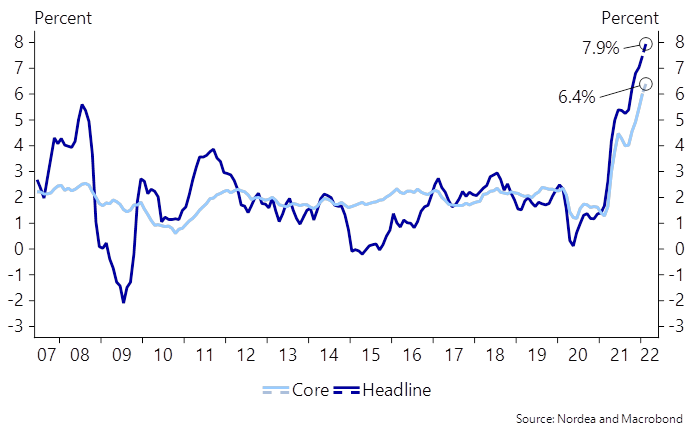
Our models suggest that inflation climbed further in February. Once again supply-chain disruptions from last year show in prices on used cars and trucks, likely adding about 1.14% to the all items y/y growth. The lagging contribution from increased shelter costs throughout last year put pressure on over-all living costs, hence OER contributed by 1% to headline inflation. We estimate that headline inflation will print above consensus at 7.9% with risk to the upside. We have estimated core inflation to print at 6.4%, in line with other forecasters.
The majority of pressure on oil and gas prices will first show in the March release. WTI crude oil has risen by 63% year-to-date and for March alone oil is up 28%. (Nordea)
Higher core and headline inflation in February
-
Ukraine bans wheat exports. (AP)
-
Dr. Pippa Malmgren:
Every core element of the food supply chain is affected by the war in Ukraine: Putin has dropped a bomb on the European agricultural sector. Russians have suspended fertilizer exports and Belarus declared a Force Majeure and cannot export their potash. Russia won’t allow it to be exported now either. Nor will the world buy anything from them as long as they are Russia’s lackeys.
To remove that much fertilizer from the world economy (Belarus provides 40% of the global supply of potash and Russia supplies 66% of ammonium nitrate), is to set the stage for massively reduced yields and possibly famine. On top of this, we now see the oil price up at $125 and heading a lot higher. This too will remove fertilizer from the reach of the common farmer.
In addition, Russia won’t sell their wheat and the world won’t buy it (or anything else due to sanctions). The good news is that alternative suppliers are coming online like, of all places, Michigan and Morroco They need to move much faster though.
-
Major Freight Forwarders Suspend Russia Services DSV and Geodis also halted deliveries to Belarus as disruption from Russia’s invasion of Ukraine spreads in global freight markets
Switzerland-based Kuehne + Nagel International AG and Germany’s DB Schenker both said in customer advisories they are halting deliveries to and from Russia by air, land and sea. Denmark-based DSV A/S and France’s Geodis said they were also suspending deliveries to Moscow ally Belarus. (…)
Digital cargo marketplace Freightos said the disruptions in services and in transportation connections to Russia, along with rising oil prices, threaten to further drive up shipping costs for companies world-wide.
Some airfreight carriers are already introducing war-risk surcharges to cover rising operating costs, Freightos said in a report Thursday. The diversion of ocean freight shipments to other ports “is already resulting in pileups at origin ports in Europe and elsewhere, possibly causing congestion and increasing rates on these lanes,” the company said.
DHL, a unit of Deutsche Post AG , had earlier halted handling of inbound shipments for Russia.
DHL, Kuehne + Nagel, DB Schenker and DSV are the world’s four largest freight forwarders by revenue, according to research group Armstrong & Associates, and Geodis is the No. 9 logistics provider.
Container shipping lines A.P. Moller-Maersk A/S, Mediterranean Shipping Co. and CMA CGM SA had earlier this week suspended their freight services to and from Russia, with exceptions for foodstuffs, medical shipments and humanitarian aid. (…)
- Unfortunately, the rising price for essentials, like food and energy, combined with the decelerating growth in the money supply, presents world-wide recession risk. Energy bills jumped to 12.4% of global GDP this week, the highest on record, other than May through July 2008. Meanwhile, agricultural commodity prices are heading to record levels. These are growing risks. The changing terms of trade resulting from higher food and energy prices are absorbing a big piece of monetary growth, and may eventually force consumers to use their extra savings accumulated during the pandemic to make ends meet. We had oil spikes before, albeit larger than the current one, and all were followed by serious slowdowns in real economic activity. (Palos Management’s Hubert Marleau)
- Chinese Nickel Giant Tsingshan Faces $8 Billion Trading Loss as Ukraine War Upends Market Nickel prices soared, part of a self-reinforcing dynamic known as a short squeeze, prompting the London Metal Exchange to suspend trading in the metal.
Tools Of Financial Destruction
From Gavekal’s Charles Gave (via John Mauldin)
Russia is one of the world’s biggest producers of oil, gas, industrial metals, wheat and other commodities. And inevitably, there are large volumes of derivative contracts outstanding against Russian commodities, bought and sold by consumers and producers looking to hedge the risk of price changes in the underlying raw materials.
Despite efforts since 2008 to contain systemic risk, it is likely that exposure to derivatives on Russian commodities creates interlinked chains of risk that stretch throughout the system.
(…) [it is probable that] the lion’s share of the problems caused by the inability of Russian institutions to fulfill their commodity derivatives contracts will rebound on banks in the eurozone. The impact will be all the more severe given the losses likely to be sustained in financing the trade in physical commodities—a business in which French banks are very much to the fore. The probable result will be a whole new collapse in the eurozone bank index. (…)
The 2008 financial crisis took place because of the discontinuity that hit the US financial system when the Treasury refused to guarantee bonds issued by Fanny Mae. Today, the world may be facing another financial crisis because of the discontinuity that has hit the commodity derivatives markets because of the West’s imposition of financial
sanctions on Russia.
Zoltan Pozsar, Credit Suisse AG’s head of short-term interest rates, is back to explain. As he puts it in a note published late on Monday, the problem is that — much like triple A-rated mortgage bonds were used as collateral to secure short-term funding before the Great Financial Crisis of 2008 — commodities have been used to secure financing that could now be stressed as Russia’s invasion of Ukraine sparks major price moves.
The issue isn’t necessarily commodities being suddenly valued at zero. (Although Urals crude and other Russian assets certainly could be.) But overall funding is being constrained as massive amounts of volatility cause market players to derisk.
“Crises happen either because collateral goes bad or funding is pulled away – that’s been the central lesson in every crisis since 1998. Now on to today… (…)
“Russia and Ukraine are the single -largest commodity exporters in the world. Russia, while only 5% of the world’s GDP, is financially deeply interlinked – it used to have $500 billion of FX reserves, and owes about as much in debt to the rest of the world, not to mention ‘off balance sheet’ debt that it owes to the world through derivatives when spot commodity prices rally, like they do now. It’s a bit more complex to de -SWIFT Russia than it was to de -SWIFT Iran… (…)
The books about 1997, 1998, and 2008 have FX pegs, default and leverage, and collateral and leverage as their central themes, respectively. The books about today’s market events will have commodities as collateral as the central theme. That’s where we need to dig…”
(…) Without an orderly end to the war, the disruptions to commodity markets and supply chains will intensify, as will “self-sanctioning” by the corporate world; Europe will be pushed into an inflationary recession; China and the U.S. economies will slow notably; some commodity-importing developing countries will risk foreign-exchange and debt crises; and the new stagflationary baseline for the global economy as a whole will be associated with a growing risk of an outright global recession.
Neither economic and financial policies nor markets are well positioned to deal with this combination, let alone overcome it.
Traditionally, stagflation has been one of the hardest challenges for policy making. It is compounded because the war in Ukraine came when the Fed had already fallen behind inflation realities and failed to build the much-needed flexibility for its policy responses. (…)
Markets have similarly been caught offsides. And it’s not just positioning. Already, market liquidity has proved patchy at times, including for U.S. Treasuries and, of course, individual stocks and commodities. In what fortunately remains a rarity for now, market malfunction has also reared its ugly head: Witness the London Metal Exchange’s suspension of chaotic nickel trading this week. (…)
New index shows U.S. inflation expectations shifting higher
A new daily index released on Tuesday by the London-based ICE Benchmark Administration (IBA) showed the expected pace of consumer price increases over the next year rising from 3.5% on Feb. 1 to 5.24% as of March 7. The index is based on trading in the roughly $300 billion monthly market for inflation-protected U.S. Treasury securities and in the $100 billion monthly market for inflation swaps contracts.
Inflation anticipated over longer 10- and six-year horizons has also turned abruptly higher since the onset of the Ukraine war, with rates as of Monday around 2.43% and 2.73%, respectively, significantly above the Fed’s 2% annual price increase target, the index shows.

Financial markets don’t see longer term inflation as problematic:

Here’s the spread between the 5Y breakeven and the 5Y-5Y:


China Growth Faces Dual Shocks from Oil Spike and Virus Spread
The economy will grow only 4.5% this year, economists at Goldman Sachs Group Inc. wrote in a note, a full percentage point below the gross domestic product target of about 5.5% set last week. Beijing will need to accelerate policy easing to keep growth from sliding further, they said, estimating the spike in oil prices alone could cut the GDP growth rate by half a percentage point.
The sudden rise in prices for oil, gas and other commodities will push up still-high producer price inflation, putting renewed pressure on manufacturers by squeezing profits and reducing funds for investment. On top of that, coronavirus cases in China — mostly the omicron variant — are climbing to levels unseen since the initial outbreak in Wuhan two years ago, a further threat to consumption.
The producer price index rose 8.8% from a year earlier, official data showed Wednesday, reflecting elevated cost-pressures on factories even before the most recent surge in crude costs was fully factored in. China will be hoping its ability to continue buying Russian energy and low consumer-price growth — which was unchanged at 0.9% — will help insulate its consumers and companies from geopolitical tensions. (…)
Core inflation, which doesn’t include volatile energy and food prices, slowed to 1.1% after remaining unchanged at 1.2% for three straight months. (…)
Some more numbers:
- February CPI was up 2.0% MoM annualized.
- Non-food CPI was up 2.5% annualized. It was up 2.1% YoY
Here’s How Surging Oil Prices Shift the Economic Outlook in Asia
Oil’s relentless surge above $125 a barrel threatens to stoke inflation across Asia, forcing central banks to decide whether to respond to higher prices with tighter policy, or hold off amid the blow to economic growth.
As a net importer of energy, Asia is vulnerable to the oil price spike triggered by Russia’s invasion of Ukraine. And with more than 40% of global exports stemming from the region, any sustained price increases will ripple throughout the world. (…)
Another New World!!!
9-11 changed the world. Now Putin, as Hubert Marleau aptly summarizes:
For all the scary unknowns Russia has brought the world, it has strengthened the will of NATO nations to defend itself, unshackling public finance to fund everything from enhanced military capabilities to alternative energy supplies. It will hasten the process of subdividing the global economy into competing blocs. It will harden economic policies toward global rivals. It will force them – especially – America, to introduce industrial policies to protect their edge or leadership in new technologies, including semiconductors, artificial intelligence, electrical vehicles and 5G wireless.