The enemy of knowledge is not ignorance, it’s the illusion of knowledge (Stephen Hawking)

It ain’t what you don’t know that gets you into trouble. It’s what you know for sure that just ain’t so (Mark Twain)

Invest with smart knowledge and objective odds

THE DAILY EDGE: 23 FEBRUARY 2022: Strongflation

U.S. Flash PMI: US economy rebounds from Omicron wave, but output prices rise at survey record pace

Growth of private sector output in the US gained considerable momentum in February as companies reported a notable recovery in demand from COVID-related disruptions at the start of the year. Services firms led the rise, although manufacturers likewise registered a stronger increase in output, buoyed by a slight easing of supply bottlenecks. However, February also saw a survey record rise in average prices charged for goods and services.

Rising from an 18-month low of 51.1 in January to 56.0 in February, the seasonally adjusted IHS Markit Flash US Composite PMI Output Index indicated a substantial expansion in private sector output that outpaced the long-run series average.

image

Both the manufacturing and service sectors recorded stronger expansions in output, with companies linking growth to substantial gains in new business, employees returning from sick leave, increased travelling and greater availability of raw materials.

February data highlighted a sharp and accelerated increase in new business among private sector companies that was the fastest in seven months. Firms mentioned that sales were boosted by the retreat of the pandemic, improved underlying demand, expanded client bases, aggressive marketing campaigns and new partnerships. Customers reportedly made additional purchases to avoid future price hikes. Quicker increases in sales were evident among both manufacturers and service providers.

Inflationary pressures across the private sector intensified in February, with the rate of input price inflation quickening from January’s ten-month low. Panellists continued to indicate higher raw material, transportation and wage costs. Global shortages of raw materials and lingering supply-chain disruptions were again cited, albeit less so than in prior months.

Prices charged for goods and services in the US rose at a record pace in February as companies continued to share additional cost burdens with their clients. Manufacturers signalled a sharper increase in selling prices than service providers, though the latter reported a record rise.

Private sector employment expanded further in February, taking the current sequence of job creation to 20 months. Moreover, the increase was marked and the strongest since last May. Anecdotal evidence indicated that hiring activity stemmed from sustained gains in new work and an associated rise in output requirements. Goods producers posted a moderate expansion in staff numbers, while jobs growth quickened to a nine-month high among services firms.

At 56.7 in February, up from 51.2 in January, the seasonally adjusted IHS Markit Flash US Services PMI™ Business Activity Index highlighted a substantial and accelerated upturn in output.

Boosting the latest rise in business activity was a quicker increase in new work intakes. Companies noted the strongest expansion in sales since last July. International demand for US services also strengthened in February.

With demand conditions improving, service providers continued to hire extra staff. The increase was marked and the fastest in nine months.

On the price front, there were sharper increases in both input costs and output prices. Notably, the rate of charge inflation hit a series peak.

The IHS Markit Flash US Manufacturing Purchasing Managers’ Index ™ (PMI™) rose from 55.5 in January to 57.5 in February, signalling a stronger improvement in business conditions across the sector. Although the Suppliers’ Delivery Times Index continued to inflate the PMI, the latest reading was also boosted by stronger increases in output and new orders.

Production rose at a quicker rate in February, albeit one that was moderate relative to those registered in 2021. Anecdotal evidence indicated that growth was hampered by raw material scarcity, supply-chain disruptions and labour shortages.

Factory orders increased at a sharp and accelerated pace in February, prompting firms to resume their hiring efforts after a blip in January. Export sales likewise expanded, with growth hitting a five-month high.

In contrast to the trend seen in the service sector, input cost inflation among manufacturers eased to a nine-month low midway through the quarter. That said, the rate of inflation remained elevated and outpaced that seen for services.

Additional cost burdens continued to be transferred to clients, as evidenced by another increase in factory gate charges. The rate of output price inflation was sharp and the fastest in three months.

Finally, manufacturers continued to purchase additional inputs for use in the production process, with the rate of input buying growth improving to a five-month high. Suppliers’ delivery times meanwhile lengthened to the least extent since last May.

unnamed - 2022-02-23T063420.368

unnamed - 2022-02-23T063558.994

To summarize the U.S. flash PMI in preparation for the March 15-16 FOMC:

  • The U.S. economy bounced back strongly in February with strong new orders from “improved underlying demand” and inventory hoarding “to avoid future price hikes” per purchasing managers seemingly not seeing much slowdown in input inflation and focused on protecting margins.
  • The February CPI is unlikely to ease much as “prices charged for goods and services rose at a record pace in February”, unless rising costs are not fully passed on to the end consumer.
  • Private employment was the “strongest since last May”.

Goldman Sachs’ transitory team seems to be wavering:

Two-thirds of the core CPI basket has seen 4% annualized inflation since last July (vs. only 19% of the basket in 2019), and 16% of prices rose at a double-digit pace (vs. 2% in 2019). Regardless of the exact threshold chosen, the breadth of high inflation has returned to levels last seen in the 1980s. And in contrast to other recent episodes of labor market tightness, the peak of the inflation distribution itself is moving higher: prices of the center fifth of the core inflation basket are increasing at a 5-6% annualized pace—compared to a 2.5-3.5% pace in normal or tight labor markets.

Statistically, the high inflation breadth of the last six months argues for continued strength in core inflation this spring. And this estimate does not take into account additional upward pressure from wage-price pass-through or from continued supply chain constraints.

The medium-term implications are less clear-cut. While high and rising inflation breadth in the late 1970s coincided with the de-anchoring of inflation expectations, shorter-lived bouts in 2000 and 2006 did not. While encouraging, we note that the Fed responded to both of those latter episodes by tightening monetary policy.

So, at JPM:

we now look for the Fed to hike 25bp at each of the next nine meetings, with the policy rate approaching a neutral stance by early next year.

Our “This time is different” outlook incorporates an underlying reflationary tilt that keeps inflation elevated even as supply constraints related to the panemic and energy markets fade. We are also being challenged, however, as we do not forecast a broad and early move toward restrictive stances prompted by global inflation remaining well above central bank tolerance zones.

We think the risk that central banks shift and perceive a need to generate slow growth—and the corresponding impact on global financial conditions—is now the most significant threat to an otherwise healthy global backdrop.

9 x 25 = 225

ZeroHedge reminds us that “the Fed has only raised rates with stocks more overvalued just one time: that was in June of 1999. Everyone remembers what happened next…”.

ZH adds that “never before has the curve been this flat before the Fed hiked rates even once!” Which actually verifies:

fredgraph - 2022-02-23T073118.845

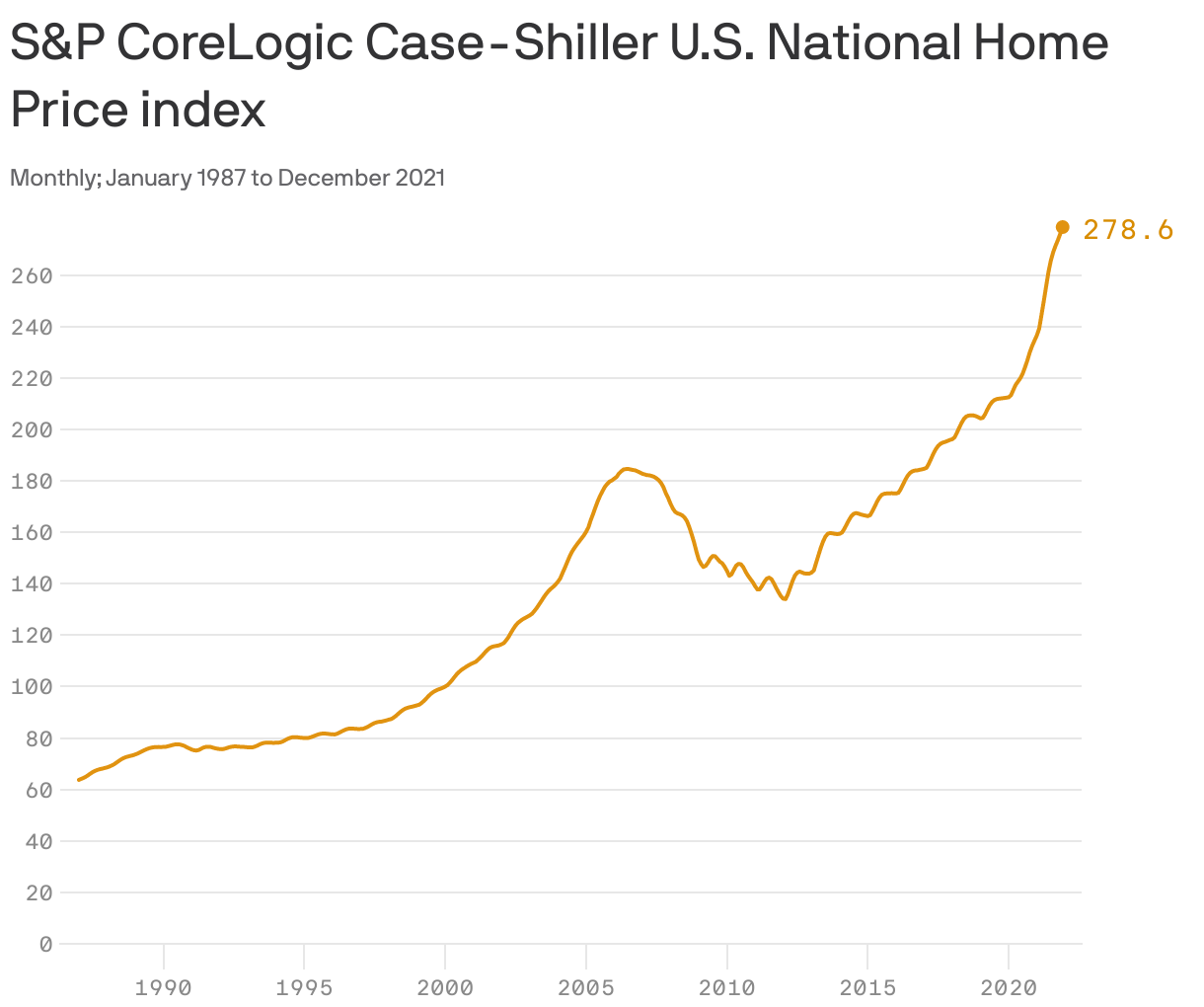
Meanwhile, supply shortages keep house prices risings:

The U.S. housing market experienced its highest one-year increase in home prices in at least 34 years in 2021, Nathan writes.

U.S. home prices soared 18.8% over 2020 levels, according to the S&P CoreLogic Case-Shiller U.S. National Home Price NSA Index released today. (Axios)
U.S. Consumer Confidence Weakens in February

(…) The expected inflation rate in twelve months rose to 7.0% in February coming after declines in the prior two months. It remained up from a 4.4% low in January of 2020. Roughly two-thirds of respondents expected that interest rates would rise over the next twelve months, the most in three years. The share of respondents planning to buy a new home within six months held steady m/m at 0.8% and remained below a June 2020 high of 2.0%. Those planning to buy a major appliance fell sharply to 47.2% of respondents, a five-month low. (…)

image

February’s U.S. Light-Vehicle SAAR Set to Decline from January

On a seasonally adjusted basis, forecast February U.S. light-vehicle sales represent weakening from January, as the chip shortage, geopolitical issues and inflation all continue to loom large. The good news is Q1 overall is running stronger than Q4-2021. Though there likely will continue to be some aberrations in individual months, as of now the outlook is for sales to strengthen from quarter to quarter in 2022, albeit remaining below pre-pandemic levels.

Yesterday:

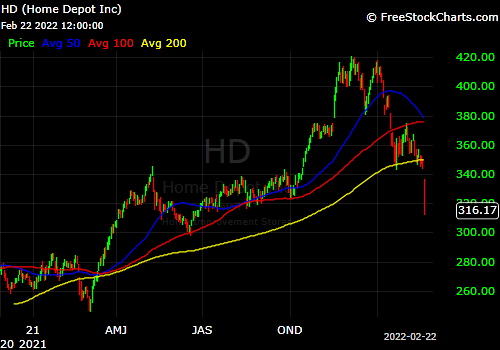
Home Depot’s Q4 comparable sales rose 8.1%. The number of transactions declined by 3.8%, but the average transaction value was up 12%. “Inflation in several product categories was responsible for much of that gain, Home Depot’s chief operating officer, Ted Decker, told analysts on a conference call.”
hd

  • Macy’s: “The retailer expects net sales in the current year to be flat to up 1% from 2021. It also guided its profit margins would shrink because of inflationary pressures and costs associated with online orders.” (WSJ)
TECH

The S&P 500 has officially corrected (-10.5%). The 38% of Investors Intelligence survey predicting a correction will now have to take another side, bull or bear.

Tech investors don’t have to make that decision. The NDX is down 17.3% and the ARKK fund is down 60%.

Are valuations getting attractive? Judge by yourselves with these charts from Ed Yardeni:

image

image

image

FYI: “Tech is one of the few sectors where buyback trends have noticeably slowed, and it now represents only 2% of new S&P 500 buyback announcements vs. 30-35% of buybacks in recent years.” (The Market Ear)

Punishing Putin – How Biden could cut Russia off from world tech

If Russia further invades Ukraine, the Biden administration could deprive it of a vast swath of low- and high-tech U.S. and foreign-made goods, from commercial electronics and computers to semiconductors and aircraft parts, people familiar with the matter told Reuters.

President Joe Biden would achieve that by expanding the list of goods that require U.S. licenses before suppliers can ship them to Russia, and his administration would then deny those licenses, the people said. (…)

The official added: “Export controls are really potent because we’re talking about critical technology inputs that Russia needs to diversify its economy.” (…)

U.S. exports to Russia were under $5 billion in 2020, according to the Commerce Department, and already face many curbs. But the use of the FDPR rule dramatically expands the impact of the restrictions included in the package.

But The Telegraph’s excellent Amrose Evans-Pritchard has a completely different view:

Vladimir Putin controls the supply chain of western technology, so who is bluffing? Russia has the power to hobble key industries in the US and Europe by restricting supplies of metals

(…) Bear in mind what Putin has lost by this action: he has killed the Minsk accord and therefore ended the possibility of controlling Kyiv’s foreign and security policy through the veto power of these two puppet regions.

If he left it there, he would emerge from this crisis in a weaker strategic position. (…)

The West cannot activate serious measures because it risks an asymmetric response – a lighter variant of ‘mutual assured destruction’ from the Cold War.

It is already well understood that Europe is a captive of Russian gas, and dares not eject Russia from the SWIFT system of international payments because it would suffer a more immediate crisis than fortress Russia itself. (…)

Putin has the means to cut off critical minerals and gases needed to sustain the West’s supply chain for semiconductor chips, upping the ante in the middle of a worldwide chip crunch.

Furthermore, he could hobble the aerospace and armaments industry in the US and Europe by restricting supply of titanium, palladium, and other metals.

If he controlled Ukraine, his control over key strategic minerals would be even more dominant, giving him leverage akin to Opec’s energy stranglehold in 1973. (…)

Some 90pc of the world supply of neon, used as laser gas for chip lithography, comes from Russia and Ukraine. Two-thirds of this is purified for the global market by one company in Odessa. There are other long-term sources of neon in Africa but that is irrelevant in the short run.

Technet said Russian C4F6 gas is used for etching node logic devices. Palladium is used for sensors, plating material and computer memory (MRAM).

The world’s biggest producer of titanium is VSMPO-AVISMA, located in the ‘Titanium Valley’ of Western Siberia.

It is owned by Rostec, the state conglomerate controlled by Sergey Chemezov, an ex-KGB operative who served with Putin in East Germany. Russia and Ukraine together account for 30pc of the global supply of titanium, but this understates their hegemony over the production chain.

VSMPO-AVISMA supplies 35pc of Boeing’s titanium, mostly for 737, 767, 777, and 787 jets. It is used in engines, fans, disks and frames, prized for its resistance to heat and corrosion, and for its ratio of weight to strength. (…)

The Bureau warned that the US is down to one ageing plant capable of producing titanium sponge at scale, and no longer has any titanium reserve in the National Defense Stockpile.

It relies on supply from a hostile state-controlled entity to build US fighter jets, rockets, missiles, submarines, helicopters, satellites, and advanced weaponry. The report called for urgent measures to rebuild domestic production and acquire strategic reserves. What a shambles.

Airbus is even more vulnerable. Half its titanium sponge comes from Russia.

Britain’s aerospace industry depends on Russian supply. VSMPO-AVISMA has an operation near Birmingham, making commercial alloys for aerospace, medical technology, and the military.

(…) Russia cannot be strangled because it is systemically central to the world economy.

Nor can Washington easily deny Russia semiconductor chips over the long run. (…)

But the semiconductor chain is notoriously complex and populated by middlemen.

“There would be all kinds of work arounds: Russia wouldn’t be able to get the cutting edge stuff but it could get by with intermediate chips for most of its weapons,” said James Lewis, technology director at Washington’s Center for Strategic and International Studies.

“They can always fall back on the Chinese, and this would dilute the sanctions. It would not be easy for Russia because you can’t just switch over. Everything has to be redesigned to accept the Chinese chips, and they’re not the best either. It would set them back two or three years,” he said.

Chinese companies were reluctant to breach US sanctions after the annexation of Crimea in 2014. It is a different world today. Xi Jinping has made it illegal for them to comply with US extraterritorial sanctions. (…)

The fate of Ukraine’s people is not so different from the story of the Czechs in September 1938.

THE DAILY EDGE: 22 FEBRUARY 2022

Did you miss yesterday’s Daily Edge?

Worried About Inflation and Supply Constraints? Try Being a Small Business. Larger companies have used their heft to turn higher demand into increased earnings, but smaller firms are adding debt and burning cash

(…) Two-thirds of small businesses impacted by supply-chain constraints said suppliers are favoring large businesses because of the volume of orders, according to a recent Goldman Sachs survey of more than 1,400 businesses. Eighty-four percent of small businesses said inflationary pressures had worsened since September, according to the Goldman survey, with more than three-quarters reporting that inflation had hurt their business’s financial health.

“Larger firms have been able to weather rising costs and labor shortages better than smaller firms, which is likely a function of larger workforces, greater pricing power and stronger margins that have allowed them to absorb economic pressures more easily,” said Mahir Rasheed, U.S. economist at Oxford Economics. (…)

Sixty-two percent of small businesses said they had applied for a loan or considered doing so to fund additional expenses because of inflation, according to a survey of more than 2,000 small firms by Hello Alice, a software platform that provides resources for small-business owners. (…)

Funds from the federal Paycheck Protection Program and other aid efforts initially helped cushion the economic blows, he said. “That liquidity is waning,” said Mr. Taets. “That’s why we are starting to see these requests.” (…)

In the same WSJ article, we learn that some companies are raising prices retroactively:

In December, Honeywell International Inc. added an 8% inflation surcharge for existing and new orders from its U.S. Fire unit. In a call with analysts in early February, Honeywell chief executive and chairman Darius Adamczyk said that “swift pricing actions allowed us to stay ahead of the inflation curve,” increase revenue and expand profit margins. (…)

Vendors now routinely add surcharges of as much as 21% to items ordered months earlier.

From The Transcript:

  • “Looking at price versus cost, we continue to experience high inflationary impacts for material cost, labor, and freight. The pricing that we put in place last year is currently lagging inflation. That coupled with productivity challenges is a major contributor to margin declines in Q4. We implemented additional price increases during the fourth quarter and have already announced another price increase for Q1 2022 that goes into effect this month. We are aggressively pursuing price across all products and in all channels to offset unprecedented inflation and expect price to exceed inflation in 2022.” – Allegion (ALLE) CEO Dave Petratis
  • “Inflationary pressures continue but have yet to curtail demand, so we remain optimistic about the underlying strength of the industry. we’ve really not seen any decline and rather pools are getting fancier, they’re not into value engineering…An $80,000 pool doesn’t buy you as much as it did a few years ago, but it really has yet to curtail demand.” – Pool (POOL) CEO Peter Arvan
  • “We have labor problems everywhere. We can’t find people. Our labor costs are going up significantly, well beyond minimum wage for certain functions that used to be minimum wage – – We just can’t find people. The people we find if we find them are not trained to the extent we would like them to be trained. And they may work 2 or 3 weeks and leave. It’s very, very hard to find competent people.” – Ark Restaurants (ARKR) CEO Michael Weinstein

Prices rise at record rate as eurozone growth rebounds in February

(…) The easing of supply constraints recorded during February also helped moderate manufacturers’ input cost inflation. Although average prices paid for materials rose sharply again, the rate of increase was the slowest since March of last year.

However, although raw material price inflation in manufacturing eased, service sector input cost inflation accelerated to a record high reflecting rising wages and soaring energy costs. The resulting overall rate of input cost inflation seen across both sectors rose to the second-highest on record, surpassed over the past 24 years only by that seen last November.

Average prices charged for goods and services rose at the sharpest rate yet recorded by the survey as firms increasingly sought to pass persistent higher cost inflation on to customers. A record high rate of inflation in the service sector was accompanied by a near-record rate in manufacturing.

The intensifying selling price pressures seen in February therefore suggest that consumer price inflation could also rise further during the month, having already risen to 5.1% in January – the highest in the history of the euro. (…)

In the U.K.:

unnamed - 2022-02-22T073638.660

Such strong input price growth suggests no imminent cooling of consumer price inflation pressures, which are currently running at the highest for three decades.

unnamed - 2022-02-22T073722.964

Inflation Starts to Show Up in Asia Early warning signs of inflation are appearing in some parts of Asia, as higher energy and food prices start to bite in countries that recently seemed immune to cost pressures.

(…) India’s inflation accelerated to 6% in January, well above the trend of around 3.6% in the three years leading up to the Covid-19 pandemic, while Sri Lanka’s inflation hit 14.2% that month, the highest in more than a decade. In South Korea, core consumer inflation recently rose to 3%, its highest level since January 2012.

Thailand’s consumer price inflation is now 3.2%—after averaging less than 1% in the three years leading up to 2020—even though the tourism-reliant country has one of Asia’s weakest economies. (…)

Consumer price pressures are particularly weak in China, despite recent cost increases for factories. (…) Consumer inflation inched up just 0.9% in January from a year earlier, down from December’s 1.5% gain. It is widely expected to stay below 3% this year. (…)

Food prices globally rose 28.1% in 2021, according to the Food and Agriculture Organization of the United Nations. After doubling in price during 2021, U.S. West Texas Intermediate crude futures have climbed another 20% this year to around $91 per barrel. (…)

From January’s Japan Manufacturing PMI:

January data signalled further rises in average cost burdens among Japanese manufacturers. The rate of input price inflation was substantial amid higher raw material prices, though was broadly unchanged for the third month running. That said, firms were increasingly reporting that costs were partially being passed to clients to protect margins, with output prices rising at the fastest pace since July 2008 and the second-fastest in survey history.

From its February Flash PMI:

(…) supply chain disruption continued to hinder manufacturing activity in February as a marked lengthening of delivery times exacerbated material shortages, leading to a further rapid rise in input cost inflation. (…)

With demand conditions weakened by the ongoing pandemic, Japanese service providers attempted to draw in customers with a renewed reduction in prices charged, the first since last August. This was despite the joint-sharpest rise in input prices for 13-and-a-half years.

Reuters: “Investors are reviving one of the most unprofitable wagers of the past two decades and betting that a combination of politics and price pressures would prompt the unthinkable: a hawkish shift at the Bank of Japan, perhaps as soon as the summertime.

Oil Nears $100 a Barrel After Putin Orders Troops Into Ukraine. Why $130 Is in Sight.

BTW: Ukraine is a huge exporter of corn and wheat.

Fiscal Stimulus Is Turning Into a Fiscal Drag, in a Big Headwind for Growth Drop in federal relief could help curb inflation, while elevated savings should blunt impact on consumers

(…) By the fourth quarter of 2021, the various Covid-19 relief packages enacted since 2020 had boosted the level of U.S. GDP by just under 6 percentage points, said David Mericle, chief U.S. economist at Goldman Sachs. Mr. Mericle estimates by the end of 2022 that boost will shrink to a little less than 2 percentage points. That’s equivalent to 4 percentage points of drag on economic growth compared with what would have been if pandemic programs offered the same support as in 2021.

“That is a pretty big pullback in the level of fiscal support to the economy,” Mr. Mericle said. “Our base case is that other factors can offset that and the economy will keep growing, but it is a lot to contend with.”

Goldman expects GDP to grow 2.2% in the fourth quarter of this year from a year earlier. The average of economists surveyed by The Wall Street Journal in January was 3.3%. (…)

Still, with consumer prices rising at the fastest pace since February 1982, “the really big risk for this year is that consumers don’t dip into those excess savings as much as we anticipate because of concerns about inflation,” Mr. Dent said. (…)

Through February 14, the Chase card spending tracker points to flat nominal control sales after January’s jump which followed weak Christmas sales.

image

The fiscal drag + rising inflation, particularly on essentials, but also on services will in themselves slow GDP growth. The Fed has no reason to hike more than 25bps but 4-5 hikes in 2022 will add to the economic headwinds. I am much more concerned about corporate margins than about inflation which should abate during the second half. Unless:

If we really screw it up, I don’t mean we, if the world really screws it up, it’s going to be a headwind to growth and there’ll be a consequence to that. I mean, I’m a great student of the ’70s, and I’m not saying we’re going back to the 1970s, but everybody is used to asset appreciation in everything that we do, we might have a period of time where there’s less asset appreciation. If you own equities during the 1970s, from 1970 to 1980, you owned U.S. equities. The U.S. equity is worth 50% less in 1980 than they were in 1970. Nobody remembers that. Now I’m not saying we’re going back to that. But how we navigate those policy decisions from here will have an impact on the environment” – Goldman Sachs (GS) CEO David Solomon

Too Complex To Follow? Look To the Bond Market for Orientation

By Hubert Marleau at Palos Management:

(…) It’s not going to be like it was during the past 10 years. The old way of trading stock may be over. Blame it on elevated inflation. Until recently, risk was on when the economic data was strong because inflation was so low the Fed was not expected to remove monetary support. Now that we have high inflation, risk is on only when the prints are weak, because it reduces the chances that the Fed might be too aggressive. In a world where everything seems weird, I go to the bond market for guidance. I rely on it as I would on a compass to set direction. (…)

Evidently, bond investors cannot give us god-like predictions, but their reflections on what the future bears is worthy of serious consideration. (…) The point is that the bond market offers the best guess for where we are headed. Firstly, bond traders, unlike stock traders, can trade billions of dollars worth of trades without going to their bosses for permission. Secondly, they are the smart ones who incorporate the monetary and Keynesian theories in their thinking, diligently following macroeconomic developments, and interpreting data prints rationally. Thirdly, central banks rely on their expectations to orchestrate macroeconomic outcomes.

What they expect is written in the yield curve: the gap between the neutral and policy rates, and 10-year real rates. For guidance and without much effort, stock market civilians should look there in order to see what the rational expectation of the bond experts is. Given that the future will in time become the present, the rationality of the bond market can assist investors pick a macro-path that will help the job of managing asset allocation.

The bond market is signalling:

1) That inflation is embedding itself in the economy everywhere except in long-run expectations.

2) A 100% chance that the Fed will raise its policy rate by 25 bps at its next meeting, to be held on March 15-16. The market sees only a 30% probability of a half a point rate increase, but has baked in 5 rate hikes over the next 12 months.

3) Based on the theory that the yield on five-year notes fairly represents a neutral policy rate that is consistent with output being at full potential with stable inflation, it’s unlikely that the Fed will drive the Federal Funds rate any higher than 1.50%. The narrowing yield curve is either telegraphing that the Fed is acting just as inflation is about to start falling back to its 2.0% goal, or just as growth is about to slow down close to its pre-pandemic path of 2.0%. Investors should note that the shape of the yield curve signals recession only when the 3-month interest rate and two-year bond yield are both higher than 10-year Treasury yields, not when the curve is flattening. The spread between 10-year and 2-year Treasuries is roughly 50 bps and 160 bps between 10-year and 3-month Treasuries.

4) If bond investors were really worried about a recession, they would completely avoid default-prone, high yield bonds. Some money has fled the junk bond funds–$3.6 billion. However, it would be an over-stretch to say credit is cracking: junk bond issuance is still being snapped-up. The allocation of credit remains smooth, credit spreads are wider but anchored, and the capital market is open to triple-C-rate bonds.

5) The spread between the 5Y5Y rate, the Fed’s destination (2.00%), and the 1Y1Y rate – the Fed’s policy gap (4.50%) – defines the boundaries for its activity. The wider the gap between the short and terminal rates, the more scope for stock market volatility. As one can see the spread is wide. Hence volatility.

6) Real rates have risen considerably, not because prospects are for faster growth. Lack of visibility, when it comes to long-term forecasting, has brought about higher term premiums. Indeed, contrary to the past 20 years, bond investors now want to be compensated for the risk they take.

7) Bond market derivatives are predicting that the inflation rate will fall to 4.5% by February 2023, 2.7% in February 2024, 2.5% in February 2025 and 2.0% in February 2026.

(…) The message that I get from the bond market is that withdrawing money from the stock market would be the wrong thing to do at this time. Bond traders are predicting that the Fed will execute a soft landing, extend the growth cycle and prevent runaway inflation.

Ray Dalio has this caveat:

(…) History has repeatedly shown that people tend to have a strong bias to believe that the future will look like a modestly modified version of the past even when the evidence and common sense point toward big changes. I believe that’s what’s going on and that we are in the part of the cycle when most people’s psychology and actions are shifting from deeply imbued disinflationary ones to inflationary ones.

For example, people are just beginning to transition from measuring how rich they are by how much “nominal” (i.e., not inflation-adjusted) money and wealth they have to realizing that how rich they are should be measured in “real” (i.e., inflation-adjusted) money and wealth. From studying history, and with a bit of common sense, we know that when people shift their perceptions in that way, they change their investment and non-investment behaviors in ways that produce more inflation and that make central banks’ difficulties in balancing inflation and growth harder.

For example, people realize that cash is a trashy investment rather than a safe one, that virtually all debt assets (i.e., bonds) are bad, that inventories and forward coverage should be built up to protect against inflation, and that cost-of-living adjustments should be built into contracts to protect against inflation—all of which make upward inflation pressure more intense.

Think of bond investors. Prices rose for over 40 years and yields declined to lousy levels (in both nominal and real terms), and they accepted them. Now they still have those lousy yields (though slightly better than when they were at the absolute lows) plus they are now experiencing price losses. After that huge 40+ year bull market in bonds, imagine how many investors are complacently long and beginning to get stung, and imagine how their behaviors could change to become sellers of bonds, and imagine the effects that would have. (…)

fredgraph - 2022-02-22T065213.688

HSBC takes charge on Chinese real estate and warns of wealth slowdown Outlook blemishes otherwise buoyant fourth-quarter earnings as profit doubles and targets boosted