U.S. Flash PMI: US economy rebounds from Omicron wave, but output prices rise at survey record pace
Growth of private sector output in the US gained considerable momentum in February as companies reported a notable recovery in demand from COVID-related disruptions at the start of the year. Services firms led the rise, although manufacturers likewise registered a stronger increase in output, buoyed by a slight easing of supply bottlenecks. However, February also saw a survey record rise in average prices charged for goods and services.
Rising from an 18-month low of 51.1 in January to 56.0 in February, the seasonally adjusted IHS Markit Flash US Composite PMI Output Index indicated a substantial expansion in private sector output that outpaced the long-run series average.
Both the manufacturing and service sectors recorded stronger expansions in output, with companies linking growth to substantial gains in new business, employees returning from sick leave, increased travelling and greater availability of raw materials.
February data highlighted a sharp and accelerated increase in new business among private sector companies that was the fastest in seven months. Firms mentioned that sales were boosted by the retreat of the pandemic, improved underlying demand, expanded client bases, aggressive marketing campaigns and new partnerships. Customers reportedly made additional purchases to avoid future price hikes. Quicker increases in sales were evident among both manufacturers and service providers.
Inflationary pressures across the private sector intensified in February, with the rate of input price inflation quickening from January’s ten-month low. Panellists continued to indicate higher raw material, transportation and wage costs. Global shortages of raw materials and lingering supply-chain disruptions were again cited, albeit less so than in prior months.
Prices charged for goods and services in the US rose at a record pace in February as companies continued to share additional cost burdens with their clients. Manufacturers signalled a sharper increase in selling prices than service providers, though the latter reported a record rise.
Private sector employment expanded further in February, taking the current sequence of job creation to 20 months. Moreover, the increase was marked and the strongest since last May. Anecdotal evidence indicated that hiring activity stemmed from sustained gains in new work and an associated rise in output requirements. Goods producers posted a moderate expansion in staff numbers, while jobs growth quickened to a nine-month high among services firms.
At 56.7 in February, up from 51.2 in January, the seasonally adjusted IHS Markit Flash US Services PMI™ Business Activity Index highlighted a substantial and accelerated upturn in output.
Boosting the latest rise in business activity was a quicker increase in new work intakes. Companies noted the strongest expansion in sales since last July. International demand for US services also strengthened in February.
With demand conditions improving, service providers continued to hire extra staff. The increase was marked and the fastest in nine months.
On the price front, there were sharper increases in both input costs and output prices. Notably, the rate of charge inflation hit a series peak.
The IHS Markit Flash US Manufacturing Purchasing Managers’ Index ™ (PMI™) rose from 55.5 in January to 57.5 in February, signalling a stronger improvement in business conditions across the sector. Although the Suppliers’ Delivery Times Index continued to inflate the PMI, the latest reading was also boosted by stronger increases in output and new orders.
Production rose at a quicker rate in February, albeit one that was moderate relative to those registered in 2021. Anecdotal evidence indicated that growth was hampered by raw material scarcity, supply-chain disruptions and labour shortages.
Factory orders increased at a sharp and accelerated pace in February, prompting firms to resume their hiring efforts after a blip in January. Export sales likewise expanded, with growth hitting a five-month high.
In contrast to the trend seen in the service sector, input cost inflation among manufacturers eased to a nine-month low midway through the quarter. That said, the rate of inflation remained elevated and outpaced that seen for services.
Additional cost burdens continued to be transferred to clients, as evidenced by another increase in factory gate charges. The rate of output price inflation was sharp and the fastest in three months.
Finally, manufacturers continued to purchase additional inputs for use in the production process, with the rate of input buying growth improving to a five-month high. Suppliers’ delivery times meanwhile lengthened to the least extent since last May.


To summarize the U.S. flash PMI in preparation for the March 15-16 FOMC:
- The U.S. economy bounced back strongly in February with strong new orders from “improved underlying demand” and inventory hoarding “to avoid future price hikes” per purchasing managers seemingly not seeing much slowdown in input inflation and focused on protecting margins.
- The February CPI is unlikely to ease much as “prices charged for goods and services rose at a record pace in February”, unless rising costs are not fully passed on to the end consumer.
- Private employment was the “strongest since last May”.
Goldman Sachs’ transitory team seems to be wavering:
Two-thirds of the core CPI basket has seen 4% annualized inflation since last July (vs. only 19% of the basket in 2019), and 16% of prices rose at a double-digit pace (vs. 2% in 2019). Regardless of the exact threshold chosen, the breadth of high inflation has returned to levels last seen in the 1980s. And in contrast to other recent episodes of labor market tightness, the peak of the inflation distribution itself is moving higher: prices of the center fifth of the core inflation basket are increasing at a 5-6% annualized pace—compared to a 2.5-3.5% pace in normal or tight labor markets.
Statistically, the high inflation breadth of the last six months argues for continued strength in core inflation this spring. And this estimate does not take into account additional upward pressure from wage-price pass-through or from continued supply chain constraints.
The medium-term implications are less clear-cut. While high and rising inflation breadth in the late 1970s coincided with the de-anchoring of inflation expectations, shorter-lived bouts in 2000 and 2006 did not. While encouraging, we note that the Fed responded to both of those latter episodes by tightening monetary policy.
So, at JPM:
we now look for the Fed to hike 25bp at each of the next nine meetings, with the policy rate approaching a neutral stance by early next year.
Our “This time is different” outlook incorporates an underlying reflationary tilt that keeps inflation elevated even as supply constraints related to the panemic and energy markets fade. We are also being challenged, however, as we do not forecast a broad and early move toward restrictive stances prompted by global inflation remaining well above central bank tolerance zones.
We think the risk that central banks shift and perceive a need to generate slow growth—and the corresponding impact on global financial conditions—is now the most significant threat to an otherwise healthy global backdrop.
9 x 25 = 225
ZeroHedge reminds us that “the Fed has only raised rates with stocks more overvalued just one time: that was in June of 1999. Everyone remembers what happened next…”.

ZH adds that “never before has the curve been this flat before the Fed hiked rates even once!” Which actually verifies:

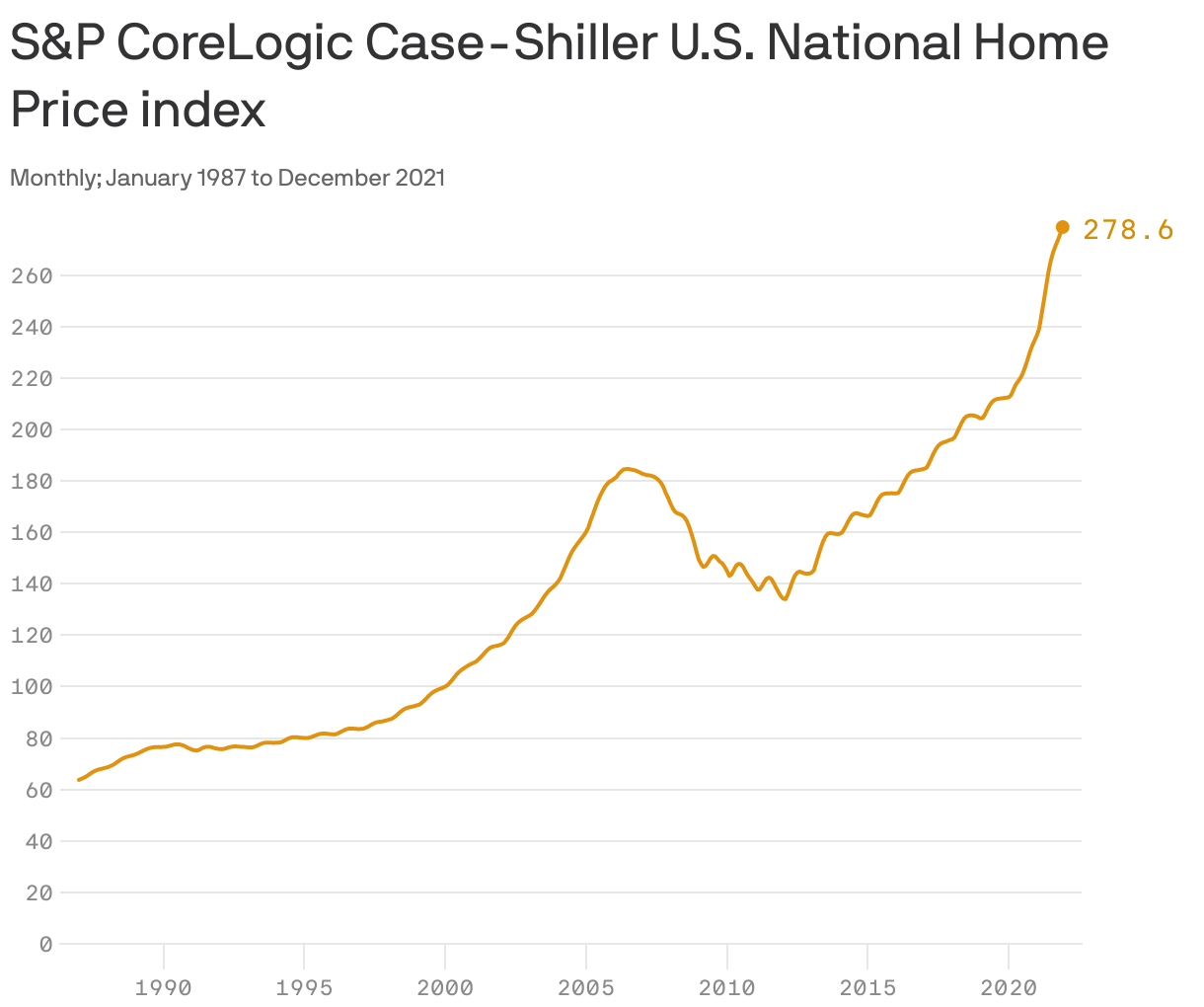
The U.S. housing market experienced its highest one-year increase in home prices in at least 34 years in 2021, Nathan writes.
U.S. home prices soared 18.8% over 2020 levels, according to the S&P CoreLogic Case-Shiller U.S. National Home Price NSA Index released today. (Axios)
U.S. Consumer Confidence Weakens in February
(…) The expected inflation rate in twelve months rose to 7.0% in February coming after declines in the prior two months. It remained up from a 4.4% low in January of 2020. Roughly two-thirds of respondents expected that interest rates would rise over the next twelve months, the most in three years. The share of respondents planning to buy a new home within six months held steady m/m at 0.8% and remained below a June 2020 high of 2.0%. Those planning to buy a major appliance fell sharply to 47.2% of respondents, a five-month low. (…)

February’s U.S. Light-Vehicle SAAR Set to Decline from January
On a seasonally adjusted basis, forecast February U.S. light-vehicle sales represent weakening from January, as the chip shortage, geopolitical issues and inflation all continue to loom large. The good news is Q1 overall is running stronger than Q4-2021. Though there likely will continue to be some aberrations in individual months, as of now the outlook is for sales to strengthen from quarter to quarter in 2022, albeit remaining below pre-pandemic levels.


Yesterday:
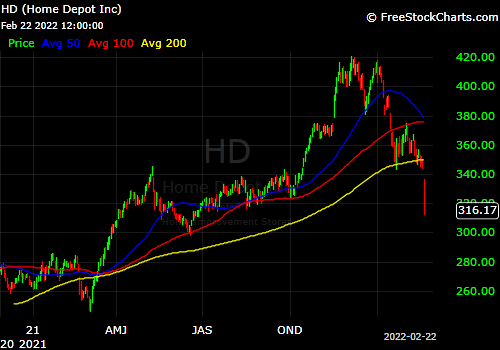
Home Depot’s Q4 comparable sales rose 8.1%. The number of transactions declined by 3.8%, but the average transaction value was up 12%. “Inflation in several product categories was responsible for much of that gain, Home Depot’s chief operating officer, Ted Decker, told analysts on a conference call.”
- Macy’s: “The retailer expects net sales in the current year to be flat to up 1% from 2021. It also guided its profit margins would shrink because of inflationary pressures and costs associated with online orders.” (WSJ)
TECH
The S&P 500 has officially corrected (-10.5%). The 38% of Investors Intelligence survey predicting a correction will now have to take another side, bull or bear.
Tech investors don’t have to make that decision. The NDX is down 17.3% and the ARKK fund is down 60%.
Are valuations getting attractive? Judge by yourselves with these charts from Ed Yardeni:


FYI: “Tech is one of the few sectors where buyback trends have noticeably slowed, and it now represents only 2% of new S&P 500 buyback announcements vs. 30-35% of buybacks in recent years.” (The Market Ear)

Punishing Putin – How Biden could cut Russia off from world tech
If Russia further invades Ukraine, the Biden administration could deprive it of a vast swath of low- and high-tech U.S. and foreign-made goods, from commercial electronics and computers to semiconductors and aircraft parts, people familiar with the matter told Reuters.
President Joe Biden would achieve that by expanding the list of goods that require U.S. licenses before suppliers can ship them to Russia, and his administration would then deny those licenses, the people said. (…)
The official added: “Export controls are really potent because we’re talking about critical technology inputs that Russia needs to diversify its economy.” (…)
U.S. exports to Russia were under $5 billion in 2020, according to the Commerce Department, and already face many curbs. But the use of the FDPR rule dramatically expands the impact of the restrictions included in the package.
But The Telegraph’s excellent Amrose Evans-Pritchard has a completely different view:
Vladimir Putin controls the supply chain of western technology, so who is bluffing? Russia has the power to hobble key industries in the US and Europe by restricting supplies of metals
(…) Bear in mind what Putin has lost by this action: he has killed the Minsk accord and therefore ended the possibility of controlling Kyiv’s foreign and security policy through the veto power of these two puppet regions.
If he left it there, he would emerge from this crisis in a weaker strategic position. (…)
The West cannot activate serious measures because it risks an asymmetric response – a lighter variant of ‘mutual assured destruction’ from the Cold War.
It is already well understood that Europe is a captive of Russian gas, and dares not eject Russia from the SWIFT system of international payments because it would suffer a more immediate crisis than fortress Russia itself. (…)
Putin has the means to cut off critical minerals and gases needed to sustain the West’s supply chain for semiconductor chips, upping the ante in the middle of a worldwide chip crunch.
Furthermore, he could hobble the aerospace and armaments industry in the US and Europe by restricting supply of titanium, palladium, and other metals.
If he controlled Ukraine, his control over key strategic minerals would be even more dominant, giving him leverage akin to Opec’s energy stranglehold in 1973. (…)
Some 90pc of the world supply of neon, used as laser gas for chip lithography, comes from Russia and Ukraine. Two-thirds of this is purified for the global market by one company in Odessa. There are other long-term sources of neon in Africa but that is irrelevant in the short run.
Technet said Russian C4F6 gas is used for etching node logic devices. Palladium is used for sensors, plating material and computer memory (MRAM).
The world’s biggest producer of titanium is VSMPO-AVISMA, located in the ‘Titanium Valley’ of Western Siberia.
It is owned by Rostec, the state conglomerate controlled by Sergey Chemezov, an ex-KGB operative who served with Putin in East Germany. Russia and Ukraine together account for 30pc of the global supply of titanium, but this understates their hegemony over the production chain.
VSMPO-AVISMA supplies 35pc of Boeing’s titanium, mostly for 737, 767, 777, and 787 jets. It is used in engines, fans, disks and frames, prized for its resistance to heat and corrosion, and for its ratio of weight to strength. (…)
The Bureau warned that the US is down to one ageing plant capable of producing titanium sponge at scale, and no longer has any titanium reserve in the National Defense Stockpile.
It relies on supply from a hostile state-controlled entity to build US fighter jets, rockets, missiles, submarines, helicopters, satellites, and advanced weaponry. The report called for urgent measures to rebuild domestic production and acquire strategic reserves. What a shambles.
Airbus is even more vulnerable. Half its titanium sponge comes from Russia.
Britain’s aerospace industry depends on Russian supply. VSMPO-AVISMA has an operation near Birmingham, making commercial alloys for aerospace, medical technology, and the military.
(…) Russia cannot be strangled because it is systemically central to the world economy.
Nor can Washington easily deny Russia semiconductor chips over the long run. (…)
But the semiconductor chain is notoriously complex and populated by middlemen.
“There would be all kinds of work arounds: Russia wouldn’t be able to get the cutting edge stuff but it could get by with intermediate chips for most of its weapons,” said James Lewis, technology director at Washington’s Center for Strategic and International Studies.
“They can always fall back on the Chinese, and this would dilute the sanctions. It would not be easy for Russia because you can’t just switch over. Everything has to be redesigned to accept the Chinese chips, and they’re not the best either. It would set them back two or three years,” he said.
Chinese companies were reluctant to breach US sanctions after the annexation of Crimea in 2014. It is a different world today. Xi Jinping has made it illegal for them to comply with US extraterritorial sanctions. (…)
The fate of Ukraine’s people is not so different from the story of the Czechs in September 1938.
3 thoughts on “THE DAILY EDGE: 23 FEBRUARY 2022: Strongflation”
In the above article, the statement is made, “The Bureau warned that the US is down to one ageing plant capable of producing titanium sponge at scale.” Per the attached article from Real Clear Policy that one ageing plant no longer is in production:
“America now has no domestic titanium metal production since the last American plant that made titanium sponge — a porous form of titanium from the first stage of processing the metal — closed in Henderson, Nevada.”
https://www.realclearpolicy.com/articles/2021/05/13/us_titanium_supply_chain_needed_for_national_security_776880.html#:~:text=America%20now%20has%20no%20domestic,%E2%80%94%20closed%20in%20Henderson%2C%20Nevada.&text=No%20U.S.%20operations%20are%20converting%20titanium%20ore%20into%20titanium%20metal.
Houston. We have a problem.
See https://wits.worldbank.org/trade/comtrade/en/country/ALL/year/2018/tradeflow/Exports/partner/WLD/product/261400
Sophisticated metal refineries in the west might be able to replace Russian titanium sponge in a relatively short time working 24×7.
Comments are closed.