CONSUMER WATCH
J.P. Morgan updated its Chase card spending tracker to December 24:


Tuesday, I wrote: “But if “holiday sales” are up 8.5% as Mastercard data says, it means that December sales are up only 0.9% YoY, before inflation which is now running in the 5-6% range (5.5% in November). If so, real retail sales would be down 4-5% YoY this month.”
David Rosenberg yesterday calculated that “sales in December actually plunged 8% sequentially! confirmed by the Johnson Redbook chain store sales survey into mid-month.”
That would be a real shocker…probably blamed on Omicron and the weather…even though its the fundamentals (labor income minus inflation) that are kicking in.
Speaking of fundamentals, J.P. Morgan has its own job tracker based on alternative data:

JPM also has this forecast to lift our spirits:
JP Morgan sees oil prices hitting $125 in 2022, $150/bbl in 2023 “We think OPEC+ will slow committed increases in early 2022, and believe the group is unlikely to increase supply unless oil prices are well underpinned,” the bank said.
Goldman Sachs sees oil at $100 by 2023.
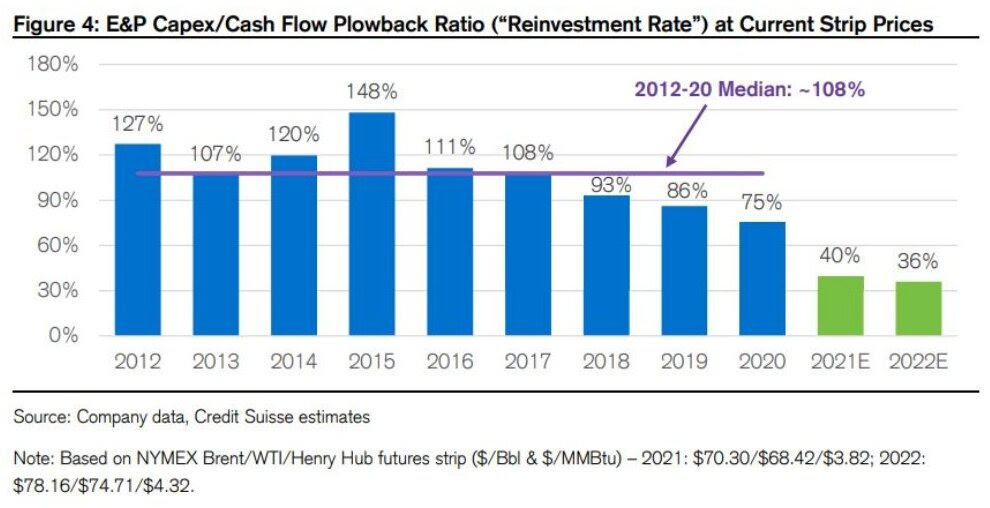
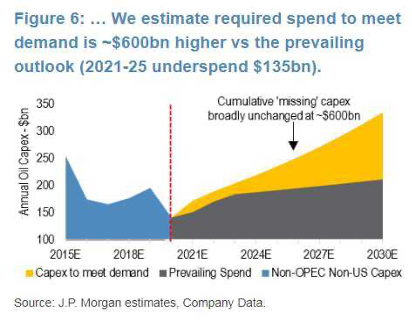
The December 27 Daily Edge presented an analysis by Bison Interest summarized by this comment: “The lack of investment in the sector has compounded for some time now, and it is becoming increasingly clear that future production will fall short of demand unless investment picks up materially.” These two charts explain:
BTW:
Europe Has Never Paid So Much for Power as 2021 Costs Hit Record
Unrelated but related:

Covid-19 Pandemic Gives New Hope to One of the World’s Fastest-Shrinking Countries Coronavirus pushed many to return to Eastern European countries like Bulgaria that had seen sharp population declines
(…) After decades of mass migration from former Eastern Bloc countries to more lucrative opportunities in the West, the flow of people in Europe is showing signs of reversing. (…)
Now, the question is whether those returnees will stay. The answer will have major implications for both sides of the continent. Western European countries are confronting record labor shortages, with many jobs that are usually filled by foreign workers sitting empty. And in countries like Bulgaria, return migrants would be a boon to economies that have bled skilled workers and young people for a generation.
“(…) There’s been a realization that you can have a good quality of life back in Eastern Europe.” (…)
Germany has more than a million open jobs after a sharp drop in net immigration, and officials say they want to attract some 400,000 skilled workers from abroad each year. Belgium, the Netherlands, Austria and the United Kingdom all broke job vacancy records this year. (…)
Meanwhile:
Apple Aims to Prevent Defections to Meta With Rare $180,000 Bonuses for Top Talent
Apple Inc. has issued unusual and significant stock bonuses to some engineers in an effort to retain talent, looking to stave off defections to tech rivals such as Facebook owner Meta Platforms Inc.
Last week, the company informed some engineers in silicon design, hardware, and select software and operations groups of the out-of-cycle bonuses, which are being issued as restricted stock units, according to people with knowledge of the matter. The shares vest over four years, providing an incentive to stay at the iPhone maker.
The bonuses, which came as a surprise to those who received them, have ranged from about $50,000 to as much as $180,000 in some cases. Many of the engineers received amounts of roughly $80,000, $100,000 or $120,000 in shares, said the people, who asked not to be identified because the program isn’t public. The perk was presented by managers as a reward for high performers. (…) They were given to about 10% to 20% of engineers in applicable divisions. (…)
Meta has hired about 100 engineers from Apple in the last few months, but it hasn’t been a one-way street: Apple also has lured away key Meta employees. (…)
Apple acknowledged this month that workers will likely stay at home for the foreseeable future. After scrapping its office-return deadline, Apple said it would issue $1,000 bonuses to all corporate, retail and technical-support employees so they can purchase home equipment.
China Land Sales Remain Sluggish Even as Bidding Rules Eased
China’s cash-strapped developers have become reluctant to acquire land even as some local governments relax bidding rules, adding to signs of their liquidity crunch and threatening to deepen the nation’s economic slowdown.
Land plots auctioned in the fourth quarter through Dec. 20 only fetched an average 3% premium over their starting prices, according to data compiled by China Real Estate Information Corp. That’s down from a 17% premium in the second quarter and 8% in the third, said the research agency, which tracks auctions across 300 Chinese cities. (…)
Weaker land sales bode ill for the world’s second-largest economy, which slowed in the third quarter as the property and construction sectors shrank. It’s also set to worsen the debt problem at local governments, which, according to E-house China Research and Development Institute, rely on land sales for about 40% of their revenue. Municipalities are already facing revenue pressure from the flagging economy and struggling under a mountain of debts following years of investment binges. (…)
- Hugo Boss moves production closer to home to shorten supply chain German fashion house to hire additional workers for Turkish factory as it reduces dependence on south-east Asia
Didi Reveals $4.7 Billion Loss Ahead of 2022 Hong Kong Debut
Didi Global Inc. disclosed a $4.7 billion loss after revenues shrank in the September quarter, revealing the rising cost of a series of regulatory actions that will force China’s ride-sharing leader to shift its listing to Hong Kong next year.
Didi, one of the highest-profile targets of a broad Beijing campaign to rein in the country’s giant tech sector, reported $6.6 billion of sales, down more than 13% from the June quarter and 1.6% from a year earlier. The surprise disclosure comes as the company prepares to delist from New York. (…)
“It’s clear that many investors have underestimated the impact of the regulatory reforms,” said Justin Tang, head of Asian research at United First Partners. “Didi’s disclosure of its losses might be a benchmark for investors. Sentiment is still weak for these Chinese tech names and investors are focused on any reason to sell.” (…)
Spending rose 16% during the quarter after Didi was forced to comply with new requirements to better compensate its drivers and improve data governance. Worker rights protections for drivers were formalized into a set of guidelines from Chinese regulators in November. It also booked a 20.8 billion yuan investment loss, mainly from its nascent community group buying business, which focuses on intensely competitive hyper-local groceries. (…)
 I am no Didi expert but I note that
- $4.7B is a lot of money to lose, particularly on $6.6B in revenues.
- The “underestimated impact of the regulatory reforms” is another way of saying that investors overestimated the capacity of the biz model to be profitable, even for a company with a near-monopoly of China’s $50 billion domestic ride-hailing market.
- From its $18 June 2021 high, DIDI shares are down 72%. FYI, UBER is down 34% from its February high.
- From its February 2021 high, Cathie Wood’s ARKK fund is down 40%. It sure looks like some investors are realizing that a story is only worth what profits it can actually generates.
- The time will come when, seeing no profits to sustain valuations, investors will become focused on any reason to sell. Never pretty as some story-minded shareholders are realizing.
- The Renaissance IPO Index is down 26% from its February high.
- The De-SPAC ETF is down 46% from its June 2021 high. “The De-SPAC ETF (NYSE: DSPC) is the first exchange traded fund to offer pure-play exposure to private companies that come public as the result of a merger with a Special Purpose Acquisition Company. SPACs are one of the most disruptive structures to hit the U.S. capital markets over the past several years.” Disruptive indeed!
- The average S&P 500 stock is actually down 11% from the 52-week highs!
AI-Powered Stock Fund Bails Out of Mega-Cap FANG+ Stocks An artificial intelligence-guided fund that has been lagging the market has jettisoned its mega-cap tech names in a bid to right the ship.
The AI Powered Equity exchange-traded fund sold down its so-called FANG+ positions this month, leaving just Apple Inc. in its top 20 holdings, according to the latest filings. On Dec. 1, Microsoft Corp. was the ETF’s number one position with Google parent Alphabet Inc. and Amazon.com Inc in third and fourth place, respectively. (…)
“AIEQ continues to lighten up on its Big Tech exposure, with none in its top ten positions,” said Jessica Rabe, co-founder of DataTrek Research. “The only overlapping theme in its top ten positions is cybersecurity, with the rest spanning everything from cloud computing and commercial real estate to medical devices and the semiconductor industry.”
The shift in positioning suggests the AI fund’s “manager” — a quantitative model which runs 24/7 on IBM Corp.’s Watson platform — is not buying into the narrative that America’s tech giants can lead the market higher next year. The NYSE FANG+ Index — a gauge of tech megacaps — has fallen some 7% from its all-time high in November, even as the S&P 500 climbs to fresh records. (…)
The quantitative model behind the $170 million fund, developed by EquBot, assesses more than 6,000 U.S. publicly-traded companies each day. It scrapes millions of regulatory filings, news stories, management profiles, sentiment gauges, financial models, valuations and bits of market data, and then chooses about 30 to 70 stocks for the fund, which is run by ETF Managers Group LLC.
Launched in October 2017, AIEQ has delivered a total return of about 66% since inception, compared with 102% for the S&P 500 Total Return Index. (…)

It seems fitting to close this Daily Edge and this “amazing” (!) year with:
 HAPPY NEW YEAR!
(Mainly health and love to all!)


 (
(