The enemy of knowledge is not ignorance, it’s the illusion of knowledge (Stephen Hawking)

It ain’t what you don’t know that gets you into trouble. It’s what you know for sure that just ain’t so (Mark Twain)

Invest with smart knowledge and objective odds

THE DAILY EDGE: 27 DECEMBER 2021: Weak Christmas Sales?

HAPPY HOLIDAYS!

The Daily Edge will be published sporadically in the next 2 weeks.

A special thank you to donators who help support this blog. Very, very much appreciated.

Apologies if  have not sent a personalized thank you note like I normally do. The recent weeks/months have been particularly busy for me.

Spending Was Strong Heading Into Omicron, and Will Be After A shift in spending toward services—and away from goods—last month hints at what next year might look like

The Commerce Department on Thursday reported that consumer spending rose a seasonally adjusted 0.6% in November from October and also revised its October spending figures higher. (…)

Digging into the data a little more, the increase in spending was driven by a 0.9% increase in services expenditures. Spending on goods rose just 0.1%. And that is before the bite from inflation, which has been concentrated in goods. Adjusted for inflation, spending on services rose 0.5%, but spending on goods fell 0.8%.

(…) a fair amount of holiday spending looks as if it was pulled into October, since people were worried that supply-chain snarls might mean they wouldn’t get their gifts on time (a concern that retailers encouraged). (…)

Credit and bank card data from both Bank of America and JPMorgan Chase indicate that spending has weakened this month, particularly in services-related categories such as airlines and restaurants — and of course one might have gathered as much from reading the news or walking around. (…)

In [Omicron surge’s] aftermath, the spending dynamics that were in place last month might well reassert themselves. Next year could be when demand for services really drives spending, and demand for goods moves to the passenger seat.

The BEA’s Table 5 provides the important income/spending stats:

image

  • Wages and Salaries (#3) slowed a little in November (+0.5%) but growth this year is huge. Last 4 months: +7.7% a.r. (total comp (#2): +6.8% a.r.).
  • The problem is inflation. Real personal income ex. transfers (#19) has totally stalled since July.
  • Real disposable income (#20) has declined in each of the last 4 months and is up only 2.0% from its pre-pandemic levels, 21 months ago.
  • Real expenditures are up 4.4% since February 2020 but abruptly stalled in November after jumping 0.7% in October. The decline in the savings rate to 6.9%, its lowest level since December 2017, helped sustain consumption in spite of declining disposable income.

fredgraph - 2021-12-24T065445.671

Since 1969, there is a pretty good +0.68 correlation between core CPI and the savings rate, which would suggest a higher savings rate in 2022, at least during the first half when most forecasters expect inflation to peak. But who really knows? Americans had displayed a somewhat higher propensity to save since 2013 but the pandemic could have changed that trend.

The savings rate is the erratic and elusive wild card. Forecasting higher consumer spending based on possible dissaving is dangerous, particularly when inflation is rising.

U.S Savings Rate And Core CPI 1969-2019fredgraph - 2021-12-25T061844.864

Real expenditures on goods peaked in March but are still 16.2% above their pre-pandemic level, and about 10% above trend. Meanwhile, consumption of services is about 3% below trend but has been growing at an 8.0% annualized rate in 2021 from a depressed base, four times faster than its pre-pandemic trend growth rate.

fredgraph - 2021-12-24T072046.762

Demand for services will likely keep growing in 2022 but whether it can offset a return to trend in goods will require Americans really step up using some services. In total, services account for 64% of total expenditures but services such as shelter and medical services account for nearly 2/3rd of the total.

Discretionary services on which one could splurge (e.g. restaurants, hotels, travels, recreation) account for no more than 15% of total spending and have limitations that goods don’t have (number of restaurant meals, travels, etc. per week, month, year).

Spending on services as a percent of disposable income is almost back to its long-term declining trend while the proportion of income spent on goods is 4% above trend:

image

Meanwhile, inflation on services is steady at between 4% and 5% annualized but the official measure of inflation on the heavy-weight shelter is still relatively subdued at 3.8% YoY in November but is dangerously accelerating (+6.2% a.r. in the last 2 months). Real world data suggest actual rent inflation is much higher.

As often shown in the Daily Edge, CPI-Essentials is now 7.0% YoY and has risen at a 12% annualized rate in the last 2 months.

The impact on real income is significant. The impact on discretionary income and spending is even more significant for most Americans.

CPI-Essentials And Private Wagesfredgraph - 2021-12-25T063027.960

  • Producers Expect Food Prices to Rise in New Year Many food manufacturers say they plan to raise prices in 2022 for a range of products from macaroni-and-cheese to snacks, the latest sign that consumers will continue to face higher costs at the supermarket.

(…) Food prices are estimated to rise 5% in the first half of 2022, according to research firm IRI, though the level of increases will vary by grocers and regions.

Mondelez International Inc. MDLZ 0.17% said recently that it was raising prices across cookies, candy and other products sold in the U.S. by 6% to 7% starting in January. General Mills Inc. GIS 0.44% and Campbell Soup Co. CPB -0.02% said their price increases also would take effect in January. Kraft Heinz Co. KHC 0.40% told retailer customers that it would raise prices across many of its products including Jell-O pudding and Grey Poupon mustard, with some items going up as much as 20%, according to a memo viewed by The Wall Street Journal. (…)

Kraft Heinz said the average price increase on its products will be 5%, adding that it wasn’t passing all of its cost increases to customers. Production costs of Grey Poupon rose 22%, and the company is raising it by 6% to 13% for customers, the company said. (…)

Holiday Sales Jump 8.5% as U.S. Consumers Return to Retailers U.S. holiday sales jumped 8.5% from last year as consumers spent more money on clothes, jewelry and electronics, a report from Mastercard SpendingPulse showed. Sales grew across the board, both in stores and online, for the holiday season defined as Nov. 1 to Dec. 24.

High five But note the period: Nov. 1 to Dec. 24. Retail sales were up 16.1% YoY in November. Control sales were up 13.6%. Seems December was rather weak…

The Chase card spending tracker, updated through Dec. 14, suggests sales peaked at Thanksgiving:

image

Omicron Starts to Slow U.S. Economy as Consumer Spending Flags Fewer people are dining in restaurants, and rising case numbers are leading many businesses to close for a short period.

The number of diners seated at restaurants nationwide was down 15% in the week ended Dec. 22 from the same period in 2019, a steeper decline than in late November, data from reservations site OpenTable show. U.S. hotel occupancy was at 53.8% for the week ended Dec. 18, slightly below the previous week’s level, according to STR, a global hospitality data and analytics company. (…)

In the 10 days through Dec. 22, the number of travelers passing through Transportation Security Administration checkpoints was more than double the number of passengers flying in the same period of 2020, though still below 2019 levels. (…)

The forecasting-firm Oxford Economics now expects U.S. gross domestic product to grow at a 2.5% annual rate in the first quarter, down from a previous estimate of 3.4% growth. (…)

The Return of the Wage COLA Kellogg workers are the latest to demand inflation insurance.

By the WSJ Editorial Board

(…) The latest sign that Americans think inflation will be more than transitory is the labor agreement struck at Kellogg Co. Production workers for the cereal giant spent almost three months on strike before accepting a deal Tuesday night. (…)

One provision is a five-year moratorium on closing plants. Kellogg will also accelerate the path for newer employees to earn senior wages and benefits.

But when it comes to their base pay, workers chose a deal that offers more in inflation insurance than immediate gains. They’ll get no across-the-board raise after the first year of the contract. But Kellogg will provide a periodic COLA, granting up to $3 an hour in additional pay by 2026. Kellogg workers are following the successful quarterly COLA demands of Deere & Co. employees after they went on strike this fall.

(…) COLAs also force companies to pay for economy-wide price increases even if their own sales haven’t kept up. (…)

Unions like those at Kellogg and Deere represent a small share of overall employment in the private economy. But they represent more than one-third of the public workforce, and watch for their demands in the coming year. If public union wage demands rise, including COLAs, city and state budgets will be under pressure.

(…) the Kellogg contract is another sign that the 2021 inflation surge will have damaging economic consequences.

  • Amazon, NLRB Reach Accord on Organizing The agreement with the National Labor Relations Board comes as some Amazon workers push for unionization. Amazon will notify warehouse staff of their rights to organize in its buildings.

(…) The agreement is significant because of Amazon’s size and because the company agreed to do away with a rule that limited how employees could communicate with each other at its facilities outside of work hours, said Risa L. Lieberwitz, a professor of labor and employment law at Cornell University. That had made it difficult for workers to organize, she said.

“This can give an enormous boost to organizing at Amazon and at other large employers in the United States,” she said.

The NLRB settlement is one of a number of steps the Biden administration has taken to show its support for the U.S. labor movement. The president reiterated his pro-union views a few weeks ago at an event promoting his $1 trillion infrastructure plan, and he has previously voiced support for Amazon workers seeking to unionize. (…)

More than 70% of Amazon warehouse workers in Bessemer, Ala., who voted in a union election earlier this year decided not to unionize, a margin that illustrates the challenge workers at Amazon will face nationally, labor experts have said.

That election is set to be held again after a federal labor official in November ruled that Amazon violated labor law during the first vote due to a mailbox it had installed outside of the Alabama facility. Amazon has denied any wrongdoing and said the decisive margin of victory was a vindication of its labor practices. (…)

U.S. Durable Goods Orders Up Sharply in November

Manufacturers’ new orders for durable goods rose 2.5% m/m (15.7% y/y) in November versus and upwardly revised 0.1% m/m gain in October (initially reported as a 0.5% m/m decline). The Action Economics Forecast Survey was expecting a 1.5% m/m increase.

The sharp November increase was led by a 6.5% m/m (19.4% y/y) rebound in transportation orders after having declined in three of the previous four months. Excluding transportation orders, the remainder rose 0.8% m/m (14.1% y/y), the ninth consecutive monthly increase. Orders for motor vehicles and parts increased 1.0% m/m on top of a 5.8% m/m jump in October. Orders for aircraft and parts surged 23.8% m/m in November after having declined in three of the previous four months. Orders for nondefense aircraft jumped 34.1% m/m while orders for defense aircraft rose a more modest 3.0% m/m. Across the other major sectors, orders for primary metals, fabricated metal products, and computers and electronic products rose in November while orders for machinery and electrical equipment fell. (…)

Also in the report are key readings on capital goods shipments and orders. The shipments figures provide a dependable reading on the course of business spending on equipment in the national accounts. Core (that is, excluding defense and aircraft) capital goods shipments increased 0.3% m/m (10.9% y/y) in November following a 0.4% gain in October. The October/November average is 6.4% annualized above the Q2 average, pointing to another quarter of solid business spending on equipment. Core capital goods orders slipped 0.1% m/m (12.8% y/y) in November, their first monthly decline in nine months. (…)

image

Capex are booming, up 21.4% from their pre-pandemic level and way above the last 3 cyclical peaks:

image

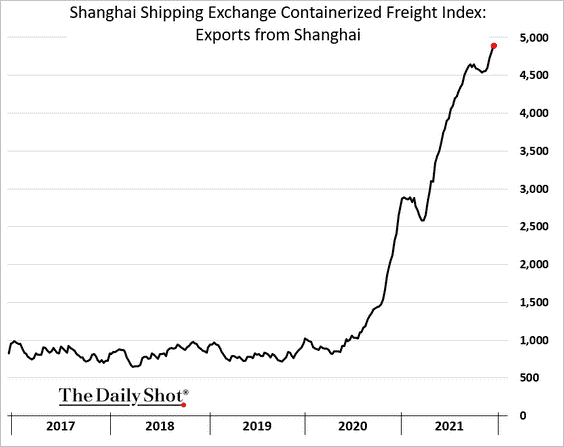
  • Although there’s lots of talk of #supply disruptions easing container #freight rates in #China don’t seem to reflect any #slowdown. (Richard Bernstein)
Image

Richard Bernstein @RBAdvisors

Oil Prices Could Hit $100 By 2023 Despite Omicron Concerns

Oil at $100 a barrel was considered all but certain, until the Omicron variant struck. Goldman Sachs, however still thinks it’s a possibility in 2023. Rising oil prices has been driving inflation. But it works the other way too. Inflation has an effect on the value of the dollar, the currency in which oil contracts are priced. As it strengthens, thanks to Fed policy, $100 oil could come faster than expected.

From Bison Interest, a Houston based firm dedicated to energy investments:

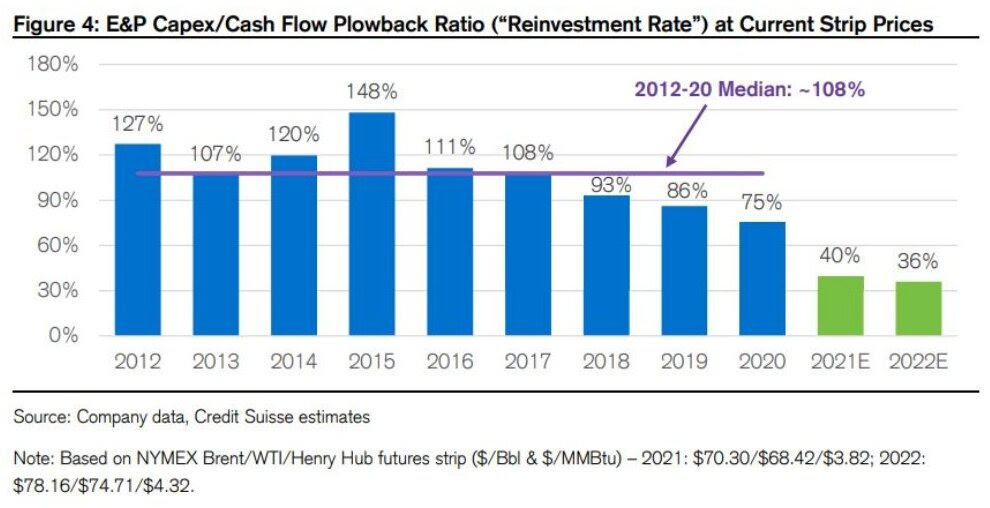
The longer-term oil bull thesis remains intact. Producers continue to exhibit capital discipline, using the cash flow generated from higher market prices to buy back shares and pay dividends, rather than investing in exploration and drilling to sustain production. This is well illustrated in a recent chart from Credit Suisse:

1475f5c3-738b-477a-b1ea-2a3688e86bfc-1

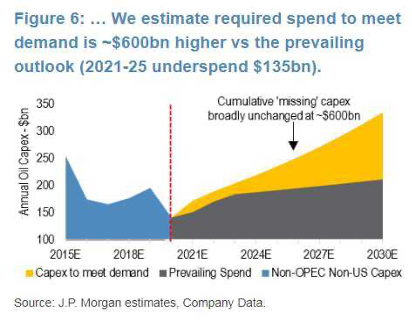
The lack of investment in the sector has compounded for some time now, and it is becoming increasingly clear that future production will fall short of demand unless investment picks up materially. This is illustrated in a chart from JP Morgan, which implies much higher future oil prices:

Picture2-1

Problematic policy will continue to contribute to projected energy deficits as world governments become increasingly hostile to the fossil-fuel industry, which ironically, coincides with the reduction in industry capital spending. World leaders and governments continue to reduce the industry’s ability to operate. In the US, the government has banned oil leases on federal lands and cancelled pipelines while simultaneously pushing for lower gasoline prices—policies which they insist are not causing higher energy prices. Our CIO Josh Young addressed this profound misunderstanding of basic market economics recently on Al Jazeera.

Shifting investor preferences are also driving the investment shortfall, as banks and investment funds continue restrict oil and gas producers’ access to capital. Consequently, the supply of credit available to E&Ps has been shrinking, resulting in a higher cost of capital and contributing to lower industry-wide investment, further exacerbating likely future under-supply:

408568973

You may not have heard this from muted news headlines in the US, but there is an ongoing energy crisis in Europe and Asia. It is likely the culmination of years of underinvestment in reliable energy sources, as a part of a poorly implemented energy transition. Global commodity prices continue to rise, fuelling price inflation as higher costs are passed along the value chain. The situation is especially bad in Europe, where natural gas prices have nearly quadrupled this year and are now sitting above $200 per barrel of oil equivalent, recently hitting a high of $270!

In addition to costing people more to heat and power their homes in the winter and disproportionately burdening the poorest people, higher energy prices have a negative spillover effect into other industries. For instance, higher gas prices are forcing ammonia factories—which convert gas into fertilizer used to grow crops—to shut down, driving food prices higher. Historically, food inflation has not reflected positively on the incumbent administration, and in some cases, has catalyzed revolutions such as the Arab Spring. As fuel and energy price subsidies roll out across Europe and elsewhere, prices may go even higher as demand destruction is averted through subsidies. Additionally, gasoline substitutes like fuel oil and diesel will be increasingly consumed, potentially forcing oil prices much higher from “surprise” demand.

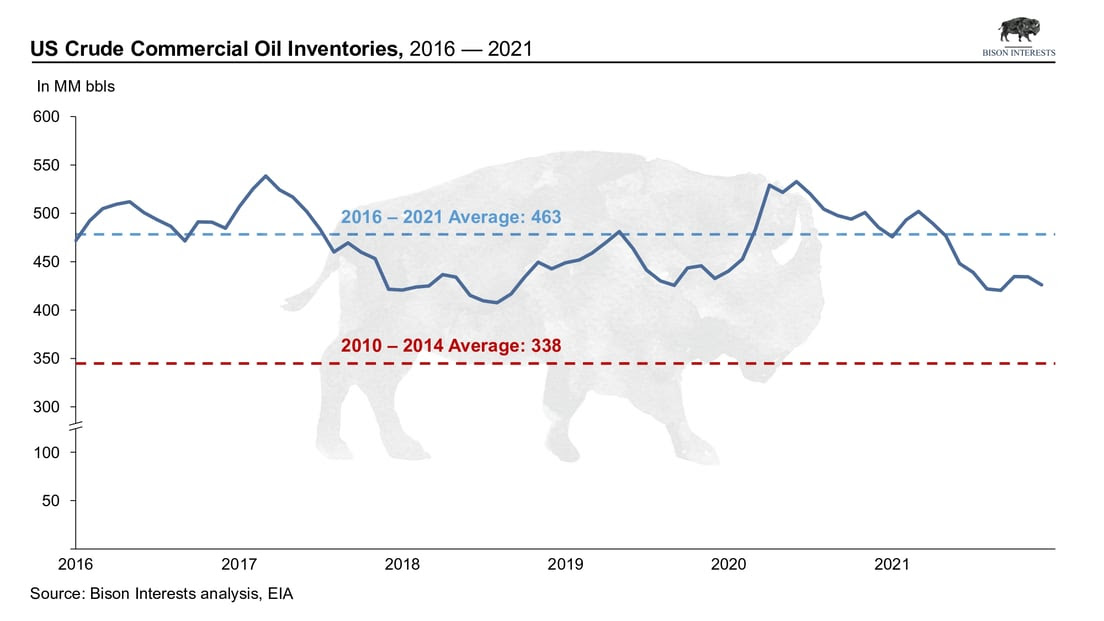
Onshore stockpiles of crude oil and distillates continue to draw down amidst a backdrop of post-pandemic heightened demand, which in our view, increases the likelihood of an undersupplied market moving forward. We addressed this previously in “Oil Demand is Outweighing Supply”, and the situation has since worsened. Additionally, the OPEC+ has the stated their intention to get inventories back to their 2000—2014 average of 338 MM bbls, a period in which oil prices were ~$100/barrel:

Embracing the Volatility and Buying the Black Friday Sale on Oil - Charts v3_page-0001

A consequence of sustained underinvestment in oil exploration, production and critical infrastructure is that most oil-producing countries simply don’t have the spare capacity needed to ramp up production moving forward. As such, it is likely that oil prices will rise as the market shifts into a structural deficit. This deficit may persist due to non-economic reasons such as ESG-driven divestment and unfavourable regulations. Our early call on OPEC+ spare capacity being lower than advertised is rapidly becoming a widely adopted narrative, with the cartel having once again come short of its own targets in November.

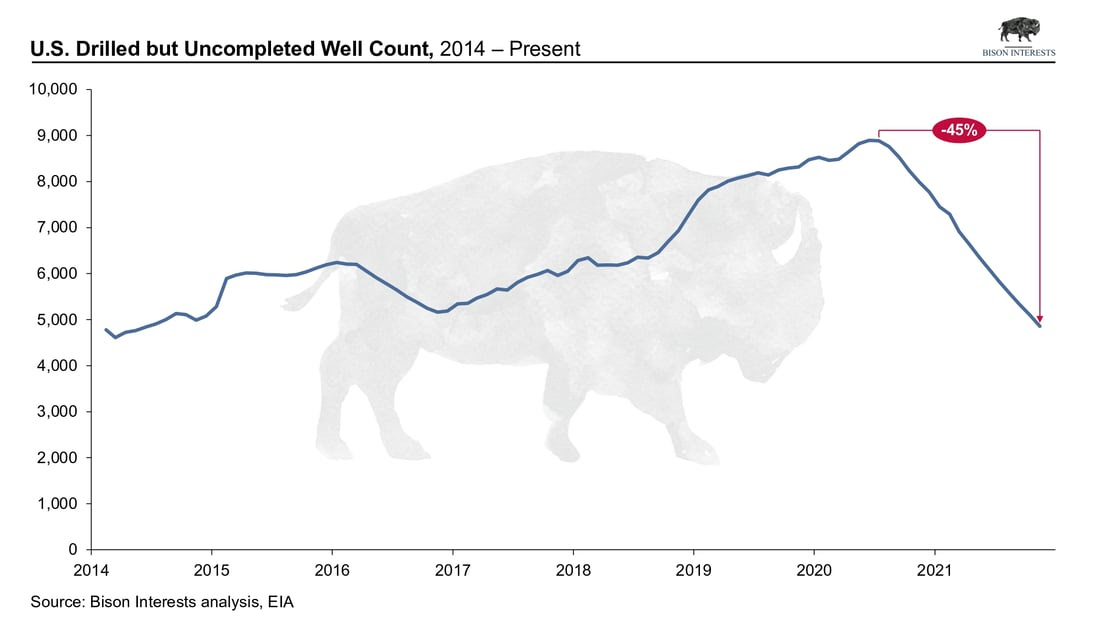
The situation in the U.S, which supplies roughly a fifth of global oil supplies, is equally promising for higher prices. The inventory of drilled but uncompleted wells (DUC’s), which are a form of working capital for E&P’s and are necessary to maintain and grow production, is approaching dangerously low levels:

Embracing the Volatility and Buying the Black Friday Sale on Oil - Charts v3 copy 4_page-0001-1

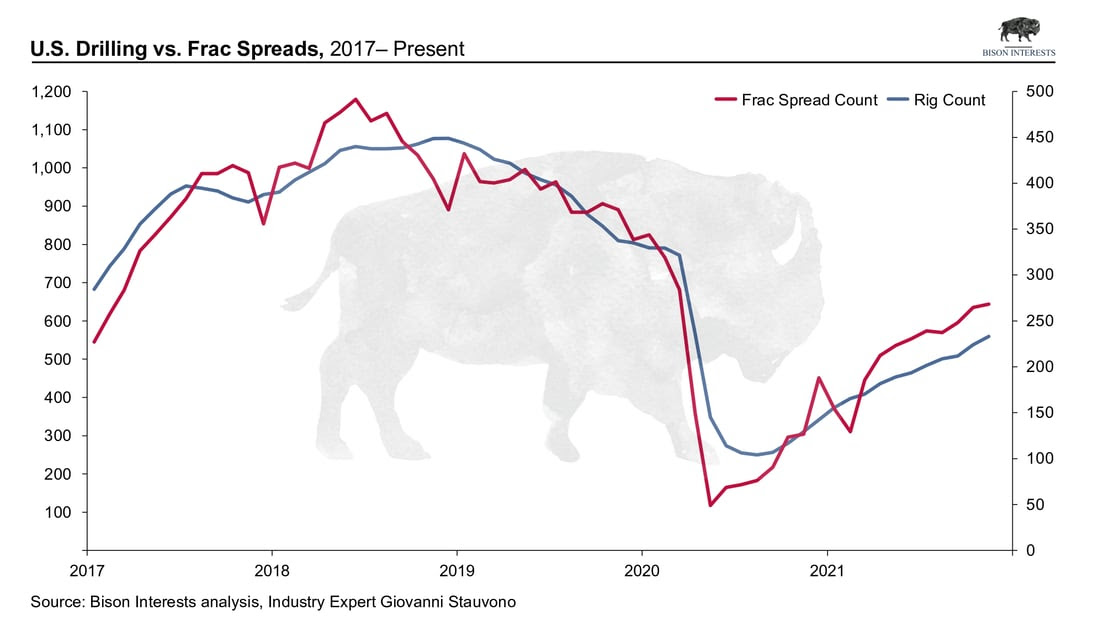
DUCs are a form of oilfield working capital. A producing shale oil well is brought online in two distinct phases, each requiring different specialized crews and equipment: The well is first drilled using a drilling rig, and is then stimulated to production, or “completed,” using a frac spread. A DUC is a well that has been drilled but has not yet been completed (thus the DUC acronym: Drilled Un-Completed). Therefore, when the rate of drilling outpaces completions DUC inventory rises—which has been the case for some time now—DUC inventory draws down.

Bison is currently performing an in-depth analysis of the DUC shortage and possible outcomes moving forward (more on this to come). At a high level, we surmise that the higher supply of frac spreads relative to drilling rigs is a major driver of DUC depletion:

Embracing the Volatility and Buying the Black Friday Sale on Oil - Charts v3 copy_page-0001

Our preliminary calculations indicate that the U.S needs to add over 100 drilling rigs to keep the DUC count flat and sustain production at current levels or deliver moderate growth:

Screen Shot 2021-12-17 at 4.07.46 PM

This is a material increase over the existing rig count, which currently sits at 560 as of November. This has meaningful implications for likely US production, as there is substantial lead time needed for rigs to be refurbished and/or re-activated, transported to the appropriate well pad and to then begin drilling. Additionally, severe labor and supply shortages may exacerbate the issue even if the equipment could otherwise be supplied on time. Ultimately, we anticipate that the rig count may not reach necessary levels for the reasons above, US production may continue to underwhelm expectations, and oil and gas prices will likely continue their climb higher.

Like many of the topics we address in our research, the potential impact on US production of the rapidly depleting inventory of DUCs is under appreciated.
TECHNICALS WATCH

First the sell side:

JPMorgan Says Investors Too Bearish, Doesn’t See Stock Selloff

There’s no reason to fear that the rally that catapulted U.S. stocks to successive records this year will end anytime soon, according to JPMorgan Chase & Co. strategists. In fact, more investors may soon join.

“Conditions for a large selloff are not in place right now given already low investor positioning, record buybacks, limited systematic amplifiers, and positive January seasonals,” the strategists led by Dubravko Lakos-Bujas wrote in a note to clients. “Investor positioning is too bearish — the market has taken the hawkish central bank and bearish omicron narratives too far.” (…)

For JPMorgan strategists, however, the “extreme stock dispersion and record concentration within equities” is an indicator of an abundance of caution, not a looming selloff. Investors have been treating mega caps as safe-havens, or “pseudo-bonds,” the strategists wrote.

If anything, the drawdown in smaller companies offers investors attractive entry points for “reopening stocks”, such as travel and hospitality, as well as energy and e-commerce, as inflation normalizes and concerns over the Fed’s hawkishness abate, the strategists said.

The bullish outlook echoes the one of Goldman Sachs Group Inc. strategists, who also said earlier this month that the narrowing rally doesn’t point to an imminent major drawdown.

“Rising concentration is not a reliable indicator for market peaks,” JPMorgan strategists said.

The buy side:

T Rowe Price chief warns of ‘free-form risk-taking’ in buoyant markets Bill Stromberg, head of $1.6tn fund group, sees increased speculation as stocks hit new records

The neutral side:

My favorite technical analysis firm says that the accumulated internal market damage will need time, and still missing sustained demand, to cure.

This NDR chart (via CMG Wealth) illustrates the weak demand/supply trend:

U.S. large cap indices remain in an uptrend, mainly carried by a few heavyweights. Callum Thomas shows the “Stealth Correction” — around a 3rd of the market is tracking below their respective 200-day moving averages.

Outside the USA, equities are struggling with all moving averages pointing down.

acwx

U.S. small caps are also struggling with unfriendly moving averages:

iwm

Satellite images show Russia still building up forces near Ukraine President Vladimir Putin said on Thursday that Russia wanted to avoid conflict, but needed an “immediate” response from the United States and its allies to its demands for security guarantees.
Santa shortage

Demand for professional Santas surged this season, but supply dwindled as many chose to retire or take the year off, Axios Local reporters found across the U.S. Many Santas fall into the high-risk category due to their age or weight. Hundreds have died since the beginning of the pandemic, many due to COVID-19, Slate reports.

Shortages may continue next season, with enrollment at “Santa schools” down and fewer St. Nicks entering the industry.

THE DAILY EDGE: 23 DECEMBER 2021: China’s Coming Omicron Wave

HAPPY HOLIDAYS!

The Daily Edge will be published sporadically in the next 2 weeks.

A special thank you to donators who help support this blog. Very, very much appreciated.

Apologies if  have not sent a personalized thank you note like I normally do. The recent weeks/months have been particularly busy for me.

On January 3rd, I will begin my 14th year blogging!

U.S. Existing Home Sales Rise in November to a 10-Month High

Existing home sales rose 1.9% m/m (-2.0% y/y) to 6.460 million units (SAAR) in November after unrevised rises of 0.8% to 6.340 million in October and 7.0% to 6.290 million in September, according to the National Association of Realtors (NAR). November existing home sales were at the highest level since January, up 11.8% from a May low. The Action Economics Forecast Survey expected a rise in sales to 6.53 million units in November. These data are compiled when existing home sales close.

Existing single-family home sales rose 1.6% (-2.2% y/y) to 5.750 million units in November after a 1.3% increase to 5.660 million in October. That was the third successive m/m rise to the highest level since January. Sales of condos and co-ops rebounded 4.4% (0.0% y/y) to 710,000, the highest level since July, after a 2.9% decline to 680,000.

Sales patterns mostly improved last month. Sales in the South a

dvanced 2.9% (1.1% y/y) to 2.850 million in November after holding steady at 2.770 million in October. Sales in the West rose 2.3% (-3.6% y/y) to 1.330 million, the highest level since February, following a 0.8% decline to 1.300 million. Sales in the Midwest grew 0.7% (-0.7% y/y) to 1.520 million, a 10-month high, on top of a 4.9% gain to 1.510 million. However, sales in the Northeast were unchanged (-11.6% y/y) at 760,000 in November after a 1.3% October drop.

The median price of an existing home increased 0.3% (13.9% y/y) to $353,900 in November, a three-month high, after a 0.4% rebound to $352,700 in October. Prices in the South rose 1.7% (18.4% y/y) to $318,900, a record high, after having recovered 2.7% to $313,600. In the Midwest, prices were up 0.2% (9.0% y/y) to $260,100 following four consecutive m/m drops. In contrast, prices in the Northeast fell 1.7% (+4.7% y/y) to $372,500 after a 2.1% drop to $379,100, registering the fifth straight m/m fall to the lowest level since March. In the West, prices held steady (+8.4% y/y) at $507,200 after a 0.2% October rise. The price data are not seasonally adjusted.

The number of existing homes on the market dropped 9.8% (NSA) in November to 1.110 million units (-13.3% y/y), the lowest level since March, after a 2.4% decline to 1.230 million in October. The supply of homes on the market fell to 2.1 months in November, an eight-month low, from 2.3 months in October. That was well below the high of 4.6 months in May 2020 but above the all-time low of 1.9 months reached last December. These figures date back to January 1999.

image

image
U.S. Consumer Confidence Improved in Early December A monthly survey found that consumers’ concerns about inflation declined as did concerns about Covid-19.
Surging Inflation Has Workers Demanding Bigger Raises Higher prices, a worker shortage and a revitalized labor movement are bringing about the return of pay increases tied to inflation, known as cost-of-living adjustments, or COLAs.

(…) “While understandable from the point of view of workers, the danger of widespread use of COLAs is they institutionalize inflation and contribute to a wage-price spiral,” said Michael Walden, professor emeritus at North Carolina State University.

Such a wage-price spiral emerged in the 1970s and was broken only by tighter monetary policy, Mr. Walden said. A wage-price spiral could reoccur if the Federal Reserve doesn’t raise interest rates significantly more than it has signaled, he said.

Some economists see less reason to worry. COLA clauses were only a small contributor to higher inflation in the 1970s and 1980s, which was propelled by other factors including oil crises, said Mr. Katz, the Cornell economist.

Further, a much smaller share of workers are in a union today, and COLAs are rarer, reducing the likelihood of a wage-price spiral, Mr. Katz said. Roughly 6.3% of private sector workers belonged to a union last year, down from 16.8% in 1983, according to the Labor Department.

Last month, members of the United Auto Workers at Deere & Co. ended a five-week strike by ratifying a contract that, among other pay and benefit increases, would adjust wages every three months to match inflation.

Tuesday’s five-year contract between Kellogg and the Bakery, Confectionery, Tobacco Workers and Grain Millers International Union gives employees pay raises and quarterly cost-of-living adjustments. (…)

Union members aren’t the only workers getting pay increases tied to inflation.

Minimum-wage workers will see pay increases reflecting the higher cost of living in several states including Arizona, Colorado, Maine, Minnesota, Montana, Ohio, Washington and South Dakota, according to an analysis by the National Conference of State Legislatures.

In Arizona, for example, minimum-wage workers will see their hourly pay rise 5.3% to $12.80 at the start of next year from the current $12.15. The minimum wage rose 1.3% at the beginning of this year, reflecting lower inflation at the onset of the pandemic. (…)

A number of major union contracts expire next year, including between West Coast dockworkers and the companies that operate marine terminals. (…)

So far, nonunion workers have seen their wages rise faster than union workers whose pay increases tend to be set in multiyear contracts. In the third quarter, nonunion wages for private-sector workers rose 4.7% from the same quarter a year ago, compared with 3.5% for union wages, according to the Labor Department.

“If history is any guide, I expect we’ll see significant wage pressure in the union part,” said Gad Levanon, chief economist at the Conference Board.

fredgraph - 2021-12-23T060155.332

Larry Summers Gets His ‘Told You So’ Moment on Inflation Summers Sees Risk of Recession Soon, ‘Secular Stagnation’ Later

(…) I did what I thought was a straightforward analysis of the situation. I looked at how short incomes were of trend. And I saw that they were about $25 billion or $30 billion short of trend each month. And that that number was declining. And then I saw that the proposed transfer payments and other stimulus represented close to $200 billion a month.

And so I thought if you were filling a $30 billion hole with $200 billion of spending, there was likely to be some overflow and that overflow would translate into inflation. I did the same calculation essentially, looking at GDP, and I saw a 2% or 3% GDP gap, met with about 15% of stimulus.

(…) people had not seen inflation in 40 years. So they assumed it was something you didn’t need to worry about, but that if you just did a straightforward analysis, demand was gonna run ahead of supply. And I have to say, I think that’s pretty much what we’ve seen.

I don’t think that the analyses suggesting that this is all bottlenecks are right, 90% of CPI components show inflation above 3%, more than 50% above the Fed’s target. If I look at what’s happening in the labor market, it looks to me like we’ve got substantial labor shortages that push wages up, but only with a lag because wages aren’t reset constantly. We’ve got substantial pressures in the housing market that have not manifested themselves at all, really, in the official price indices yet. So I think we’ve got a fairly serious inflationary situation that’s been growing for quite some time. (…)

I’m much more influenced by the experience of my own talking to businesses and even more people like those Bloomberg employees who spend their lives talking to companies, and they all say more or less the same thing. “We’re gonna have to push up wages because of labor shortages. And when we do, we have plenty of pricing power.”

And I guess I trust those anecdotes more than I trust econometric relationships estimated over periods when there’s been very little variation. We did have some months in 2019 with low unemployment and not extremely rapid wage pressure, but that’s one several-month experience in 20 years. I don’t think there’s any support in the data for the view the Fed took that the economy can enjoy 3.5% unemployment for multiple years with significantly declining inflation.

Indeed, the Fed’s forecasts call for unemployment below its estimates of the normal level, interest rates never reaching in the next few years its concept of the normal level and, nonetheless, continuous deceleration of inflation. That might happen. But it doesn’t seem to me that it is the most intuitive reading of our macroeconomic history. (…)

If I thought we could sustainably run the economy in a red-hot way, that would be a wonderful thing. But the consequence, and this is the excruciating lesson we learned in the 1970s, the consequence of an overheating economy is not merely elevated inflation, but constantly rising inflation. And that’s why my fear is that we are already reaching a point where it will be challenging to reduce inflation without giving rise to recession.

Should we do all kinds of things? Should we raise the minimum wage? Absolutely. Should we empower unions? Yes. But this kind of policy—there are no examples of successful inflationary policy that has worked out to the benefit of workers. And there are dozens of examples from the Labor Party in Britain in the 1970s to multiple Latin American experiences to our own experience in the ‘60s and ‘70s where it backfired with respect to the very people it was trying to help. (…)

I’m surprised by how low long-term interest rates are. That’s something I didn’t get right. I would have forecast larger increases in interest rates, given conditions. I think part of it is that markets are foreseeing that we will do what’s necessary to contain inflation and that process will be quite contractionary. And that’s part of what I think is being factored into the level of markets.

But I do think there’s a real chance that there will be a return to secular stagnation. (…) I’m really not sure what’s gonna come after this current episode. I’m certainly not confident that we’re gonna have sustained excess demand for many years. I think the challenge is that we’ve pumped up aggregate demand now, and then who knows how we’re gonna work our way through back to more normal levels of demand. (…)

Biden Extends Student-Loan Payment Pause After Virus Surges The move on Wednesday takes the moratorium on payments, interest and collections through May 1. The latest extension will help 41 million people save $5 billion per month.

China Cements Rare Earths Dominance With New Global Giant China formed a rare-earths giant by merging some key producers, creating a behemoth that will strengthen its control over the global industry it has dominated for decades.

(…) China controls most of the world’s mined output of rare earths, a broad group of 17 elements that are used in everything from smartphones to fighter jets, and has a stranglehold over processing. (…)

The State-owned Assets Supervision and Administration Commission will hold a 31.21% stake in the new group, while Chinalco, China Minmetals and Ganzhou Rare Earth Group will each own 20.33%, it said. (…)

The government also controls production, granting annual quotas to the firms. This year’s volume has been set at 168,000 tons. (…)

The country’s dominance of the sector has been an increasing concern. The little-known materials were thrust into the spotlight in 2019 when China considered export controls as part of its trade war with the U.S., which relies on the country for 80% of its imports. While ultimately no restrictions were ever implemented, it highlighted the risks of being dependent on one country and spurred a raft of announcements from Western economies pledging to boost their rare-earths independence. (…)

Rare earth prices have surged this year as demand outpaced supply, while a power shortage exacerbated disruptions and a broad rally in commodity prices increased production costs. Neodymium and praseodymium — two elements used in permanent magnets — have jumped to the highest in a decade.

Omicron Update: Dec 22 (Katelyn Jetelina)

Dr. Jetelina still provides the best accounts I can find:

Well, Omicron continues to show its colors across the globe with case rates surging far beyond what we’ve seen with any previous waves, like in Denmark and the UK. Other countries, like France, the United States, and Canada have a recent explosion of cases pointing to the beginning of their Omicron wave. Places that put in country-wide restrictions, like the Netherlands and Germany, have altered their Omicron path thus far.

It’s clear that Gauteng—Omicron’s epicenter—peaked. It looks like cases in South Africa, as a whole, also peaked.

But this peak is far more interesting than some may think, as it’s a sign that we are missing a fundamental piece of the Omicron puzzle. With R(t)=3, we would expect an attack rate of 90%, so we would expect Gauteng and South Africa to peak much higher. Scientists have offered several hypotheses:

  1. Testing. South Africa’s test positivity continues to hover around 30%, which is very odd because usually this decreases before cases decrease. So this could mean that people aren’t bothering to get tested or South Africa has reached testing capacity.

  2. Asymptomatic spread. Somewhat relatedly, the peak could mean there are far more asymptomatic cases that just aren’t detected. So there are far more “true” cases than the epi curves portray. I think this is the most likely scenario.

  3. Secondary attack rate. Omicron could have a shorter generation time, so positive cases infect far less people than Delta. In other words, the secondary attack rate is much smaller. Data from the UK, though, shows household transmission higher with Omicron than Delta, so I’m not convinced this is a driving factor.

  4. Susceptibility. Omicron is only spreading among certain levels of immunity and/or susceptibility. A running hypothesis is that Omicron and Delta will co-exist with different paths: Omicron will spread through immune evasion and come and go, while Delta could persist onward.

  5. Behaviors. Behaviors of people drastically changed due to increasing cases. While, as far as I can tell, national policies on the ground haven’t drastically changed in South Africa, people did go on summer holiday. As South African scientists warned, we need to compare the South African Omicron wave to Beta (not Delta) to account for seasonality and human behavior.

  6. Network effects. This plays some sort of role, too (and I think the most interesting). As people see their regular contacts and these networks reassert themselves, Omicron runs out of places to go.

Nonetheless, South Africa showed us that Omicron spread incredibly quickly, and we will continue to see this rate of spread across the globe.

South Africa’s hospitalizations remain about 50% of what they were for the Delta wave. Deaths continue to increase, but also much, much lower than before. Is this because immunity is working or because Omicron is less severe? We don’t know yet.

But an important preprint was released yesterday describing Omicron hospitalizations in South Africa. There was a lot in this paper, but, to me, the following was the biggest finding: Once someone got to the hospital, the odds of disease becoming severe was the same as Delta. So if the immune system was breached, Omicron did the same damage as Delta. This is consistent with another robust analysis of hospitalizations from the UK that found Omicron is not less severe than Delta.

On the other hand, lab data is showing that there are certainly physiological differences between Omicron and Delta disease processes (go here for more great details). It will be weeks or months until data crystallizes and we have a clear picture of Omicron severity. What all this means for hospitalizations and deaths in places like the United States remains unknown.

Omicron became the dominant variant in just two short weeks and now accounts for more than 73% of cases in the United States now. By next week Omicron could easily account for 100% of cases. Will Omicron completely overtake Delta or will Delta continue its path among some groups? We should get clarity on this soon.

With more Omicron will come more cases. The Northeast has, by far, the most cases right now. Washington DC is the leader (134 cases per 100,000) in which cases have increased 440% in the past two weeks. This is followed by New York City with 121 cases per 100K and a 342% increase.

The state leader is Rhode Island (118 per 100K) followed by New York (100 per 100K) and New Hampshire (88 per 100K). Hawaii (+557%), Florida (+371%), Georgia (+139%), Louisiana (+132%), and Texas (+113%) have the fastest 14-day case growth though.

Nationwide hospitalizations are only up a modest 13% and deaths continue to remain “low” at 1,351 deaths per day. But severe disease patterns lag cases 3-4 weeks, so we will see what happens in a few weeks. While I expect an uptick, I certainly don’t think we will reach levels like we saw in the past thanks to our vaccines and adaptive immune systems. It’s noteworthy, though, that the first Omicron death was reported this week in Houston among a male aged 50-60 years old who previously recovered from COVID19. Do not rely on previous infections to get you through this Omicron wave.

Throughout the pandemic, the CDC has looked to a consortium of scientific teams across the country to model projections. Recently the teams presented their Omicron projections. One of these teams, University of Texas, made their modeling public over the weekend. Their report looked at 16 omicron scenarios that varied three variables:

  1. How quickly Omicron spreads

  2. How easily Omicron evades immunity, and

  3. How quickly we’re able to roll out booster shots

The graphs below display their results for cases, hospitalizations, and deaths. The left and right graphs correspond to the low and high severity scenarios, respectively. Briefly:

  • Best case scenario (purple line below; scenario B): By mid-January 190,000 people catch the virus every day—about double what the case rate is today. In this scenario, Omicron would lead to 10,500 hospitalizations per day (a few thousand more than today) and 1,400 deaths (a few hundred more than today).

  • Worst case scenario (pink line; scenario C): By January more than 500,000 people would catch the virus every day, which is more than double the peak reached last winter. 30,000 people would be hospitalized per day and 3,900 would die every day. This scenario is the most pessimistic and, in my opinion, won’t happen for two reasons:

    • This model assumes that Omicron is more severe than Delta. This is not the case; in fact, there is considerable debate as to whether Omicron is less severe.

    • This model also assumes that there is no behavior change, which is also not realistic. People change their behaviors when cases increase, whether they realize it or not.

So, like everything in epidemiology, the “truth” lies somewhere between the best and worse case scenario in the United States.

Boosters

Not nearly enough people have their boosters in the United States: 32% of eligible Americans and 55% of those 65+. Omicron has motivated people to get boosted, though. Omicron is convincing 1 in 8 unvaccinated to change their mind, too.

One thing that’s increasingly obvious is how important boosters be in our projections. While we will start seeing an uptick in cases, we will continue to see a distinct pattern between unvaccinated, vaccinated, and boosted. Massachusetts has a great graph illustrating this effect so far.

(MA DPH)

We also really need guidance for the J&J folks. A new study showed the effectiveness of boosters with vaccines distributed in the United States. While 1 mRNA booster after JJ helps, it doesn’t help as much as the 3 mRNA series. In other words, it looks JJ people need 2 mRNA shots for full neutralizing antibody protection instead of just one.

But neutralizing antibodies isn’t the only line of defense. Another study found T-cells among those who received one or two doses of the J&J only dropped with Omicron by 30%. So, people with 1 mRNA booster after JJ should largely stay out of the hospital. I’m really hoping it doesn’t take J&J, the FDA and/or the CDC too long to comment on this. We need guidance now.

As expected, Omicron is taking hold in the United States and case rates will start skyrocketing across the country. What this means for our hospital systems is yet to be seen. As with everything in public health, we prepare for the worst and hope for the best.

Pointing up Three Sinovac Doses Fail to Protect Against Omicron in Study

Two doses and a booster of the Covid-19 vaccine made by China’s Sinovac Biotech Ltd., one of the most widely used in the world, didn’t produce sufficient levels of neutralizing antibodies to protect against the omicron variant, a laboratory study found. 

The research suggests that people who’ve received Sinovac’s shot, known as CoronaVac, should seek out a different vaccine for their booster: Getting Germany’s BioNTech SE’s messenger RNA as a third dose saw those previously fully vaccinated with CoronaVac significantly improve in protective levels of antibodies against omicron, according to the study from the University of Hong Kong and The Chinese University of Hong Kong.

Two doses of the BioNTech shot, known as Comirnaty, was also insufficient, though adding a booster of the same type raised protection to adequate levels, the researchers said in a statement.

While much is still unknown about how Sinovac’s shot holds up to omicron — including how T cells, the immune system’s weapon against virus-infected cells, will respond — the initial results are a blow to those who have received CoronaVac. There have been more than 2.3 billion doses of the shot produced and shipped out, mostly in China and the developing world. (…)

Last week, Sinovac released lab studies saying 94% of people getting three doses generated neutralizing antibodies, though it didn’t say what level. The Hong Kong researchers set a threshold for what they considered a sufficient level of antibodies for protection based on earlier studies published in the journal Nature Medicine. (…)

Pointing up The findings are bad news for China, which has managed to insulate the vast majority of its people from Covid-19 with closed borders and strict containment measures, but now faces the challenge of keeping omicron out. The government has given out 2.6 billion homegrown shots — many of them CoronaVac — to its population of 1.4 billion people, but will likely have to develop and roll out new vaccines before it can shift away from its isolationist stance.

  • China Locks Down City of 13 Million in Protracted Covid War China locked down the western city of Xi’an on Thursday to stamp out a persistent Covid outbreak, its biggest such move since the pandemic started in Wuhan, underscoring how the country’s zero-tolerance approach hasn’t allowed it to move on since the virus emerged nearly two years ago.

(…) While local authorities have in the past used targeted lockdowns to slow outbreaks in smaller places in China, no major city has been put under mass restrictions since Wuhan in early 2020. It has a similar population size as Xi’an.

Officials in Beijing on Thursday acknowledged that there will inevitably be Covid infections at the winter Olympic Games, which are set to begin in early February. They urged all participants to get booster shots to better protect against the virus, especially those caused by the immunity-evading omicron variant. (…)

Meanwhile, China has found four omicron infections from people returning from overseas. It hasn’t yet seen the far more infectious strain spread in the local community. Authorities have vowed to tighten restrictions at borders and ports as they see a mounting risk of infection seeping in from overseas.

Intel Apologizes to China Customers Over Xinjiang Stance

Intel Corp. apologized after its opposition to Xinjiang labor sparked a backlash against the U.S. chipmaker in China, highlighting how multinational companies are increasingly getting caught up in a geopolitical spat between two global powers over issues such as human rights.

The chipmaker sent a letter asking suppliers not to use any labor or products sourced from Xinjiang “in order to ensure compliance with U.S. legal requirements,” it said in a WeChat statement Thursday. The company had no other intention and did not mean to express a position on the matter, according to the statement. (…)

Intel’s apology comes after social media users this week seized on the issue to criticize the U.S. firm. The lead singer of TFBoys — one of China’s most popular boy bands — Wang Junkai said it will terminate all partnerships with the U.S. company immediately, according to a statement by his studio Wednesday. The studio said it had repeatedly asked Intel to “express a correct stance,” but the chipmaker had yet to respond.

“National interests trump everything!” the studio wrote in its post. (…)

Intel’s continuing access to the Chinese market is crucial to its growth as it struggles with increasing competition. China is the largest consumer of semiconductors in general and the biggest market place for personal computers, the main destination for Intel’s microprocessors. The chipmaker derived more than a quarter of its 2020 revenue from the country. (…)

The Communist Party’s Global Times cited unnamed analysts as warning that while no official measures had been taken by China, the severing of ties by the pop idol “serves as a fresh warning siren” to Intel and other foreign companies that wanted to profit from the Chinese market, but were at the same time seeking to undermine the country’s core interests.

Tencent Hands Out $16 Billion of JD Stock in Crackdown-Led Shift Tencent Holdings Ltd. plans to distribute more than $16 billion of JD.com Inc. shares as a one-time dividend, a surprise retreat from the Chinese e-commerce firm after Beijing moved to curtail the power of tech monopolies.