The enemy of knowledge is not ignorance, it’s the illusion of knowledge (Stephen Hawking)

It ain’t what you don’t know that gets you into trouble. It’s what you know for sure that just ain’t so (Mark Twain)

Invest with smart knowledge and objective odds

THE DAILY EDGE: 5 NOVEMBER 2021: Fear is Gone, It Should Not

Payroll employment rises by 531,000 in October; unemployment rate edges down to 4.6%

Total nonfarm payroll employment rose by 531,000 in October, and the unemployment rate edged down by 0.2 percentage point to 4.6 percent, the U.S. Bureau of Labor Statistics reported today. Job growth was widespread, with notable job gains in leisure and hospitality, in professional and business services, in manufacturing, and in transportation and warehousing. Employment in public education declined over the month. (…)

The labor force participation rate was unchanged at 61.6 percent in October and has remained within a narrow range of 61.4 percent to 61.7 percent since June 2020. The participation rate is 1.7 percentage points lower than in February 2020. The employment-population ratio, at 58.8 percent, was little changed over the month. This measure is up from its low of 51.3 percent in April 2020 but remains below the figure of 61.1 percent in February 2020. (…)

Thus far this year, monthly job growth has averaged 582,000. (…)

The change in total nonfarm payroll employment for August was revised up by 117,000, from +366,000 to +483,000, and the change for September was revised up by 118,000, from +194,000 to +312,000. With these revisions, employment in August and September combined is 235,000 higher than previously reported.

U.S. Productivity Declines & Unit Labor Costs Surge in Q3’21

Nonfarm business sector productivity fell 5.0% (SAAR) during Q3’21 following a 2.4% Q2 increase, revised from 2.1%. It was the sharpest decline since Q2’81. A 1.8% decline had been expected in the Action Economics Forecast Survey.

Nonfarm business production grew 1.7% last quarter (6.1% y/y). The gain was the smallest in five quarters. Growth of hours-worked surged to 7.0% (6.7% y/y), the strongest rise in three quarters.

Compensation per hour rose 2.9% (4.3% y/y), the fourth straight quarter of growth.

The rise in compensation and the fall in productivity combined to lift unit labor costs 8.3% to a record level, following a 1.1% increase in Q2. A 5.6% increase had been expected.

In the manufacturing sector, productivity declined 1.0% after surging 8.5% in Q2. Output rose a steady 5.7% last quarter (6.3% y/y) and hours-worked increased 6.7% (3.8% y/y) after falling 2.5%.

Factory sector compensation rose 1.9% in Q3, firm for the fourth straight quarter. Unit labor costs rose 2.9% and reversed much of the Q2 decline.

This is the YoY trend:

fredgraph - 2021-11-05T060353.302

Since Q4’19, unit labor costs are up 4.4% annualized, way above trend. Let’s see how this, and biz sales, evolve as the economy “normalizes”.

image

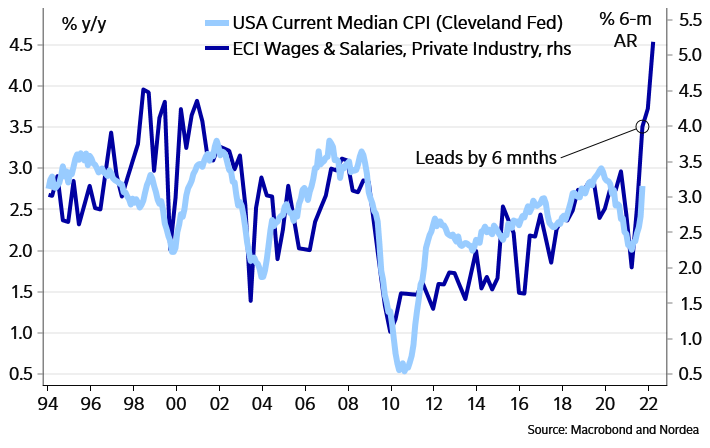
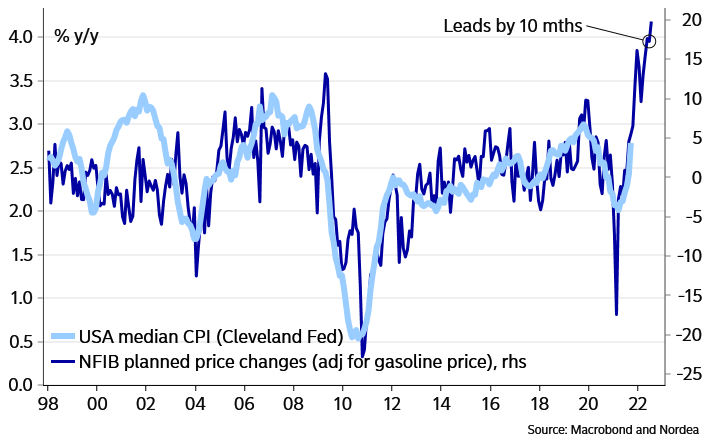
At its Wednesday presser, Powell said “The inflation that we’re seeing is really not due to a tight labor market.” He may be right, but he also could have added “yet” as these Nordea charts suggest:

High labour cost increases should lead to higher median CPI
US companies continue to signal major price hikes
BTW: “the Bakery, Confectionary, Tobacco Workers and Grain Millers’ Union yesterday declined to bring Kellogg’s latest proposal, termed its “best and final offer” by management, to those striking laborers for a vote. “There’s no question that today’s business environment is as challenging as we’ve ever seen it,” lamented CEO Steve Cahillane.” (ADG)

OPEC, Russia Stick to Gradual Oil Production Boost Producers reject U.S. pressure to boost output faster and ease prices

OPEC and a group of Russia-led producers agreed to keep to their gradual, monthly increase in oil output, deciding to boost production by 400,000 barrels a day next month and rebuffing stepped-up pressure from the U.S. to boost output and ease prices. (…)

In recent days, apart from public comments, U.S. officials have reached out to Saudi Arabia, the United Arab Emirates and Iraq, asking to get more oil to the market, according to people familiar with the matter. (…)

“If we increase output all of a sudden and demand is hit in one area because of a new wave of covid, the price would collapse,” a Saudi oil official said. “So bringing back more oil to the market rapidly is not on the cards at the moment.”

unnamed - 2021-11-05T071911.180

  • Other supply problems: the number of dairy cows in the U.S. is plunging at a pace not seen in more than a decade, leading to weak production. (…) Global stockpiles of milk powder, which are exported around the world and can be reconstituted into the beverage, have been dropping for four years. (Bloomberg)
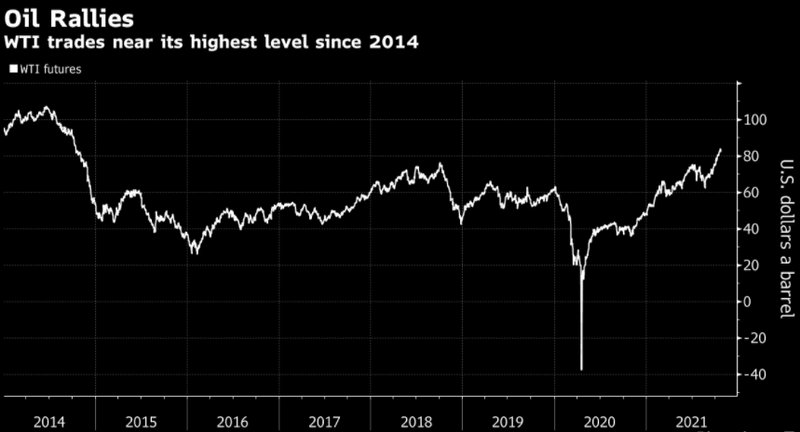
Oil rallies

  • And meat:

image

U.K. Rate-Decision Surprise Ripples Across Global Bond Markets The Bank of England holds fire on an interest-rate move, triggering the biggest U.K. bond-yield drop in years.

The bank has said it expects to raise borrowing costs soon, moving ahead of the Federal Reserve and other major central banks in withdrawing stimulus to tame inflation.

But the bank held fire Thursday, surprising investors who had become convinced an increase was coming. Yields on one-year government bonds, known as gilts in the U.K., nearly halved within hours, dropping 0.22 percentage point, in their biggest daily move since the 2009 financial crisis. The move also sent the pound down 1.4% against the dollar to $1.349, its biggest one-day fall in more than a year. (…)

Yields on U.S. two-year Treasury notes slipped 0.07 percentage point to 0.41%. German one-year government-bond yields fell 0.08 percentage point to negative 0.83%, their biggest one-day drop since the coronavirus market panic of March 2020, according to FactSet. (…)

Mr. Bailey said he was clear the need for tighter policy was closely linked to developments in the labor market and on inflation.

“It was a very close call,” he said at a news conference. “We are in a situation where the calls are close, they’re quite hard.” (…)

New forecasts showed officials expect annual inflation will be close to 2% in two years and below 2% in three if interest rates are ratcheted higher, to around 1% by the end of next year, as implied by prices in financial markets when the BOE concluded its forecasts. That suggests officials anticipate a slower and steadier path of rate increases than investors. (…)

It expects supply-chain disruption and labor shortages to dog the U.K. throughout next year, pulling expected growth in 2022 to 5%, from a forecast of 6% previously. (…)

Euro zone retail sales record surprise fall on weak Germany

Retail sales, a proxy for consumer demand, in the 19 countries sharing the euro, fell 0.3% month-on-month in September and were up 2.5% from a year earlier, the European Union’s statistics office said.

Economists polled by Reuters had expected a 0.3% monthly rise in retail sales and a 1.5% year-on-year increase.

Part of the month-on-month miss, however, may be down to revisions as retail sales in August were now estimated to be up 1% compared with a 0.3% rise reported earlier. (…)

Eurostat said car fuel sales rose 1% on the month while food, drinks and tobacco sales rose 0.7%. But non food sales dropped by 1.5%, including a 1.4% decline in Internet and mail order sales.

Germany, the euro zone’s biggest economy, recorded the largest, 2.5% drop in retail sales but Finland and the Netherlands were also deep in negative territory.

U.S. Trade Deficit Deepens to New Record in September

The U.S. trade deficit in goods and services increased to $80.93 billion during September from $72.81 billion in August, revised from $73.25 billion. The latest deficit was a record for the series which extends back to January 1992. A deficit of $80.3 billion was expected in the Action Economics Forecast Survey. Exports declined 3.0% in September (+16.6% y/y) following a 0.6% August gain while September imports rose 0.6% (19.9% y/y) after increasing 1.3% in August.

The trade deficit in goods deepened to $98.2 billion in September from $80.2 billion in August, revised from $89.41 billion. It compared to a $96.25 billion deficit in the advance report issued last week. Exports of goods fell 4.7% (+16.8% y/y) after a 0.8% August rise. Holding back the export total, industrial supplies & materials exports fell 9.9% (31.3% y/y) following a 6.7% rise. Capital goods exports declined 3.6% (+12.3% y/y) after falling 1.9% in August. Auto exports fell 2.0% (-11.7% y/y) following an 8.0% drop. Food exports were off 1.2% (-3.6% y/y), the third decline in four months. Increasing were nonauto consumer goods exports which strengthened 3.7% (30.5% y/y) in September after rising sharply in four of the prior five months.

Imports of goods rose 0.9% in September (18.4% y/y), about the same as in August. Capital goods imports increased 4.0% (18.7% y/y) after falling in three of the prior four months. (…) Nonauto consumer goods imports eased 0.1% (+12.4% y/y), the third decline in four months. Auto imports dropped 7.7% (-16.6% y/y), and they’ve fallen 21.8% since December of last year.

Petroleum imports rose 4.3% in September and have roughly doubled y/y. The  monthly rise occurred despite a decline in the price of crude oil to an average $64.43 per barrel from $65.06 in August. The price was substantially higher than $37.60 per barrel one year earlier. Nonpetroleum imports rose 0.6% (14.3% y/y) after rising 1.0% in August.

The real (adjusted for price changes) trade deficit in goods deepened to $111.0 billion (chained 2012 dollars) in September from $101.5 billion in August. Real exports of goods fell 4.9% (+0.8% y/y) after a 0.5% rise. Real imports of goods increased 1.0% (9.9% y/y), the same as in August. (…)

The chart below plots imports and exports, nominal and real, with Q4’19 = 100. Imports are up 13.2% (5.9% real) while exports are unchanged (and down 9.3% in real terms).

fredgraph - 2021-11-05T055433.909

JPMorgan cuts China growth forecast for fifth time since August

JPMorgan cuts its fourth quarter growth forecast for China to 4.0% quarter-on-quarter from 5.0% on Friday, citing the impact of power shortages and the recurrence of COVID-19 clusters hitting consumer spending and services.

“Looking back, we have downgraded China’s growth forecasts five times since August,” JPMorgan’s Haibin Zhu said in a note, adding the bank now expected full-year growth of 7.8% and 4.7% in 2022.

China’s housing market is more than “adjusting”: watch commodities!

EARNINGS WATCH

We now have 420 reports in, an 81% beat rate and a declining +10.7% surprise factor, bested by Financials at +18.9% after having cut their loan-loss reserves.

Trailing EPS are now $197.49. 2021e: $204.21. 2022e: $220.63.

Q4’21 EPS are seen up 22.0%, in line with the 21.7% growth expected on Oct.1.

But 2022 growth has been reduced from +9.2% to +7.5%.

Pointing up We got the first tally of Q4 pre-announcements from Refinitiv/IBES: not off to a good start. Eight more companies than at the same time last year have pre-announced, all negative plus 2 more. Compared with Q3, the N/P ratio has tripled.

image

Meanwhile, fear is gone:

image

Canada’s Banks Get Green Light to Resume Share Buybacks, Dividend Increases

Fingers crossed Why a New Pill to Treat Covid Could Be a Game Changer Molnupiravir, an antiviral pill being developed by Merck & Co., has been touted as a potential game changer in the fight against Covid-19. The experimental medication was shown to reduce the risk of hospitalization or death by about half in a late-stage study of adults with mild-to-moderate cases. The promise of a drug that patients can easily get and take at home has prompted some governments to order supplies even before most regulators have decided whether to approve its use.

  • Pfizer said its antiviral pill was 89% effective at preventing people at high risk of severe Covid-19 from dying or needing hospitalization, as it plans to ask the FDA to authorize the drug’s use this month. (WSJ)

THE DAILY EDGE: 4 NOVEMBER 2021: Services PMIs; Small Caps Jump.

Inflation Debate Can Wait as Fed Tapers The Federal Reserve has time to determine whether inflation will prove transitory before it has to make a decision on rates.

The Fed’s policy-setting committee on Wednesday said that it would continue to hold rates near zero but also said that starting this month it will reduce its purchases of Treasurys and mortgage-backed securities, and expects to continue to reduce them in the months ahead. (…)

In the press conference following the central bank’s meeting, Fed Chairman Jerome Powell (…) said that before raising rates the Fed would like to see more healing in the labor market, which is still five million jobs short of where it was before the pandemic. (…)

The Fed said it would reduce asset purchases by $15 billion a month, but reserved the prospect of accelerating or slowing down that pace “if warranted by changes in the economic outlook.” Officials don’t want to lift rates until after they have ended the bond purchases.

The pace of asset-purchase reductions that the Fed set out on Wednesday suggests the tapering process won’t be complete until sometime in June. (…)

Mr. Powell said the rate-setting committee wanted to “take a step back from transitory,” which is a word that has become increasingly confusing, he added. “It means different things to different people,” he said. “For some, it carries a sense of ‘short-lived’” or a time interval “measured in months, let’s say. Really, for us, what transitory has meant is that it will not [lead to] permanently or very persistently higher inflation.”

The changes to the statement, Mr. Powell said, also acknowledged greater uncertainty about the Fed’s expectation over how soon inflation would slow. (…)

“What’s happened—and we’re very, very straightforward about it—is that inflation has come in higher than expected, and bottlenecks have been more persistent and more prevalent,” said Mr. Powell. “We see that just like everybody else does, and we see that they’re now on track to persist well into next year.”

Mr. Powell said the central bank hoped to see inflation moving down by next spring or summer. He also said it was possible that labor-market conditions by the second half of next year could be consistent with the Fed’s goal of maximum employment, which would be sufficient to justify higher interest rates. (…) “The inflation that we’re seeing is really not due to a tight labor market.”

Mr. Powell also acknowledged more explicitly how higher demand was contributing to kinks in supply chains. “Our policy will adapt, and has already adapted, to the changing understanding of inflation, and of bottlenecks and the whole supply-side story, which is also partly a demand story,” he said. (…)

“We think we can be patient,” he said. “If a response is called for, we will not hesitate.” (…)

What’s new?

  1. Powell acknowledged that they have been wrong on inflation so far, “higher and more persistent”, and that it is also “demand related”.
  2. The Fed now “hopes”, no longer “expecting”, to see inflation moving down by spring or summer.
  3. But never mind inflation, the main concern is employment now seen “possibly” at “maximum employment” in the second half of 2022. This would then “justify higher interest rates”.
  4. Problem is “There’s room for a whole lot of humility here as we try to think about what maximum employment would be,” Powell said. He tried to clarify with “maximum employment can be measured in several ways. We look at a range of things. By many measures we are already at a very tight labor market, but the issue is how persistent is that”. Powell mentioned quit rates, wage growth and employment to population ratios as three gauges of the labour market strength that the Fed looks at. Quit rates are clearly exploding, wage growth is running around 4.0% but trending higher. The Employment-Population ratio is the only weak labor indicator, 3.9% below its pre-pandemic level. That’s because the participation rate is mysteriously stuck at 61.6%, down from 63.4% in January 2020.

Powell and Lagarde are in sync: lower for longer for rates, both interest and, hopefully, inflation rates.

(…) The problems couldn’t have come at a worse time for agricultural supply chains. Global food prices have surged more than 30% in the past 12 months to reach a decade high as climate change ravages crops and the pandemic’s blow snarls production. Meanwhile, about a 10th of the world already doesn’t have enough to eat. The fertilizer crisis means major staple crops — corn, rice and wheat — are in further jeopardy, sending the Bloomberg Grains Spot Subindex up about 4% in the past month.

Nitrogen-based fertilizers, the most important crop nutrients, are made through a process dependent on natural gas or coal. Those fuels are in extremely tight supply, forcing fertilizer plants in Europe to cut back on production or even, in some cases, close. Meanwhile, China has curbed exports to ensure enough domestic supply. That’s on top of elevated freight rates, increased tariffs and extreme weather, all of which have disrupted global shipments. (…)

Across Brazil, about a third of the nation’s coffee farmers don’t have enough fertilizer. In the U.S., some corn growers are seeing prices that are more than double what they paid last year. In Thailand, some rice farmers are calling on the government to intervene in the spiraling market.

And two of the world’s top fertilizer producers,  Nutrien Ltd. and Mosaic Co., have said they expect the price surge will continue. (…)

Fertilizer scarcity could curb grain yields and quality in the European Union, the world’s biggest wheat exporter and a major barley supplier. (…)

UN's gauge of food prices jumps, getting closer to a record high image image

 image image

(Ed Yardeni)

Deere Says It’s Done Bargaining The farm and construction equipment maker said it has made its best and final offer, while striking UAW-represented workers discussed their next steps after a second vote to ratify a new contract failed.

(…) The contract rejected Tuesday would have given more than 10,000 striking Deere employees an immediate 10% increase in pay, plus an $8,500 bonus for each worker and additional 5% pay raises in 2023 and 2025. That proposal followed a previous contract offer rejected by Deere workers Oct. 10. (…)

Employees said Deere should have provided bigger raises and benefit expansions, given a surge in the company’s farm and construction equipment sales, and the pay increases other employers have offered this year to recruit workers. (…)

SERVICES PMIs

US service providers registered a steep upturn in business activity during October, according to the latest PMITM data. The rise in output was the quickest for three months and was supported by a stronger expansion in new business. In line with greater new order inflows, firms signalled the fastest increase in backlogs of work since data collection began in October 2009, despite a faster pace of job creation. Nonetheless, concerns regarding labor shortages and unstable supply chains led business confidence to drop to an eight-month low.

Meanwhile, the rate of cost inflation eased to an eight-month low, despite being quicker than any pace of increase seen before March 2021. In response to a further rise in costs, firms raised their selling prices at the fastest rate on record.

The seasonally adjusted final IHS Markit US Services PMI Business Activity Index registered 58.7 in October, up from 54.9 in September and above the earlier released ‘flash’ estimate of 58.2. The latest expansion was sharp overall and the quickest since July. The upturn was faster than the series average, with firms linking the increase to greater client demand and a further rise in new business.

image

October data signalled a strong rise in new orders at service providers, with the pace of growth quickening to a three-month high. Companies stated that demand from new and existing customers helped boost new sales. At the same time, some firms noted that greater confidence at clients alongside the return to office for some customers supported the upturn.

Conversely, new business from abroad fell for the third successive month at the start of the fourth quarter. Demand was reportedly stymied by pandemic uncertainty in key export markets. The decrease was modest overall and broadly in line with the pace seen in September.

In line with greater new order inflows and burgeoning pressure on capacity, firms registered an unprecedented rise in backlogs of work during October. Labor shortages reportedly exacerbated the strain on business capacity.

imageIn response to a record rate of accumulation in outstanding business, firms expanded their workforce numbers in October. The rate of job creation was solid overall and the fastest since June, despite some companies continuing to note challenges finding suitable candidates for current vacancies.

Service providers recorded another marked uptick in cost burdens. The rate of inflation eased but was faster than any seen before March 2021. Greater input prices were attributed to higher fuel, wage, transportation and material costs.

Subsequently, firms sought to pass on higher costs to clients through a further sharp increase in selling prices. The latest rise in output charges was the steepest since data collection began 12 years ago.

Finally, the level of optimism slipped to the lowest since February, as service providers reported ongoing concerns surrounding inflation and material shortages.

The IHS Markit US Composite PMI Output Index posted 57.6 in October, up from 55.0 in September to signal the fastest rise in private sector output since July. Although manufacturing production continued to be constrained by supply issues, the overall expansion was supported by a sharper service sector upturn.

image

Contributing to the overall expansion was a faster increase in new business. The rise was supported by sharp upticks in new orders at services providers and manufacturers. Foreign client demand fared less well, however, as goods producers registered only a fractional expansion and service sector firms saw a further contraction.

Meanwhile, backlogs of work continued to expand sharply as new orders rose and firms struggled to fill current vacancies. Employment increased solidly despite ongoing concerns regarding labor shortages.

The rate of cost inflation slowed to a six-month low in October, but remained historically elevated amid supply shortages. Firms passed costs through to clients, with private sector selling prices rising at the sharpest rate on record.

The ISM Non-Manufacturing:

unnamed - 2021-11-04T074426.328

The slowdown in euro area growth continued at the start of the fourth quarter as expansions in the manufacturing and service sectors cooled. Growth at goods producers slowed to a particularly notable degree, easing to the weakest since the recovery in manufacturing began last July. Meanwhile, activity growth hit a six-month low at service providers as strong post-lockdown rates of expansion petered out.

Supply-side constraints were a major headwind to businesses in October and also fuelled strong inflationary pressures, with both input costs and output prices rising at record rates.

After accounting for seasonal factors, the IHS Markit Eurozone PMI® Composite Output Index fell to 54.2 in October, from 56.2 in September and its lowest reading for six months. Furthermore, the latest data represented a third successive slowdown in growth across the euro area and marked a further easing from July’s 15-year high.

image

The service sector continued to be the primary driver of economic growth at the start of the fourth quarter, despite the expansion weakening. Meanwhile, material shortages and supply bottlenecks squeezed production at manufacturers, particularly in the autos sector.

imageWeaker rates of output growth were, with the exception of Ireland, broad-based across the euro area. Germany recorded the softest increase in activity during October and registered marked slowdowns in both monitored sectors. Ireland’s economy produced a robust performance in October, with growth remaining among the fastest on record.

The slowing trend in business activity was also mirrored in that of new orders during October. Demand for eurozone goods and services rose to the softest extent in six months as order book growth weakened in a broad-based fashion. That said, new export business rose solidly and at a rate which was unchanged since September. According to reports, looser travel restrictions supported faster growth in demand for services from international clients.

Nevertheless, backlogs of work continued to rise at an elevated pace in October, particularly in the manufacturing sector, as component shortages and substantial lead times on input deliveries weighed on production schedules. Outstanding work at services firms rose at a slower pace as reports of staff shortages faded.

Indeed, overall jobs growth strengthened across the eurozone during the latest survey period and was among the fastest since data collection began in 1998.

In further positive news, business confidence held stable in October and at a level that was well-above the historical average. Trends did diverge by sector, as waning optimism at goods producers was offset by improved sentiment in the services sector.

Finally, as a result of the intense supply-side issues at present, but also as a consequence of rising costs for energy, fuel and labour, input price inflation hit a fresh series record in October. To combat greater cost burdens, firms also increased their selling charges to the fastest extent on record.

The IHS Markit Eurozone PMI® Services Business Activity Index fell to a six-month low of 54.6 in October, from 56.4 in September. The headline services figure has now shed over five points since July’s 15-year zenith as business activity across the euro area gets closer to pre-pandemic levels.

New business growth slowed fractionally in October, although increased tourism and greater flexibility towards international travel reportedly boosted overseas demand.

The strong growth trend in service sector employment continued into October, with staffing levels rising at the quickest pace since October 2007. As a result, the rate of backlog accumulation was its slowest since April.

Inflationary pressures continued to build as service providers registered the strongest increases in both costs and selling prices for just over 21 years.

China’s service sector maintained strong growth momentum in October, according to latest PMI data, with both business activity and new work expanding solidly at the start of the fourth quarter. As a result, employment at services companies rose for the second month in a row.

The further recovery in conditions was accompanied by stronger inflationary pressures, with input costs rising at the fastest rate since July and output charge inflation quickening to a solid pace.

At 53.8 in October, the headline seasonally adjusted Business Activity Index rose from 53.4 in September to signal a second successive monthly rise in Chinese service sector activity. The rate of growth was the quickest seen since July and solid, albeit slightly softer than the long-run series average (54.1).

image

New business also expanded at a stronger rate at the start of the fourth quarter. The rate of new order growth was the steepest seen for three months and solid overall, with a number of firms commenting that improved market conditions and increased customer demand had supported sales. Notably, new export orders returned to growth in October, following a slight fall in September. Though only marginal, the increase in foreign sales was the quickest for six months.

image

Employment at services companies rose for the second month in a row, though the rate of job creation remained mild overall. Companies that added to their staffing levels generally linked this to rising customer demand and efforts to increase capacity.

While some firms cited having sufficient capacity to process orders, others indicated that that a sustained upturn in new orders and insufficient staff numbers had imparted greater pressure on capacity. As a result, backlogs of work across China’s service sector were unchanged in October, following a three-month sequence of accumulation.

Service providers recorded a further increase in average input costs in October, with the rate of inflation quickening to a three-month high. Panel members attributed the latest rise in expenses to greater staff and raw materials costs.

Subsequently, prices charged by services companies increased again at the start of the fourth quarter. The rate of inflation picked up to the fastest since July and was solid overall.

Chinese service providers expect a further recovery from the pandemic and subsequent increases in client demand to support growth of business activity over the coming 12 months. The overall degree of optimism softened slightly from that seen in September, however, and was below its long-run average. Some firms expressed concerns overrising costs and supply chain disruption, which in turn could dampen performance over the next year.

At 51.5 in October, the Composite Output Index rose slightly from 51.4 in September to signal a second successive monthly rise in overall Chinese business activity. The rate of growth remained modest, however, and below the historical average (52.6). The upturn was driven by a further expansion in services activity, as manufacturing production declined for the third month in a row.

image

Composite new business increased for the second straight month,and at a solid pace that was the fastest since May. Sector data showed that both manufacturers and service providers recorded stronger increases in sales in October. Overall employment rose slightly for the first time in three months, as job creation at services firms offset job shedding at goods producers.

Input prices faced by Chinese firms rose at the sharpest rate for five months, with a notable pick up in cost inflation seen at manufacturers.

Euro zone producer prices make record jump in September – Eurostat

The European Union’s statistics office Eurostat estimated that prices at factory gates in the 19 countries sharing the euro rose 2.7% month-on-month in September for a 16.0% year-on-year jump, in the biggest increases ever recorded for the bloc.

Energy prices rose 7.7% month-on-month for a 40.7% year-on-year surge, accelerating their increase. However, total industry prices excluding energy rose only 0.6% on the month, slowing from previous months.

The rise in industrial prices mirrors the surge of consumer prices which increased in the bloc annually 3.4% in September, according to Eurostat, which has estimated a 4.1% surge in October read more .

TECHNICALS WATCH

Small Caps Make a Big Move

Small-cap stocks soared yesterday as the Russell 2000 and S&P 600 had clear breakouts, joining the major indexes with all-time highs. The S&P 500 gained 0.65% but the S&P 600 rose 2.1% and the Russell 2000 1.8%. Since last Friday, the Russell 2000 is up 4.6% with both the Value and Growth indices participating equally.

iwm

Here’s SentimenTrader’s take:

After more than six months of consolidating in a tight range, the Russell managed to push over the hurdle and close at a record high on Tuesday. That ended more than 160 days without one. (…)

Once the Russell broke out to a new high for the first time in more than six months, it fell back only twice over the following two months [since 1982], and both were minor losses that were quickly recouped.

Looking at the Risk/Reward Table for the Russell, there was only a single loss of more than -5% at any point within the next three months.

Just as remarkably, 15 out of 18 signals showed more reward than risk over the next three months, 16/18 did so over the next six months, and 17/18 over the next year.

Breakouts in small-cap stocks tend to be a decent sign for the major indexes, and indeed, the S&P 500 showed good returns after these signals. Over the next two to three months, the S&P suffered only a few minor losses, none leading to imminent cascades. (…)

The fact that small-cap stocks have now broken out to new highs, on the heels of broader advance/decline lines, is more evidence that an imminent correction seems like a low probability.

Stock flipping:

In today’s WSJ: Cathie Wood’s Flagship ETF Buys More Zillow Shares Amid Steep Drop ARK Investment fund bought 288,800 shares Tuesday, the day the real-estate company said it would exit the home-flipping business

In today’s Bloomberg: Cathie Wood’s Ark Dumps 3.9 Million Zillow Shares Cathie Wood’s exchange-traded funds sold 3.9 million shares in Zillow Group Inc. on Wednesday as the stock’s rout deepened — a day after buying 288,813 of the securities.

Both right, but be careful if you only read the WSJ.