What’s Pulling the 10-Year Lower?
Moody’s:
Technical factors are pulling the U.S. 10year Treasury yield lower recently. They include the dearth of Treasury issuance and short coverings. More fundamental factors pushing rates lower are the fading reflation trade and peak U.S. growth.
On the technical factors, the Treasury has drawn down its General Account at the Federal Reserve faster than expected. The Treasury’s General Account at the Fed has fallen by more than $1 trillion since mid-September. This has reduced the need for the Treasury to issue additional Treasury notes and bonds to finance past rounds of fiscal support. Less Treasury supply, all else being equal, pushes Treasury prices higher and yields lower. Its account remains double that seen pre-pandemic, so it still has some cash it can tap into. This week there is also little Treasury issuance, and what is scheduled to be issued is mostly bills. This dearth of bill supply is also putting downward pressure on rates this week. There also appears to be another wave of short coverings as traders are ditching losing positions.
Another likely weight on long-term rates is the perception that U.S. economic growth this cycle already may have peaked, though that doesn’t mean the economy won’t do well through the rest of this year and next. Despite a possible peak, growth through the rest of this year will be stout compared with that seen pre-pandemic. There is a scarcity of U.S. economic data this week, so there isn’t a catalyst that could alter the bond market’s view of peak growth. The bond market also likely got ahead of itself on the reflation trade, since a hot U.S. economy doesn’t mean runaway inflation is guaranteed. Also, long-term rates are down across many parts of the globe. This may signal renewed angst that the pandemic will re-intensify again as the Delta-variant gains traction and vaccinations in much of the world are going slowly.
We use an ordinary least squares regression to estimate an “economic fair value” of the 10-year Treasury yield. A significant deviation from this estimate would imply that there are other forces driving long-term interest rates.
The five variables used in the regression are our estimate of monthly real U.S. GDP, the CPI, the current effective fed funds rate, the Fed’s balance sheet as a share of nominal GDP, and a Fed bias measure constructed using fed funds futures.
All five variables were statistically significant with the correct sign and explained 63% of the fluctuation in the 10year Treasury yield. The regression used monthly data. The model’s implied economic fair value of the 10-year Treasury yield is between 1.6% and 1.65%.
Our forecast has the 10-year U.S. Treasury yield ending this year around 1.9%, but risks are clearly weighted to the downside.

(…) Since hitting 1.77 per cent at the end of March, the yield on the benchmark 10-year U.S. Treasury bond has slipped below 1.30 per cent despite a robust economic recovery and rising inflation. Over a similar period, the yield on the 10-year Government of Canada bond has fallen to around 1.25 per cent. from 1.68 per cent. (…)
Bond-market commentary in recent days has focused on the notion that yields are falling because investors are losing faith in the recovery, perhaps because of the threat from coronavirus variants, perhaps because of supply-chain bottlenecks, perhaps because of reduced hopes for additional stimulus spending from Washington. (…)
To be sure, an initial period of faster-than-expected growth from pandemic lows has faded into something more humdrum, but that doesn’t mean disaster looms. The notion that markets are turning skeptical about the recovery seems odd to some observers, especially when it comes to the implication that faltering growth will force central banks to keep their policies ultraloose. (…)
It might have something to do with foreign investors attempting to escape the negative rates on offer in their home countries and hunting for any sliver of positive yield they can find. It might also reflect a move by some institutional investors to cash in their recent stock market gains and take refuge in bonds.
But the most intriguing explanation maintains that the yield swoon largely reflects the odd complexities of U.S. government financing. What is crucial right now, according to this theory, is the looming expiration of a two-year-old bipartisan agreement to suspend the U.S. government’s debt limit.
The agreement wraps up on July 31, at which point Congress will have to approve a new deal to allow the U.S. federal government to go on borrowing money.
There is no doubt that Congress will eventually hammer out an understanding – the only alternative would be to shut down Washington – but debt-ceiling talks provide plenty of opportunity for politicians to strut, tout their pet peeves and pontificate about the state of government finances. Getting all sides to agree on a new deal can be a tedious, protracted process.
Until a pact is reached, the U.S. Treasury will be on a short rein, especially when it comes to its General Account at the Federal Reserve Bank of New York – essentially, the chequing account for the entire federal government.
The Treasury said earlier this year that, when the current debt-ceiling agreement expires on July 31, it wants the amount of money in its General Account to be sitting around US$450-billion – a moderate level given the enormous size of the U.S. government. Analysts say the Treasury does not want to stockpile more cash ahead of the expiration of the debt-ceiling agreement, because doing so could be viewed as an end-run around the borrowing limit.
This all makes perfect sense. But working toward the US$450-billion target has meant flooding the U.S. economy with cash. Last year the Treasury had accumulated a hoard of roughly US$1.8-trillion to finance pandemic spending. Since then, it has reduced its cash pile by more than US$1-trillion.
Where has all that money gone? It has helped to fund stimulus payments and general government spending, of course. But so much cash is now coursing through the U.S. economy that much of it is now winding up in the Federal Reserve’s reverse repo facility – an overnight arrangement designed to mop up excess liquidity. Previously ignored, the reverse repo facility now plays host to hundreds of billions of dollars a day.
Reverse repos provide a place for financial institutions to park extra cash but offer a yield only microscopically above zero. By comparison, bonds look very attractive indeed. It may be that bond prices are climbing and yields are falling, not because of growing economic worry, but because of surging levels of cash.
Bloomberg’s Emily Barrett:
Strategists and investors see three forces pushing yields lower still. Fading growth optimism is one, as more-infectious strains of the virus force further curbs on activity. A related setback is the loss of momentum in the drive for more fiscal stimulus—the promise of more-generous spending under the Biden administration delivered arguably the strongest blow to government bonds in the first quarter.
Add to this, the Federal Reserve’s tilt at its June 16 meeting, which unexpectedly flagged a possible interest-rate hike by the end of 2023. That really put the oomph in the market’s bullish reversal.
TD Securities’ global head of rates strategy sees this as the central theme. “The market is questioning the Fed’s reaction function” and its commitment to keeping policy loose to allow a fuller economic recovery even as inflation pressures build, said Priya Misra. “The Fed started it so I think they need to stop it.”
All eyes will be on Chairman Jerome Powell’s semi-annual testimony to Congress in the middle of next week.
It’s also hard to ignore the risks to the growth outlook—which central banks have spent much of this year revising higher—as leaders around the world struggle to reopen their economies.
“The data that’s coming out is good, but maybe not good enough,” Jim Caron, portfolio manager at Morgan Stanley Investment Management said in this regular message to clients this week.
“There’s a lot of cash still on the sidelines, so unless we’re getting strong, robust data that suggests job growth is really accelerating and inflation is really starting to accelerate beyond the peaks that we’ve seen in the last month or so, it’s just going to be hard for yields to really rise.”
That cash glut is still acting as a dead weight on yields, and it’s still mounting. While the Fed decides on when to taper asset purchases, it’s scooping up roughly $120 billion of bonds a month. The Treasury’s adding to the flow with plans to draw down its own mammoth cash pile, as our Alex Harris reports. If that’s not enough, the sentiment-busting prospect of a rancorous debt-ceiling debate, with all the hysteria over a possible debt default, is heaving into view.
And, in the northern hemisphere, summer beckons traders from their desks, leaving the promise of exaggerated moves in thin markets. Only the brave, or those happily wedded to work/life balance, will actually log off.

- Delta wave forces Asia into retreat Indonesia’s coronavirus crisis deepens as lockdowns are reinstated from Seoul to Sydney
- Has the Fed Begun a Stealth Tapering/Tightening?
From Paul Kasriel, founder of Econtrarian, LLC:
The Fed has not announced that it has begun to taper the size of its outright purchases of securities. Nor does it appear that it has. But the Fed has allowed the dollar amount of reserves held by depository institutions to decline or taper. At the same time that the dollar amount of reserves held by depository institutions has declined, the interbank borrowing interest rate on these reserves, the federal funds rate, has risen. Effectively, the Fed has tightened monetary policy in recent weeks.
Plotted in Chart 1 are the point-to-point four-week dollar changes in reserves held by depository institutions at the Fed (the blue line) and securitites held outright by the Fed (the red bars). In the four weeks ended June 30, 2021, securities held outright by the Fed increased $139.7 billion whilst reserves held by depository institutions at the Fed declined by $336.6 billion. When the Fed purchases securities, all else the same, depository institution reserves increase by the same amount as the Fed’s securities purchases. But all else seldom is the same. If the public’s demand for currency increases, this will be a drain on the outstanding amount of reserves. If the Treasury’s cash balances at the Fed increase, this will also will be a drain on the outstanding amount of reserves. If the Fed does not want the amount of outstanding reserves to fall, it engages in operations to replenish these reserves – perhaps adding to its outright holdings of securities or entering into short-term repurchase agreements, which are essentially short-term loans to securities dealers that are collateralized by Treasury securities.

Similiarly, the Fed can reduce the dollar amount reserves outstanding by engaging in short-term reverse repurchase agreements (in the old days, matched sale-purchase operations). In this case, securities dealers lend funds to the Fed on a short-term basis and receive Treasury securities in return. When the dealers transfer funds to the Fed, the outstanding dollar amount of reserves is reduced. Plotted in Chart 2 are the point-to-point four-week dollar changes in the total factors absorbing (draining) reserves, such as increases in currency in circulation and/or reverse repurchase agreements (the red bars) and reverse repurchase agreements alone (the blue line).
In the four weeks ended June 30, factors draining reserves totaled $479.2 billion. Reverse repurchase agreements alone drained $588.0 billion. Thus, some other factors, on net, added $108.8 billion of reserves ($588.0 billion minus $479.2 billion). Thus, the dominant factor draining reserves in the four weeks ended June 30 was reverse repurchase agreements. On June 17, the Fed announced an increase in the minimum interest rate it would pay on reverse repurchase agreements from 0.00% to 0.05%. Thus, the draining of reserves via reverse repurchase agreements in recent weeks has been a conscious decision by the Fed.
On June 17, the Fed also raised the interest rate is pays on reserves held by depository institutions from 0.10% to 0.15%. All else the same, this should increase the demand for reserves. At the same time, the Fed has been reducing the supply of reserves. When demand increases and supply decreases, Econ 101 tells us that the price should rise. In the case of reserves, the combination of an increase in their demand and a decrease in their supply would be expected to drive the interest rate on reserves traded in the interbank market, the federal funds rate, higher. Sure enough, that’s what Chart 3 shows. As reserve balances have been declining in recent weeks (the blue bars), the federal funds rate has risen from 0.06% to 0.10%, a whopping 4 basis points (the red line). Nothing to get excited about.
But when you look at what has happened in recent weeks to the growth in the sum of the monetary base (currency plus reserves of depository institutions) and commercial bank credit, the sum being credit created, figuratively, out of thin air, the Fed’s tapering represents a more considerable tightening in monetary policy. Plotted in Chart 4 is the 13-week annualized percent change in the sum of the monetary base and commercial bank credit (the blue line, and blue lines matter), commercial bank credit by itself (the red line) and the monetary base by itself (the green bars). All three have demonstrated slower growth in recent observations.
The annualized percent change in the monetary base has slowed from its 2021 high of 80.7% in the 13 weeks ended April 7 to 0.3% in the 13 weeks ended June 23 (negative 8.1% in the 13 weeks ended June 30). The annualized percent change in commercial bank credit has slowed from its 2021 high of 8.9% in the 13 weeks ended May 19 to 5.9% in the 13 weeks ended June 23. And, most importantly, the annualized percent change in the sum of the monetary base and commercial bank credit has slowed from its 2021 high of 23.9% in the 13 weeks ended April 14 to 4.3% in the 13 weeks ended June 23.
Not only is the latest 13-week annualized growth of 4.3% in thin-air credit low in relative terms, but the change in the change from its 2021 high, minus 19.6 percentage points, is akin to your vehicle’s automatic collision prevention electronics slamming on the brakes. If I had been “driving” I would have tapped the brakes to gradually slow the degree of accommodation of monetary policy rather than slamming them on.
I have been arguing in recent months that by allowing historically rapid growth in thin-air credit hitherto, the Fed has been sowing the seeds of relatively high future sustained consumer price inflation. If the Fed restricts growth in thin-air credit to 4-1/4% going forward, then the risk of higher sustained inflation is greatly reduced. But that’s a big if. The Fed is under intense pressure, both from within and without, to keep the monetary policy pedal to the metal to mitigate perceived racial/gender wage/income inequities. (In my opinion, these inequities are best addressed by targeted policies such as an expanded/enhanced Earned Income Tax Credit rather than by the blunt instrument of an inflationary monetary policy.) Stay tuned.


Why Aren’t Millions of Unemployed Americans Finding Jobs? A mismatch between available workers and job openings is plaguing the labor market as potential employees leave cities or industries where businesses need them most.
Good research by Jon Hilsenrath and Sarah Chaney Cambon:
(…) Several factors are behind the development: Many workers moved during the pandemic and aren’t where jobs are available; many have changed their preferences, for instance pursuing remote work, having discovered the benefits of life with no commute; the economy itself shifted, leading to jobs in industries such as warehousing that aren’t in places where workers live or suit the skills they have; extended unemployment benefits and relief checks, meantime, are giving workers time to be choosy in their search for the next job. (…)
A recent ZipRecruiter survey found 70% of job seekers who last worked in the leisure and hospitality industry say they are now looking for work in a different industry. In addition, 55% of job applicants want remote jobs. An April survey of U.S. workers who lost jobs in the pandemic, conducted by the Federal Reserve Bank of Dallas, found that 30.9% didn’t want to return to their old jobs, up from 19.8% last July. (…)
Some Fed officials are now echoing those sentiments. “Policy makers should be cognizant of a range of supply factors that may currently be weighing on employment,” Dallas Fed President Robert Kaplan said in a research report on mismatch recently. “These factors may not be particularly susceptible to monetary policy.”
The Fed’s leader, Jerome Powell, for now is sticking to a view that these disruptions are temporary and low interest rates remain warranted. (…)
The shifts [to remote work] create demand for local services in small towns and suburbs that aren’t always equipped with the labor force to meet that demand. It also leaves workers from big city sandwich shops, coffee shops and other service providers with fewer opportunities. (…)
Job openings are elevated in the South and Midwest, where unemployment rates are low, according to Labor Department data. In the West and East, unemployment is high and job openings depressed. Shortages, in other words, are specific to certain parts of the country. (…)
States that eased Covid-19 restrictions earliest have lower unemployment rates, meaning tighter labor market conditions, he noted. Some economists say high taxes also have driven people from states such as New York and California to low tax states including Texas and Florida. (…)
“People are taking their time to find better matches and that is being in part facilitated by the additional support, the unemployment insurance as well as the stimulus checks,” said Michael Hanson, an economist at J.P. Morgan. Better fits, he noted, could lead to higher wages and more worker productivity in the long-run. The slow matching process, in other words, might not be all bad. (…)
One key question is whether these developments are temporary or long-lasting. Federal Reserve officials are expecting the jobless rate to fall faster than it has. By the fourth quarter, they expect it to reach 4.5%, more than a percentage point from where it was in June. Reaching that goal will be a stretch if the pace of job matching doesn’t pick up. (…)
Because all states are slated to end supplemental benefits by early September, the next few months will be critical in shaping how aggressively people look for jobs. (…)
Goldman Sachs now expects employment growth to average 1M jobs over the next 3-4 months. It has averaged 622k in the last 4 months
Initial claims for unemployment insurance rose to 373,000 in the week ended July 3 from 371,000 in the prior week, revised from 364,000. The Action Economics Forecast Survey expected 359,000 initial claims. The 4-week moving average of 394,500 initial claims compared to 394,750 in the prior week.
Initial claims for the federal Pandemic Unemployment Assistance (PUA) program fell sharply to 99,001 from 114,186, following three weeks of increase. The PUA program provides benefits to individuals who are not eligible for regular state unemployment insurance benefits, such as the self-employed. Given the brief history of this program, these and other COVID-related series are not seasonally adjusted.
Continuing claims for regular state unemployment insurance in the week ended June 26 fell [4.2%] to 3.339 million from 3.484 million in the prior week, revised from 3.469 million. The insured rate of unemployment eased to 2.4%. The rate reached a high of 15.9% in the week of May 9, 2020.
Continued claims for PUA fell [1.9%] to 5.825 million in the week ended June 19 (the lowest since the week ended April 25, 2020) from 5.936 in the previous week. Continued PEUC claims fell sharply to 4.908 million in the June 19 week from 5.262 million in the previous week. The Pandemic Emergency Unemployment Compensation (PEUC) program covers people who have exhausted their state unemployment insurance benefits.
The total number of all state, federal, PUA and PEUC continuing claims declined [3.1%] to 14.209 million the lowest level since the first week of April 2020. The level is down from the high of 33.228 million in the third week of June 2020. These figures are not seasonally adjusted.
U.S. Consumer Credit Surges in May
Consumer credit outstanding soared $35.3 billion during May (3.7% y/y) following a $20.0 billion April strengthening, revised from $18.6 billon. The March increase of $19.3 billion was revised up, also from $18.6 billion. An $18.0 billion May rise had been expected in the Action Economics Forecast Survey. The ratio of consumer credit outstanding-to-disposable personal income of 23.2% in May compared to 23.9% during all of last year and 25.6% during 2019.
Nonrevolving credit usage expanded a sizable $26.1 billion (5.6% y/y) after a $21.0 billion April rise, revised from $20.6 billion. (…)
Revolving consumer credit balances jumped $9.2 billion (-2.2% y/y) after a one billion dollar April decline, revised from -$2.0 billion. (…)
The value of motor vehicle loans increased an accelerated 4.8% y/y.


Getting back on trend?
China Inflation Cools but Beijing Worries Economy Is Losing Heat Price increases moderate in June, but authorities appear to be uneasy about the short-term cost pressures on manufacturers and the unbalanced nature of the longer-term recovery
China’s producer-price index rose 8.8% in June from a year earlier, edging down from May’s year-over-year surge of 9.0%, the National Bureau of Statistics said Friday. The reading was in line with forecasts from economists polled by The Wall Street Journal. It was the first time the figure declined from the previous month since last October. (…)
Consumer-price inflation, meantime, ticked 1.1% higher in June from a year earlier, slightly lower than economists’ forecast for a 1.2% gain (…). The year-over-year decline in pork prices steepened to 36.5% in June from the previous month’s 23.8% year-over-year drop. (…)
Wait! There is also a base effect in China, but the other way around (Goldman Sachs):
China’s headline CPI moderated to +1.1% yoy in June from +1.3% yoy in May, on a high base (headline CPI prices were up 4.3% mom s.a. ann in June 2020), as shown in Exhibit 2. In month-on-month terms, headline CPI prices increased 1.8% (seasonally adjusted annualized rate) in June (vs. -1.5% mom s.a. ann in May).
Core CPI inflation (headline CPI excluding food and energy) was flat at +0.9% yoy in June, with inflation in services up slightly to +1.0% yoy in June.
Year-on-year PPI inflation moderated to 8.8% yoy in June from +9.0% yoy in May, largely on base effects. In month-on-month terms, PPI increased 6.4% (seasonally adjusted annualized rate) in June, down notably from several months of double-digit increase.

Chip shortage pushes China auto sales down 12.4% in June
China’s overall sales stood at 2.02 million vehicles in June, according to data from the China Association of Automobile Manufacturers (CAAM). The country sold 12.89 million vehicles between January and June, up 25.6% from year-ago levels. (…)
Sales of new energy vehicles (NEVs) including battery-powered electric vehicles, plug-in petrol-electric hybrids, and hydrogen fuel-cell vehicles maintained their strong momentum, jumping 139.3%, with 256,000 units sold last month. (…)
U.S. electric vehicle maker Tesla Inc (TSLA.O) sold 33,155 China-manufactured electric cars in June.
American Frackers Show Restraint as Oil Tops $70 Shale companies are generating record amounts of cash. Instead of more drilling, they are paying off debt and sharing it with investors.
Also fracking:
A basket of retail traders’ favorite stocks was on the brink of a bear market, plunging 2.6% as investors turned to safer bets. Today’s decline extended the group’s retreat from a June 8 high to just shy of 20%. (Bloomberg)

Pfizer to Ask Regulators to Authorize Covid-19 Vaccine Booster The company and its partner BioNTech are also developing an updated version of their vaccine to better protect against the Delta variant.
(…) The companies said the data showed that a booster shot given at least six months after the second dose produced antibodies protective against the original strain of the virus and a more recent strain, Beta.
The companies said the antibody levels were five to 10 times higher than after two doses. The companies said they expect their booster shot to provide similarly higher levels of protection against the Delta variant. (…)
Monica Gandhi, a professor of medicine and infectious disease specialist at the University of California, San Francisco, said that booster shots aren’t necessary except for those who have compromised immune systems and the very elderly.
Recent peer-reviewed studies, she said, have shown that two shots of the Pfizer vaccine are adequate to protect against variants including Delta.
“I am very concerned that there is a profit motive for this announcement, rather than sound scientific reasoning,” Dr. Gandhi said.
(…) the companies said that it appears that the vaccine’s effectiveness begins to wane about six months after the second dose, based on their own clinical trials and recent data released by the Israeli Ministry of Health.
Israel said earlier this week that the shot protected 64% of inoculated people from infection during an outbreak of the Delta variant, down from 94% before.
The vaccine still provided 94% protection against severe illness during the outbreak, compared with 97% before, the health ministry said. (…)
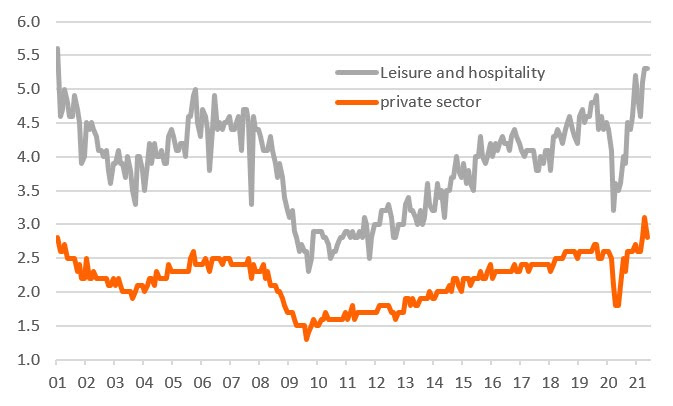 Source: Macrobond, ING


