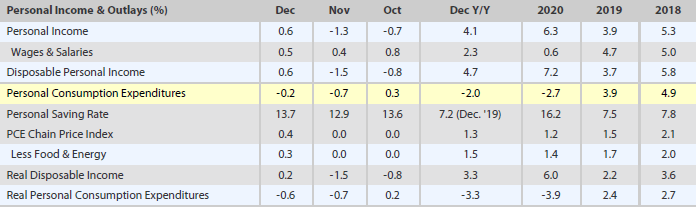
Republicans Propose $618 Billion Covid-19 Stimulus Plan The Senate Republicans’ proposal includes $1,000 in direct payments. President Biden has called for $1,400.
(…) The Republican plan calls for sending $1,000 checks to many Americans, with $500 available to children and adult dependents. In a shift from previous direct payments, the Republicans call for scaling back the size of the checks for individuals making $40,000 a year or more and phasing them out entirely when income reaches $50,000. Married couples with a joint annual income of $80,000 would see smaller checks, going to zero when income reaches $100,000. Mr. Biden’s plan offers $1,400 a person, though it doesn’t yet include specifics on income cutoffs. (…)
The Republican proposal extends a $300 weekly federal unemployment supplement through June. Mr. Biden’s proposal increases the supplement to $400 and extends it through September. (…)
Bloomberg reports that “House Speaker Nancy Pelosi and Senate Majority Leader Chuck Schumer introduced a budget resolution yesterday, the first step in a process called budget reconciliation which would allow much of President Joe Biden’s $1.9 trillion stimulus plan to pass the Senate with just a simple majority. The move does not mean that hopes of a bipartisan agreement are dead, with yesterday’s meeting between the White House and Republican senators dubbed “very productive.””
- Fed’s Kashkari: Fed Shouldn’t Pull Back on Aid The U.S. economy has a long way to go before it fully recovers and will need strong support from the Federal Reserve and the broader government to get there, Federal Reserve Bank of Minneapolis President Neel Kashkari said Monday.
-
U.S. Economy Is Expected to Reach Pre-Pandemic Peak by Mid-2021 The U.S. economy will grow faster this year than projected earlier, the Congressional Budget Office forecasts, helped by a pandemic aid bill passed in December.
MANUFACTURING PMIs
USA: January PMI hits record high amid strong client demand
January PMITM data from IHS Markit indicated a robust improvement in the health of the U.S. manufacturing sector. Alongside a severe deterioration in vendor performance, the headline figure was pushed up to a record high by accelerated expansions in output and new orders. Meanwhile, cost pressures intensified amid raw material shortages. Firms were able to partially pass on higher costs, however, with selling prices rising at the fastest pace since July 2008.
Robust business confidence was reflected in the strongest rise in workforce numbers for two years, as pressure on capacity increased once again.
The seasonally adjusted IHS Markit final U.S. Manufacturing Purchasing Managers’ Index™ (PMI™) posted 59.2 in January, up from 57.1 in December and broadly in line with the earlier released ‘flash’ figure of 59.1. The latest data signalled a substantial improvement in operating conditions among manufacturers, and the most marked since data collection began in May 2007.
Output increased steeply at the start of 2021, as the rate of growth quickened to the fastest since August 2014. The rise in production was often attributed by panellists to stronger client demand and a sharper increase in new orders.
The recommencement of projects following an easing of coronavirus disease 2019 (COVID-19) restrictions reportedly helped boost sales in January. The rate of expansion of new orders was the sharpest in just under six-and-a-half years.
Growth in foreign client demand also accelerated, as new export orders rose at the fastest pace since September 2014.
At the same time, supplier delays persisted. Excluding December’s record low, vendor performance deteriorated to the greatest extent since data collection began in May 2007. Supply chain disruption reportedly stemmed from raw material and transportation shortages, notably trucking.
As a result, input costs rose markedly and at the second-steepest pace since April 2018. The rapid increase in cost burdens reportedly led many firms to partially pass on higher input prices to clients. Amid favourable demand conditions, companies registered the sharpest increase in output charges since July 2008.
Alongside greater production requirements, longer lead times for inputs led firms to increase their purchasing activity in January. Efforts to build stocks were reflected in the fastest rise in pre-production inventories since December 2019. Stocks of finished goods, however, fell as companies depleted inventory holdings as demand often outstripped production.
Manufacturers remained upbeat regarding the outlook for output over the coming year at the start of 2021. The robust degree of confidence was often linked to hopes of a successful vaccine roll-out, stronger client demand and reduced uncertainty. That said, the level of optimism was the lowest for three months.
Finally, goods producers increased their workforce numbers in January amid greater pressure on capacity and a faster rise in new orders. The rate of job creation was the quickest for two years, as backlogs of work rose modestly.

CHINA: Operating conditions improve at slowest rate for seven months
Business conditions faced by Chinese manufacturers improved at the slowest rate for seven months at the start of 2021, according to latest PMI data. Companies signalled softer increases in output and new orders, alongside a renewed decline in new export work, as the coronavirus disease 2019 (COVID-19) pandemic weighed on demand conditions. At the same time, stock shortages and shipping delays led to a further marked deterioration in supplier performance and added further upwards pressure on costs. Consequently, firms raised their selling prices at the steepest rate since mid-2018.
The headline seasonally adjusted Purchasing Managers’ Index ™ (PMI ™ ) fell from 53.0 in December to 51.5 in January. This signalled a modest improvement in the health of the sector that was the weakest since last June. The reading also marked a further loss of momentum from November, when the headline index reached a decade high.
Chinese goods producers signalled a sustained rise in output during January, to extend the current period of expansion to 11 months. That said, the rate of growth was the least marked since last April and modest. The subindex for output in January was the lowest in nine months, and the one for total new orders was the lowest in seven months.
The slowdown coincided with a weaker increase in total new work at the start of the year. Data indicated this was partly driven by a renewed drop in export orders, which fell for the first time in six months. Survey respondents often cited the resurgence of the COVID-19 virus globally when explaining the reduction.
After broadly stabilising at the end of 2020, employment at Chinese manufacturers fell in January. That said, the rate of decline was only marginal. Lower staff numbers were generally attributed to company restructuring and the non-replacement of voluntary leavers. At the same time, manufacturers recorded the slowest accumulation in backlogs of work for eight months.
Goods producers recorded a softer expansion of buying activity at the start of the year, with firms generally commented that purchasing rose in line with sales. Notably, the latest upturn was the weakest since the current period of recovery began last May. At the same time, stocks of purchases fell modestly after a slight increase at the end of 2020.
Stock shortages at suppliers and shipping delays led to a further increase in delivery times for inputs. Furthermore, average vendor performance deteriorated at the steepest rate since last March.
Low stock availability and higher raw material prices drove a further increase in operating expenses. Moreover, the rate of inflation eased only slightly from December’s three-year high. As part of efforts to protect operating margins, manufacturers raised their selling prices at the steepest rate since June 2018.
Although manufacturers in China generally expect output to rise over the next year, the degree of positive sentiment edged down to an eight-month low in January. While many firms anticipate a rebound in global demand once the pandemic ends, there remained concerns over any resurgence of the virus at home and overseas, and further disruption to business operations and supply chains.


EUROZONE: Manufacturing growth remains marked at start of 2021
Growth of the Eurozone manufacturing economy remained resilient at the start of 2021, with the sector expanding for a seventh successive month and again at a marked pace. After accounting for seasonal factors, the PMI® recorded 54.8, down slightly on December’s 55.2 and little-changed on the earlier flash reading. January’s figure was amongst the highest seen over the past two-and-a-half years.
Growth was recorded across all three broad market groups during the latest survey period. However, the improvement in operating conditions seen at consumer goods producers was marginal amid a drop in new orders. In contrast, marked rates of expansion continued to be recorded in both the intermediate and investment goods sectors at the start of 2021.
The best manufacturing growth was again seen in those countries with strong export bases, the Netherlands and Germany. In the Netherlands, expansion was the sharpest seen for over two years.
Italy also turned in its best performance for nearly three years, whilst there was also marked growth seen in Austria.
Elsewhere, rates of expansion tended to be modest or, in the case of Greece, stagnant. Spain was the only country to record a contraction, slipping to the bottom of the rankings, though this in part reflected the disruptive effects on production of Storm Filomena.
Overall, eurozone manufacturing production increased for a seventh successive month, although the rate of expansion was the weakest in the current sequence. Similar developments were seen for new orders. Whilst the current growth sequence was also extended to seven months, the rate of expansion was down since December. That was despite export trade registering its best growth performance in the past three months.
With overall new order book volumes increasing markedly, manufacturing companies faced further pressure on their capacity as evidenced by another month of backlog growth. January marked the sixth successive month that work outstanding has risen, although growth was the weakest since last September.
A noticeable development in January was a further worsening of supplier delivery times, which deteriorated for a twelfth successive month. Latest data showed that lead times lengthened to a degree unmatched since April 2020 amid evidence of challenges in securing supplies from Asia. Another marked rise in purchasing activity, the fifth successive increase, added to pressure on vendors.
With supply-side shortages intensifying, prices paid for inputs increased markedly. January’s survey showed that input costs rose to the greatest degree in nearly three years with Germany, the Netherlands and Italy recording the sharpest monthly increases. Whilst firms sought to pass on these higher costs on to clients, the overall rate of inflation was modest and noticeably weaker than input costs.
Faced with delays in the receipt of goods, companies utilised their existing inventory wherever possible, resulting in a firmer decline in stocks of purchases. There was also another round of destocking of finished goods, which fell for an eighth successive month albeit at the slowest rate since last June.
On the jobs front, companies on average cut their staffing levels, albeit at the weakest pace since June 2019 and some nations led by Italy and the Netherlands recording net rises in employment.
Finally, looking ahead to the next 12 months, confidence improved to a three-year high in January largely on hopes that vaccine developments in the coming months will help to ease current pandemic restrictions and lead to a noticeable uplift in economic activity.


JAPAN: Renewed contraction in manufacturing in January
The latest PMI® data pointed to a renewed deterioration in operating conditions across the Japanese manufacturing sector in January. Survey respondents registered a fall in output in the latest survey period, following a broad stabilisation seen in December, as rising coronavirus disease 2019 (COVID-19) cases had a renewed impact on the economy. That said, Japanese manufacturers reported a stable trend in new business inflows for the first time in over two years, as some businesses anticipated a recovery in demand in 2021. As a result, firms in the Japanese manufacturing sector remained optimistic of a rise in output over the coming year.
The headline au Jibun Bank Japan Manufacturing Purchasing Managers’ Index™ (PMI) slipped from 50.0 in December to 49.8 in January, signalling a renewed contraction in the sector. That said, the overall pace of contraction was only fractional, reflecting an improving trend in new business.
The deterioration in the health of the sector was partly due to a renewed fall in output volumes in January. After remaining broadly unchanged in December, output fell at a marginal pace in the latest survey period. Production has not registered outright growth since December 2018, a sequence of 25 months. Where production fell, firms often attributed this to rising COVID-19 infections and the implementation of new restrictions under a new state of emergency.
Positively, Japanese manufacturers indicated a stable level of new orders for the first time in over two years in January. The expansion ended a sequence of 24 consecutive declines, as businesses reported demand was starting to recover amid the launch of new products. That said, some firms noted that the COVID-19 pandemic had dampened client confidence at the start of 2021. At the same time, goods producers recorded a third consecutive decline in export demand, and one that was quicker than that seen in December.
Employment levels at Japanese manufacturing firms returned to contraction in January after a stable trend in December. Moreover, the rate of job shedding was the fastest seen since August. Anecdotal evidence suggested that the non-replacement of voluntary leavers was widespread in the sector, although some firms commented that pressures from the pandemic had led to reduced staffing levels to save costs. A lack of pressure on capacity was apparent, as backlogs of work fell for the twenty-fifth month in a row.
Input cost inflation strengthened further in January. The pace of inflation was solid overall and was the strongest since May 2019. Manufacturers often linked a rise in average cost burdens with higher raw material and logistics costs. Concurrently, average output charges rose at a quicker pace in January, as firms sought to partially pass on some of the increases in input costs to clients.
Supply chain disruptions continued to build during January with average lead times lengthening to the most marked degree since last June. Restrictions to curb rising COVID-19 infections domestically and abroad had continued to delay receipt of inputs, therefore firms utilised existing stocks of both pre- and post-production inventories to fulfil orders.
Looking forward, business confidence regarding output over the year ahead remained positive, with sentiment underpinned by hopes of an end to the pandemic to trigger a wider economic recovery.

Global manufacturing upturn slows at start of 2021 as supply chain pressures continue to build
The performance of the global manufacturing sector remained solid at the start of 2021. Although the J.P.Morgan Global Manufacturing PMI™ fell to a three-month low of 53.5 in January, down from 53.8 in December, it remained at one of its highest levels over the past three years.
Of the 30 nations for which January data were available, 23 registered PMI readings above 50.0 (signalling expansions) compared to only six indicating contractions. World manufacturing production and new orders both expanded again in January, extending the current sequence of concurrent growth to seven months. However, rates of increase eased for the second successive month, as growth of new export orders slipped to near-stagnation.
Data broken down by sector signalled increases in output and new business across the consumer, intermediate and investment goods categories. Intermediate goods producers fared best, slightly outperforming their investment goods counterparts in terms of both output and new order growth. The consumer goods sector saw the weakest expansion in production as new business growth stalled.
Supply chains were increasingly stretched at the start of 2021, with January seeing vendor lead times lengthen to one of the greatest extents in the survey history. Disruptions and resulting shortages contributed to an uptick in purchase price inflation, which was passed on to clients through higher output charges. Input price inflation was the strongest since May 2011, and charge inflation the joint-highest over the same period.


Growth is particularly strong on electronic goods:


U.S. Construction Spending Continues to Improve During December
The value of construction put-in-place increased 1.0% during December (5.7% y/y) following November’s 1.1% gain, revised from 0.9%. October’s increase was revised to 2.5% from 1.6%. During all of 2020, construction activity rose 4.7% versus a 2.4% gain in 2019.
Private construction increased 1.2% (6.5% y/y) in December following a 1.5% November increase. Residential construction jumped 3.1% (20.7% y/y) as single-family building surged 5.8% (23.5% y/y), the sixth consecutive month of notably strong increase. The value of multi-family construction was little changed (17.8% y/y) for the second month. Home improvement expenditures edged 0.4% higher (17.7% y/y) after little change during November.
Weakness in business spending continued as nonresidential private construction fell 1.7% in December (-9.8% y/y), the sixth consecutive monthly decline. Lodging construction declined 6.4% (-24.6% y/y) while commercial building weakened 2.8% (-1.4% y/y). Manufacturing construction fell 5.6% (-17.6% y/y) while education construction eased 0.8% (-15.3% y/y). To the upside, transportation building rose 2.2% (-1.6% y/), strong for the fourth straight month. Office building improved 0.2% (-3.3% y/y) about as it did in November.
Public construction rose 0.5% during December (3.0% y/y) following a 0.1% November slip. Spending on highways & streets, which makes up nearly one-third of public spending, rose 0.9% (3.9% y/y) and outlays on health care units improved 0.4% (4.7% y/y). Power construction eased 0.5% (-15.2% y/y) while spending on educational buildings gained 0.6% (4.5% y/y).
VACCINATION
The deputy director of the Center for Disease Control and Prevention signaled the outbreak may have peaked, saying: “If this pandemic were a stock, we might be wanting to sell.” The benefits from a rapid rollout of vaccines is clear in the U.K., where the pound has rallied strongly as investors grow more optimistic about the prospects for the economy. In Europe, meanwhile, German Chancellor Angela Merkel is trying to reassure citizens on the availability of vaccines amid the region’s slow rollout. (Bloomberg)
Gavekal Research would not go short the “pandemic stock” just yet:
Immunizing 80% of the US population by late this year, will need vaccinations to rise to about 3mn doses a day (and see children approved for vaccination, for which there is no timeline). At that rate, the project would take six months.
How likely is this? Distribution will need to rise fast from the current rate of 1.3mn doses a day. At the present rate of increase, it will be late April or early May before supply crosses 3mn doses a day.
Manufacturers have forecast that by the end of 2021 they will be producing at an annualized rate of 11bn doses, more than double the global production of all types of vaccines in any prior year. In reality, pharma firms have no experience in scaling up production of innovative mRNA vaccines, and shortages of everything from vaccine raw materials to glass needed for vials are likely. Even so, the US and the UK have a shot at reaching herd immunity by the end of the year. Most European countries, on present trends, do not; they will need to ramp up the pace of immunization much more rapidly (see right-hand chart below).
These estimates do not take account of other well-advertised risks: that the more transmissible UK variant becomes the predominant strain in the coming months, thereby raising the proportion of the population that must be vaccinated to achieve herd immunity; or that vaccines prove less effective against new strains such as the one from South Africa, meaning that a third booster shot will be needed to complete the vaccine regimen.
Finally, all these problems will be more acute in emerging economies, which are farther behind the curve in contracting for vaccine doses, and have weaker distribution infrastructure. With the exception of China and Russia which have strong domestic vaccine production and thus have a good shot of reaching herd immunity levels of vaccination by early 2022 (Russia) or mid-2022 (China), much of the emerging world might have to wait until 2023, or even later, to get to herd immunity.
As of February 1, the U.S. was administering 1.36 million doses per day (7-day average), up 562k (70%) from 0.8M on January 15. Extrapolating the numbers (not %), U.S. vaccination could actually increase by 1M per month, exceeding 3M by the end of March. Here’s the weekly trend in January:
- week to Jan. 7: +76k to 378k (+10.8k/day)
- week to Jan 24: +368k to 747k (+52.6k/d)
- week to Jan 21: +167k to 914k (+23.9k/d)
- week to Jan 28: +326k to 1.24M (+46.6k/d)
- last 4 days: +120k to 1.36 (+30k/d)
Averaging since Jan. 7, vaccination increased 38k per day or 1.15M per month. Will supply and logistics keep pace?


Apple Sells $14 Billion of Bonds as Share Buybacks Seen Rising
Apple Inc. sold $14 billion of bonds to take advantage of cheap borrowing costs, tapping the market for a third time since May as it looks to return more cash to shareholders.
The company issued debt in six parts. The longest portion of the offering, a 40-year security, will yield 95 basis points above Treasuries, after initially discussing between 115 and 120 basis points, according to a person with knowledge of the matter, who asked not to be identified as the details are private. (…)
GameStop Falls Premarket; Silver Retreats After High GameStop shares tumbled in premarket trading while silver futures fell after the CME slapped additional margin requirements on traders.
The naked swimmers will get exposed…

Here’s the long-term history. Reports are that losses for short sellers have totalled $70B+ this year ($54B+ net).

A different look: The 5% of small-caps in the Russell 2000 index that have the least short interest have actually fallen slightly for the year. The 5% with the greatest short interest are up more than 50%. (The Market Ear)

Seems the game is about to stop…

Traders once again totally shunning fundamentals:

The Robinhood Non-Conspiracy A margin call is not a Wall Street plot to fleece Reddit traders.
(…) It turns out the controversy was essentially about a larger than normal clearinghouse call for capital. (…) The reality is more prosaic. Robinhood and other brokers were deluged by traders looking to invest in GameStop and other shares, often with options contracts that can increase leverage and trading risk. A clearinghouse that processes and settles trades watched the volatile trading and demanded more collateral to cope with potential losses. (…)
A [$3 billion] margin call is not a conspiracy. A clearinghouse is an intermediary between buyers and sellers in a financial market. It “clears,” or finalizes, trades and makes sure the parties fulfill the contract and assets are delivered. It also mitigates risk by requiring that trades be backed by enough capital to reduce the chances that one of the trading parties goes bankrupt. This protects investors as well as brokers.
Robinhood [and most other brokers] clears its trades through the well-known Depository Trust & Clearing Corp., which is owned by a consortium of banks, broker-dealers and other financial firms. (…)
By restricting trades in some stocks for a time, Robinhood has reduced the size of the DTCC’s capital demand. The firm also promptly raised $1 billion in new capital last week and has since raised $2.4 billion more, the Journal reports. This should help the company serve customers while riding out the volatility in popular shares. (…)
Short-sellers who were caught on the wrong side of the GameStop price movements have learned a hard lesson about risk in the current market. So much the better for price discovery and trading discipline. (…)
In this era of limited social trust, financial markets are bound to become targets of populist conspiracy theorists on the right and left. In the past, conservatives at least tried to understand how financial trading works before joining left-wingers like Rep. Alexandria Ocasio-Cortez and Sen. Elizabeth Warren in forming a hang-’em-high posse against private markets. Alas, in this age of conspiracy, knowing less gets you more attention.
CHECK YOUR TICKERS
Trading apps help you trade quickly, sometimes too quickly. GME Resources is a small Australian miner…and its not mining bitcoins.

Really, that crowd is getting ridiculous! And I did not talk of these stocks whit a ticker starting with BB which rose after frenzy traders rushed to buy Bed Bad and Beyond…