Inside the long-delayed COVID relief package (Axios)
What’s in the package, via AP:
- Provides $600 direct payments to individuals making up to $75,000 per year and couples making $150,000 per year — with payments phased out for higher incomes — with $600 additional payments per dependent child.
- Unemployment insurance: Revives supplemental federal pandemic unemployment benefits but at $300 per week — through March 14 — instead of the $600 per week benefit that expired in July.
- Extends special pandemic benefits for “gig” workers and extends the maximum period for state-paid jobless benefits to 50 weeks.
- Revives the Paycheck Protection Program, which provides forgivable loans to qualified businesses. Especially hard-hit businesses that received PPP grants would be eligible for a second round.
- Provides $25 billion for a first-ever federal rental assistance program — funds to be distributed by state and local governments to help people who have fallen behind on their rent and may face eviction.
- Surprise medical billing: Protects consumers from huge surprise medical bills after receiving treatment from out-of-network providers.
US says it will miss vaccine distribution target Plan to inoculate 20m Americans pushed back to new year as states complain of slashed doses
Countries Ban Travel From U.K. in Race to Block New Covid-19 Strain Germany, France, Italy, Canada, Israel, the Netherlands and Belgium on Sunday announced bans on passenger air travel from the U.K. as authorities assessed the impact of a fast-spreading new virus variant.

TECHNICALS WATCH
Canvassing technical advisors and indicators, there is no denying that equity demand is strong and broad. Lagging countries and sub-groups have generally joined the party and 200-day moving averages have turned upwards almost everywhere. Ignoring high valuation fundamentals is justified by positive narratives on health and continued government and central bank support. In fact, negative economic surprises are often seen positively as they support even more support.
One widely followed advisor calls the current technical picture “the most ideal phase of a bull market”, the “sweet spot” that should prove difficult to reverse given that measures of demand are rising while selling is waning.
Legendary Bob Farrell said that “markets are strongest when they are broad and weakest when they narrow to a handful if blue-chip names.”
SentimenTrader illustrates how broad markets currently are:
The breadth of the advance continues to be impressive. Out of the 10 major S&P 500 sectors, the median one has more than 95% of its member stocks in an uptrend. That’s the most in almost a decade.
We can see from the chart that only about 1% of days over the past 30 years have seen participation this wide across sectors. The S&P’s annualized return after those days wasn’t too inspiring. That figure is derived by looking at very short-term returns and projecting it over the year.
Not only does the median sector have almost every one of its stocks in an uptrend, even the worst sector recently had more than 80% of its stocks above their 200-day moving averages.
It’s rare to see even the worst laggard among sectors see such widespread uptrends among its stocks, only occurring on about 2% of all days. And, again, the S&P’s annualized return after those days was poor.
Over the past 30 years, there have been 23 days when the median sector had at least 95% of its members in uptrends, and even the worst sector had at least 75% participation.


Farrell also said that
- Markets tend to return to the mean over time
- Excesses in one direction will lead to an opposite excess in the other direction
- There are no new eras — excesses are never permanent
- Exponential rapidly rising or falling markets usually go further than you think, but they do not correct by going sideways
- The public buys the most at the top and the least at the bottom
- Fear and greed are stronger than long-term resolve
- Markets are strongest when they are broad and weakest when they narrow to a handful of blue-chip names
- Bear markets have three stages — sharp down, reflexive rebound and a drawn-out fundamental downtrend
- When all the experts and forecasts agree — something else is going to happen
- Bull markets are more fun than bear markets
Fundamental excesses are now well documented and we know that the Rule of 20 P/E always mean-reverts.

Many technical measures also mean-revert:

One of my favorite, the 13/34–Week EMA Trend is showing no sign of weakness, so far (CMG Wealth):

So is Ned Davis’ 50-Day/200-Day Moving Average Cross:

But note that these indicators are also very extended, vulnerable to black, even greyish swans. Bird watching should now focus on:
- Vaccines vs virus progression.
- Long-term interest rates and inflation; one bullish economic narrative is a coming boom in consumer spending as economies reopen and high savings get rapidly spent, potentially putting upward pressures on prices of many goods and services. Inflation expectations have recently increased much faster than 10Y Treasury yields, which have nonetheless almost doubled since mid-summer. Can the Fed keep the real yield genie from popping out of his bubbling world? Mr. Powell must know he cannot use any word with a meaning close to “tapering” unless he wants to see a repeat of 2013;

- Corporate profits. Can we reopen and spend merrily and keep margins high enough to meet profit expectations? Energy prices remain depressed but most other commodity prices are up significantly, not only from their spring 2020 lows but often from their pre-pandemic highs. This is true for metals, lumber and ag products. The FIBER Industrial Materials Price Index is up 14.7% YoY with Metals up 20.3% as Have Analytics charts show. The weaker USD will also pressure import prices in the U.S.. Nonpetroleum import prices are up 1.6% YoY in November but +3.8% annualized in the last 6 months. Also, private employees hourly earnings are rising in the 4.5% range, a full percentage point faster than pre-pandemic and significantly faster than core CPI and Business Sales.


- Technical indicators. Amid very poor valuation fundamentals, some technical indicators proved very useful, namely Lowry’s Research work and the 13/34- Week EMA Trend on the S&P 500 Index.
EARNINGS WATCH
We now have 499 reports in, an 84% beat rate and a +19.5% surprise factor. Q3 earnings, expected to crater 21.4% on October 1, actually declined only 6.1% after -12.8% in Q1 and -30.6% in Q2. Ex-Energy, earnings were down 1.9% following -24.1% in Q2.
Remarkably, ex-E revenues grew 2.4% in Q3 after declining 0.4% in Q1 and 4.0% in Q2. Six sectors recorded positive YoY revenue gains vs three in Q2 and seven in Q4’19.

Q4’20 estimates now see earnings down 10.6% (-7.5% ex-E) before rising 17.6% in Q1’21. Most investors would bet analysts remain too pessimistic.

Corporate pre-announcements remain encouraging compared with Q3 and have not deteriorated in recent weeks.

Trailing EPS are now $142.52. 2020: $138.17. Forward 12-m: $160.90. 2021: $169.46.
SENTIMENT WATCH
According to The Market Ear, “BofA’s greed and fear indicator has been the most accurate of them all. While many were flashing overbought and suggested to trim longs, BofA’s indicator continued flashing to buy this market. We are now approaching pre Corona bullishness, which was rather extreme.”

John Mauldin re-uses a short piece by Doug Kass that is quite appropriate in today’s market:
The Dunning-Kruger effect is a cognitive bias in which people with low ability at a task overestimate their ability. It is related to the cognitive bias of illusory superiority and comes from people’s inability to recognize their lack of ability. Stated simply, the Dunning-Kruger effect observes that people who are the most ignorant about something will be the least aware of their own ignorance; they have the highest sense of false confidence.
With the benefit of a zero-commission trading app it is now easy and costless to trade, and the COVID-induced “stay-at-home” factor coupled with the desire of many to reclaim agency has contributed mightily to 2020’s trading fever. As I have mentioned previously, the big marketing push of Robinhood’s platform is taking advantage (selling orders) of those who don’t understand and are likely to wind up losing plenty of money.
Perhaps, with so much out of their control this year, some have seen trading as a way of reclaiming the wheel and making risky bets on their own terms (or so they think).

For those who missed this last week from Almost Daily Grant:
The Wall Street Journal reports today that the Massachusetts Securities Division’s enforcement arm accused the platform of exposing investors to “unnecessary trading risks,” and “falling far short of the fiduciary standard” requiring brokers to act in the best interest of the customer in providing investment advice.
According to the complaint, Robinhood permitted one novice punter to place more than 12,700 trades over a six-month period (or 101 trades per business day), while most in-state users who had engaged in options trading had either no experience or limited experience with the derivatives. Rather than framing its platform as “serious investing with substantial risk,” Robinhood is “presented as some sort of game that you might be able to win,” William Galvin, Secretary of the Commonwealth of Massachusetts, told the Journal.
Then again, you can’t win if you don’t play, as the following Twitter exchange demonstrates:
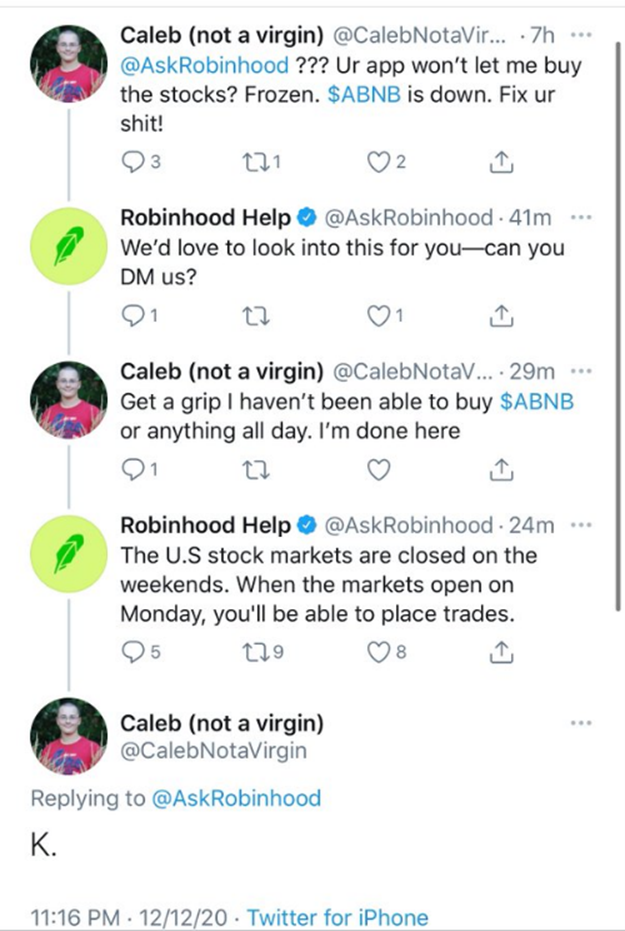
Caleb simply closed with a capital “K”, likely indicating his gratefulness for his education that U.S. equity markets are closed during weekends and also at 11:16pm. Go to bed boy, (not a virgin) (!), thanks for the info, we would not have guessed.
True story!!!! You know there will be blood. Just not when…
In the meantime, many newer investors have developed an illusion of invincibility that keeps them playing, possibly raising their monetary involvement, until reality (gravity) takes over again. It always does.
Prem Watsa, often called the Canadian Warren Buffett, said last week
with a “market cap in excess of Royal Bank, even though Royal Bank earns more money annually than Shopify has revenue.” He highlighted the soaring share prices of Peloton Interactive Inc., Pinterest Inc. and everyone’s new favourite meeting place, Zoom, “with a market value of US$130-billion, yes, US$130-billion,” on revenue of US$1.8-billion over the past nine months.
“These are all wonderful companies, but their valuations are insane,” added Mr. Watsa in an interview last week, as he described his speech to staff earlier in the month. “As in the past, this will end – and it will not be pretty.”
Mr. Watsa, who founded Fairfax in 1985 and has prospered through multiple downturns, made the case to colleagues for a “renaissance of value” that he believes has already begun in equity markets (…). “For value investors, this has been a tough decade,” Mr. Watsa said. “I tell people, value investing has worked over a 100 years, you just have to be patient.” (…)
The insurance and asset management company’s stock price is down 29 per cent this year, in part on concerns that a value investment strategy doesn’t fit with the times.
Historically, Fairfax shares have traded at a premium to their underlying book value, and Mr. Watsa and his crew have compounded that value at an 18-per-cent annual pace over more than three decades. Right now, the company’s share price is about 70 per cent of its book value. Fairfax stock also trades at a larger-than-normal discount to peers such as Markel Corp. and Berkshire Hathaway Inc. Mr. Watsa described the stock as “ridiculously cheap” in June, when he invested US$149-million of his own money to buy additional Fairfax shares. (…)
A student of markets, Mr. Watsa pointed out to his team this month that valuations on the so-called FAANG stocks – Facebook Inc., Amazon.com Inc., Apple Inc., Netflix Inc. and Google, now known as Alphabet Inc. – echo the lofty earnings multiples seen on the Nifty-Fifty growth stocks of the 1960s, or on Cisco Systems Inc. and Microsoft Corp. in the dot.com boom of the 1990s. When these companies fall out of favour, and the stock price falls, it can take years for the stock to recover, even when the underlying business does well. In contrast, Mr. Watsa said: “The best days for value investors are ahead of them.”
Lance Roberts combines sentiment on markets with sentiment on valuation:
The chart below shows the combined average of institutional and individual investor valuation confidence subtracted from future returns confidence. When the reading is positive, the confidence the market will be higher one year from now is more elevated than the confidence in the market’s valuation. The opposite is the case when the reading is in negative territory.
The key takeaway is that investors think simultaneously, the market is over-valued but likely to keep climbing.

Small Businesses Are Being Starved of Credit Banks are lending less to small businesses today than they did before the financial crisis. Loans to big businesses, meanwhile, have surged.
Fed Says Banks Can Withstand Pandemic U.S. banks are allowed to restart share buybacks, with limits, as the Federal Reserve continues to restrict dividend payouts.
(…) On Friday, the Fed said the banks could restart making repurchases in the first quarter, but still can’t return to shareholders more than they have been making in profit over the past year. The aggregate dividends and repurchases can’t exceed the average quarterly profit from the four most recent quarters.
Under two hypothetical scenarios, in which unemployment remains high and the economy doesn’t bounce back for several quarters, the 33 largest U.S. banks could be hit with as much as $600 billion in loan losses, the Fed said in the latest iteration of its stress test. That would erode the capital buffers meant to keep them on sound financial footing, the central bank said. (…)
The big banks have added more than $100 billion in loan-loss reserves, the Fed said, a move that fueled an increase in their capital cushions. A key metric known as the common-equity Tier 1 ratio, which is a measure of high-quality capital as a share of risk-weighted assets, increased from 12% in the first quarter to 12.7% at the end of September for the largest lenders. (…)
After the results were released, JPMorgan Chase & Co. announced it would repurchase $30 billion in stock and would start in the first quarter. Its shares rose 5.1% in after-hours trading Friday. Other banks climbed as well, with Citigroup Inc. up 5.4%.
Citigroup said in a statement it also would restart buybacks. But it and other banks didn’t disclose how much they planned to repurchase. (…)
The Flood Gates Still Aren’t Open for Banks—Yet The Federal Reserve is letting banks pay out more to shareholders, but likely not enough to sop up big excess capital buffers that drag on returns.
(…) The six biggest U.S. banks now have common equity Tier 1 capital ratios that are on average more than 2 percentage points above the requirements set by the June stress test. Importantly, the Fed didn’t for now recalibrate those minimums based on the latest test results. (…)
Meanwhile, banks’ capital cushions may grow even bigger next year. A combination of good credit performance spurring reserve releases and tepid loan growth is generally a formula for bumping up capital ratios. That, in turn, means return on equity could lag behind profit growth. (…)
BTW, the same is true for Canadian banks’ excess capital. Some (BMO, TD?) may use it for acquisitions.
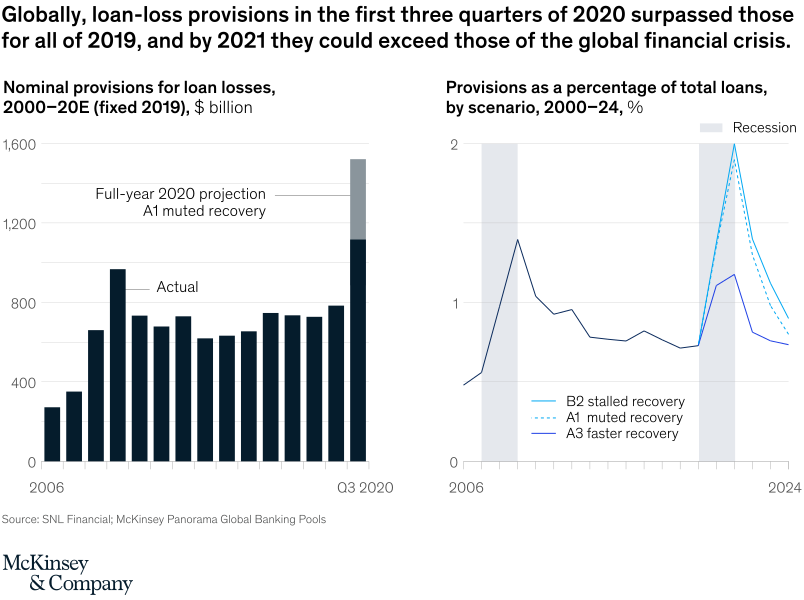
From McKinsey’s Global Banking Annual Review:
In anticipation of a sharp increase in personal and corporate defaults due to the COVID-19 crisis, global banks have provisioned $1.15 trillion for loan losses through the third quarter of 2020—more than they did in all of 2019. We project that loan-loss provisions in the coming years will exceed those of the global financial crisis.
Google May Face Antitrust Suit Early 2021 Over App Store Fees
New U.S. Restrictions Will Help Make China Great Again Under massive pressure, Chinese tech giants finally have an incentive to use and improve local suppliers.
(…) It’s possible that U.S. sanctions could hobble companies such as SMIC and Huawei before they can measurably improve the quality of local suppliers. But technology lives in people’s heads and China’s tech champions have been eagerly recruiting engineers, scientists and academics; those employees will inevitably find new homes or start companies of their own. There are no instances in history of a country monopolizing key technologies forever and, given how large the Chinese market is today, big holes of demand won’t stay unfilled for long.
Meanwhile, the Trump administration’s attempts to crush China’s tech companies are also damaging the bottom lines of their U.S. suppliers. The incoming Biden administration would be better off pouring its efforts into extending the advantages that made the U.S. technology sector the world’s leader to begin with — welcoming more immigrants, investing more in basic research and working with industry to cultivate emerging technologies. China can now count on a whole-of-society effort to expand its technological prowess. The U.S. needs one of its own.
Jack Ma Makes Ant Offer to Placate Chinese Regulators Trying to salvage his relationship with regulators in a Nov. 2 meeting, the Chinese billionaire said he was ready to do what the country needed
As Jack Ma was trying to salvage his relationship with Beijing in early November, the beleaguered Chinese billionaire offered to hand over parts of his financial-technology giant, Ant Group, to the Chinese government, according to people with knowledge of the matter.
“You can take any of the platforms Ant has, as long as the country needs it,” Mr. Ma, China’s richest man, proposed at an unusual sit-down with regulators, the people said. (…)
Mr. Xi personally ordered Chinese regulators to investigate the risks posed by Ant, according to Chinese officials with knowledge of the matter, and to shut down Ant’s IPO. (…)
Chinese officials say the leadership is particularly concerned that highflying entrepreneurs such as Mr. Ma keep attracting capital while exposing the financial system to greater risks. (…)
Alibaba and Tencent have sometimes heeded demands from law enforcement and other authorities to access user data, but they have so far resisted routinely sharing swaths of data that could help the government in other ways, such as building a consumer-credit scoring system akin to FICO used in the U.S. (…)
For now, regulators are debating whether Alipay or any other parts of Ant’s business represent monopolistic competition and if so, what actions should be taken against the firm.
“The odds of nationalizing at least parts of the company are not zero,” says a government adviser in Beijing.
Hack Tests the Limits of U.S. Response Despite its size, a computer hack blamed on Russia that hit six cabinet-level agencies could leave President Trump and the incoming Biden administration struggling to find the right response, experts said.
While Sen. Dick Durbin (D., Ill.) called the breaches that hit at least six cabinet-level departments as well as private companies “virtually a declaration of war,” the former officials said the intrusions fell more along the lines of classic digital espionage, however brazen. As far as is known from descriptions of the hack, no data was altered or destroyed, and no computer systems or other infrastructure damaged. (…)
Because of the careful and stealthy nature of the incursion, a full damage assessment and recovery operation “is a months, if not yearslong, ordeal,” a senior intelligence official said. (…)
“The most disconcerting thing is the uncertainty around what [computer] systems they are in.” The official added that there was no evidence that classified systems had been violated, but cautioned that was a preliminary conclusion. (…)
“It’s a clear dilemma for this nation about how we continue to be pounded by other countries…and don’t have a response,” said a former top U.S. intelligence official with decades of cybersecurity experience. “We’re incredibly vulnerable, and nothing that any administration has been able to do has changed that.” (…)
U.S. intelligence agencies engage in cyberspying all the time, although U.S. officials say they don’t generally conduct destructive attacks or steal intellectual property. Because traditional cyber espionage is typically considered fair intelligence activity by most countries—even, sometimes, among allies—retaliation or public condemnation isn’t usually an option that is considered.
Others said the sheer breadth of the SolarWinds hack makes it different from traditional cyberspying.
“The fact that this took place on such a massive scale sort of puts it in a different category,” said John Dermody, counsel at the O’Melveny law firm and former deputy legal adviser at the National Security Council. The economic costs could be enormous, as companies scour their networks to determine whether the perpetrators installed additional malware, he said. (…)
The WSJ editorial board:
(…) The U.S. has spent tens of billions on cyber defenses in a project known as Einstein, yet it appears to have been the cyber equivalent of France’s Maginot Line on the German border in 1940. (…)
Vladimir Putin denies Russian involvement, which he always does. But if the Russians are behind the hack, the U.S. will have to respond with more than a tut-tut protest or by indicting a few hackers in Moscow who will never be extradited. (…) Like hijackings in the 1980s and terror attacks in the 1990s, cyber attacks like this will keep happening as long as there is no cost to their state sponsors.


 Cyberhack looks like act of war