Personal income decreased $221.8 billion (1.1 percent) in November according to estimates released today by the Bureau of Economic Analysis. Disposable personal income (DPI) decreased $218.0 billion (1.2 percent) and personal consumption expenditures (PCE) decreased $63.3 billion (0.4 percent).
Real DPI decreased 1.3 percent in November and Real PCE decreased 0.4 percent. The PCE price index had no change. Excluding food and energy, the PCE price index had no change.

Trump Asks Congress to Amend Covid-19 Package, Boost Direct Payments President Trump criticized the roughly $900 billion coronavirus relief deal passed by Congress, saying the bill has “almost nothing to do with Covid” and called on lawmakers to increase direct payments to Americans.
“I am asking Congress to amend this bill and increase the ridiculously low $600 to $2,000 or $4,000 for a couple,” he said in a tweeted video. (…) If he vetoes it, lawmakers would need to either pass new legislation meeting his demand for larger stimulus checks or vote to override his veto—which requires a two-thirds threshold for passage in each chamber. (…) If Mr. Trump doesn’t sign or veto the bill within 10 days after it is passed, it would become law without his signature.
Aides said they view the tweet more as the president voicing his displeasure with the bill than an actual veto threat. (…) Most lawmakers have already left Washington for the holidays following the bill’s passage.
The White House didn’t immediately respond to a question about whether the president planned to veto the bill. But the president—who is scheduled to leave Washington on Wednesday to spend the holidays at his Florida resort, Mar-a-Lago—indicated he wouldn’t sign the current version.
“I am also asking Congress to immediately get rid of the wasteful and unnecessary items from this legislation, and to send me a suitable bill, or else the next administration will have to deliver a Covid relief package,” he said. “And maybe that administration will be me, and we will get it done.” (…)
 Let’s Limbo Some More

Data: Axios Research; Chart: Andrew Witherspoon/Axios

COVID19
- The new Covid-19 strain that emerged in the U.K. is possibly already in the U.S., Germany, France and Switzerland, officials in those countries said. Ireland imposed new restrictions to stem an “extraordinary growth” in cases, and said the nation should act on the assumption that the new variant has arrived.
- Denmark’s health authorities said that about 10% the country’s positive test results are now of the N439K mutation of the virus, calling the rate “concerning.” The mutation, which was first discovered in Romania in May, is different from the one spreading in the U.K. and also from the one that infected the Danish mink farms earlier this year, authorities said.
- Boris Johnson’s government is examining whether to move more areas of England into lockdown to counter a faster-spreading variant of coronavirus. Ministers are considering whether to apply the highest Tier 4 restrictions — forcing non-essential shops and leisure facilities to close — to more regions, according to a person familiar with the matter.
States Impose Strictest Covid-19 Lockdowns Since Spring New restrictions on business and social gatherings seek to prevent a holiday-fueled coronavirus surge, as some people remain defiant and fatigued.

From Goldman Sachs:


The National Association of Realtors (NAR) reported that sales of existing homes fell 2.5% (+25.8% y/y) during November to 6.690 million (AR) from 6.860 in October, revised from 6.850 million. (…)
The number of homes on the market declined 22.0% y/y. The months’ supply of homes on the market fell to 2.3, a record low, down from 4.8 months in May.
Sales declined in most of the country. In the Northeast, sales eased 2.2% (+25.7% y/y) to 880,000 units after double-digit increases in each of the prior four months. Sales in the Midwest fell 2.5% (+24.2% y/y) to 1.590 million after rising to a record 1.630 million in October. In the South, sales fell 3.8% (+25.9% y/y) to 2.820 million from the record 2.930 million in October. In the West, sales held steady at 1.400 million (27.3% y/y) after a 1.4% October rise.
The median price of an existing home eased 0.7% (+14.6% y/y) to $310,800. The mean sales price slipped 0.5% last month (+11.3% y/y) to $343,000. (…)
Sales of existing single-family homes declined 2.4% (+25.6% y/y) to 5.98 million units after increasing for five consecutive months. Sales of condos and co-ops fell 2.7% (+26.9% y/y) to 710,000 units. It also followed five straight months of strong gains and left sales at the highest level since February 2007.


(…) The jobs gap, representing the difference between respondents indicating ‘jobs are plentiful’ and those saying ‘jobs are hard to get’, declined to -0.2% from +6.9% suggesting the unemployment rate will hold steady or potentially rise in December. This series has an 80% correlation with the unemployment rate over the last ten years. The decline in the labor market differential was the result of both a decrease in the ‘jobs plentiful’ measure and a rise in the ‘jobs hard to get’ index. (…)

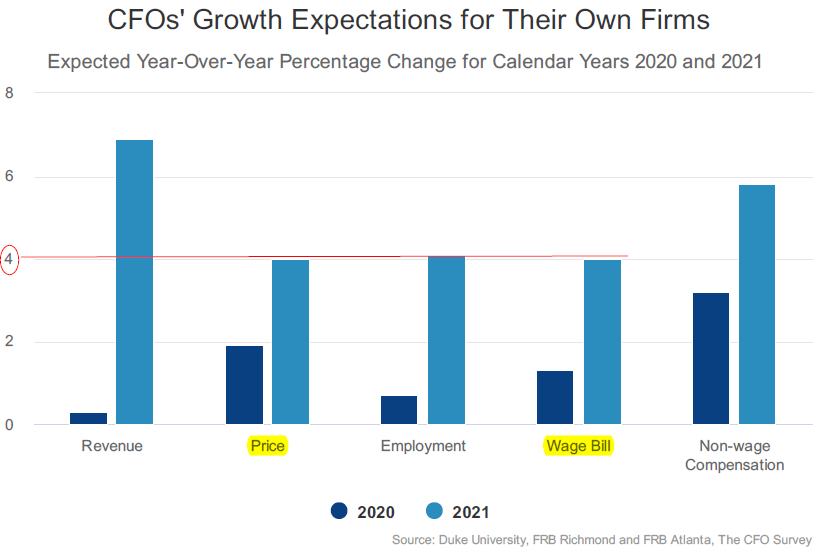
The Duke University’s Fuqua School of Business survey was fielded from November 30 to December 11, 2020.


(…) Strong fiscal support, the start of vaccinations and a growing pile of savings in consumers’ accounts have caused forecasters to revise their views of Canada’s recovery. Economists surveyed by Bloomberg this month see output expanding by an average 5.4% annualized in the final three quarters of 2021, much higher than the 3.8% forecast in November.
Canada has proved itself a fiscal champion during the pandemic, with the most generous emergency response in the Group of Seven, according to International Monetary Fund data. The longer-term implications of such massive deficit spending are unclear, but it has left the country well-positioned for a strong 2021 rebound, mostly on the potential upside from consumption when vaccines roll out and restrictions lift.

(…) Container ships have been sailing at full load since August – something that has not happened in a decade, said Peter Sand, chief shipping analyst with trade association BIMCO. (…) Importers and exporters are “upset they’re not able to move their product or crop as willingly as they would like to,” said Gene Seroka, executive director of Port of Los Angeles – the busiest U.S. seaport. (…)
“It’s a combination of strong volume and slower and less efficient operations,” said Lars Mikael Jensen, head of network with Denmark’s A.P. Moller Maersk, the world’s biggest container line. “This is the perfect storm for global container flows,” Jensen said.

Companies dump US office space at rapid rate Success of remote working during pandemic raises prospect that many workers will not return to offices
Biden Pledges Tough Response to Suspected Russian Hack President-elect Joe Biden promised a forceful response to the suspected Russian hack of the federal government, faulting President Trump for not prioritizing cybersecurity and saying digital threats were among the most grave problems facing the U.S.
A REUTERS SPECIAL REPORT: China launches ‘gray-zone’ warfare to subdue Taiwan Having crushed the resistance to its rule in Hong Kong, China is moving against Taiwan with irregular tactics meant to exhaust the island’s military – which is in bad shape to confront the threat. It’s unclear how the incoming Biden administration will respond.
(…) It’s not the final, titanic clash that Taiwan has long feared, with Chinese troops storming the beaches. Instead, the People’s Liberation Army, China’s two-million-strong military, has launched a form of “gray zone” warfare. In this irregular type of conflict, which stops short of an actual shooting war, the aim is to subdue the foe through exhaustion.
Beijing is conducting waves of threatening forays from the air while ratcheting up existing pressure tactics to erode Taiwan’s will to resist, say current and former senior Taiwanese and U.S. military officers. The flights, they say, complement amphibious landing exercises, naval patrols, cyber attacks and diplomatic isolation.
The risk of conflict is now at its highest level in decades. PLA aircraft are flying menacingly towards airspace around Taiwan almost daily, sometimes launching multiple sorties on the same day. Since mid-September, Chinese warplanes have flown more than 100 of these missions, according to a Reuters compilation of flight data drawn from official statements by Taiwan’s Ministry of National Defense. The data shows that in periods when political tension across the Taiwan Strait peaks, China sends more aircraft, including some of its most potent fighters and bombers. (…)
There has been a “clear shift” this year in Beijing’s posture, a senior Taiwanese security official responsible for intelligence on China told Reuters. Chinese military and government agencies have switched from decades of “theoretical talk” about taking Taiwan by force to debating and working on plans for possible military action, the official said. (…)
This is from Phillip Orchard on Geopolitical Futures last August 21:
China is beginning to feel more restless about Taiwan – and a convergence of internal pressures in China, along with the belief in Beijing that Washington is too concerned with its own issues to stomach the costs of coming to Taipei’s defense, gives China reason to consider moving on Taiwan sooner rather than later. (…)
But Beijing has an inescapable problem: It’s still a long way from being able to invade and hold Taiwan – at least not without incurring costs it could not stomach. Still, it needs to do something to reverse Taiwan’s outward drift. And what it can do is manufacture a crisis on Taiwan’s periphery – one intended to make Taipei conclude that reunification by force is a matter of when, not if, and that it might just find itself without any friends in the fight when it comes. (…)
Beijing’s strategy toward Taiwan the past decade has thus relied on tools like political operations, economic coercion and diplomatic isolation. The overriding goal has been to make it easier for Taipei to one day decide that peaceful reunification is in its own best interest. For Taipei to reach this conclusion, though, it still needs to believe that China is willing to take matters into its own hands and impose reunification by force – especially since China’s soft power tools have evidently been failing.
Short of an invasion, China does have a number of options. (…)
Instead, expect Beijing to look for moves that simultaneously A) make Taiwan feel alone against a foe whose military threats are not mere bluffs, B) please nationalists back home, C) carry a low risk of provoking the U.S. and friends into coming to Taiwan’s defense, and D) allow itself to back down without appearing to back down if the moves begin to backfire.
There are two ways to do this. One is to impose a much more limited, selective blockade. It could start intercepting Taiwanese cargo ships, claiming that they’re carrying some sort of contraband or cooking up some other sort of rationale. No one would believe Beijing’s claims, but it wouldn’t matter. No one is going to come to Taiwan’s defense in that situation either way. And it would be unlikely to lead to war with Taiwan itself. If the diplomatic backlash became too intense, or if Taipei signaled a willingness to talk, Beijing could claim success and back down whenever it saw fit.
Far more likely is the scenario that Beijing appears to be actively prepping for: Taking one of Taiwan’s lightly defended far-flung islands in the South or East China sea. (…)
For Beijing, the islands are an ideal target for a number of reasons. They have at least some strategic value, given their location amid critical shipping lanes, particularly in the Bashi Channel. The Pratas or Itu Aba could be useful, if only marginally so, in expanding the range of Chinese bombers and anti-ship missiles. More important, they would deepen China’s regional superiority in information operations (i.e. its communications, surveillance and reconnaissance capabilities). If nothing else, they would function as missile sponges in a conflict, expanding the target set for the U.S. at a time when the U.S. would be fighting with limited reserves of ammo.
Meanwhile, Chinese strategists are constantly bemoaning the fact that Chinese forces have minimal experience, particularly with amphibious operations. This is deeply problematic given that China also wants the disputed, Japan-controlled Senkakus (ironically, also vigorously claimed by Taipei) and needs to be prepared for a scenario in which it needs to retake an island from the U.S. or a rival claimant state in the Spratlys or Paracels. Perhaps most important, since the U.S. is highly unlikely to go to war over a remote island well within China’s anti-ship missile umbrella, taking the islands could deepen doubts in Taipei and other regional capitals about U.S. willingness to shed blood on their behalf.
Still, this, too, would carry numerous risks for China. It would mean abandoning any remaining hope of winning over Taiwan largely through soft power, while compelling Taipei to strike back with its own considerable economic leverage. It would also raise the political costs in Taipei of pursuing a cross-strait strategy of engagement, while fanning the flames of independence forces on the island. Moreover, there’s always a risk that the operation could result in an embarrassing failure that President Xi Jinping couldn’t tolerate. Nobody really knows just how much China’s naval, air force and missile buildups match quantity with quality, and there’s quite a bit of evidence that Chinese forces would still struggle to project power far from Chinese shores. There’s a case to be made that the PLA is better off playing pufferfish than risking exposure as a paper tiger.
The biggest risk, of course, is the international backlash it would likely generate – particularly if an actual military engagement is involved. Taiwan’s deployment of 200 marines to the Pratas wasn’t meant as a way to forcefully block a Chinese landing, just to function as a tripwire and raise the political stakes of China going forward with it. It’s one thing, in other words, for China to just claim squatters’ rights on an uninhabited reef. It’s quite another to start stacking bodies. While China’s inherent maritime disadvantages may be its biggest strategic vulnerability, this only becomes a problem if Beijing gives the U.S. and other powers a reason to exploit it.
Far more pressing and far more existential for the Communist Party is still its internal economic fragility. At a time when U.S. economic pressure is only intensifying, and with its aggressive moves elsewhere starting to turn other major economic powers against it as well, it would seem to have good reason to refrain from making matters worse for itself by launching a kinetic operation of marginal benefit against a foe whose stellar COVID-19 management has suddenly made it a diplomatic darling.
And yet, such concerns haven’t deterred China elsewhere in the South China Sea, nor in Hong Kong, nor in the Himalayas, nor with Australia, nor anywhere else that has alienated Western business partners it needs. Time and again, Beijing appears to be declaring that it’s willing to bear the costs of pursuing what it has deemed critical political interests at home and strategic imperatives abroad. Paradoxically, the more U.S. economic pressure and political opposition in Taiwan mounts, the less China may have to lose by staying the course. Though China is unlikely to pick a “practice fight” over Itu Aba or the Pratas in the near future, the chances of it are certainly rising. Best of luck to those 200 Taiwanese marines.
Canada Vetoes China Gold Deal in Arctic Canada blocked Chinese state-owned Shandong Gold Mining Co. from buying a gold mine in the Canadian Arctic
 BEST WISHES

Hope, patience, courage, health and recovered freedom and joy in 2021