FLASH PMIs
USA: Solid rise in private sector business activity in September
U.S. companies signalled a further solid rise in business activity during September, albeit one that was slightly weaker than seen in August, rounding off a solid third quarter. Manufacturers and service providers alike noted strong expansions in output, with goods producers registering a faster rise in production.
Adjusted for seasonal factors, the IHS Markit Flash U.S. Composite PMI Output Index posted 54.4 at the end of the third quarter, down slightly on 54.6 seen in August. The index’s quarterly average was the highest since the opening three months of 2019.
Although the pace of expansion slipped slightly from that seen in August, the solid upturn in private sector output was a marked improvement following the substantial drops in activity during the second quarter, with the downturn having peaked in April at the depths of the pandemic.
Meanwhile, new orders increased for the second successive month, growing at the fastest rate since February 2019. The strong expansion was largely linked to an acceleration in the pace of new business growth at service providers. Companies continued to report a recovery in foreign client demand, notably for services, although the overall pace of new export order growth eased following a slowdown in manufacturers’ foreign sales.
Although pressure on operating capacity persisted in September, the rate of backlog accumulation slowed slightly, largely due to recent hiring. Manufacturers and service providers both recorded slower increases in outstanding business, which reflected further growth of payroll numbers.
Private sector firms remained optimistic regarding the outlook for output over the coming 12 months at the end of the third quarter, but the overall degree of confidence dropped to a four-month low. Election uncertainty and the ongoing pandemic reportedly weighed on sentiment.
Companies meanwhile raised their average selling prices at the fastest pace since October 2018 in September, amid a further sharp increase in cost burdens. Both good producers and service providers recorded quicker increases in selling prices.
The seasonally adjusted IHS Markit Flash U.S. Services PMI™ Business Activity Index registered 54.6 in September, down slightly from 55.0 in August. Nonetheless, the rate of expansion was the second-fastest since March 2019 and solid overall. Firms noted that increased business activity stemmed from the resumption of client operations following lockdowns.
The rate of new business growth quickened in September, and was the strongest for 18 months. The pick-up in sales was commonly linked to firmer demand conditions. New business from abroad also rose at a strong pace, with growth slowing only slightly from August’s record high.
Meanwhile, employment continued to increase solidly, albeit at a softer pace than in August following a slower upturn in backlogs of work. Business expectations also moderated amid election and coronavirus disease 2019 (COVID-19) uncertainty.
On the prices front, service providers increased their selling prices steeply in September alongside a sharp rise in cost burdens. Firms reportedly sought to pass on higher input prices to clients, especially the costs of PPE.
Manufacturers indicated the fastest improvement in operating conditions since January 2019 in September, as highlighted by the IHS Markit Flash U.S. Manufacturing Purchasing Managers’ Index™ (PMI™) posting 53.5, up from 53.1 in August. The expansion was solid overall, signalling a further recovery from April’s nadir.
The overall upturn was supported by a faster rise in production at manufacturers, with a further increase in new orders and the resumption of operations at clients helping drive growth. New business rose at a solid pace that was broadly similar to August’s 19-month high.
The expansion in new export orders slowed, however, and was only marginal overall.
At the same time, output charges rose at the fastest rate since January 2019, as firms partially passed higher costs on to clients following sustained growth in demand.
Goods producers registered a slower increase in backlogs of work in September as pressure on capacity eased. As such, firms expanded their workforce numbers at a slightly softer pace.
In line with their service sector counterparts, manufacturers were less confident of an increase in output over the coming 12 months in September. Firms often linked the moderation in optimism to operational difficulties and the ongoing COVID-19 pandemic.

Eurozone business activity stagnates in September as rebound falters
Business activity stalled across the eurozone in September, albeit with increasingly divergent trends by sector and country. Faster growth of manufacturing, led by Germany, was offset by a renewed downturn in the service sector, which was often linked to resurgent coronavirus disease 2019 (COVID-19) infection rates.
A net loss of jobs continued to be reported, though the rate of payroll reduction eased, notably in manufacturing, thanks in part to improved future expectations. Price pressures meanwhile moderated during the month.
The flash IHS Markit Eurozone Composite PMI® fell for a second successive month in September, dropping from 51.9 in August to 50.1, indicating only a very marginal increase in business activity. Having rebounded sharply in July and, to a lesser extent, August from COVID-19 lockdowns during the second quarter, the PMI has since indicated a near stalling of the economy at the end of the third quarter as rising infection rates and ongoing social distancing measures curbed demand, notably for consumer-facing services.
Manufacturing output growth accelerated in September to the fastest since February 2018, fueled by the largest rise in new orders seen over this period. But the service sector, having already almost stalled back in August, recorded the largest contraction of output since May, albeit with the rate of decline running far weaker than seen during the height of the pandemic.
Germany continued to lead the recovery, though even here a strong surge in manufacturing output, which grew at the fastest rate since January 2018, was countered by a decline in services activity for the first time since June to cause the rate of expansion to slow for a second month running.
France meanwhile saw business activity deteriorate for the first time in four months as falling service sector output more than offset a modest rise in factory production.
Elsewhere, business activity fell for a second successive month after July’s brief return to growth, with the pace of decline accelerating as an increased rate of contraction in services was accompanied by slower manufacturing output growth.
Employment was meanwhile cut for a seventh successive month. Although the rate of job losses moderated further from April’s record peak, the pace remained higher than at any time since June 2013 prior to the pandemic. An easing in manufacturing job cutting to the lowest since February contrasted with a slight increase in the rate of job losses in services, reflecting the divergent business activity trends between the two sectors. Reduced staff cuts in Germany and France were partly countered by greater job losses in the rest of the region.
Backlogs of work fell at a slightly reduced rate, showing encouragingly robust growth in manufacturing but falling at an increased rate in services due to the latter’s drop in inflows of new business. While the build-up of uncompleted work in manufacturing hints at growing capacity pressures in the factory sector, the service sector data point to the development of excess capacity.
Average prices charged for goods and services meanwhile fell at the steepest rate since June, down on average for a seventh month running as firms increasingly reported the need to offer discounts to stimulate sales.
The drop in charges occurred despite costs rising again. Average input prices increased for a fourth consecutive month in September, albeit only modestly and at a slightly reduced rate compared to August. Falling manufacturing input prices, often linked to the appreciation of the euro, were offset by a further rise in services costs, in turn often blamed on higher virus protection costs.
The combination of falling selling prices and rising costs indicated the greatest squeeze on companies’ margins since December 2018.
Looking ahead, business expectations about the coming 12 months hit the highest since February, improving in both manufacturing and services and across Germany, France and the rest of the euro area as a whole. Optimism stemmed mainly from the belief that disruptions from COVID-19 will ease over the course of the coming year.


JAPAN: Private sector downturn extends into September
Flash Composite Output Index, Sep: 45.5 (Aug Final: 45.2)
Flash Services Business Activity Index, Sep: 45.6 (Aug Final: 45.0)
Flash Manufacturing Output Index, Sep: 45.2 (Aug Final: 45.8)
Flash PMI survey data indicated a further decline in Japanese private sector output during September, setting the scene for further economic weakness in the third quarter. Other survey indicators pointed to a challenging recovery in the coming months. New order inflows continued to fall in September, reflecting subdued demand. This contributed to further evidence of spare operating capacity.
That said, the picture of the economy remained much improved when compared to the height of the pandemic during the second quarter. The survey also revealed some positive signs. Firstly, employment moved closer to stabilisation, with only a marginal drop in workforce numbers that was the weakest in the current sequence of job shedding. Secondly, business sentiment improved to the strongest since the start of the year, with manufacturing firms particularly optimistic about the year-ahead outlook.


U.S. Existing Home Sales & Prices Strengthen in August
The housing market remains on a firm footing. The National Association of Realtors (NAR) reported that sales of existing homes increased 2.4% (10.5% y/y) during August to 6.000 million units (AR). It was the highest level of sales in fourteen years. The rise came after a 24.7% strengthening in July to 5.860 million and 20.2% to 4.700 million in June. The Action Economics Forecast Survey expected August sales of 6.06 million. Existing home sales data are compiled when sales close.
Sales of existing single-family homes improved 1.7% (11.0% y/y) to 5.370 million units following two months of strong gain. Sales of condos and co-ops rose 8.6% (6.8% y/y) to 630,000 units. It was the third straight month of strong increase and left sales at the highest level since January 2018.
The median price of an existing home increased 1.7% (11.4% y/y) to a record $310,600 after a 3.7% July rise. The mean sales price improved 1.3% last month (8.8% y/y) to $342,500. (…)
Sales in all four regions of the country strengthened last month. In the Northeast, sales surged 13.8% (5.7% y/y) to 740,000 after rising by one-third in July. Sales in the Midwest rose 1.4% (9.3% y/y) to 1.410 million units, the highest level since December 2006. In the West, sales edged 0.8% higher (9.6% y/y) to 1.250 million after two months of strong increase. Sales in the South improved 0.8% during August (13.0% y/y) to 2.600 million units after two months of strong improvement.
The number of homes on the market declined 18.6% y/y. The months’ supply of homes on the market fell to 3.0, matching the record low.

- The number of homes for sale when sales were last this high, in 2006, was more than double the current supply. (Axios)
 But availability and affordability are increasing problems:
U.S. lumber prices rose 170% from April to an all-time high in August and moderated only slightly in September, driving the cost of the average new home up $16,148 since April 17, according to the National Association of Home Builders, a Washington, D.C.-based trade organization. (…)
The home market is hot, but it is driven by millennials and first-time homebuyers who want mid-priced homes that are under $400,000. For every $1,000 price increase, some 150,000 potential buyers are priced out of a home purchase, according to the NAHB.
“That [the price of lumber] is really starting to have an impact on the builders’ ability A, to get lumber, and B, to build affordably with it,” said Howard. That “is really really what has me worried about the first-time homebuyer market and therefore potentially the overall markets.” (Yahoo Finance)
 (Bespoke)
The high-wage jobs aren’t coming back
- Postings for the highest-paying jobs on the site Indeed are down 24% year over year, even though most of the work in this wage bracket can be done from home.
- Compare that with low-wage jobs (down just 12%) and middle-wage jobs (down 18%). (Axios)

This from the World Economics’ Sales Managers Survey:
The Staffing Index remains deep in negative territory, with few respondents appearing to have need of more staff, and most making do with fewer employees than a year ago.
In general panelists report an economy slowly re-opening and ready to produce, but still waiting for the resurgence of consumer demand that makes up a sizeable proportion of overall economic activity in the USA. Conditions as yet do not appear to be getting better in the sense of showing real and significant sales increases, but at least the dive into recession is moderating, and confidence clearly improving.

Only 29% of Canada’s Small Businesses Are Back to Full Sales Only one in three, or 29%, of small- and medium-sized companies surveyed by the Canadian Federation of Independent Business said they’re back to “normal or better” sales as of Sept. 16. That number is largely unchanged since mid-July.
 Jerome Powell to the House Financial Services Committee on Tuesday: “We still have 11 million people out there without jobs. There is a lot of work to do there.”
I am sure Mr. Powell has a lot of numbers in his head which can get confusing for a lawyer. But the facts are:
- August unemployment level was 13.55 million per the BLS;
- Continued unemployment claims were 12.63 million during the week ended Sep. 5 per the U.S. Employment and Training Administration;
- Continuing Pandemic Unemployment Assistance claims totalled 14.47 million on Sep. 5;
- Pandemic Emergency Unemployment Compensation claims were 2.1 million at the end of August.
- In total, 28.3 million Americans were actually jobless last month.
China’s uninspiring consumer environment
After months of contraction, Chinese retail sales grew slightly for the first time since February, up 0.5% in the twelve months to August. This is a positive development for the Chinese economy, which up to now had only seen signs of recovery in the stimulus-fuelled producer economy. However, compared to the pre-COVID economy, this retail sales growth is disproportionately dependent on the growth in online retail sales, which grew by 9.5% annually in August. Despite reported new COVID cases in China hovering around zero, and an apparent return to ‘normality’, consumers still seem to be avoiding bricks and mortar stores. Furthermore, countries such as the US and the UK have experienced a much more pronounced rebound in retail sales, despite still being in the midst of the COVID-19 pandemic. This could suggest that, relative to other global powerhouses, there are fundamental weaknesses in China’s consumer environment.

This is in stark contrast to measures of the producer economy, which have been in positive growth territory for many months. With goods being manufactured and domestic demand in the doldrums, this excess capacity may well be sold to international markets, and perhaps at a discount, just as China has done in the past. Raw monthly data from China are already suggesting that this is translating into an increase in China’s trade surplus with the US, which would be a significant blow to President Trump. (…) In terms of the Phase one deal, there are many signs that suggest this will soon be a Phase none deal.

VIRUS UPDATE
These trends are not friendly. 19 of the 26 countries listed by NBF are uptrending:

China’s state media denounce TikTok deal as ‘dirty and unfair’ Editorials signal Beijing may not approve parent ByteDance’s agreement with Oracle and Walmart
GUARANTEE!!
Lev Parnas and David Correia, former associates of Rudy Giuliani, were charged with defrauding investors through a company that ironically purported to insure investors against corporate fraud.
According to an indictment filed in the Southern District of New York, the two conspired to defraud multiple victims over the course of seven years by inducing them to invest in a corporate fraud protection firm called “Fraud Guarantee.”
The indictment alleges that Parnas and Correia pitched Fraud Guarantee to potential investors as a company that would provide services to protect investors from fraud. They said Fraud Guarantee would offer an insurance product that would allow policyholders to recoup their losses if they lost money as a result of fraudulent activity. For example, if an investor invested in a company that purchased a Fraud Guarantee policy, he or she would be able to recoup any losses caused by criminal fraud at the company. (…) (Chief Investment Officer)


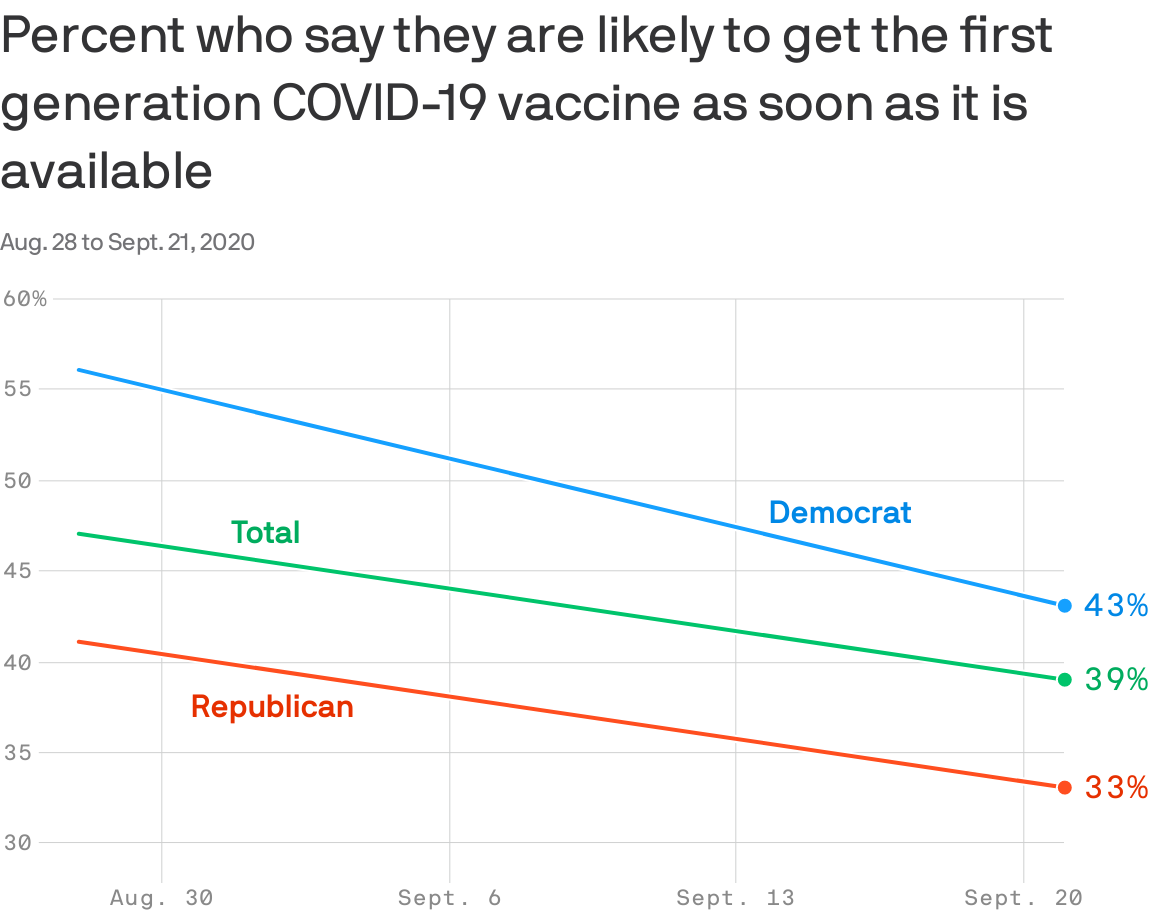
 Axios-Ipsos poll: America turns against vaccine