The enemy of knowledge is not ignorance, it’s the illusion of knowledge (Stephen Hawking)

It ain’t what you don’t know that gets you into trouble. It’s what you know for sure that just ain’t so (Mark Twain)

Invest with smart knowledge and objective odds

THE DAILY EDGE: 21 SEPTEMBER 2020

Fresh Surge in U.S. Covid-19 Cases Is Feared as Death Toll Nears 200,000 The U.S. reported 39,844 new coronavirus cases Sunday and was closing in on 200,000 deaths, amid fears that the country was heading for a new wave of infections.

(…) The daily increase was smaller than the 41,037 a day earlier. But the seven-day average for Saturday was 39,978, higher than the two-week average of 37,143. When the seven-day average is higher than the two-week average, which has been the case in the U.S. since Tuesday, it suggests cases are increasing.

Twelve states reported at least 1,000 new confirmed cases on Saturday, led by California with 3,822 and Texas with 3,377.

“I think we have at least one more cycle with this virus heading into the fall and winter,” Dr. Scott Gottlieb, a former Food and Drug Administration commissioner, said on “Face the Nation” on Sunday. “If you look at what’s happening around the country right now, there’s an unmistakable spike in new infections.“ He cited about 30 states where the rate of transfer is above one, which indicates “an expanding epidemic.” (…)

  • Indonesia’s capital is adding thousands of beds to house Covid-19 patients as its health system struggles with record increases in virus cases. The system is “already overwhelmed,” said Jossep William, coordinator of volunteer department at the pandemic task force.
  • Czech Health Minister Adam Vojtech quit on Monday, saying he wants to let the government apply a different strategy in tackling the pandemic. After being among Europe’s least affected nations during the spring outbreak thanks to early, strict quarantine measures, the Czech Republic is now one of the hardest-hit on the continent.
  • India added almost 87,000 cases to its virus tally Monday, pushing the total to nearly 5.5 million cases in the nation that already has the world’s second largest coronavirus outbreak. Deaths rose by 1,130 to cross 87,800, according to the India’s health ministry.
  • Germany’s tally of new cases ticked back above 2,000 on Friday for the first time since the end of April and there were just over 1,000 additional infections in the 24 hours through Monday morning.
  • France’s daily coronavirus cases rose by 10,569 on Sunday, after surging to more than 13,000 twice in the highest daily increases since the national lockdown ended in May on Saturday. Still, the seven-day average, which smooths out reporting spikes, rose above 10,000 for the first time, indicating a significantly higher pace of infections than a week ago.
  • Britain is at a “critical point” in the coronavirus pandemic and data on cases are heading in the “wrong direction,” Chief Medical Officer Chris Whitty is expected to warn on Monday, as concern mounts that a second lockdown may be needed. Expectations are running high that local restrictions elsewhere in the U.K. could be extended to London. Mayor Sadiq Khan will recommend tightened rules for the capital on Monday, LBC radio reported.
  • South Korea added 70 more coronavirus cases in 24 hours compared with 82 a day earlier, according to data from Korea Disease Control and Prevention Agency. The number of confirmed cases remained below 100 for a second day, the first time since mid-August. Meanwhile China reported 12 new cases for September 20, all of which were imported.
  • New virus cases in Victoria fell to 14 on Sunday, the state’s health department said on Twitter. That’s the lowest in more than three months. The 14-day rolling average declined to 36.2 in metropolitan Melbourne, comfortably below the 50 level the local administration has set as the benchmark for a slight easing of restrictions on Sept. 28.
STALL SPEED

From John Mauldin’s Thoughts From the Frontline:

“(…) The economy is just barely at stall speed, coasting along on the previously generated momentum but unable to accelerate. It can only stay in the air so much longer, and our pilots are pointing fingers at each other instead of restarting the engines.

Philippa Dunne and Doug Henwood calculated this week the stopgap benefit payments, cash for which is coming from FEMA disaster relief funds, are almost exhausted (my emphasis):

FEMA is reporting that it’s spent $30 billion of the $44 billion allocated by the executive order, though all that spending has not showed up in the Daily Treasury Statement yet. In any case, the program will run out of money in a week or two. In fact, a number of states have already run through their allowances. The program will be history before the month is over. And that $44 billion is a bit more than half what the CARES Act program spent in its peak month, June—$80.4 billion. With nearly 28 million people drawing traditional and expanded pandemic benefits, a lot of people are suffering sharp cuts in income now and Congress doesn’t seem to be motivated to address the problem.

(…) I hope everyone understands we are on the edge of a cliff. Moves that would normally be harmless could spell disaster. We need leaders to represent all their constituents, not just those who voted for them. This necessarily means compromise. Yes, I’m using that word a lot. It’s not profane. It is a way to get things done. And right now, compromise may be the only way to keep this plane in the air. (…)”

  • STALL SPEED? DEPENDS WHERE YOU LOOK

Some recent corporate quotes from The Transcript:

  • “I’ll start by saying that things look better than we thought they would. The data looks pretty good relative to what we would have thought at second quarter earnings. But, importantly, we still haven’t seen the typical recessionary indicators that you would expect to see at this point.” (…) “And so, while things do look a little bit better than we thought they would, we’re still dealing with an enormous amount of uncertainty looking ahead…Obviously, we have an election. We have a potential second wave. We have tapering of stimulus, as you said. There’re still lots of things to be worried about.” – JPMorgan Chase (JPM) CFO Jen Piepszak
  • “I think for the whole industry, it’s probably a little too soon to say that things are better than previously forecast. They’re probably not worse than previously forecast.” – Wells Fargo (WFC) CFO John Shrewsberry
  • “…we are encouraged about the recovery we are seeing in most of our markets…Our full-sized and SUV plants are running all out and our other facilities are operating in line with market demand. We are selling every full-sized truck and SUV we can produce as demand remains strong and our inventories remain lean.” (…) “In China, the industry continues its recovery and our JVs have been seen improved sales since the deepest impact of the virus in February. Our retail sales were up over 10% year-over-year in each of the past two months.”  – General Motors (GM) CEO Mary Barra
  • “China is in many ways up and running in a very, very normal way. We look at our businesses there. People are walking around without mask. People are back in the office. So we are really seeing that part of the world kind of coming back up to normal. Even in parts of Europe, particularly around Denmark and places like that, we have seen life return to the new normal.” – Herman Miller (MLHR) CEO Andi Owen
  • “…our second lead growth market, which is our business in China, you can see that our business there is approaching full sales recovery. We’ve posted flat comps in August, up from minus 10% in July.” – Starbucks (SBUX) CFO Pat Grismer
Canadian Retail Sales Slow After Surpassing Pandemic Losses

Sales grew 0.6% in July, versus 23% in June and 21% in May, Statistics Canada said Friday in Ottawa. Excluding vehicles, receipts unexpectedly dropped 0.4%, versus a forecast gain of 0.5%. Core retail sales, or those excluding vehicles and gasoline, dropped 1.2%. Preliminary estimates from the agency show receipts climbed 1.1% in August, suggesting the weaker trend will continue. (…) In July, retail sales were up 2.7% compared with year earlier levels.

Growth slowing after retailers fully recover pandemic losses

EQUITIES
A Healthy Correction That Finally Merits the Label If there is ever such a thing, the retracement of U.S. mega-cap tech stocks fits the description.

(…) Herd mentality is in the news, as well as herd immunity. Whatever its role in combating the pandemic, it has long played an important part in the world of investing. Professional investors are paid not to make the most money possible with the least risk, but to accumulate the most assets — which generally means doing a bit better than their peers. That makes big contrarian bets very dangerous to their careers, and creates an incentive to hug their benchmark. It’s often best expressed in terms of herd psychology; in a herd of antelope, it is safest to be in the middle, as it is those at the front or the back who are most likely to be attacked by lions. (…)

The herd psychology isn’t just visible at the level of individual stocks. If we look at funds’ sectoral holdings, the same pattern appears. The sectors in which funds were overweight at the beginning of the year are now even more overweight, and vice versa. There has been very little rotating from successful sectors, or profit-taking thus far: (…) (John Authers)

relates to A Healthy Correction That Finally Merits the Label

Well, the some in the herd may feel less healthy today:

Weekly Equity Fund Flows
TECHNICALS WATCH

Last week saw a small uptick in Lowry’s Buying Power Index and a small easing in its Selling Pressure measure but the basic trends are unchanged: BP keeps waning while SP failed to rise, reflecting only selective selling. In fact, the recent relatively better behavior of Consumer/Cyclicals, Materials and Industrials suggests “that Technology corrected while money moved into other areas instead of being withdrawn from the market altogether.”

Lowry’s analysis remains “biased to the upside” but prefers to “wait for the return of enthusiastic demand” before giving an all-clear signal.

Not happening this morning…

The other indicator I closely follow is the 13/34–Week EMA Trend from CMG Wealth. Still positive:

The S&P 500 traversed below its still rising 50dma and remains 6.3% above its 200dma (3099).

spy

Reflective of the sector shifts, its equal-weight clone closed at its 50dma, 4.8% above its declining 200dma

rsp

Small caps remain weak, well below their pre-pandemic highs, and sitting or near their declining 200dma.

sly

iwm

BUYING THE DIP?

Only 46% of NYSE Stocks Are > Their 200-Day MAs
(Major Lows Occur w/ This Indicator Below 20%).

Source: Wolfe Research (via Barry Ritholtz)

At today’s pre-op (3260), the R20 P/E is 24.2.

image

At the 200dma level: 23.0. At 5-10% “undershoot” like in 2010, 20112015, 2016 and 2018: 22.0-21.0.

image

A 20.0 R20 P/E is at 2650. And trailing EPS are not about to get better any time soon, dragging the Rule of 20 Fair Value (yellow line above) even lower in Q4.

European Banks Consider Mergers for Survival Banks in Europe are facing a prolonged era of low interest rates, a gloomy economic outlook and souring loans that are expected to rise.

(…) Many of the conversations are happening internally and have yet to translate into deal talks or takeover offers. And most discussions at this stage are around domestic rather than cross-border deals, which offer less cost synergies and would require deeper government involvement to push through to completion. (…) Now, the feeling that something needs to be done and done soon has never been so strong, according to bank executives and outside advisers. (…)

Curious about U.S. bank ROEs? Currently running at 8.3% down from the 11.0-11.5% range pre-pandemic. Price to book values are back below 1.0.

image

U.S. banks have not grown their EPS in 25 years!!

image

Their 4.0% collective dividend yield may look attractive to some but Canadian banks are yielding 4.9%, also selling near book (1.1) but with a better ROE of 11.1%, down from 14% in 2018 and 13.4% pre-pandemic.

image

Canadian banks profit performance has been much, much better with very solid dividends (the 2013 dip in the dividend line must be a software glitch; National Bank is the only Canadian bank to have cut its dividend, in 1983 and 1993). (Charts using Morningstar/CPMS software)

image

U.S. bankers quotes:

  • “…we’re not seeing anything that you would typically expect to see at this point in a recession…on the wholesale side, given the amount of liquidity that’s out there…we may see some losses there later this year, but more likely really see that start to emerge in the first half of 2021. On the consumer side…I think it’s easy to see that, that could be the back half of 2021 before we really start to see those losses realized in a material way.” – JPMorgan Chase (JPM) CFO Jen Piepszak
  • “…the actual loss taking or charge off activity is getting pushed out on the consumer side. And these deferral programs are certainly a big part of it. And then all of the liquidity in the system and other forms of state and federal government support are having the effect of either making things better or at least pushing losses for the future. So we’re not anticipating those losses being worse sitting here in the third quarter, but it’s hard to know whether they’re going to be better or just further out in the future.” – Wells Fargo (WFC)

And now this:

Banks Moved $2 Trillion Amid Laundering Orders, ICIJ Says
PANDEMONIUM
Confused smile  ByteDance adamant it will retain majority ownership of TikTok in US Chinese company contradicts assertions of Donald Trump, Oracle and Walmart

The new deal to rescue TikTok from a threatened U.S. ban — full of provisions aimed at creating the temporary appearance of a presidential win — looks like a sort of Potemkin village agreement. Potemkin villages were fake-storefront towns stood up to impress a visiting czar and dignitaries. When the visitors left, the stage set got struck. Similarly, many elements of this plan look hastily erected and easily abandoned once the spotlight moves on. (…)

  • Oracle’s TikTok Deal Pours Trump Toxin Into Capitalism: Rewarding your friends in business is the hallmark of countries like Russia, not America (Bloomberg)

In the communist party’s Global Times:

Chinese regulators may block Nvidia’s $40b Arm buyout: analysts

(…) Arm, which was acquired by SoftBank in 2016, is seen as an independent entity that gives equal treatment to all licensees, with its major customers including Apple, Samsung, Qualcomm and Huawei.

“As part of Nvidia, Arm will continue to operate its open-licensing model while maintaining the global customer neutrality that has been foundational to its success,” the US firm said in a statement.

However, the “neutrality” is in serious doubt as Arm will become part of a US firm, which means the Trump administration could contain China’s growing chipset industry from the design side, following its crackdown on Huawei, Ma Jihua, a veteran telecom industry analyst, told the Global Times on Monday.

“The acquisition will affect the development path of China’s chipset industry as most of its products are based on Arm architecture,” said Ma.

Huawei’s Kunpeng, Kirin and Ascend chips are all based on Arm architecture. “If the US prohibits Arm from cooperating with Huawei, the design of Huawei chips will be temporarily suspended,” said Huang Haifeng, an independent semiconductor industry observer.

But the deal is likely to prompt close scrutiny by antitrust authorities around the world, including those in the US, UK, EU and China, and whether the deal goes through hinges on the regulators’ reviews.

Xiang Ligang, director-general of the Beijing-based Information Consumption Alliance, told the Global Times on Monday that the Chinese government is likely to play a role in reviewing the case and the chance of its approval is low.

“Regardless of whether the US government stands behind the purchase, its impact on China’s semiconductor industry is not something we want to see in the future,” said Xiang. (…)

China’s Rejection of Taiwan Buffer Zone Raises Risk of Clash

China is ratcheting up the risk of military confrontation in the Taiwan Strait, as Beijing seeks to deter Taipei from continuing to deepen ties with the U.S. and other like-minded democracies.

People’s Liberation Army aircraft repeatedly breached the median line between Taiwan and the Chinese mainland last week, in the latest of a series of military exercises in the area. The Chinese pilots signaled a willingness to continue the practice, telling Taiwanese personnel who attempted to warn them away that “there is no median line,” the Taipei-based China Times newspaper reported Friday, citing unnamed military officials.

The report was widely circulated by Chinese state media, with the PLA’s Eastern Theater Command responding to one post by urging citizens to “discard any illusions and prepare to fight.” The PLA Air Force separately released a video Saturday showing H-6 bombers making a simulated strike on a runway that looked similar to one at Anderson Air Force Base on Guam, a key staging area for any U.S. support for Taiwan.

“The risks of war are rising considerably, and redrawing the map over the median line in the Taiwan Strait is a very obvious step by Beijing to not only raise the pressure, but also justify use of force,” said Malcolm Davis, a former defense adviser to the government and now a senior analyst at the Australian Strategic Policy Institute in Canberra. “These aggressive probes are perhaps designed to provoke the Taiwanese air force to ‘shoot first’ and then Beijing has all the justification it needs.” (…)

The incursions across the median line, which the U.S. established in 1954 to prevent a conflict, signal Chinese President Xi Jinping’s displeasure with Trump administration overtures to Taiwan, including the visit last week by U.S. Undersecretary of State Keith Krach. Nineteen Chinese warplanes, including fighter jets and bombers, crossed the center line Saturday, according to Taiwan’s defense ministry. (…)

Chinese Foreign Ministry spokesman Wang Wenbin told a regular news briefing Monday that there “is no so-called median line.” (…)

U.S. Image Plummets Internationally as Most Say Country Has Handled Coronavirus Badly

THE DAILY EDGE: 18 SEPTEMBER 2020

U.S. Initial Jobless Claims Decline; Continuing Claims Range-bound

Seasonally adjusted state initial jobless claims for unemployment insurance declined to 860,000 in the week ending September 12 from 893,000 in the previous week. The Action Economics Forecast Survey anticipated 850,000. (…)

Claims for the federal Pandemic Unemployment Assistance (PUA) program, which covers individuals such as the self-employed who are not qualified for regular/state unemployment insurance, decreased for the first time in four weeks to 658,737 from 868,314. PUA claims are up roughly 170,000 since their near-term low in the week ending August 8. Numbers for this and other federal programs are not seasonally adjusted. (…)

image

U.S. Housing Starts Decline in August as Multi-Family Weakens

Housing starts declined 5.1% (+2.8% y/y) during August to 1.416 million (SAAR) from 1.492 million during July, revised from 1.496 million. The decline left starts 12.4% below their January peak of 1.617 million. The Action Economics Forecast Survey expected 1.484 million starts in August.

A 22.7% decline (-15.2% y/y) in starts of multi-family units to 395,000 accounted for the drop in starts overall last month. Starts of single-family homes rose 4.1% last month (12.1% y/y) to 1.021 million after surging 10.1% in July to 981,000, revised from 940,000. The latest level was a six-month high, up 50.4% from the April low.

Building permits slipped 0.9% in August (-0.1% y/y) to 1.470 million from 1.483 million in July, revised from 1.258 million. Permits to build single-family homes increased 6.0% (15.6% y/y) to 1.036 million after improving 16.3% in July and 12.6% in June. Permits to build multi-family homes decreased 14.2% (-24.5% y/y) to 434,000 after rising 21.1% in July.

image

The NY FEd’s latest Weekly Economic Index (WEI):

image

Goldman Sachs:

The prospects for further fiscal stimulus have dimmed further, as another week has gone by without any progress. At this point, a major stimulus package before the election looks like a long shot and we expect Congress to leave at the end of September without extending the extra unemployment insurance payment, approving another round of stimulus payments, or providing additional support to small businesses or state and local governments.

Next week is likely to bring some clarity. Congress is likely to start moving next week on the final piece of major pre-election legislation, to extend spending authority past September 30, the end of the fiscal year. If fiscal stimulus measures are not included in that bill, or a deal is not announced next week, fiscal stimulus will likely be on hold for the rest of the year. (…)

Failure to pass any additional fiscal measures would likely lead us to downgrade our growth estimates for Q4. By contrast, enactment of the sort of package that President Trump or Speaker Pelosi have both endorsed would likely lead us to upgrade our view for Q4.

Why China’s recovery is not what it seems

(…) As the graph below shows, before 2020 retail sales had grown slightly faster than industrial production, indicating a slow rebalancing in an economy that urgently needed it. But in 2020 that relationship has inverted, with industrial production now growing so much faster than retail sales that it threatens to reverse the past two to three years of China’s limited rebalancing. (…)

What the past few months of economic data tell us is that, not only has sustainable domestic demand barely recovered from the pandemic, but that even this limited recovery has been driven by Beijing’s substantial boosting of the production side of the economy. By expanding public sector investment in logistics and infrastructure, underwriting an expansion of credit to businesses, and otherwise subsidising production, Beijing has bolstered production to create the employment that has indirectly boosted consumption.

Put differently, economic recovery in China (and the world, more generally) requires a recovery in demand that pulls along with it a recovery in supply. But that isn’t what’s happening. Instead Beijing is pushing hard on the supply side, mainly because it must lower unemployment as quickly as possible. It is this push on the supply side that is pulling demand along with it. (…)

China’s “recovery”, in other words, is largely an exacerbation of the problems that have long been recognised by Beijing. It is a supply-side recovery in an economy that urgently needs more domestic demand but that has found it politically very hard to manage the wealth transfers that it requires.

This recovery isn’t sustainable without a substantial transformation of the economy, and unless Beijing moves quickly to redistribute domestic income, it will require either slower growth abroad or an eventual reversal of domestic growth once Chinese debt can no longer rise fast enough to hide the domestic demand problem.

The communist party’s first objective is its own survival. Excerpts from Geopolitical Futures’ Phillip Orchard essay

China’s Trial by Fire

(…) Two weeks ago, in a triumphant speech, Xi said, “The CCP’s strong leadership is the most reliable backbone when a storm hits. The pandemic once again proves the superiority of the socialist system with Chinese characteristics.” (…)

The systemic shock from the pandemic could well have exposed China’s economy as a house of cards. China shut down the bulk of its domestic economy almost overnight. Millions were abruptly out of work. Countless small businesses – which were already weighed down by tariffs and a credit crunch before the pandemic – faltered, searching for rescue from an immature banking system that had already proved ill-suited for meeting the needs of China’s burgeoning private sector. China’s convoluted financial system, already awash in shadow lending and toxic loans, appeared on the brink. Once Beijing was able to reopen most of the economy, it faced a secondary crisis in the form of collapsing demand for Chinese exports as the rest of the world sunk into crisis.

And yet, Beijing has somehow been able to keep its myriad interlocking systemic risks from triggering a cascading crisis. It never even needed to unleash a firehose of stimulus as it did after 2008 – measures that contributed directly to its staggering financial risks today. This week, the Organization of Economic Cooperation and Development predicted that China would be the only one of the world’s 20 leading economies to post positive growth this year. Here, Xi can rightfully take credit for pushing through a series of painful measures to curb financial risk beginning in his first term; these worked better than many expected. Meanwhile, his emphasis on strengthening state-owned enterprises – which in normal times have sapped the economy of its dynamism and are at the core of Western trade grievances – has been validated since SOEs have sopped up surplus labor and kept industrial production humming. Perhaps most important, Beijing’s worst nightmare – a massive spike in unemployment – came true, but without the attendant social unrest. There’s a case to be made that the experience will ultimately make Beijing confident enough to adopt a more sustainable economic model that doesn’t prioritize stable employment at the expense of profitability and dynamism. (…)

Xi’s administration will need all the luck it can get and all the savvy at its disposal because China has no shortage of crises on the horizon. The current pandemic may be under control, but the culture of censorship and institutional rigidity fostered by Xi may keep Beijing unprepared for the next one. The scale of the structural damage on the Chinese economy left behind by the pandemic won’t be fully apparent for years to come. The “grey rhinos” and black swans Xi is always warning about in the financial sector are still out there – and many of Beijing’s critical reform plans aimed at thwarting them have been put on hold. The pandemic, along with the CPC’s increasing dependence on state control, has accelerated the slide toward open hostility between China and the West. The Three Gorges Dam cannot realistically be upgraded. Floods will return. The problems exposed this year are really just the tip of the iceberg.

But to Beijing, the lesson of this year is evidently: trust only the party’s power. Its solution to a dysfunctional public health sector, for example, is to tighten central control over it. The only way to stave off a financial collapse is through painful measures aimed at curbing financial risk, and these can only be implemented with the brute force required to remove opposition and contain the fallout. (…)

Mao may have thrived on a doctrine of perpetual revolution, but Xi appears to be inescapably driven by permanent crises. This mindset is perhaps the inevitable result for a government haunted by China’s history – by the weight of rising public expectation, by the impossible task of meeting the needs of 1.4 billion people, and by the inherent difficulty of trying to make the massive machinery of the state run efficiently through sheer force of central will and ideology. But the downside risk of this mindset for Beijing is obvious – and for China’s neighbors, it’s particularly alarming. Either way, it’s the one Beijing is sticking with, whatever storms may come.

VIRUS UPDATE

Not trending positively in the USA:

image

Upticks are visible in all regions, even in the NE, if you look carefully:

image

  • France’s daily coronavirus cases rose by more than 10,000 to the highest since the end of lockdown in May, with Health Minister Olivier Veran warning the disease “is again very active” in the country. The uptick in French infections mirrors steady increases across Europe, with the number of new cases in Germany rising Friday by more than 2,000, the most since late April. Portugal on Thursday reported the most new infections in five months, with 770, while Spanish cases rose at a slower pace than the previous day but still by more than 4,500. Health officials blame the increase on social gatherings, especially among younger people, and on travelers bringing the virus back from vacation.
  • A surge of Covid-19 cases in London is expected to be announced on Friday, potentially putting the city on track for curbs on socializing in about a fortnight, the Evening Standard said, without saying how it obtained the information. The capital has recorded about 25 cases per 100,000 over the last seven days, rising from 18.8, according to the report.
  • India’s epidemic is showing no sign of peaking as the country added more than 96,000 cases overnight, bringing its tally — the highest in the world after the U.S. — to more than 5.2 million. Amid the outbreak, economists and institutions like the Asian Development Bank have cut India’s growth projections from already historic lows. Goldman Sachs now estimates India’s economy will shrink 14.8% for the year through March 2021, while the ADB is forecasting a 9% contraction. The Organization for Economic Cooperation and Development expects India’s economy to shrink 10.2%.
  • The infection-fighting antibodies that people with Covid-19 naturally produce appear to decline over time, with 58% of volunteers in one trial showing no sign of them two months after testing positive.
Moderna Vaccine Study Results Could Come in Late October Company also released the guidelines for the shot’s final-stage trial

A large, pivotal study of Moderna Inc.’s MRNA -1.38% Covid-19 vaccine could yield a preliminary answer about whether the shot works safely as early as October, though it’s more likely to be November, the company’s leader said.

Moderna Chief Executive Stephane Bancel said in an interview the timing will depend on rates of infection in the U.S. locations where the trial is being conducted, because the study is comparing whether fewer vaccinated people come down with symptomatic Covid-19 than unvaccinated people.

Researchers will assess this at intervals after a certain number of cases occur, ranging from 53 cases to 151 cases. (…)

Pfizer Chief Executive Albert Bourla, in recent television interviews, also gave an end-October time frame. Its vaccine is being developed with partner BioNTech SE.

If Moderna’s interim results are positive, the company could seek government authorization for emergency use of the vaccine soon thereafter, Mr. Bancel said. That could lead to quick distribution of any available doses, which Moderna has been manufacturing. (…)

Even if the trials provide positive results this fall, most people wouldn’t be able to get vaccinated until next year because supplies will be limited early on. (…)

Goldman, quite interestingly: “Just as safety concerns can lead to trials being ended, compelling statistical evidence can lead to the early disclosure of success; when the drug is compellingly effective and safe, it is unethical to refuse it to those participants in the placebo group and beyond.” So watch for disclosure in mid-to-late October. No announcement could be interpreted negatively.

FLUidity

From RBA’s Richard Bernstein:

I recently ventured to one of America’s largest pharmacy chains to get a flu shot. My doctor emphatically told me to get one because of the potential complications of COVID-19. I made an appointment through the pharmacy chain’s app, but upon arriving I was told that there were no flu shots available. This was the second branch of the particular chain in which I was informed there were no flu shots.

(…) the pharmacist felt obligated to share with me why I couldn’t get my flu shot. (…)

He mentioned:
1. The pharmacy chain can’t keep enough of the flu vaccine in stock and local pharmacies have no idea when new shipments will be delivered. Local
pharmacists have no ability to manage flu shot inventory.
2. The chain doesn’t have enough pharmacists to administer flu shots. If one
comes to the pharmacy with an appointment at a busy time, the pharmacy
might not be able to honor the appointment and one might have to wait well
over an hour because the pharmacist(s) are too busy filling prescriptions. Ill
patients necessarily have priority over preventative medicine.
3. The chain’s app doesn’t have access to inventory, so people are making
appointments only to find, as I did, that there are no flu shots available. (…)

It’s typical for people to get flu shots each fall, but there is increased demand
this year because of COVID-19. The pharmacist effectively outlined how the
production and distribution chains can’t handle this year’s increased demand for flu shots.

If the US health care system can’t handle increased production and distribution of flu vaccines when there has been advance notice regarding increased demand, how will it cope with the production and distribution of a COVID-19 vaccine? Everyone KNEW more people would need flu shots this year. Yet, there is limited coordination to produce enough flu vaccines and, equally important, to effectively distribute and administer them.

The CDC on August 19:

For the upcoming flu season, flu vaccination will be very important to reduce flu because it can help reduce the overall impact of respiratory illnesses on the population and thus lessen the resulting burden on the healthcare system during the COVID-19 pandemic.

Flu vaccine is produced by private manufacturers, so supply depends on manufacturers. Vaccine manufacturers have projected that they will supply as many as 194 to 198 million doses of influenza vaccine for the 2020-2021 season. (…)

Currently, manufacturers have indicated there are no significant delays in the distribution of influenza vaccine this season. Shipments have begun with doses of vaccine being distributed as production and approval is finalized. Vaccine distribution is expected to go on longer this season because a record number of doses are being produced. CDC will continue to provide weekly updates on total influenza vaccine doses distributed throughout the 2020-2021 influenza season.

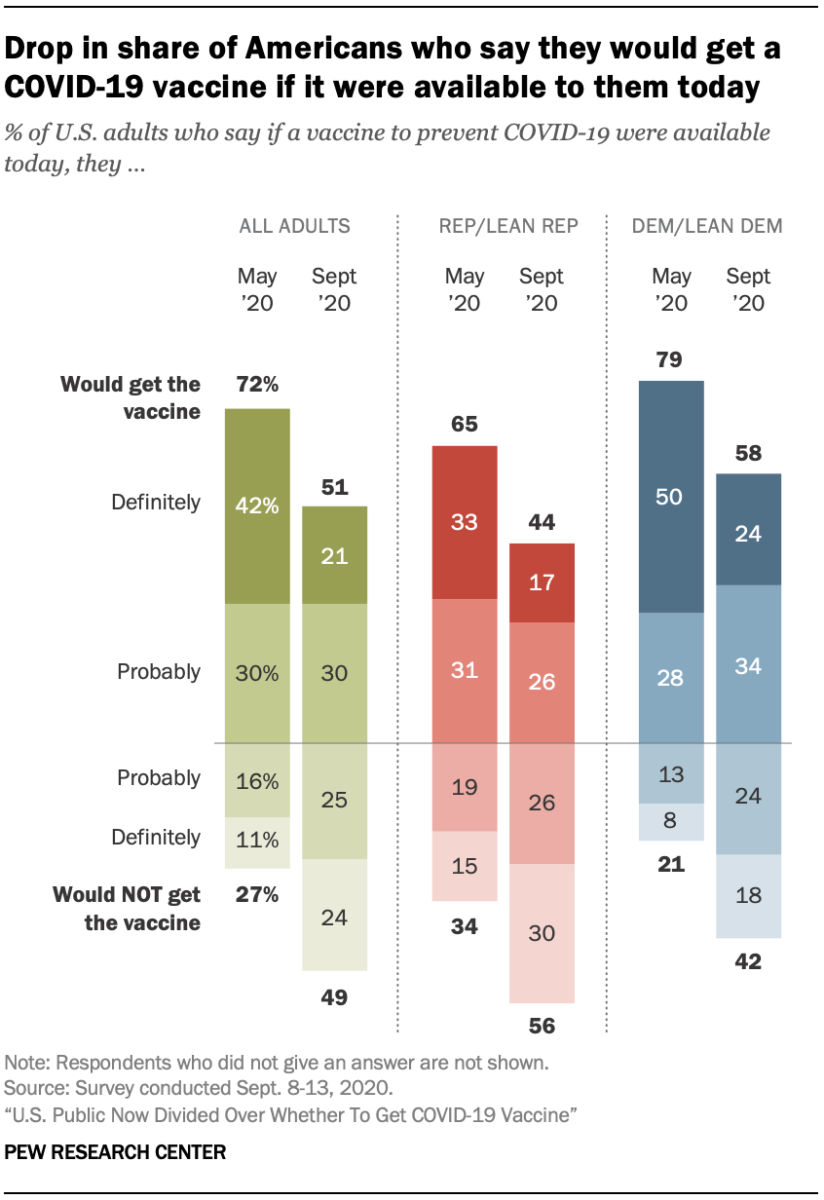
But if Americans don’t care…even Dems are not sure.

EQUITIES

Zero Hedge informs us that “Bloomberg notes that during the week ended September 11, insiders sold $473 million in shares while only buying $9.5 million.” INK’s  analysis suggests insiders have been more net sellers since mid-July and that “insiders are sticking to their value strategy of favouring stocks that are cheap relative to their growth prospects. Unfortunately, the value opportunities in the market are rare and are found primarily in the Energy and Financials sectors.”

image

Inside vs outside:

China’s Stock Bulls Spark a Decoupling in Market Prices Some mismatch between a company’s shares listed on China’s mainland and their counterparts in Hong Kong isn’t unusual. But the growing gulf is creating a strange situation where companies can simultaneously have two radically different valuations.

(…) On Friday the premium for shares trading in Shanghai and Shenzhen, compared with equivalent stocks in Hong Kong, topped 45%, the highest since February 2016, according to the Hang Seng AH Premium Index. (…)

That is partly because trading onshore is dominated by mom-and-pop investors rather than the big institutions that hold more sway in Hong Kong and other international markets. That can mean shorter time horizons and more focus on headlines and price momentum than on corporate fundamentals, investors and analysts say. (…)

And while A and H shares in the same company carry similar economic rights, they aren’t fungible, meaning they can’t be exchanged for each other. (…)

For your enjoyment from Axios:

Jupiter and its enticing moon Europa shine in a new photo by the Hubble Space Telescope, AP reports.

  • Hubble snapped the picture last month when the planet was 406 million miles away, and the Space Telescope Science Institute in Baltimore released it yesterday.

Europa, which is smaller than our own moon, appears as a pale dot alongside its giant, color-streaked gas planet.

  • Jupiter’s Great Red Spot is unusually red.