The enemy of knowledge is not ignorance, it’s the illusion of knowledge (Stephen Hawking)

It ain’t what you don’t know that gets you into trouble. It’s what you know for sure that just ain’t so (Mark Twain)

Invest with smart knowledge and objective odds

THE DAILY EDGE: 17 SEPTEMBER 2020

U.S. Stock Futures Fall as Fed Outlook Rattles Investors

(…) Federal Reserve Chairman Jerome Powell’s comments Wednesday that the economic outlook is “highly uncertain” are weighing on sentiment. Policy makers indicated concern that easy gains from reopening the economy could mask deeper scars among the most vulnerable businesses, with people likely to face longer spells of joblessness. The central bank also signaled that interest rates would stay near zero until 2023.

“The Fed said it would keep rates low for ages. But that’s not enough,” said James Athey, senior investment manager at Aberdeen Standard Investments. “Not taking away is no longer sufficient for this market. You need to do more, more, more.” (…)

Mr. Powell cautioned that it was possible that the lower unemployment rate partly reflects fewer Americans looking for work right now, which means they aren’t formally counted among the jobless. He said the economic recovery may take longer than people would like, and reiterated calls for Congress to spend more money to support households and businesses. (…)

“There’s fatigue on the fiscal and policy front. The Fed didn’t take any new steps and no deal has passed Congress,” said James McCormick, a strategist at NatWest Markets. “There are signs of a fiscal cliff emerging,” he warned, and pointed toward the high number of Americans drawing on unemployment support. (…)

Fed Sets Higher Hurdles for Rate Increase Central bank signals rates near zero at least through 2023 to help support recovery

In new projections released Wednesday after a two-day policy meeting, all 17 officials who participated said they expect to keep rates near zero at least through next year, and 13 projected rates would stay there through 2023.

image

The Fed’s rate-setting committee also revised its postmeeting statement to specify it would maintain rates near zero until it sees evidence of a tight labor market and inflation reaches 2% “and is on track to moderately exceed 2% for some time.” (…)

Separately, officials revised their June economic forecasts to reflect expectations of a less severe contraction this year and a lower unemployment rate. They now project unemployment will average around 7% to 8% during the last three months of this year, down from June projections of around 9% to 10%. (…)

Mr. Powell said it would be important for Congress to spend more money to support these households, along with hard-hit businesses and state and local governments, to limit additional damage to the economy. (…)

“For the last 60 days or so, the economy’s recovered faster than expected, and that may continue or not. We just don’t know,” said Mr. Powell. (…)

But with short- and long-term interest rates at historically low levels, the Fed could have fewer tools to spur a recovery than it did after the 2008 financial crisis. At Wednesday’s news conference, Mr. Powell used the word “powerful” 10 times to describe the Fed’s new guidance. (…)

Which can be summed up by “We just don’t know”.

John Authers shows us that the Fed is now aiming at a rather elusive nirvanian environment:

(…) According to Powell, rates will stay where they are until inflation gets back up to 2%, in combination with maximum employment, which according to the Fed’s own estimates would be a rate of 4.1%. Neither of these levels sounds that remarkable, but there have been only three periods in the last 60 years when they have co-existed. They are marked on the following chart:

Sub-4.1% unemployment combined with 2% inflation is very rareSo, Powell told us that rates will stay effectively at zero unless and until the economy reaches a state of near-perfection it has glimpsed only briefly and only three times in the lifetimes of most people now living. Traders will likely work out soon enough that it was greedy to hope that the Fed would be any more dovish than that.

“Credibility is like virginity. Once you lose it, you can never get it back.”

Trump Moves Closer to Bipartisan Plan for More Stimulus Spending

(…) Trump, at a White House press conference on Wednesday evening, said that he liked “the larger numbers” in a compromise $1.5 trillion stimulus proposal from a bipartisan group of House lawmakers that was an effort to break a months-long deadlock over bolstering the U.S. economy amid the coronavirus pandemic.

“I agree with a lot of it,” Trump said of the plan. “I heard Nancy Pelosi say she doesn’t want to leave until we have an agreement” and “she’s come a long way.”

The plan from a 50-member group of House Democrats and Republicans has a bigger total spending figure than the administration previously endorsed. It’s also higher than what Senate GOP leaders say would be acceptable to Republicans. (…)

  • White House Chief of Staff Mark Meadows said he is “probably more optimistic about the potential for a deal in the last 72 hours than I have been in the last 72 days.” (CNBC)

Closer to closing:

As of August 31, 163,735 total U.S. businesses on Yelp have closed since the beginning of the pandemic (observed as March 1), a 23% increase since July 10. In the wake of COVID-19 cases increasing and local restrictions continuing to change in many states we’re seeing both permanent and temporary closures rise across the nation, with 60% of those closed businesses not reopening (97,966 permanently closed). (…)

The restaurant industry continues to be among the most impacted with an increasing number of closures – totalling 32,109 closures as of August 31, with 19,590 of these business closures indicated to be permanent (61%). (…) Retail and shopping follows closely behind restaurants with 30,374 total business closures, 17,503 of which are permanent (58%). (Yelp)

VIRUS UPDATE
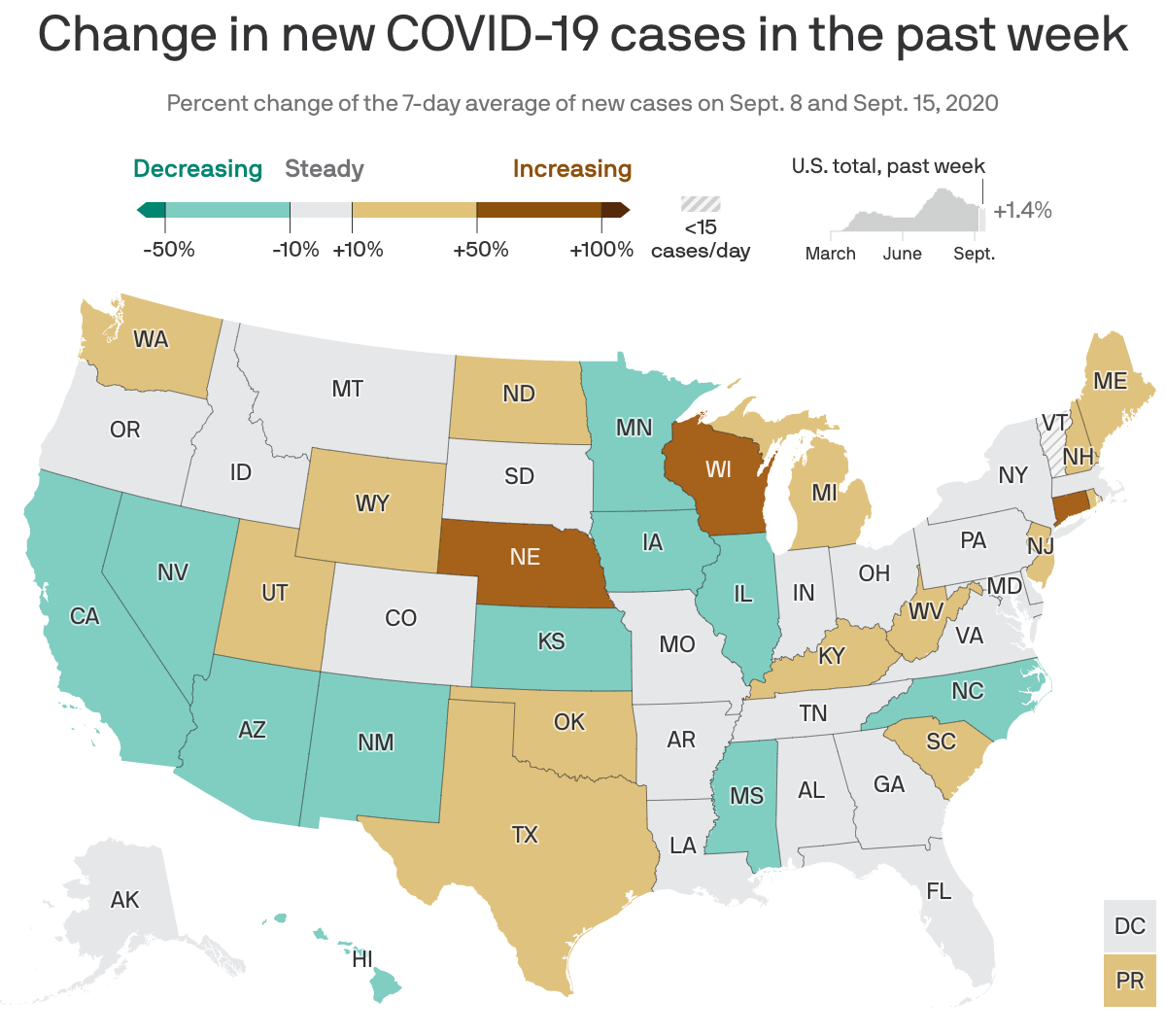
COVID-19’s summer surge into red America sets the stage for November’s election

(…) COVID-19 spread much more dramatically during the height of the summer to states, counties, and, in particular, small towns and rural areas that voted for Trump in the 2016 election. The pandemic’s spread from “blue” America to “red” is evident when looking at the rate of new COVID-19 cases per 100,000 population in states won by Trump or Hillary Clinton in the 2016 presidential election. This analysis looks at the spread over the bimonthly periods: March to April, May to June, and July to August.

Fig1(…) 17 states added at least 1,000 cases per 100,000 population over this period—of which, 15 voted for Trump in 2016. (…)

Another feature of this summer dispersion of new COVID-19 cases is the spread away from urban cores and into smaller-sized places. Using a Brookings classification system of counties that identifies urban cores, large suburbs, small metropolitan areas, and non-metropolitan areas. While new COVID-19 case rates rose in all urban classifications in July and August compared to the earlier two-month periods, the summer case rates were much more similar across all urban types, rather than accentuated among large urban cores.

Fig3

(…) the red counties with new high COVID-19 case rates are heavily represented in all parts of the country, but a fair number are located in what might be considered November’s swing states: Florida, Arizona, Georgia, North Carolina and Texas. Clearly, the recent rise in new COVID-19 cases in these counties should raise concerns about the pandemic in ways that cannot be easily be dismissed. (…)

0_All Key Metrics (35)

1R_Reg Positive (4)

(Axios)

Many EU countries are near or back to their March case numbers!

coronavirus-data-explorer (19)

coronavirus-data-explorer (18)

CDC Chief Predicts Covid-19 Vaccine May Not Be Generally Available Until Next Summer President Trump disputed that timeline, though, saying Robert Redfield may have been confused.

The director of the U.S. Centers for Disease Control and Prevention, Robert Redfield, said he believes a vaccine will be available to the general public in the late second quarter or third quarter of 2021. At a Senate Appropriations subcommittee hearing on Wednesday, Dr. Redfield said the vaccine would be in “very limited supply” at the end of the year and priority would be given to individuals at the greatest risk and first responders.

“If you’re asking me when is it going to be generally available to the American public, so we can begin to take advantage of vaccine to get back to our regular life, I think we’re probably looking at third, late second quarter, third quarter, 2021,” Dr. Redfield said.

During an evening briefing, President Trump disputed that timeline, saying he called Dr. Redfield after he made his remarks before the Senate panel.

“I think he got the message maybe confused, maybe it was stated incorrectly,” Mr. Trump told reporters Wednesday. “It could be announced in October, it could be announced a little bit after October,” he said.

Mr. Trump said a vaccine would be distributed to the general public immediately. Scott Atlas, Mr. Trump’s coronavirus adviser, said 700 million doses would be available for Americans by the end of March.

Dr. Redfield had said a vaccine could be available sometime between November and December in a “very limited supply” and would have to be prioritized when released publicly. Mr. Trump said the “distribution is going to be very rapid,” and that Dr. Redfield may not be aware of the administration’s plan for that. (…)

At the Senate hearing, Dr. Redfield held up a mask and said it “is more guaranteed to protect me against Covid than when I take a Covid vaccine,” because it may not work for everyone. “If I don’t get an immune response, the vaccine is not going to protect me. This face mask will.” He repeated that message in his tweet.

Mr. Trump said Dr. Redfield misunderstood the question, “but we are beyond that now.” The president added that “there are some people who don’t like the mask.” (…)

  • “The goal is to have 100 million doses on tap by Dec. 31, Mike Pence told Fox.” (Bloomberg)

Narratives!

Justin Lahart in today’s WSJ: “Consider the August retail sales report that the Commerce Department released Wednesday. This showed that spending at service stations, stores, restaurants and online rose a seasonally adjusted 0.6% in August from a month earlier, which was a bit shy of what economists expected and showed that the big rebound in spending has begun to fade.”

A bit shy? The consensus was +1.0% and July’s numbers were cut 0.5%, taking actual August sales 0.9% below expectations…

EQUITIES
Should You Buy Stocks Because Rates Are Low? Many investors see the 2020 bull market as a logical consequence of a drop in discount rates, but the reality is murkier

(…) trying to justify asset values based on risk-free interest rates gets even harder because, even though the equity risk premium is now historically high, it doesn’t appear to hover around any given level.

The Credit Suisse Research Institute suggests that over a very long timespan—between 1910 and 2019—high [equity risk] premiums did tend to narrow, and vice versa, but only with the hindsight benefit of knowing what was “high.” At each point in time, using past data to determine whether the spread was high enough to trigger a stock rally wouldn’t have worked. (…)

The lesson may be that uncertainty about the future prevents rational discounting of cash flows at any given rate. Instead, both numbers are often concocted to justify investment decisions that already have been made. The prospect of a more digital post-pandemic economy, if sustained, can well justify the optimism fueling this year’s 25% rise in the Nasdaq Composite. Low rates on their own are a flimsy argument.

Even more so if expectations for future cash flows do not take into account the economic reality that low interest rates reflect.

From UBS, for what it’s worth:

Upside vs. Downside Estimated Potential Impact for U.S. Equities

What it’s worth:

Snowflake’s Stock Price Soars in IPO Snowflake’s shares made their debut at $245 a share on their first day of trading, more than double the IPO price.

In Canada:

Nuvei raises target price to US$26 on initial public offering amid strong demand

Montreal payments-processing company Nuvei Corp. has priced its initial public offering at US$26 a share, well in excess of its original goal, in advance of its debut on the Toronto Stock Exchange in the next few days.

The company last week disclosed plans to raise at least US$600-million in its initial public offering, setting a price range of US$20 to US$22 per subordinate voting share (…)

Two sources familiar with the deal said Nuvei and its underwriters increased the price range to between US$22 and US$24 this week based on strong investor demand, before settling on the final price, which was disclosed in a press release early Thursday morning. (…)

Nuvei, founded by Mr. Fayer in 2003, grew steadily to become one of Canada’s largest private financial-technology companies. The company has 765 employees and 50,000 merchant customers globally across a range of industries, including online retail, online gambling and financial services. Nuvei generated revenue of US$245.8-million in 2019 and posted a net loss of US$69.5-million.

THE DAILY EDGE: 16 SEPTEMBER 2020

U.S. Retail Sales Rebound Slows After Extra Jobless Aid Lapses

The value of overall sales increased 0.6% after a downwardly revised 0.9% increase the prior month, Commerce Department figures showed Wednesday. So-called control group sales, which exclude food services, car dealers, building-materials stores and gasoline stations, fell 0.1%, also missing estimates [with July revised 0.5% lower!]. The measure is often considered more reflective of underlying consumer demand.

The median estimate in a Bloomberg survey called for the overall measure to increase 1% from the prior month. (…)

From ING:

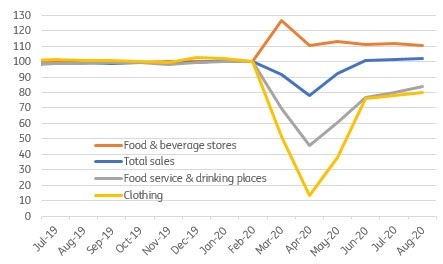
Levels of retail sales expenditure versus February Source: Macrobond, ING

This leaves the total value of retail sales 1.9% above where they were pre-Covid, which is a fantastic outcome, but there have clearly been winners and losers as we have all been forced to adjust the way we can spend our money. Grocery remains the main beneficiary with sales more than 10% higher, while food service is down 16% and clothing is still 20% lower.

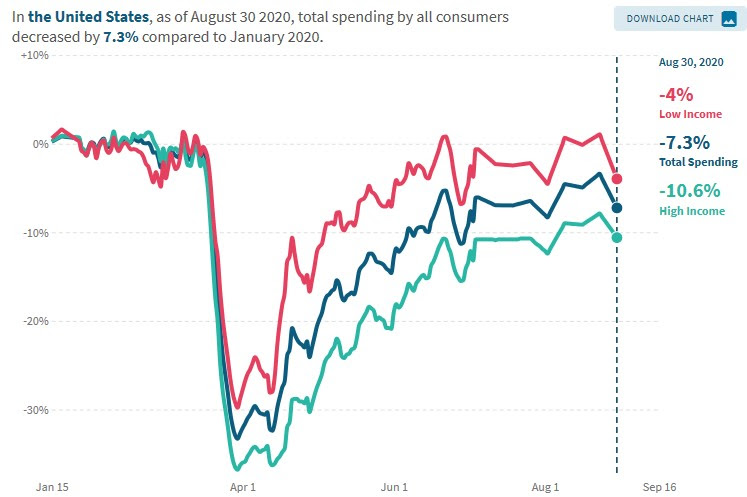
Moreover, the broader consumer spending picture is bleaker. Remember retail sales only make up around half of consumer spending with education, healthcare, travel and hotel stays also contributing to the total – areas that have been hit far harder by the pandemic. While we have been able to substitute some of our spending towards “things” (measured in retail sales) and away from “experiences”, it doesn’t fully make up the shortfall. High frequency data from www.tracktherecovery.org suggests that based on credit and debit card transactions total consumer spending remained down 7% as at the end of August.

 Source: www.tracktherecovery.org

Empire State Manufacturing Much Stronger than Expected in September

Economic activity in New York surprised market expectations in September with the Empire State General Business Conditions Index, jumping up to 17.0 from 3.7 in August and almost recouping all its lost ground in August. The Action Economics Forecast Survey had looked for a modest rise to 5.6. Of respondents, 39.8% reported increased business conditions in September, up from 33.6% in August, while 22.8% reported a decline, down from 29.8% in August. The overall measure is a diffusion index which is constructed by subtracting the percentage decrease from the percentage increase and measures the breadth of change in manufacturing activity across the state. [It does not measure the actual level of activity].

Haver Analytics calculates an ISM-Adjusted Index which mimics the construction of the purchasing managers’ index. This figure rose to 52.5 in September, comfortably above the 50 level which separates expansion from contraction, after having dipped to 49.8 in August.

The underlying indexes in the report uniformly strengthened in September. The new orders index rose to 7.1 from -1.7 in August. The shipments measure rebounded to 14.1 in September from 6.7 in August. Delivery times increased while unfilled orders and inventories continued to decline but at a slower pace than in August.

The employment indicators were also positive. The number of employees index rose to 2.6 in September, its best reading since February, from 2.4 in August. On an even more positive note, the average workweek index jumped up to 6.7 in September, its first positive reading in eight months, from -6.8 in August. (…)

image

Here’s the measure of the actual level of industrial activity:

The Federal Reserve on Tuesday said industrial production—a measure of output at factories, mines and utilities—rose a seasonally adjusted 0.4% in August from July, following a revised 3.5% rise in July. Despite several months of advances, output remains far below its level before the coronavirus pandemic hit in the spring.

Economists surveyed by The Wall Street Journal had expected a 1% increase in August.

Industrial production is still 7.3% down from its level in February, the last month before factories shut down across the country to control the spread of the coronavirus.

Manufacturing, the biggest component of production, rose 1%, a slower pace than in June and July.

 image image

(Haver Analytics)

The actual indices, along with manufacturing employment, all swooshing:

fredgraph - 2020-09-16T063209.386

China has returned to growth - the U.,S. is still below last year's levels(Financial Times)

(…) The decision to reverse course in a matter of weeks comes in the shadow of President Donald Trump’s re-election efforts, in which major polls show him trailing Democratic nominee Joe Biden in key battleground states. The tariffs increased domestic aluminum prices amid a shortage of beverage cans in North America, heightening concerns that an increase in the raw material could fall on the shoulders of domestic brewers and soda companies, and eventually consumers. (…)

THE NY FED’S SEPTEMBER SERVICE BUSINESS LEADERS SURVEY

The survey’s headline service business activity index rose twelve points to -5.4, pointing to a slower pace of decline than in August. The business climate index rose eight points to -66.5, indicating that firms viewed the business climate as worse than normal, though to a somewhat lesser extent than last month. Employment levels continued to decline, though only modestly, and wages were higher. Input prices increased at the same pace as last month, while selling prices stabilized. Capital spending fell for a sixth consecutive month. Looking ahead, firms were just slightly optimistic about the six-month outlook, on net, and expected the business climate to remain worse than normal in the months ahead. (…)

image

image

Speaking of business leaders:

The business leaders were in strong agreement (95%) that more fiscal policy action is needed to help the U.S. economy. And a majority (54%) said they “strongly agree” that a federal COVID-19 strategy is critical to improve consumer confidence, which is trending downward. (PwC a survey via Fortune)

VIRUS UPDATE
Daily U.S. Coronavirus Tally Hits Highest Level in More Than One Month New coronavirus cases in the U.S. rose to 52,081 from about 34,000 a day earlier, as wildfires in some Western states and an approaching hurricane in the Southeast opened potential pathways for the virus to spread further.

Bizarre, but I was unable to verify this 52k jump headlined by the WSJ! All other media report a 35k increase yesterday and John Hopkins numbers confirm that.

0_All Key Metrics (34)

  • Health officials in South Korea have begun relaxing social-distancing measures that came into effect after an uptick in cases that began in mid-August. Starting next week, restaurants will be allowed to resume normal operations, and schools in the Seoul metropolitan area will be allowed to hold in-person classes. The daily tally of new cases in South Korea has remained below 200 for the past two weeks.
  • Japan: The country on Wednesday reported 532 new cases, nearly doubling the previous day’s count, which was the lowest daily tally in about two months.
  • Israel will close its schools on Thursday, a day earlier than planned, due to the significant increase in coronavirus infections, the prime minister’s office said. The government had planned to close schools from Friday to coincide with the start of a partial three-week countrywide lockdown. Over 5,500 cases were confirmed in the past day.
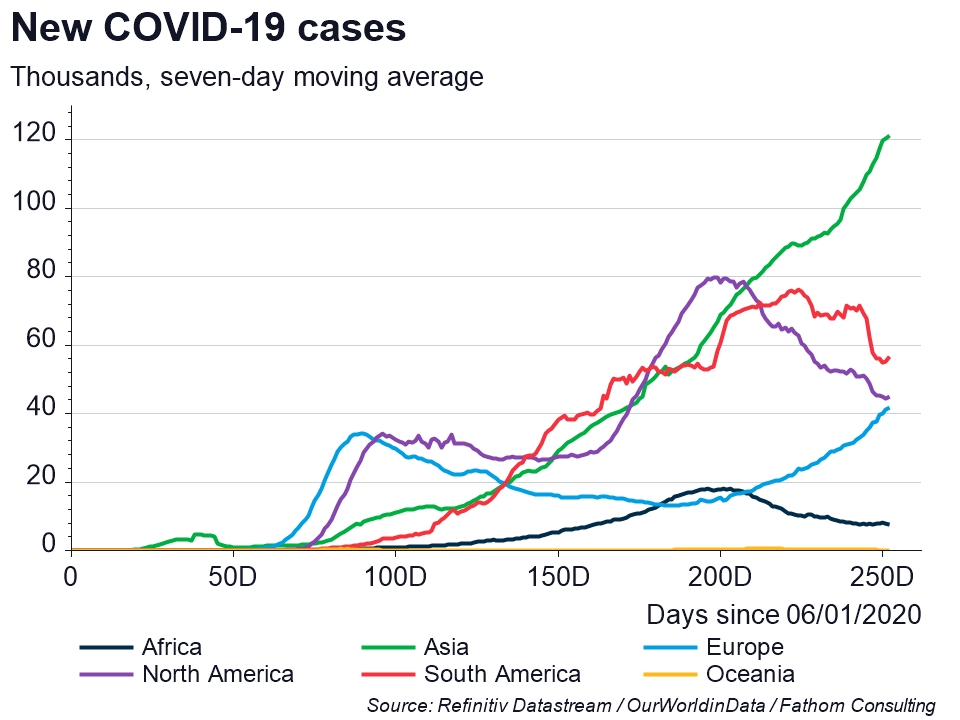
  • The number of newly identified cases of COVID-19 has doubled over the past three months, with first Brazil and the US and then India bearing the brunt of new infections. Cases have been rising in Europe too (including in a number of countries that suffered severe outbreaks in the spring). Much more widespread testing means that identified levels of infection today cannot be compared with identified levels of infection through March and April. Nevertheless, the fact that the reproductive rate appears to have moved back above 1.0 in France, Spain and the UK, among other countries, is cause for some concern.

  • Coronavirus vaccines will be ready for public use as early as November or December in China, a top scientist said, which would make the country one of the first in the world with an inoculation. Several vaccine candidates progressed very smoothly through the final stage of clinical trials, Wu Guizhen, chief bio-safety expert at China’s Disease Control and Prevention Center, said in an interview with state television on Tuesday.
Trump Claims Coronavirus Vaccine May Be Ready Within Four Weeks

(…) “The previous administration would have taken perhaps years to have a vaccine, because of the FDA and all the approvals,” Trump said on Tuesday. “We’re within weeks of getting it. You know, could be three weeks, four weeks.” (…)

Maybe we will eventually learn that he was talking about the Chinese vaccines referred to above…

Back to the ABC News interview:

“It would go away without the vaccine,” he told the host, George Stephanopoulos. “You’ll develop like a herd mentality, it’s going to be herd developed, and that’s going to happen. That will all happen.” (…)

Stephanopoulos noted that Fauci has disagreed that the virus will disappear on its own.

“But a lot of people do agree with me,” Trump said. “You look at Scott Atlas, you look at some of the other doctors, that are highly, from Stanford, look at some of the other doctors, they think maybe we could have done that from the beginning.”

The Washington Post has reported that Atlas, a neuroradiologist associated with Stanford University’s conservative Hoover Institution who advises Trump, has urged the president to pursue a herd immunity strategy. Atlas has previously denied that report.

From NPR on September 4: “In a statement to NPR, Atlas says that he has never told the president or the White House to pursue a herd immunity strategy.”

Herd immunity? Are you sure?

“Tens of thousands of Covid-19 patients are likely to have neurological impairments and possible permanent brain injuries, US researchers say. The list of complications now includes stroke, brain haemorrhage and memory loss, according to an article published on Tuesday in Nature. (…) “The neurological symptoms are only becoming more and more scary,” Alysson Muotri, a neuroscientist at the University of California, San Diego, in La Jolla told Nature.” (FT)

EQUITIES
JPMorgan Says $200 Billion May Flow Out of Stocks This Quarter

Pension and sovereign wealth funds are set to offload about $200 billion of equities as they rebalance their portfolios, posing a risk for global shares, according to JPMorgan Chase & Co.

This would be the most negative quarterly adjustment since the pandemic hit, strategists led by Nikolaos Panigirtzoglou said Tuesday. The overall figure stems from calculations spanning U.S. defined-benefit pension portfolios, Japan’s Government Pension Investment Fund and Norway’s oil fund.

“This negative rebalancing flow becomes even more problematic given this month’s sharp decline in equity market depth,” they wrote in a note.

Institutions tend to adjust portfolios each quarter to maintain their target asset allocation. A gauge of global stocks has climbed about 10% since the end of June, exceeding returns from fixed income and pointing to the need for some funds to adjust their investment mix back to preferred limits. (…)

A new ETF offering 4-per-cent retirement income is going to be big

The new Vanguard Retirement Income ETF Portfolio, which makes its debut on Wednesday, is designed to pay predictable amounts of monthly income to retirees. To underscore this purpose, the ticker symbol is VRIF. V is for Vanguard and RIF is a play on registered retirement income fund, which is where people have all, most or some of their retirement savings. (…)

VRIF attacks the problem by bundling eight Vanguard equity and bond funds (the stocks-bonds mix is 50-50) into a single package designed to pay monthly income targeting a real-world 4-per-cent yield. “That is what clients will get in their pocket, or bank account,” said Scott Johnston, head of product for the Americas at Vanguard.

Dividends and interest income will account for about 60 cents per $1 of income, with capital gains providing the other 40 cents. Basically, Vanguard will strategically sell holdings that have risen in price to top up dividends and interest. This approach highlights the fact that this is an ETF designed for generating income, not for growing your money. (…)

The management expense ratio for VRIF is projected to be 0.31 or 0.32 per cent (…).

In a 50-50 mix of stocks and bonds, the fund holds Canadian, U.S. and international stocks (including a minuscule 1 per cent weighting in emerging markets), plus bonds.

There are no preferred share, high yield bond or emerging market bond funds, or use of a covered call strategy, where financial instruments called derivatives are used to augment income. Mr. Johnston said these securities can add risk to a portfolio as well as higher levels of income. “What we have with VRIF is a simple, broadly diversified portfolio – that is it.” (…)

There’s nothing particularly exotic about VRIF’s total return approach to generating a payout targeting 4 per cent, but it does raise the question of what happens when there aren’t enough capital gains to augment dividends and bond interest. Vanguard says it would use a return of capital in such situations, which it expects to do (in other than negligible amounts) roughly one in every 10 years. (…)

So: SP500 dividend yield: 1.7%. Bond yields: from 0.13% to 1.4% on the curve, average 0.8%. 50:50 = average yield of 1.25% less mngt fee of 0.3% = 0.9% give or take. All you need is a 3.0% annual capital appreciation or 4% pretax. At current valuation levels?

image

image

(Kansas City Fed)

Snowflake Prices IPO at $120 a Share The price values the company, which offers businesses cloud-based data management, at more than $30 billion.

The price was driven above Snowflake’s target range of $100 to $110 by investors hungry for a piece of the fast-growing company, which offers businesses cloud-based data management.

The pricing gives Snowflake a valuation of roughly $33 billion. That is more than double the $12.4 billion valuation it reached in a private funding round earlier this year, a sign of the enthusiasm surrounding U.S.-listed IPOs in 2020. (…)

In its last fiscal year ended in January, Snowflake’s revenue grew 174% from the year before, according to a regulatory filing. Its net loss also grew during that period, and Snowflake remains unprofitable. (…)

Warren Buffett’s Berkshire Hathaway Inc. BRK.B -0.45% has agreed to make a concurrent $250 million investment in Snowflake, alongside current investor Salesforce Ventures LLC, Salesforce.com Inc.’s CRM 2.04% corporate investment arm, which has also pledged $250 million. (…)

In reality, the $100 to $110 range had already been boosted from $75 to $85 on Monday. From $80 to $120: +50%!

In the fiscal year that ended Jan. 31, Snowflake’s revenue soared 174% to $264.7 million YoY. In the sixth months that ended July 31, sales were $242 million, +133% YoY.

And in case you care, Snowflake lost $348.5 million in F2020 up from $178.0 million in F2019. Last 6 months to July 31, 2019, the loss was $177.2 million.

From FT Alphaville:

(…) A new report from Bernstein’s Toni Sacconaghi has taken a look at the Nasdaq (…) And how did those companies fare? Well, here’s the top 9 technology stocks in March 2000 by market cap, with a helpful tag as to whether they ever hit those valuations again:

Eek. Just 22 per cent of them ended up justifying their valuations! And those two — Microsoft and IBM — only did so 12 years later.

Bubble stock buyers, you’ve been warned.

Light bulb Singapore to Pay Citizens for Keeping Healthy

Apple Inc. and the Singapore government have partnered on a two-year health initiative dubbed LumiHealth, which is built around tracking and rewarding user behavior through the Apple Watch gadget and an iPhone app. As part of the plan, Singapore residents will be able to earn as much as S$380 ($280) by completing goals and tasks set within the app. Goals can be accomplished by walking or doing other exercises like swimming or yoga, and the LumiHealth app will offer personalized coaching and reminders for health screenings and immunizations. (Bloomberg)