U.S. Stock Futures Fall as Fed Outlook Rattles Investors
(…) Federal Reserve Chairman Jerome Powell’s comments Wednesday that the economic outlook is “highly uncertain” are weighing on sentiment. Policy makers indicated concern that easy gains from reopening the economy could mask deeper scars among the most vulnerable businesses, with people likely to face longer spells of joblessness. The central bank also signaled that interest rates would stay near zero until 2023.
“The Fed said it would keep rates low for ages. But that’s not enough,” said James Athey, senior investment manager at Aberdeen Standard Investments. “Not taking away is no longer sufficient for this market. You need to do more, more, more.” (…)
Mr. Powell cautioned that it was possible that the lower unemployment rate partly reflects fewer Americans looking for work right now, which means they aren’t formally counted among the jobless. He said the economic recovery may take longer than people would like, and reiterated calls for Congress to spend more money to support households and businesses. (…)
“There’s fatigue on the fiscal and policy front. The Fed didn’t take any new steps and no deal has passed Congress,” said James McCormick, a strategist at NatWest Markets. “There are signs of a fiscal cliff emerging,” he warned, and pointed toward the high number of Americans drawing on unemployment support. (…)
Fed Sets Higher Hurdles for Rate Increase Central bank signals rates near zero at least through 2023 to help support recovery
In new projections released Wednesday after a two-day policy meeting, all 17 officials who participated said they expect to keep rates near zero at least through next year, and 13 projected rates would stay there through 2023.
The Fed’s rate-setting committee also revised its postmeeting statement to specify it would maintain rates near zero until it sees evidence of a tight labor market and inflation reaches 2% “and is on track to moderately exceed 2% for some time.” (…)
Separately, officials revised their June economic forecasts to reflect expectations of a less severe contraction this year and a lower unemployment rate. They now project unemployment will average around 7% to 8% during the last three months of this year, down from June projections of around 9% to 10%. (…)
Mr. Powell said it would be important for Congress to spend more money to support these households, along with hard-hit businesses and state and local governments, to limit additional damage to the economy. (…)
“For the last 60 days or so, the economy’s recovered faster than expected, and that may continue or not. We just don’t know,” said Mr. Powell. (…)
But with short- and long-term interest rates at historically low levels, the Fed could have fewer tools to spur a recovery than it did after the 2008 financial crisis. At Wednesday’s news conference, Mr. Powell used the word “powerful” 10 times to describe the Fed’s new guidance. (…)

Which can be summed up by “We just don’t know”.
John Authers shows us that the Fed is now aiming at a rather elusive nirvanian environment:
(…) According to Powell, rates will stay where they are until inflation gets back up to 2%, in combination with maximum employment, which according to the Fed’s own estimates would be a rate of 4.1%. Neither of these levels sounds that remarkable, but there have been only three periods in the last 60 years when they have co-existed. They are marked on the following chart:
So, Powell told us that rates will stay effectively at zero unless and until the economy reaches a state of near-perfection it has glimpsed only briefly and only three times in the lifetimes of most people now living. Traders will likely work out soon enough that it was greedy to hope that the Fed would be any more dovish than that.
“Credibility is like virginity. Once you lose it, you can never get it back.”
Trump Moves Closer to Bipartisan Plan for More Stimulus Spending
(…) Trump, at a White House press conference on Wednesday evening, said that he liked “the larger numbers” in a compromise $1.5 trillion stimulus proposal from a bipartisan group of House lawmakers that was an effort to break a months-long deadlock over bolstering the U.S. economy amid the coronavirus pandemic.
“I agree with a lot of it,” Trump said of the plan. “I heard Nancy Pelosi say she doesn’t want to leave until we have an agreement” and “she’s come a long way.”
The plan from a 50-member group of House Democrats and Republicans has a bigger total spending figure than the administration previously endorsed. It’s also higher than what Senate GOP leaders say would be acceptable to Republicans. (…)
- White House Chief of Staff Mark Meadows said he is “probably more optimistic about the potential for a deal in the last 72 hours than I have been in the last 72 days.” (CNBC)
Closer to closing:
As of August 31, 163,735 total U.S. businesses on Yelp have closed since the beginning of the pandemic (observed as March 1), a 23% increase since July 10. In the wake of COVID-19 cases increasing and local restrictions continuing to change in many states we’re seeing both permanent and temporary closures rise across the nation, with 60% of those closed businesses not reopening (97,966 permanently closed). (…)
The restaurant industry continues to be among the most impacted with an increasing number of closures – totalling 32,109 closures as of August 31, with 19,590 of these business closures indicated to be permanent (61%). (…) Retail and shopping follows closely behind restaurants with 30,374 total business closures, 17,503 of which are permanent (58%). (Yelp)
VIRUS UPDATE
COVID-19’s summer surge into red America sets the stage for November’s election
(…) COVID-19 spread much more dramatically during the height of the summer to states, counties, and, in particular, small towns and rural areas that voted for Trump in the 2016 election. The pandemic’s spread from “blue” America to “red” is evident when looking at the rate of new COVID-19 cases per 100,000 population in states won by Trump or Hillary Clinton in the 2016 presidential election. This analysis looks at the spread over the bimonthly periods: March to April, May to June, and July to August.
(…) 17 states added at least 1,000 cases per 100,000 population over this period—of which, 15 voted for Trump in 2016. (…)
Another feature of this summer dispersion of new COVID-19 cases is the spread away from urban cores and into smaller-sized places. Using a Brookings classification system of counties that identifies urban cores, large suburbs, small metropolitan areas, and non-metropolitan areas. While new COVID-19 case rates rose in all urban classifications in July and August compared to the earlier two-month periods, the summer case rates were much more similar across all urban types, rather than accentuated among large urban cores.
(…) the red counties with new high COVID-19 case rates are heavily represented in all parts of the country, but a fair number are located in what might be considered November’s swing states: Florida, Arizona, Georgia, North Carolina and Texas. Clearly, the recent rise in new COVID-19 cases in these counties should raise concerns about the pandemic in ways that cannot be easily be dismissed. (…)


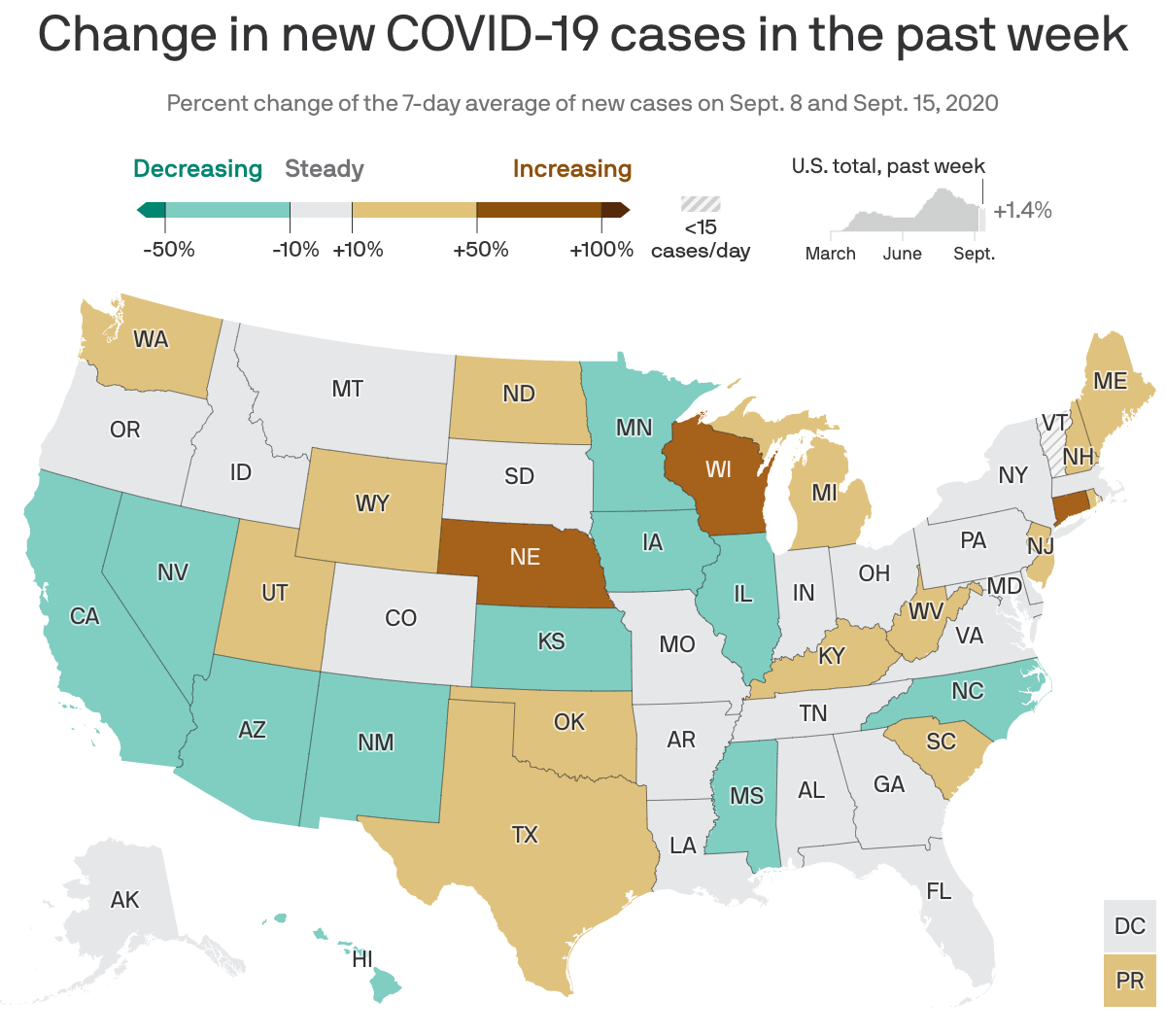
(Axios)
Many EU countries are near or back to their March case numbers!


CDC Chief Predicts Covid-19 Vaccine May Not Be Generally Available Until Next Summer President Trump disputed that timeline, though, saying Robert Redfield may have been confused.
The director of the U.S. Centers for Disease Control and Prevention, Robert Redfield, said he believes a vaccine will be available to the general public in the late second quarter or third quarter of 2021. At a Senate Appropriations subcommittee hearing on Wednesday, Dr. Redfield said the vaccine would be in “very limited supply” at the end of the year and priority would be given to individuals at the greatest risk and first responders.
“If you’re asking me when is it going to be generally available to the American public, so we can begin to take advantage of vaccine to get back to our regular life, I think we’re probably looking at third, late second quarter, third quarter, 2021,” Dr. Redfield said.
During an evening briefing, President Trump disputed that timeline, saying he called Dr. Redfield after he made his remarks before the Senate panel.
“I think he got the message maybe confused, maybe it was stated incorrectly,” Mr. Trump told reporters Wednesday. “It could be announced in October, it could be announced a little bit after October,” he said.
Mr. Trump said a vaccine would be distributed to the general public immediately. Scott Atlas, Mr. Trump’s coronavirus adviser, said 700 million doses would be available for Americans by the end of March.
Dr. Redfield had said a vaccine could be available sometime between November and December in a “very limited supply” and would have to be prioritized when released publicly. Mr. Trump said the “distribution is going to be very rapid,” and that Dr. Redfield may not be aware of the administration’s plan for that. (…)
At the Senate hearing, Dr. Redfield held up a mask and said it “is more guaranteed to protect me against Covid than when I take a Covid vaccine,” because it may not work for everyone. “If I don’t get an immune response, the vaccine is not going to protect me. This face mask will.” He repeated that message in his tweet.
Mr. Trump said Dr. Redfield misunderstood the question, “but we are beyond that now.” The president added that “there are some people who don’t like the mask.” (…)
- “The goal is to have 100 million doses on tap by Dec. 31, Mike Pence told Fox.” (Bloomberg)
Narratives!
Justin Lahart in today’s WSJ: “Consider the August retail sales report that the Commerce Department released Wednesday. This showed that spending at service stations, stores, restaurants and online rose a seasonally adjusted 0.6% in August from a month earlier, which was a bit shy of what economists expected and showed that the big rebound in spending has begun to fade.”
A bit shy? The consensus was +1.0% and July’s numbers were cut 0.5%, taking actual August sales 0.9% below expectations…
EQUITIES
Should You Buy Stocks Because Rates Are Low? Many investors see the 2020 bull market as a logical consequence of a drop in discount rates, but the reality is murkier
(…) trying to justify asset values based on risk-free interest rates gets even harder because, even though the equity risk premium is now historically high, it doesn’t appear to hover around any given level.
The Credit Suisse Research Institute suggests that over a very long timespan—between 1910 and 2019—high [equity risk] premiums did tend to narrow, and vice versa, but only with the hindsight benefit of knowing what was “high.” At each point in time, using past data to determine whether the spread was high enough to trigger a stock rally wouldn’t have worked. (…)
The lesson may be that uncertainty about the future prevents rational discounting of cash flows at any given rate. Instead, both numbers are often concocted to justify investment decisions that already have been made. The prospect of a more digital post-pandemic economy, if sustained, can well justify the optimism fueling this year’s 25% rise in the Nasdaq Composite. Low rates on their own are a flimsy argument.
Even more so if expectations for future cash flows do not take into account the economic reality that low interest rates reflect.
From UBS, for what it’s worth:

What it’s worth:
Snowflake’s Stock Price Soars in IPO Snowflake’s shares made their debut at $245 a share on their first day of trading, more than double the IPO price.
In Canada:
Nuvei raises target price to US$26 on initial public offering amid strong demand
Montreal payments-processing company Nuvei Corp. has priced its initial public offering at US$26 a share, well in excess of its original goal, in advance of its debut on the Toronto Stock Exchange in the next few days.
The company last week disclosed plans to raise at least US$600-million in its initial public offering, setting a price range of US$20 to US$22 per subordinate voting share (…)
Two sources familiar with the deal said Nuvei and its underwriters increased the price range to between US$22 and US$24 this week based on strong investor demand, before settling on the final price, which was disclosed in a press release early Thursday morning. (…)
Nuvei, founded by Mr. Fayer in 2003, grew steadily to become one of Canada’s largest private financial-technology companies. The company has 765 employees and 50,000 merchant customers globally across a range of industries, including online retail, online gambling and financial services. Nuvei generated revenue of US$245.8-million in 2019 and posted a net loss of US$69.5-million.
2 thoughts on “THE DAILY EDGE: 17 SEPTEMBER 2020”
The long covid reportings are becoming tiresome. I read a historical account of the 1918 Spanish Flue (influenza) that killed millions. It started (like covid) in the 1918 summer-winter, then decreased a lot, then we had a second much higher wave in the 1919 summer-autumn, then a sharp collapse of cases in the winter period in 1919, and a third and final sharp rise of cases from Januari till March 1920, and then it basically ‘disappeared’ from the radar due to too low or insignificant mortality numbers, although we still are infected up to this day by the influenza strain. We simply got more resistant to influenza, while the strain also became less lethal after various morphing phases, and after having killed all those that could be killed. The same will happen with this covid thing, and I think your blog should reduce the space to a short daily thread on this issue if you still want to report on it, by example, to only showing the mortality chart in the blog post, which will show a totally different curve than the infection charts, which will stay at elevated rates for several years (just like everyone in the world who is getting the banal flu, but not being killed by it). In other words: dial back the sensation, and only report on the mortality curves. I understand that you are 68 years old, and thus fall into a target group of the Covid virus, which may explain your drive.
Thank you Al for your empathy re: my age. I am also tiring of posting about this, and of US politics but, rightly or wrongly, I believe they have some influence on other investment matters. I try to focus on things not well covered elsewhere that I judge have some investment relevance. For instance, and to your point, yesterday I included a chart on EU death trends which can have a powerful influence on populations and decision-makers. Since virus and political stuff are treated in sections, simply bypass what you don’t care about. As Trump says regularly, it will, eventually, go away. The sooner, the better, hoping history will repeat itself. Be safe!
Comments are closed.