The enemy of knowledge is not ignorance, it’s the illusion of knowledge (Stephen Hawking)

It ain’t what you don’t know that gets you into trouble. It’s what you know for sure that just ain’t so (Mark Twain)

Invest with smart knowledge and objective odds

THE DAILY EDGE: 23 JUNE 2020

  • Reopening plans have slowed in Louisiana, where Gov. John Bel Edwards said the state wouldn’t move into its third phase of reopening by the end of the week as planned due to increased infections and hospitalizations. Mr. Edwards said 630 people were in hospitals for the coronavirus, an increase of almost 90 over the past 10 days. The state passed two milestones Monday, with more than 50,000 total cases and 3,000 total deaths.
  • Texas: Gov. Greg Abbott said the virus was “now spreading at an unacceptable rate” after two weeks of record hospitalizations and as the rate of positive coronavirus tests roughly doubled since late May. Mr. Abbott emphasized that he doesn’t want to backtrack on his opening of Texas and said residents need to take it upon themselves to wear masks and practice social distancing.

Meanwhile, Goldman Sachs points out

With reopening under way, regular hospital occupancy is increasing as patients resume elective procedures and seek non-Covid medical care for illnesses and trauma. Exhibit 3 below, shows the share of inpatient hospital beds that are occupied. Occupancy has risen by about 15pp to 60-65% in California, Florida, and Texas. In Arizona, occupancy is even higher, and only about 30% of capacity is available, just 5-10pp below the levels reached in New York and New Jersey at the peak of the outbreak.

Exhibit 3: States with High Rates of Case Growth Also Have Less Hospital Capacity Available

image

Notably, Covid patients currently make up only a small fraction of this occupancy. (…) only about 5% of patients hospitalized in California, Florida, and Texas are Covid patients. In New York and New Jersey, Covid patients occupied over 40% of hospital beds at the peak.

The upshot is that without lockdowns in place, a smaller increase in hospitalizations could overwhelm capacity. For example, in Arizona, a doubling in COVID-19 patients would increase occupancy to 80%, reducing available capacity to the minimum recommended limit for any degree of reopening. At the moment, state officials have opened the door for local governments to impose mask requirements but have not entertained reversing the reopening or imposing stricter social distancing requirements. If hospital capacity becomes problematic in a state, officials could be forced to limit certain elective procedures requiring inpatient care. Back in March, many states limited medical procedures before imposing broader lockdown orders.
Pence Warns of Young People Testing Positive as Hot Spots Worsen

Vice President Mike Pence told governors Monday that government health experts were worried that more young people are testing positive for the coronavirus around the country. (…)

The mayor of Miami, Francis Suarez, meanwhile delayed the reopening of movie theaters, nightclubs and other large venues because of the spike in coronavirus cases. He and the mayors of neighboring cities in Florida’s Miami-Dade County also said they were mandating the wearing of masks in public upon the advice of state health officials.

“This is a real spike,” Miami Beach Mayor Dan Gelber said at a news conference. “Nobody can argue with the fact that more people are being hospitalized.”

California saw its third-biggest daily increase in new cases, 4,230, a 2.4% rise to 178,054, according to state data. And new signs emerged that recent protests against police brutality may have helped spread the virus.

Anthony Fauci Doesn’t See Covid Summer Lull as Sun Belt Cases Swell

Asymptomatic patients may shed virus for longer than others, study says

Beijing Outbreak Shows Covid-19’s Insidious Ability to Hide

(…) Now, more than 200 people have tested positive across Beijing, schools are shut and thousands of domestic flights canceled. The resurgence offers a stark warning to countries that appear to have cut chains of transmission: The coronavirus’s ability to cause little or no symptoms in a large proportion of people enables it to spread silently for weeks — even months — creating viral reservoirs that can remain hidden until someone becomes sick enough to warrant testing. (…)

Some countries and cities that appeared to have tamed the virus are seeing cases start to increase again. Victoria, Australia’s second-most populous state, tightened control measures Monday after a spike in cases. New Zealand appointed a military leader last week to oversee the quarantining of citizens returning from abroad to head off fresh outbreaks. The country earlier this month removed physical distancing requirements after reporting zero active Covid-19 cases, indicating it had achieved its aim of eliminating the virus.

Elsewhere, countries from South Korea to Germany are battling new clusters, trying to stamp out sparks before they become raging fires. (…)

  • Gilead Sciences Inc. said it will soon begin clinical studies of an inhaled form of remdesivir with the aim of expanding the drug’s use to healthier, nonhospitalized Covid-19 patients. Remdesivir, used to treat seriously ill coronavirus patients, is currently given via daily intravenous infusions, limiting its use to patients in the hospital. An inhaled formulation could allow the drug to be used by patients with symptoms that aren’t severe enough to require hospitalization.
  • Health authorities said the Seoul metropolitan area is experiencing a second wave of coronavirus infections, with most of the new cases this month occurring in the area. South Korea added 46 new cases, bringing the nation’s total to 12,484. Thirty of the new cases were imported and 16 of them were linked to a Russian-flagged ship with 21 crew members that has been docked in Busan since Sunday. The crew members were tested on Monday after the captain, who disembarked in Russia a week ago, tested positive. Port workers who came into contact with the crew members have been quarantined.
  • Australia-New Zealand: Health authorities might start testing asymptomatic people in a handful of Melbourne suburbs that have become coronavirus hot spots, the premier of Victoria state said. Meanwhile, New Zealand said it will start testing asymptomatic border-control workers and aircrews as thousands of citizens return from global hot spots. The number of people returning to the country from overseas doubled since last month, with some 4,200 people in quarantine—close to the limits of government-run facilities.
PANDENOMICS
Key Support for the Economy May Be About to Buckle Government stimulus programs have helped support spending by lower-income Americans, but the money could soon run out

(…) An analysis conducted by nonpartisan research group Opportunity Insights of credit- and debit-card data collected by Affinity Solutions shows that by early April, spending by U.S. consumers had fallen 33% from January levels. Then starting in mid-April, when many Americans began receiving stimulus payments, things started picking up. As of June 10, spending was off by just 11.3%. (…)

But with many stimulus checks already spent, and with unemployed Americans scheduled to stop receiving the extra $600 a week in jobless benefits on July 31, poorer Americans’ wherewithal to spend is in danger of collapsing. (…)

The Senate, where some Republicans are balking at additional stimulus, won’t take up deliberations until mid-July, and hammering out a plan could take time. For investors who have pinned their hopes on a strong economic recovery, the next several weeks could be fraught.

Trump tells aides he backs new round of stimulus, but some in GOP are skeptical President Trump has told aides he is largely supportive of sending Americans another round of stimulus checks, believing the payments will boost the economy and help his chances of reelection in November, according to three people aware of internal administration deliberations.
Chicago Fed National Index Signals Easing in Recession in May

large image

Hundreds of cash-strapped cities halt plans to repair roads, water systems
FLASH PMIs
Eurozone downturn slows markedly for second month running in June

The eurozone economic downturn eased markedly for a second successive month in June as lockdowns to prevent the spread of the coronavirus disease 2019 (COVID-19) outbreak were further relaxed, according to provisional PMI® survey data. The month also saw a continued strong improvement in business expectations for the year ahead.

The flash IHS Markit Eurozone Composite PMI rose further from an all-time low of 13.6 seen back in April, surging to 47.5 in June from 31.9 in May. The 15.6-point rise was by far the largest in the survey history with the exception of May’s record increase. The latest gain took the PMI to its highest since February, though still indicated an overall decline in business output.

image

Output fell again in both manufacturing and services, the latter showing the slightly steeper rate of decline. Both sectors nevertheless reported markedly reduced rates of contraction for a second month running.

The ongoing downturn in output was linked to a fourth consecutive monthly deterioration of inflows of new business, which in turn contributed to a further steep decline in backlogs of orders for companies to work through. However, rates of decline of both new orders and order book backlogs moderated considerably during the month.

image

For those companies continuing to report falling output and order books, the pandemic was again by far the most commonly cited cause. The persistent closure of non-essential business, notably in hotels, restaurants, travel and tourism and other consumer-facing sectors, continued to be widely reported as many social distancing measures remained in place. Many other companies reported weakened demand as business and consumer customers remained cautious with respect to spending.

However, COVID-19 containment measures eased considerably across the eurozone during the month, helping many firms reopen and driving improved demand for many goods and services.

The relaxation of some lockdown measures, and planned further easing in coming months, also helped propel business sentiment for the coming year to its highest since February. The number of optimists exceeded pessimists for the first time in four months. Sentiment improved markedly in both manufacturing and services, resulting in the second-largest rise in the output expectations index since comparable data were first available in 2012.

imageJobs were cut on balance, however, for a fourth successive month in June as firms continued to worry about the lack of demand. While rates of job losses moderated in both sectors for a second month in a row, taking the rate of job shedding to its lowest in the current sequence, factory headcounts continued to be reduced at an especially marked rate as producers scaled-back operating capacity.

Average prices charged for goods and services meanwhile fell for a fourth month running as firms once again reported widespread discounting to boost sales, though the rate of deflation continued to cool from April’s near-11-year record as some companies reported improved pricing power. The resulting overall fall in prices was the smallest seen over the past four months.

Average input prices across manufacturing and services increased for the first time since February, driven principally by rising wage pressures. Average prices paid for inputs in manufacturing continued to fall sharply amid weak demand, albeit dropping to the least extent since February.

By region, France led the improvement with output returning to growth for the first time since February, fueled by a surge in manufacturing production. Germany lagged behind, reporting a steeper fall in output than the rest of the region outside of France and Germany. However, over the past four months Germany has seen the shallowest downturn, followed by France, with the rest of the region trailing behind.

(…) We therefore continue to expect GDP to slump by over 8% in 2020 and, while the recovery may start in the third quarter, momentum could soon fade meaning it will likely take up to three years before the eurozone regains its pre-pandemic level of GDP.

Japan: Downturn eases sharply as state of emergency lifted
  • Flash Composite Output Index, Jun: 37.9 (May Final: 27.8)
  • Flash Services Business Activity Index, Jun: 42.3 (May Final: 26.5)
  • Flash Manufacturing Output Index, Jun: 28.9 (May Final: 30.3)

image

Flash PMI data for June show us that economic activity in some parts of Japan has picked up at the back-end of the second quarter. Crucially, however, a sub-50.0 reading in the Composite Output Index indicates that the underlying picture remains bleak and many firms are yet to see a rise in output volumes. Nevertheless, a 10-point rise is an encouraging sign that parts of the economy are recovering and should provide some momentum for a more broad-based uptick as we head into the second half of the year.

Still, there are some disconcerting signs when we look at the sector splits. While the service sector downturn eased noticeably, goods production fell at an accelerated pace in June. The rate of decline in manufacturing order books remained severe, hinting that the shape of the recoveries in the services and manufacturing sectors could be very different. A two-speed recovery would undermine a sustainable return to pre-COVID-19 levels of economic activity.

 image image

China in Recession and Heading for Full-Year Decline: Beige Book

Key metrics including manufacturing profits, capital expenditures and retail sales volumes remained at historically low levels and barely improved from those in the first quarter, CBB International said in a quarterly report based on a survey of more than 3,300 firms. (…)

Sluggish global demand remained a key drag on growth, with regions more internationally exposed performing worse, while interior regions received a boost from a marked rebound in domestic orders, according to the report.

“The eventual return to growth does not mean a return to anything approaching the old levels of growth,” the firm said in its quarterly report on China’s economy. “Until and unless global demand recovers more forcefully, the incremental quarterly improvement just seen will make for a contraction for full-year 2020.” (…)

VEHICLES

As expected, North American light vehicle production saw a significant
increase M/M in May, up ~24x to 248,602 vehicles versus 10,247 vehicles in
April, according to Wards. April auto production ground to a halt as OEMs
and suppliers idled facilities as lockdown measures were introduced to
combat the spread of COVID-19. That said, light vehicle production was still down 83.2% when compared to May 2019. On a YTD basis, volumes are down 42.8% Y/Y to 4,028,697 vehicles.

Within North America for the month of May, U.S. light vehicle production
increased ~30x M/M but was down 79.1% Y/Y to 196,839 units. In Canada,
output fell 82.9% Y/Y to 31,411 vehicles, but this compares to nil production
in April. Mexican production was down 94.2% Y/Y to 20,352 vehicles, but
this compares to just 3,722 units produced in April.

While North American auto sales are expected to take years to recover, over
the near term this segment should continue to provide a sequential boost to
freight volumes as it bounces off its April lows, which we view as the silver
lining. Wards’ North American production schedule forecast has June down
22.5% Y/Y, July down 11.3% Y/Y, August down 16.9% Y/Y, and September
down 7.9% Y/Y. We would also note that truck demand remains healthy in
North America (SUV/CUV/pickups) and OEMs are looking to ramp-up
production given low inventory levels.

Looking at the weekly rail data, we have seen a significant improvement in
auto carload trends, which have been down 30%-40% Y/Y the last couple of
weeks versus down 85+% Y/Y back in April. Auto sales should continue to
benefit from the reopening theme as states and municipalities ease
lockdown measures. With expectations that U.S. light vehicles sales will
continue to improve through the balance of the year, we would expect auto
freight volumes to follow a similar trajectory. (CIBC)

Magna International:

The plants in China were the first to come offline and the first to ramp
back up and are now operating at ~85%-90% capacity. Operations in
Europe were the next to shut down and are now operating at nearly 80%
capacity
. And North America, while it was the last to come offline, its
ramp-up is being driven by healthy demand and the plants are now
operating at just above 80% capacity.

SENTIMENT WATCH
‘Everything Is Expensive’ as Global Stock Valuation Debate Rages

Bank of America Corp. clients are sounding the alarm on stock prices like never before — nearly 80% of them said in a survey the market is overvalued even as they sink cash into the market in droves. Bears are finding new reasons to bristle at forward price-to-earnings ratios at historic extremes, while bulls hit back with more reasonable interpretations of multiples, often relative to other asset classes. (…)

relates to ‘Everything Is Expensive’ as Global Stock Valuation Debate Rages

Via Axios:

A report from BCA Research published Monday finds Robinhood users are moving into speculative bets at an incredible rate, radically increasing holdings in three groups of stocks — airlines, cruise ships and mortgage REITs. (…)

Retail investors may be leading the charge, but the recent surges in many of the stocks BCA examined suggest that “algorithms, hedge-funds and other fast-money pools of capital may be amplifying the momentum that retail activity has set in motion.”

Which was my point in last week’s THE PROS AND THE CONS.

China Trade Deal ‘Fully Intact,’ Trump Says, as Top Adviser Stirs Confusion President Trump said the U.S.-China trade deal remains in place shortly after a senior aide appeared to say on national television that the agreement was over, prompting confusion among investors.

“The China Trade Deal is fully intact,” Mr. Trump wrote on Twitter at 10:22 p.m. on Monday. “Hopefully they will continue to live up to the terms of the Agreement!”

In a Monday night interview on Fox News, White House trade adviser Peter Navarro was asked about the trade deal, with anchor Martha MacCallum noting that the president wanted to maintain the agreement and ensure that China made good on its commitments. “But given everything that’s happened and all the things you just listed, is that over?” she asked.

“It’s over. Yes,” Mr. Navarro, a vocal critic of China, responded.

As stock futures dropped, Mr. Navarro quickly sought to clarify his comments, telling The Wall Street Journal they had been “taken wildly out of context.”

(…) “I was simply speaking to the lack of trust we now have of the Chinese Communist Party after they lied about the origins of the China virus and foisted a pandemic upon the world.” (…)

Wondering what exactly has been taken wildly out of context. Between 9:05pm and 9:39pm yesterday, E-Mini S&P 500 futures sank 1.8% before recovering.

Following talks [last week] by U.S. Secretary of State Michael Pompeo and China’s top foreign policy official Yang Jiechi, China pledged again that it would buy US$36.5B worth of American agriculture products under the phase one deal, up from US$24B in 2017 before the trade war. But we note that China has bought only US$4.65B in the first four months of the year, which is only 13% of the annual goal set in the trade deal and almost 40% below the same period in 2017. (CIBC)

U.S. Set to Announce Aluminum Tariffs on Canada by End of Week

U.S. Temporarily Suspends New H-1B and Other Job Visas President Trump signed an order temporarily barring new immigrants on a slate of employment-based visas, including the H-1B for high-skilled workers, from coming to the U.S. amid the coronavirus pandemic.722

More House Republicans Come Out Against Trump’s Troop Cut in Germany Six members of the Foreign Affairs Committee said the U.S. should ‘lead by example’ in a letter warning President Trump that his plan is ill-advised and would imperil American interests in the region.

Trump’s Polls Are Plunging But It’s Too Early to Count Him Out

EU urges Xi: drop Hong Kong security law or risk ‘negative consequences’

THE DAILY EDGE: 22 JUNE 2020: Technicalities

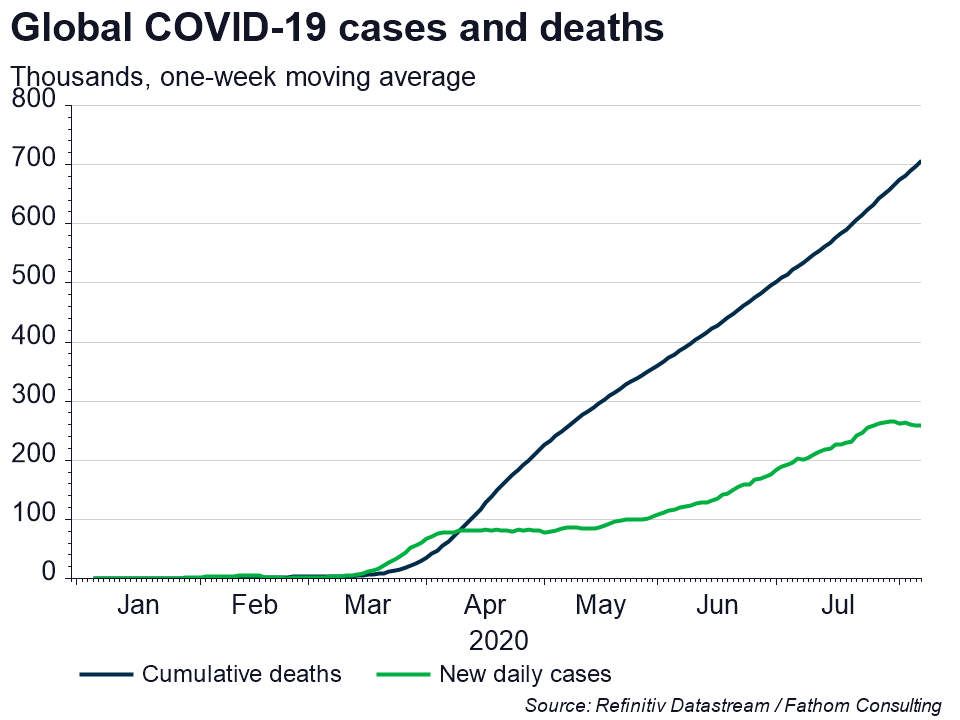
  • Daily new confirmed cases around the world continue to rise, topping 150k per day on average over the past week. New global hotspots are concentrated in the Americas. Brazil recorded a record high number of new cases, totalling over 50,000 in a single day with the total number recorded so far now over one million. Several US states are also experiencing a rapid increase in cases, notably Arizona, Florida and Texas. Talk of a second wave is premature. The world is experiencing a new ripple from the first one. (Fathom Consulting)

  • Coronavirus cases in the U.S. increased by 27,476 from the same time Saturday, to 2.27 million, according to data collected by Johns Hopkins University and Bloomberg News. The 1.2% increase matched the average daily increase of 1.2% over the past week. Fatalities rose 0.3% to 119,854. Arizona cases jumped by 2,592, or 5.2%. California added 4,515 cases, a daily record.
  • The U.S. reported more than 30,000 new coronavirus cases on Friday and Saturday, the highest daily totals since May 1, and White House trade adviser Peter Navarro said Sunday the Trump administration is preparing for a potential second wave in the fall. (Axios
  • According to rt.live, R is above one in around half of US states. New cases are rising rapidly in states that did not experience significant first waves. Despite the worrying trend, there is little sign of a return to lockdown. Around two-thirds of states where R is above 1 have Republican governors, who would be more likely to follow guidance from the administration in DC. However, even in deep blue California, Governor Newsom has said a rise in cases is to be expected with re-opening, suggesting a willingness to accept some health risks for the benefit of avoiding permanent lockdown.
  • Apple to shut some U.S. stores again due to rising COVID-19 cases

  • South Korea Limits Entry for Foreigners After New Virus Cases

  • Netanyahu Warns of Possible Second Coronavirus Lockdown

  • A non-peer-reviewed study of Wuhan health workers reports a rapid loss of antibodies after infection, raising doubts about long-term immunity of previously exposed individuals: https://www.medrxiv.org/content/10.1101/2020.06.13.20130252v1
Here’s how genes from covid-19 survivors could help you  Gene therapy could put an end to future pandemics.

Potential weapons against covid-19 include manufactured antibodies, serum transfusions from survivors, antivirals, steroids, and more than 100 vaccine candidates, some now advancing toward decisive tests in volunteers.

But there’s another approach to battling the virus—one that hasn’t won much attention, but which in the future could become the fastest way to beat back a pandemic. It involves isolating genetic material from survivors and injecting it directly into others, lending them protection against the pathogen.

DNA-encoded antibodies, as these therapeutics are called, have shown promising results in animals. In humans, genes injected into the arm or leg would convert the recipient’s muscle cells into factories to make antibodies against the virus. That could provide temporary immunity or lessen the severity of the disease for those already infected.

While no DNA-encoded antibody against covid-19 has yet reached human tests, laboratory experiments have started, says David Weiner, director of the vaccine and immunotherapy center at the Wistar Institute, who says his center has tested anti-covid gene injections on animals.

(…) gene therapy could offer a way to skip the complex and costly manufacturing of delicate antibodies and avoid the uncertainties involved in vaccines. As well, scientists say, gene injections can be used to carry information for more than one antibody at a time, which could stop a virus from developing resistance.

The advantage of the technique, researchers say, is its speed and low cost. DNA is manufactured in bacteria, which double in number every 30 minutes. “You can make DNA very readily, it’s dirt cheap, and you let the muscle make the antibody,” says Henry Ji, CEO of Sorrento, who says his company is exploring the idea with a partner, SmartPharm, of Boston. (…)

Ultimately, some researchers say, the technique could play a role beyond fighting pandemics. According to Weiner, the genetic injections might also be an inexpensive way to deliver antibody drugs for cancer and arthritis. These are some of the top-selling but most expensive drugs on the market. A 2018 study found that the average cost for antibody drugs in the US was $96,000 a year.

(…) Researchers say DNA can be made at a small fraction of the cost of manufacturing antibodies. Whereas each antibody is manufactured differently, DNA “is always the same,” says Weiner. The molecule can also stay viable at room temperature for months.

Ji, the Sorrento CEO, thinks that DNA-encoded antibodies are a sure thing for the next pandemic, if not this one. “In the future, we will have gone through the drill,” he says. “You’ll just snap your gene in.” (MIT)

Dept. of Coronavirus Good News More than 1,500 treatment studies are underway world-wide.

(…) A University of Oxford drug trial found that a low-cost steroid can substantially reduce deaths in severely ill patients. As results from more studies roll in this summer, improved treatments could blunt the impact of any second wave. (…)

Dexamethasone reduced fatalities among patients receiving supplemental oxygen by 20% and by a third among those on mechanical ventilators. The drug had no impact on less sick patients.

Oxford researchers estimated that the drug could have prevented 5,000 deaths in the United Kingdom had doctors used it to treat the sickest patients at the outset of the pandemic. “For less than £50 (US$63), you can treat eight patients and save one life,” said Oxford epidemiologist Martin Landray. Dexamethasone is the first drug shown in a large clinical trial to significantly reduce Covid deaths among the severely ill. Another trial last month found that Gilead’s antiviral drug remdesivir reduced the duration of hospitalization on average to 11 days from 15 but did not reduce deaths. (…)

Over the last two weeks coronavirus deaths in the U.S. have fallen 45% while cases have increased 6%. Earlier and better treatments are already saving lives and will enable society to cope with the virus until we get a vaccine.

PANDENOMICS
Investors sanguine following fresh outbreaks

The FT argues that investors have largely brushed off an acceleration in new coronavirus cases and are focused on the prospect of an economic recovery and betting that the new spike in infections does not lead to the sort of lockdown measures seen in March and April.

Investors see limited political appetite for a return to lockdowns. “For dispassionate markets, “it is fear of the virus, not the virus that matters,” said Paul Donovan, chief economist at UBS Global Wealth Management. So far there seems to be little evidence of widespread fear, either from consumers or from policy makers.”

I, and many others, are not so sure of this lack of fear.

Fed’s Rosengren Says U.S. Economy Will Need More Monetary, Fiscal Support Federal Reserve Bank of Boston President Eric Rosengren said the U.S. central bank and broader government will need to do more to help the economy emerge from the ongoing impact of the coronavirus pandemic.
A Continuing Fall in Business Activity has Been Reported by U.S. Sales Managers in June

(…) The question relating to the Markets panelists are working in, asks simply if markets served are growing, stable or in decline (note: no time period is specified). This question produced largely negative answers in June suggesting very few markets have seen positive sales growth. This is not an optimistic result indicating that Covid-19 related problems are far from over.

Answers to the question relating specifically to respondents Sales also generated few positive replies. The Sales index did “increase” from the all-time low level seen in May of 34.3 to 42.3 but remained far from the 50 level that separates growth from decline.

The Staffing Index is also of considerable significance this month. Like the Market and Sales Indexes, Staffing remains deep in negative territory, with few respondents appearing to have need of more people in June. Again this suggests that the months immediately following the outbreak of the Coronavirus have not been followed by resurgent demand.

In general panelists report an economy slowly re-opening and ready to produce, but still waiting for the consumer demand that makes up a sizeable proportion of overall economic activity.

Conditions as yet do not appear to be getting better in the sense of showing sales increases, but the dive into recession is getting less steep.

Chinese Sales Managers Report Economic Activity Levels Continue to Deteriorate in June

The question relating to the markets in which panelists are working, asks simply if markets served are growing, stable or in decline (note: no time period is specified). This question produced the most negative answer of all the questions asked in June. Furthermore the number of respondents reporting worsening conditions rose, after several months of negative replies. This is not an optimistic result. Few respondents see their markets as buoyant, indicating that Covid-19 related problems are far from over.

Answers to the question relating to respondents Sales has for two consecutive months turned very modestly positive , which is obviously a good sign. But we believe relates more to an increased ability to service and fulfil orders (but not the presence of actual orders in the quantities seen pre Covid-19), as plants and offices reopen, and to the fact that this question relates specifically to the current month in relation to the previous month. A bad month followed by a slightly less bad month will produce a positive 50+ result, but does not suggest an increase in economic activity, particularly when seen in the context of the previous question.

Like the Market Index, Staffing remains deep in negative territory, with few respondents appearing to have need of more people as of June. Again this suggests that the poor months immediately following the outbreak of the Coronavirus have not been followed by resurgent demand, but by the cautious reopening of existing plants and offices.

In general panelists report an economy largely re-opened and ready to produce, but still waiting for the foreign orders that previously made up a sizeable section of overall economic activity. Conditions do appear to be getting better, but very slowly

CHINA: STAFFING LEVELS INDEX

The Staffing Levels Index monitors the level of growth or decline in employment against the same period a year earlier.

COVID-19 slump in retail and recreation traffic has long tail, creating drag on recovery

GPS data from cellphones show that government-mandated restrictions on physical movement at the height of the COVID-19 pandemic caused a steep decline in trips to retail stores and recreation venues of between 40 to 90 percent. The impact has been strongest in France, which has also seen the strongest rebound in mobility in recent weeks. Mobility declined the least in the United States and Japan and is currently less than 20 percent below February levels in both nations. In contrast, movements in the UK are still more than 50 percent below February levels.

The data in the chart clearly shows that in every country, the initial drop in traffic to shops and entertainment was swift. However, the rebound toward prepandemic levels takes a lot longer, even after restrictions are lifted. This is one reason the rebound in economic activity has been limited.

A second wave of COVID-19 may not limit mobility to the same extent as in March and April, but these data are a good reminder that shutting down is easier than opening up. Even when restrictions are lifted, stagnation lingers as consumers hesitate to re-engage with the economy.

COVID-19 slump in retail and recreation traffic has long tail, creating drag on recovery
U.S. Home-Mortgage Delinquencies Reach Highest Level Since 2011

The number of borrowers more than 30 days late swelled to 4.3 million, up 723,000 from the previous month, according to property information service Black Knight Inc. More than 8% of all U.S. mortgages were past due or in foreclosure. The increase in delinquencies was smaller than the 1.6 million jump in April, when the economy ground to a halt nationwide.

The delinquency count includes homeowners who missed payments as part of forbearance agreements, which allow an initial six-month reprieve without penalty. (…) Only 15% of homeowners in forbearance made payments as of June 15, down from 28% in May and 46% in April. (…)

New Yorkers Now Can Return to the Office. Most Are Staying Away. Some companies are keeping offices closed, while others are opening them at reduced occupancy and allowing employees to decide if they prefer to keep working from home.

(…) New York real-estate brokers and landlords say they anticipate only 10% to 20% of Manhattan’s office workers will return on Monday, though they expect that figure to increase gradually over the summer. Traders at financial-services companies are eager to return, these people say, but most of their other employees are staying away. Tech and creative companies are also taking their time. (…)

In a recent global survey by trade group CoreNet Global, just 15% of companies said their office occupancy will be back to pre-pandemic levels within six months and 38% said it would take more than a year for everyone to be back. (…)

In Georgia, which began reopening in April, visits to office buildings were still at just 72% of pre-pandemic levels in mid-June, up from a low of 61% in early April, according to Openpath Security Inc., a maker of keyless access control systems. (…)

The widespread reluctance to return to the office means it could take New York City’s economy even longer to recover from the shock of the pandemic and the business shutdowns that followed. Landlords continue to collect rent even while buildings are mostly empty. But the shops, restaurants and bars clustered on Midtown streets that depend on office workers are unlikely to fill up anytime soon.

New York City stands to lose 475,000 jobs over a 12-month period starting in the second quarter, the New York City Independent Budget Office estimated in April. It projects sales-tax revenue will drop 36.4% in 2021 compared with its pre-pandemic projection. (…)

(…) Could the air within offices spread COVID-19? “Right now, there’s no clear proof,” said Tony Dingman, a mechanical engineer and partner at the Mitchell Partnership (TMP), a prominent Toronto consulting firm. “There’s also no clear proof that everything is okay.” (…)

The problem is “recirculated air.” This is what flows through most offices and other large buildings, except hospitals. Fresh air enters a building, is heated or cooled, humidified or dehumidified, and then moves around in a circuit, being periodically freshened up with new air from outside. Under normal circumstances, 80 to 85 per cent of the air in an office is recirculated. What you and your colleagues breathe out is what you and they are breathing in. (…)

While studying an early example of airborne transmission of COVID-19, in a restaurant in Guangzhou, researchers concluded that it was likely spread through droplets, pushed along by a strong air conditioner fan from an infected person’s table to the tables nearby.

The broader possibility of infection through the air, even over longer distances, has not been ruled out. Some scientists . (…)

And running air-movement systems 24/7, while making air-conditioning and heating systems work harder, is “incredibly expensive, in terms of energy and in terms of money,” Mr. Dingman added. (…)

(…) The key difference in the pandemic-induced wave of relocations could be that the movement is organic, led by employees themselves rather than their bosses. But even that could falter. Smaller towns, away from buzzing business headquarters and bustling city life, might struggle to retain their charm for transplants unless they attract a critical mass of big city refugees. While the promise of more land, more space and less commute may sound compelling, there is the threat of boredom or, a worse fate for many, career marginalization.

Working away from main offices also could be more “work” than employees bargained for. Y. Sekou Bermiss, associate professor of management at the McCombs School of Business at The University of Texas at Austin, says his research has shown remote employees actually end up working more to compensate for lost facetime.

And they might not feel so much wealthier after relocating. Companies like Facebook are planning to offer remote employees “localized” compensation, commensurate with a lower cost of living. Meanwhile, perks like free food, happy hours and on site child care won’t be available.

Along with in-person collaboration, big office settings also offer the ancillary benefits of friendship and even love at work. Mr. Bermiss warns against major corporations trading office space for a remote workforce, noting its employees are going to be “itching to get back together” once the pandemic subsides. Indeed, a survey by Vault.com last year found that 58% of workers had participated in an office romance at some point in their working lives.

Meanwhile, not everyone wants to leave “the city.” Facebook’s Mr. Zuckerberg said 38% of his employees would prefer to move to another big U.S. city rather than a smaller one.

The coronavirus could very well precipitate a temporary dispersion of American’s top talent, but it isn’t likely to stick. The gating factor preventing most smaller cities from growing may be that they are small to begin with. No one wants to “make” a city; ambitious professionals want to be made by them.

In the same article:

  • Facebook Chief Executive Officer Mark Zuckerberg said recently that 75% of his employees have expressed some degree of interest in leaving the Bay Area.
  • Zillow and Redfin are both reporting spikes in single family home searches in smaller cities, suggesting the exodus could be more than temporary.
  • The key difference in the pandemic-induced wave of relocations could be that the movement is organic, led by employees themselves rather than their bosses.

There are pros and cons everywhere but my sense is that quality of life will win. If “38% of [Facebook] employees would prefer to move to another big U.S. city rather than a smaller one”, it implies that 62% would prefer otherwise or are ambivalent.

Brookfield skips payments while demanding tenants pay up Coronavirus shutdown has hit mall operators who are dependent on rents to meet loan repayments
Warehouse Demand Surges as Retailers Reset Supply Chains

(…) The push for more storage space comes as retailers are re-evaluating their logistics networks in the wake of the upheaval during coronavirus-driven shutdowns. Merchants were already moving goods closer to customers, and the pandemic is accelerating those shifts, said Jess Dankert, vice president of supply chain for the Retail Industry Leaders Association. (…)

Prologis estimates that businesses could increase their inventories by 5% to 10% over the long term to guard against the kind of demand shocks that cleared out grocery stores shelves during the first weeks of the pandemic lockdowns.

Higher inventory levels and the accelerating growth of e-commerce, which typically requires about three times as much space as traditional distribution operations that serve stores, could increase U.S. warehouse demand by as much as 400 million square feet over the next two to three years, the company forecasts.

For the April-July period, Toyota anticipates a global production drop of 30% from its initial plans, made before the virus outbreak and a plunge in demand for vehicles.

The Pandemic Has Pushed Car Buying Online. It’s Expected to Stick. Many in the auto industry expect the recent online push to continue even as dealerships reopen, with some cutting traditional showroom sales roles and shifting more employees into digital operations.

(…) Because the online car-buying market is still young, there is little industry data on how many cars are sold this way. However, a survey published in May by Cox Automotive looking at how the pandemic is changing the car business found two in three respondents are now more likely to purchase a vehicle online than before the crisis. It also found about one-third of shoppers surveyed prefer to negotiate the deal in person, many of them baby boomers and truck buyers. (…)

How the Coronavirus Will Reshape World Trade In the post-pandemic world, more economic activity will be designated vital to national security, accelerating pressures on globalization that existed before Covid-19 arrived. If governments wall off segments of their economies, costs could rise and growth could slow

(…) Japan now pays companies to relocate factories from China. French President Emmanuel Macron pledges “full independence” in crucial medical supplies by year-end. In Washington, Republicans and Democrats alike back new “Buy American” requirements for government health spending.

From semiconductor makers to surgical-gown producers, companies are reassessing far-flung, multinational production networks that have proven vulnerable to disruption. (…)

The World Bank this month warned of lasting harm to low-income countries from “prolonged damage to global supply chains, global trade and financial flows, and global collaboration.” (…)

“Dealing with precautionism will be much tougher than dealing with protectionism,” said Mr. Lamy, the former WTO chief. The varied ways that countries choose to protect their populations from risks, he said, “will fragment the global trading system in a much more definitive way than tariffs.”

When similar strains emerged during the 2008 financial crisis, the WTO stepped in to quell a nascent trade war. The Geneva-based organization no longer has such clout. The Trump administration last year blocked the appointment of judges to the trade court, effectively stripping WTO’s legal system of its powers to enforce global rules. Longtime paralysis has stymied the WTO’s ability to write new ones to cover new challenges. (…)

Despite the rhetoric about re-shoring, the economic factors driving production abroad will persist, said Mölnlycke’s Mr. Twomey. Years of demands for cheaper medical products by cash-strapped public-health systems had driven him to shift production to Cambodia, Myanmar, and Morocco.

Governments now asking him to localize production, he said, “will have to pay a bit more.”

TECHNICALS WATCH
More Stocks Drive Rally, Decreasing Reliance on Big Tech High-flying technology companies have helped the U.S. stock market claw back most of its losses for the year. Now, other stocks are helping to carry the load.

Some market-breadth indicators have hit new highs this month, a sign that the stock market’s comeback is widening after weeks of concentrated outperformance this spring from large-cap technology stocks. Finally, after brief periods of rotating leadership, a wider-ranging group of stocks is rising in lockstep. (…)

More than 97% of the stocks in the S&P 500 traded above their 50-day moving averages, a measure that analysts use to track momentum and breadth. That marked a high since at least June 2010, according to Dow Jones Market Data, and almost doubled the percentage of stocks that were trading at such levels in early May. (…)

Technical analysts say other signs of the market’s breadth abound. The NYSE advance-decline line, a popular cumulative indicator that tracks the number of all securities rising minus the number falling on the exchange each day, has risen, recently hitting its highest level in at least two years, according to data starting in June 2018. The S&P 500’s advance-decline line, meanwhile, is edging closer to its February highs, according to Dow Jones Market Data.

At the same time, the equally weighted S&P 500 index—which gives the same weight to both the smallest and largest companies in the index—has been outpacing its traditional counterpart, which is market-cap-weighted and swayed by bigger companies’ performance. The equal-weighted index has risen 2.2% this month and 22% this quarter, compared with the S&P 500’s respective gains of 1.8% and 20%. (…)

History shows that when more than 90% of stocks in the S&P 500 rise above their 50-day moving averages—a rare occurrence, according to Ryan Detrick, senior market strategist at LPL Financial—it tends to be followed by a period of gains down the road.

“As devastating as the headlines are right now, we’re seeing the hallmarks that suggest that six or 12 months from now, equity prices could be significantly higher,” said Mr. Detrick, adding that there could be some volatility in the short term. “These historically overbought environments, where we are right now, tend to take place at the start of bull markets.” (…)

The last time that more 90% stocks repeatedly traded above their 50-day moving averages was February 2019, and before that, during the spring of 2016. Both times, the S&P 500 went on to return double-digit gains one year after the indicator crossed the 90% threshold. (…)

Lowry’s Research would generally agree. “In fact, recent days have produced a
new intermediate-term recovery high in Lowry’s Buying Power Index of 236 on June 16, accompanied by two 80% Upside Days on June 12 and June 16, and a new conventional short term buy signal on June 18. (…) To this point, the sellers failed to have been emboldened by the powerful June 11 selloff. Instead, they retreated, with Lowry’s Selling Pressure reaching a new low in its intermediate-term downtrend at 137 on June 16. (…) these new highs in breadth demonstrate an underlying bid for stocks.”

Lowry’s also says that “Rather than small traders, this combination of high volume along with robust OCO breadth suggests institutional buying.”

There’s more:

  • 13/34–Week EMA Trend (CMG Wealth):

  • Volume Demand vs. Volume Supply (Ned Davis Research), supporting Lowry’s analysis:


  • 200dma:

The S&P 500 Index: 200dma slightly upspy

Sorry to sound like a party-pooper but technicals get less bullish from here:

Lance Roberts notes that

the number of S&P 500 stocks trading above their 50-dma has peaked and started to turn lower. Such has always been a precursor to a short-term correction or worse.

And SentimenTrader points out that

The Put/Call ratio is at the 19th most overbought day in 20 years. Few days ever reached such an extreme level. This is even more extreme than at the stock market’s top in *February 2020* This is an important risk for equities – monitor carefully.

Image

The 200-day moving averages are important medium-long-term trend setters. The SP 500 has successfully crossed above its 200dma which is now rising, albeit barely. But it is alone among most other world markets:

Equal-weight SP500: not quite there yetrsp

NYSE: not there yetnyse

S&P 600: not there yetsly

Russell 2000: not quite there yetiwm

World ex-US: not there yetacwx

TSX: not there yettsx

Emerging markets: not quite there yeteem

The equity bounce has been nothing short of breathtaking, hasn’t it? But based on 200dmas, only the S&P 500 Index is back in bull market mode. SentimenTrader also noted this last Friday:

The biggest challenge is defining pessimism and optimism and determining what is healthy and what is not.

One of the better ways to define the latter is by watching how many stocks and indexes can maintain longer-term trends. The default tends to be the 200-day moving average, which in all of our testing has served about as well as any other trend measure, with the added bonus of being simple.

Since February, most days have seen fewer than 60% of stocks in the S&P trading above their 200-day averages. It poked above that threshold a couple of weeks ago and then dropped right back below. That is not what typically happens during healthy markets. The same phenomenon can be seen among major industry groups and sectors.

Even worldwide, with most major global indexes now trading below their 200-day averages again. unnamed (13)

And even within the SP 500, the breath is not all that breathtaking, is it?Five Largest Stocks vs. S&P 500

Share of S&P 500's Total Market Value, Five Biggest Stocks

The breathtaker has ben Nasdaq but…

…the Nasdaq 100 is 17% above its 200dma!ndx

Lance Roberts uses another lens on NDX:

  1. Every time, and it is only a function of time, the Nasdaq gets extremely extended above the 2-year moving average, it reverts to, or beyond, that average.
  2. The MACD is more extremely extended currently than in the past 25-years.
  3. The current deviation above the 2-year moving average matches the extension seen in February before the collapse.

BTW, IT companies are not immune to the pandemic:

image

Also FYI:

Share of U.S. Zombie Companies
The Pitfalls of America’s Ant Army of Retail Stock Traders Asian markets dominated by retail traders tend to be more volatile, pricing is more erratic and fundamentals matter less

The U.S. stands out even among advanced economies for its extremely large institutional-ownership share, according to Organization of Economic Cooperation and Development data, which ran to 80% of the average company at the end of 2017, compared with 11% for the category that includes retail traders.

In Japan, South Korea, China, Taiwan and Hong Kong, such “other free float,” including retail investors, accounts for a quarter to half of average ownership.

Ownership doesn’t map perfectly to trading volumes and might even understate the influence of retail traders. In China, as much as 80% of equity trading is done by individuals. (…)

Chinese stock markets are far more volatile than those in advanced economies. Heavily leveraged retail traders magnify moves heading both up and down.

Similar dynamics are on display in South Korea, where armies of retail traders are referred to locally as ants. Researchers at Australia’s University of New South Wales suggest that individual Koreans who trade online are particularly inclined to engage in what is known as noise trading—buying and selling on rumor and sentiment rather than fundamentals. And trading by such investors increases during periods of volatility. (…)

Economists Brad M. Barbera and Terrance Odean were unequivocal in their judgment in 2013, based on data on the behavior of individual investors holding individual stocks.

“They trade frequently and have perverse stock selection ability, incurring unnecessary investment costs and return losses. They tend to sell their winners and hold their losers, generating unnecessary tax liabilities. Many hold poorly diversified portfolios, resulting in unnecessarily high levels of diversifiable risk, and many are unduly influenced by media and past experience,” the two authors concluded. (…)

Sad smile Robinhood Updates Options Offering in Response to User’s Death Kearns, 20, killed himself after his Robinhood account showed a negative balance of more than $700,000, according to a series of tweets by a relative.