The enemy of knowledge is not ignorance, it’s the illusion of knowledge (Stephen Hawking)

It ain’t what you don’t know that gets you into trouble. It’s what you know for sure that just ain’t so (Mark Twain)

Invest with smart knowledge and objective odds

THE DAILY EDGE: 8 MAY 2020

VIRUS UPDATE

image

image

  • The number of new cases in Germany rose the most in a week, just days after the government declared the first phase of the pandemic to be over. There were 1,268 additional infections in the 24 hours through Friday morning, according to data from Johns Hopkins University. That is the third day of rising cases and brings the total number to 169,430. Germany is preparing to open restaurants, hotels and all shops as well as to restart professional soccer games as Chancellor Angela Merkel on Wednesday declared some progress in fighting the virus, which so far has caused 7,392 deaths in the country. (Bloomberg)
  • New infections from the coronavirus have surged in Iran two weeks after it began easing restrictions on its population.
  • South Korea’s Health Ministry said 13 new coronavirus cases are linked to a patient who visited three nightclubs in Seoul on May 2. About 1,500 people visited the three clubs that day, and a ministry official said there is high chance more virus cases would be confirmed.
  • Coronavirus could infect 44 million people in Africa, WHO says
  • Coronavirus Hijacks the Body From Head to Toe, Perplexing Doctors More than a respiratory infection, Covid-19 wreaks havoc not just on lungs, but also the brain, kidneys, heart, vascular and digestive systems, and feet. Inflammation and abnormal blood clotting are likely culprits.
  • A drug for rheumatoid arthritis appeared to help improve lung function in hospitalized Covid-19 patients, a positive sign for treating those with severe inflammation in their organs. Treatment with anakinra, sold by Swedish Orphan Biovitrum AB as Kineret, was associated with a 90% survival rate and reduced respiratory symptoms, according to an observational study of 29 patients published Thursday in the Lancet Rheumatology journal.
  • Antimalaria Drug Hydroxychloroquine Doesn’t Help Treat Covid-19, Large but Inconclusive Study Finds
  • Few New Antibody Tests Judged Reliable Just 12 antibody tests have been granted authorization for emergency use after being reviewed by the FDA. No at-home antibody tests have been authorized, and researchers overall have expressed greater concern about their quality.
PANDENOMICS
China’s service sector conditions remain challenging as pandemic weighs on demand

(…) Total new business received by Chinese service providers fell for the third month in a row in April. That said, the rate of decline eased further from February’s record pace and was only modest. The reduction in total sales was widely linked to weaker demand conditions both at home and overseas. Notably, new export orders fell at the second-sharpest rate since the series began in September 2014 (…).

The sustained drop in total new work led to a further fall in employment across the sector. Moreover, the rate of job shedding was the quickest recorded since data collection began in late-2005. Despite lower headcounts, backlogs of work declined again in April as lower intakes of new business freed up capacity. (…)

image

Consumer Activity Tracker Ticked Down in China, but Was Unchanged in the US (GS)

2. Our Coronavirus Consumer Activity Tracker Ticked Down in China, but Was Unchanged in the US. Data available on request.

U.S. Consumer borrowing plummets (ING)

Demand for Small Business Loans Cools Nearly two weeks after the federal government relaunched its small business aid program with an additional $310 billion, more than 40% of the money remains available.

(…) But the likely biggest reason for the slowdown is that many business owners have concluded that the SBA’s Paycheck Protection Program simply doesn’t meet their needs, lenders and others say, or they are waiting for the government to clarify the terms under which loans can be forgiven.

The program is generally aimed at companies with 500 or fewer employees, and it requires them to spend 75% of their loans on payroll to have the loan forgiven. Many small retail businesses, such as restaurants and hair salons, say that is a problem because they remain largely shut down and are operating with skeletal staffs.

“Since we can’t hire back our team, our current math is at most 10% [of the loan] will be forgiven for us,“ said Bob Garner, co-founder of Glory Days Grill, a Maryland-based casual restaurant chain with 21 locations. ”It’s basically a large loan we are going to be stuck with.”

For very small firms, especially in urban areas, payroll costs are eclipsed by other expenses, such as rent. (…)

CONSUMER WATCH

Via David Rosenberg:

  • The Washington Post/University of Maryland poll shows that only 56% of consumers intend to shop at the supermarket (I suppose that is a bullish data point for delivery services). Just 33% are comfortable entering a retail store. And a mere 22% say they are willing to dine in a sit-in restaurant.
  • In the U.K., an Ipsos Mori survey found eerily similar polling results. More than 40% are reluctant to shop or send their kids back to school, even after government officials allow for it. And more than 30% are worried about going back to work or getting together with friends.
  • A YouGov/CBS poll finds that 71% of Americans have zero intention of heading out to a restaurant or bar despite all these other feelings of being forlorn and claustrophobic and 85% say they wouldn’t get on an airplane even if they could.

From the NY Fed:

(…) Turning next to respondents’ expectations, we see a decline in median expected spending growth over the next twelve months to 1.5 percent, compared to 2.4 (2.6) percent reported in December (April) 2019—easily its lowest reading since the first reading of this series in the SCE Household Spending survey in August 2015.

As shown in the chart below, the decline in overall spending growth expectations is entirely driven by a sharp decline in expected non-essential spending growth (defined as spending on hobbies, leisure, vacation, and other items that one does not absolutely need). While the median expected growth in everyday essential spending (that is daily living expenses related to what one absolutely needs) increased slightly to 3.2 percent, the median expected growth in non-essential spending dropped to 0.2 percent in April, from 1.4 percent in December 2019, respectively.

There was also a big increase in the dispersion in non-essential spending growth expectations across respondents in April. For example, some 25 percent of respondents reported expected cuts in non-essential spending over the next twelve months of 6.8 percent or more. The declines in expected non-essential spending growth were comparable across age, education and income groups. (…)

Amid the COVID-19 Outbreak, Consumers Temper Spending Outlook

Finally, we consider expectations regarding making various large purchases over the next four months. The average probability of making a large purchase in electronics, home appliances, furniture, a car or other vehicle, or vacations and trips over the next four months all declined in April to new series lows (since this series’ start in April 2015). For most categories the magnitude of the decline was again increasing in income.

Amid the COVID-19 Outbreak, Consumers Temper Spending Outlook

CHINA

Some readers have been commenting/asking about investing in China, perhaps particularly if the U.S. market becomes less appealing (The Day After…). I am no expert on China. I post China-related items that I find relevant for the global economy and developed markets. Also

  • I am too old to invest in China, time is no longer on my side…;
  • I like to understand what I invest in and I cannot pretend to understand the Chinese economy;
  • I like to be able to invest with reasonably solid and dependable economic and financial data; I can’t rely on most government economic data from China, data that is so smooth and never revised for such a large and complex economy…

But that’s just me. At present, I am focused on return of capital and cash flow from investments in a world where capital gains will be more challenging and interest rates near zero for quite a while.

But for those who care, I will post or link interesting stuff on China. This is from Schroders:

U.S. and China Negotiators Pledge to Implement Phase One Trade Deal The top trade negotiators for the U.S. and China talked on the phone Friday, pledging to create favorable conditions for the phase one trade deal, China’s state-run Xinhua News Agency reported.
SENTIMENT WATCH
It’s JPMorgan vs. Citi as Wall Street Splits on Market Direction Wall Street’s biggest firms are divided on where markets are heading next.

(…) Citigroup Inc., for one, doesn’t get the “puzzling” rise in stocks.

“Extensive policy response, led by ample liquidity provided by central banks, likely contributed to the move in the markets,” economists including Igor Cesarec and Catherine Mann wrote in a note Thursday. “However, since it is not clear that markets can be propped up indefinitely, caution is warranted. Risk assets could be fragile once the cold, hard economic reality hits again.”

On the other hand, JPMorgan Chase & Co. sees the stock market advance as justified — and one which can continue.

“While the collapse in economic activity is historic, so too is the global policy response to cushion the impact and support a recovery,” strategists led by Marko Kolanovic wrote in a note Thursday. “We expect risky assets to continue to recover as economies reopen and given the unprecedented policy support, though we expect a moderation in the pace of gains.” (…)

Goldman attributes the market rise to a stabilization in virus infection rates and an improvement in measures of funding and liquidity stress. The firm has already said that equities price in macroeconomic performance over a two-year time horizon and investors may look past huge economic damage.

“Markets will continue to look through bad news about the depth of the economic downturn if they can continue to hold on to their view that a sizable chunk of the recent damage will be reversed by the end of next year,” strategists including Zach Pandl wrote in a note Tuesday.

And Morgan Stanley is also comfortable with the disparity between asset price performance and fundamentals, noting that markets tend to lead the economy and care more about rate of changes than absolute levels.

“Divergences between the market and economy are common at economic extremes,” wrote strategists including Andrew Sheets in a note Thursday. “Rate of change is key – a ‘U’ shaped recovery is fine, a ‘W’ is not.”

Measuring forward looking, SocGen’s Albert Edwards says this is insane (ZeroHedge)

Buybacks in 2020J.P. Morgan

SentimenTrader notes that measures of investor pessimism are at or near all-time lows, normally a dependable contrarian signal. Jason goes on showing that individuals are selling this rally across the world and that hedge funds of all kinds, including market timers, also seem to be sidelined.

So…who’s actually doing all the buying? I dunno. It seems to be a broad mix of groups, adding back modestly to whatever they sold during the plunge. There doesn’t seem to be any single group that’s helping to drive prices higher, at least not a group that’s large enough to show an impact.

spy

THE DAILY EDGE: 7 MAY 2020

Daily Coronavirus-Case Count Surges. The world recorded its highest daily number of new coronavirus cases in almost two weeks, even as the U.S. and a host of other nations relax restrictions that kept businesses closed and people off the streets.

New confirmed infections on May 6 topped 92,700, the most since April 24 and the fourth-highest daily total ever, according to data compiled by Johns Hopkins University. The U.S. accounted for more than a quarter of them, around 24,300—an elevated number but much lower than the 36,000 one-day peak it logged in April.

Other countries reporting daily totals of more than 10,000 included Russia and Brazil, whose outbreaks had seemed mild at first but where the spread of the virus has accelerated sharply. (…)

China’s National Health Commission reported eight new cases, only two with symptoms. The South Korean government reported four new confirmed cases, marking four straight days in single digits. Both countries have been slowly lifting curbs on business operations and movements outside the home. (…) (WSJ)

image

Data: The Center for Systems Science and Engineering at Johns Hopkins. Chart: Naema Ahmed/Axios

PANDENOMICS
BlackRock’s Fink Delivers Grim Outlook With Tax Hikes for Corporate America

BlackRock Inc. Chief Executive Officer Larry Fink had a stark message for a private audience: As bad as things have been for corporate America in recent weeks, they’re likely to get worse. (…)

Fink said on the call with clients of a wealth advisory firm that bankers have told him they expect a cascade of bankruptcies to hit the American economy, and he wondered if the Fed needed to do more to provide support, according to a person with knowledge of the remarks.

Even as the U.S. is plunged into deepening economic gloom, it will have to raise taxes to pay for emergency efforts to rescue sectors grappling with a difficult recovery, he warned on the call.

Among his predictions: lifting the 21% corporate rate signed into law as part of 2017’s tax overhaul to about 28% or 29% next year, according to the person. Fink also said he sees tax rates for individuals going up. (…)]

Fink also said he was concerned the worsening economic duress could further fan the flames of nationalism. The devastating impact from the coronavirus could make it a bigger threat to the global order, he said.

With a critical election in 6 months, I expect Trump and Biden to promise no tax increases, at least in 2021. Remember “read my lips” … (See The Day After…)

  • Jobless Claims Are Slowing, Suggesting Layoffs Have Peaked The number of U.S. workers filing for unemployment benefits weekly during the coronavirus pandemic has remained in record territory, but in recent weeks has dropped to about half the peak of 6.9 million touched in late March.
  • Another 3.2 million Americans filed for unemployment last week. Jobless claims have swelled to more than 33.5 million in the past seven weeks since coronavirus-driven lockdowns began.
  • Restaurants Reopen, but Not Everyone Is Coming Back to Work The pandemic forced millions of low-wage food-service workers out of jobs. Restaurants want some of them to return, but it’s unclear how much workers can earn if customers don’t come back too.

(…) The expanded unemployment benefit signed into law in March provides laid-off or furloughed workers an extra $600 a week through July 31. Combined with state unemployment, the money is more than what the majority of restaurant workers earned before the shutdowns. Nationally, median hourly pay in food-service occupations was $11.65 in 2019, or $466 for a 40-hour week. (…)

Ed Doherty, a franchisee of 146 Applebee’s and Panera Bread Co. locations across four states, said about 30% of the workers he has contacted have said they can’t return, often citing lack of child or elderly care, but he hasn’t reported them to unemployment agencies. (…)

China Counters Coronavirus Crunch With a Surprise Rise in Exports Outbound shipments rise 3.5% in April compared with a year earlier

China’s outbound shipments rose 3.5% in April compared with a year earlier, better than the 6.6% year-over-year decline in March, data from the General Administration of Customs showed Thursday. The result was far better than an 18.8% year-over-year drop expected by economists polled by The Wall Street Journal.

China’s April export figure reflected a clearing of backlogs of delayed orders from earlier this year due to the coronavirus outbreak, economists said. Southeast Asia, which as a bloc surpassed the European Union and the U.S. as China’s largest export destination earlier this year, continued to offset losses from more advanced Western economies.

Chinese officials also highlighted increased demand from countries that signed on to Beijing’s infrastructure-and-trade project, the Belt and Road Initiative, which are primarily clustered in Central Asia, Africa and the Middle East.

Chinese imports, meantime, fell 14.2% last month, far sharper than March’s 0.9% drop and the biggest decline since February 2016, indicating rapidly weakening demand at home. (…)

Major exporters surveyed by the commerce ministry are still facing order cancellations and delays, or are having difficulties winning new orders and delivering products to their customers, Mr. Gao said. (…)

As new coronavirus cases have ebbed in China, where the first outbreak emerged late last year, Beijing has moved to restart its economy by reopening factories and businesses, resuming construction projects and handing out consumer vouchers to boost spending.

However, high-frequency data shows the recovery’s pace remains slow. Restrictions on human movement remain in place, tens of millions of workers have lost their jobs and a cloud of uncertainty hovers over the economic outlook.

In one recent indicator, official data showed economic activity during a recent five-day holiday, from May 1 to May 5, fell well short of last year’s levels, despite being a day longer. (…)

  • This is due to exports of medical supplies to the rest of the world. Medical equipment exports rose by 11% year-on-year, year to date in April from -3.4% in March. Another growth item was 5G infrastructure parts and processors, which is driven by government policy rather than by market demand. Other than these two special items, we find that exports of consumer goods, including clothing and footwear, continued to contract, which signals weak global demand. (ING)
  • Goldman’s consumer activity tracker shows a gradual rebound. (The Daily Shot)

  • China’s Recovery From Coronavirus Epidemic Better Than Expected, PBOC Chief Says China’s rebound from the Covid-19 epidemic has so far been better than expected and economic growth in the second half of the year will continue to gradually improve to “more or less the potential growth rate,” central bank Governor Yi Gang said, although he cautioned that much will depend on how the rest of the world recovers.
Weak Labor Day spending shows tourism hasn’t recovered from Covid-19

Domestic tourists made tens of millions of trips and spent tens of billions of yuan during the first public holiday in China after the most serious coronavirus lockdowns were lifted, but those numbers still pale in comparison to those from last year’s Labor Day weekend.

During this year’s five-day holiday, the number of domestic trips was down 41% to 115 million and the amount of tourist spending plunged 60% to 47.6 billion yuan ($6.7 billion), compared with the shorter holiday period in 2019, according to data from the Ministry of Culture and Tourism. During this year’s Labor Day holiday, average daily tourism spending was just a third of last year’s, according to Caixin calculations based on government data. Still, the numbers do show a positive trend emerging over the past few weeks.

Jack Ma’s online bank plans $282 billion lending spree

With China’s economy in free fall and millions of small businesses running low on cash, the online lending platform backed by billionaire Jack Ma entered crisis mode. MYbank is now on track to issue a record 2 trillion yuan ($282 billion) of new loans to small and medium-sized companies this year, up nearly 18% from 2019. “In face of the virus outbreak, we have not lowered our business targets,” Jin Xiaolong, the company’s president, said in an interview. While the lending surge aligns with Chinese government efforts to revive the world’s second-largest economy from its pandemic-induced slump, it comes with plenty of risk for MYbank and its biggest shareholder, Ma’s Ant Financial. This year’s crisis marks the first major stress test of MYbank’s loan algorithms.

  • China’s Auto Market Rumbles Back to Growth. China’s auto sales reached around 2 million vehicles last month, showing growth for the first time in nearly two years, said the government-backed China Association of Automobile Manufacturers.
  • ArcelorMittal, the world’s largest steel maker, posted a loss of $1.1 billion in the first quarter and said demand for the metal fell by a third in North America and Europe as the pandemic crushed car production, among other factors.
  • International Consolidated Airlines Group, which owns British Airways, is planning a “meaningful return to service” in July, after cutting capacity across its network by 94% since late March due to the coronavirus pandemic. IAG expects to cut total capacity this year by about 50%. It cautioned that its plans are “highly uncertain” and largely rely on the easing of travel restrictions across the world. The group warned that it doesn’t expect a recovery in passenger demand to 2019 levels until 2023 and will defer delivery of 68 aircraft due in that period.
  • The Bank of England expects the U.K. economy to shrink by around 25% in the second quarter as the economy reels from the effects of the new coronavirus. The bank expects a gradual recovery in the second half of the year as businesses reopen and people return to work, though the economy won’t recover all the ground lost to Covid-19 until next year.
  • In the US, we [GS] expect -34% qoq annualized real GDP growth in Q2 before a gradual recovery in 2H in which a bit more than half the near-term output decline is made up by year end, leaving full-year 2020 growth at -6%. We see unemployment reaching 15% in Q3 and expect a decline in core PCE inflation to 1¼% by year-end 2020.
  • In China, after a 6.8% yoy decline in real GDP growth in Q1, we expect a rebound in the rest of the year driven by easing virus restrictions and robust stimulus. Our full-year real GDP growth estimate of 3% for 2020 assumes the virus comes broadly under control in most major economies by Q3 and accommodative monetary and fiscal policies generate positive growth impulses in China and globally.
  • Gloom Grips U.S. Small Businesses, With 52% Predicting Failure That’s according to a new survey from the Society for Human Resource Management which found that 52% expect to be out of business within six months. The survey of 375 firms was conducted between April 15-21 and doesn’t account for improved business conditions as some U.S. states reopen this month.
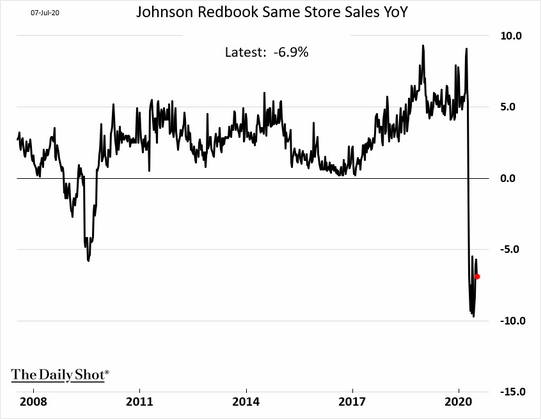
  • Costco Wholesale’s monthly sales fell for the first time since the recession, as stay-at home orders and social-distancing restrictions reduced shopper traffic and some parts of stores offered limited service. Comparable sales, those from stores and digital channels operating for at least 12 months, fell 0.5%, excluding the impact of gasoline and currency fluctuations, for the four weeks ended May 3. Including those items, sales fell 4.7% as low gas prices further pushed sales down.
  • ECB Offers to Pay Banks to Keep Credit Flowing, but Lenders Say ‘No’ The European Central Bank has offered to pay eurozone banks if they keep loans flowing to eurozone businesses, but many banks—still struggling with bad loans left over from the last crisis—have turned the ECB down.
  • World Economy Plummeted 4.8% in April, Bloomberg Tracker Shows
  • World food prices fall sharply in April because of coronavirus: U.N. The Food and Agriculture Organization (FAO) food priceindex, which measures monthly changes for a basket of cereals,oilseeds, dairy products, meat and sugar, averaged 165.5 points last month, down 3.4% on March.
  • Investors fear Italy is heading for ‘junk’ borrower status Coveted top-quality rating hanging by a thread as Moody’s decision looms
PANDEMONIUM
Coronavirus Casts Deep Chill Over U.S.-China Relations

The Trump administration has moved to involve much of the U.S. government in a campaign that includes investigations, prosecutions and export restrictions. Nearly every cabinet and cabinet-level official either has adopted adversarial positions or jettisoned past cooperative programs with Beijing, an analysis of their policies showed.

Chinese officials, for their part, are following through on President Xi Jinping’s call last fall to resist anything they perceive as standing in the way of China’s rise. They have stepped up military activities in the contested South China Sea and intimidation of Taiwan, a U.S. ally, and state media has issued extraordinary public denunciations of Secretary of State Mike Pompeo.

The coronavirus pandemic has deepened the rancor, bringing relations between the two to a modern-day nadir. Both governments are forgoing cooperation and trying to outmaneuver each other to shape events in the post-pandemic world order.

President Trump, who has sharply criticized China for its handling of the outbreak, has said he is considering using tariffs and other ways to collect compensation for it from Beijing, though senior officials signaled this week that the administration is holding off on punishing China economically. (…)

About two-thirds of Americans have an unfavorable view of China, according to a Pew Research Center survey of 1,000 Americans conducted in March. That is the most negative assessment since Pew began asking the question in 2005, and a nearly 20 percentage point increase since the Trump administration began. Positive views of China’s Mr. Xi also are at new lows.

Members of Mr. Trump’s re-election campaign want to make his tough China policy a central issue. They believe it appeals to working-class supporters and ties his presumed Democratic opponent, former Vice President Joe Biden, to what many in Washington characterize as the Obama administration’s more accommodating posture to Beijing. (…)

Domestic pressures in both the U.S. and China are likely to aggravate the already strained relations. Supporters of Mr. Biden also have produced attack ads focused on China.

Mr. Xi, too, has faced criticism at home over the coronavirus, and his administration has sought to project a sense of strength in dealing with the U.S. as he tries to revitalize an economy stalled by the pandemic, manage high unemployment and quash persistent antigovernment unrest in Hong Kong. (…)

Top Chinese and U.S. trade negotiators will speak as soon as next week on progress in implementing a phase-one deal after President Donald Trump threatened to “terminate” the agreement if Beijing wasn’t adhering to the terms. (…)

The purchases so far have been behind the pace needed to reach the target of the first year’s $76.7 billion increase, as imports from the U.S. declined by 5.9% in the first four months of 2020 from a year ago due to the coronavirus outbreak. Given that the imports in 2019 were smaller than 2017, the pressure to catch up is mounting. (…)

SENTIMENT WATCH
Hundreds of Earnings Calls Show Companies More Scared Than 2008

A new study by Federal Reserve researchers used a machine-reading program to sift through more than 600 earnings calls last month in order to map out the virus-induced fallout.

Some 42% of American non-financial public companies are discussing slashing investments, 27% are talking about equity payouts and 17% are focused on drawing down on credit lines, conclude economists Andrew Y. Chen and Jie Yang. At the peak of the last recession the figures were 25%, 11% and 7%, respectively. (…)

Based on trends in 2008, sentiment won’t normalize for a year, according to the Fed researchers.

Earnings Sentiment (Analyst Upgrades Minus Downgrades)

TECHNICALS WATCH

13/34–Week EMA Trend Chart (CMG Wealth)